
Bridge cameras give you the all-in-one convenience of a compact camera and the handling of a DSLR, with the added bonus of a big-old built-in zoom lens. Bridge cameras tend to cover massive focal ranges, from wide to ultra-mega-telephoto, beyond what's even possible on a traditional camera system. As such, they offer something unique to the photographer and videomaker.
Bridge cameras are typically solid day-to-day choices for shooting a bit of everything – from wildlife and sports to landscapes – and are popular holiday cameras for this reason. The trade-off tends to be a much smaller sensor than those in the best DSLRs and best mirrorless cameras, which impacts image quality and low-light performance.
Nonethless, bridge cameras can be incredibly useful and provide impressive value for money to photographers and videographers alike…

The editor of Digital Camera World, James has over 20 years’ experience as a journalist and started working in the photographic industry in 2014. As one of DCW's principal testers, he has a thorough and detailed knowledge of the cameras selected for this guide.
The Quick List

This is a big, bulky bridge camera – but in return it gives the biggest-ever built-in zoom range, making it our top pick. Its telephoto range is so phenomenal it is used by security services for surveillance!
Read more below

A fairly new bridge camera that shoots 4K UHD video and can take advantage of clever 4K Photo modes, this Lumix offers a 60x zoom for a fairly reasonable price. It's a solid beginner option.
Read more below

Kodak has a number of bridge cameras, which offer you a huge built-in lens range for a lower price than its Japanese rivals. With a 52x zoom, the low asking price for this model is almost hard to believe.
Read more below

The (slightly) smaller, older brother to the monster record-setting P1100, but because of this, has now been discounted to a bargain price. But still it boasts a phenomenal 83x zoom (equivalent to a 24-2000mm).
Read more below

This truly is a no-frills option, but the Kodak PixPro AZ405 has the distinction of being the cheapest bridge camera you can buy right now, with a 40x zoom lens and AA battery power.
Read more below
Best bridge cameras
Why you can trust Digital Camera World Our expert reviewers spend hours testing and comparing products and services so you can choose the best for you. Find out how we test.
Biggest zoom


For me, the all-in-one zoom range is the most important thing on a bridge camera – it's their USP, and the key reason why you'd go for a bridge rather than a smaller compact or an interchangeable-lens system camera (where getting an equivalent zoom would be a lot more expensive). As such, the Nikon Coolpix P1100 is my pick as one of the most impressive bridge cameras you can buy, purely on the strength of its bonkers zoom reach.
At its max zoom, the Nikon P1100 has an astonishing 3000mm focal length. Even if such a lens were available for a mirrorless camera (and even if it was affordable), the ability to go from shooting at 24mm all the way to 3000mm in a matter of seconds, without having to switch lenses, is simply incredible.
When shooting at the telephoto end, you do lose 3 full stops – taking the aperture down from a solid f/2.8 to a less impressive f/8. And at longer focal lengths, there is a noticeable softness in images, even with the best camera technique (aided by impressive image stabilization). This isn't helped by the sensor being a relatively small 1/2.3-inch affair, and just 16MP at that.
Still, the P1100 boasts a high-resolution electronic viewfinder, 4K video capabilities, and it shoots in raw – and did I mention that its maximum zoom is three thousand millimeters? Okay, it's a high price for not a lot of sensor, but if range is your top priority, then there's nothing better out there.
Read our full Nikon P1100 review
Best for beginners


One of the more recent bridge cameras to be released, the Panasonic Lumix FZ80D (or FZ82D in the UK, EU, and other territories) is a solid option for beginner photographers – easy to use, but offering a few more sophisticated shooting options that give beginner photographers and videographers room to learn and grow.
Its 60x zoom covers an equivalent range of 20-1200mm in full-frame terms – while that's not a patch on the P1100, it's pretty broad, and still gives you a lot of legroom for capturing different scenes and subjects (and some users may prefer having a little more play at the wide end, with 20mm as opposed to the P1100's 24mm).
The Lumix FZ80D offers consistently accurate autofocus and metering, with the option to use Panasonic's clever 4K Photo modes, with tricks like 'Post Focus' (setting the focal point after capture). Its burst mode is a sprightly 10fps, it offers a range of pleasing picture styles for giving your images specific looks, and being able to shoot 4K UHD is no bad thing for videographers.
Where it falls down is where most bridge cameras do – image quality is just fairly lacking, as it will be when you cram all those pixels on a 1/2.3-inch type sensor. Granted, this is necessary for getting such a long zoom onto a body of a manageable size, but it does still mean that in anything other than bright light, the camera struggles.
Read our full Panasonic Lumix FZ80D / FZ82D review
Best budget


Kodak continues to play to a niche but potentially still a sizeable audience of photographers who competing brands have moved on from, with the Pixpro AZ528 all-in-one ‘superzoom’, while others have abandoned the area.
The huge 52x zoom still comes in very handy, not just for budding wildlife photographers but also for casual sports photography fans, which makes this an incredibly versatile camera. However, it’s still saddled with a small-ish sensor, and any camera like this means softer results when shooting handheld, especially as we creep further towards its maximum zoom setting.
Read our full Kodak PIXPRO AZ528 review
Best overall value
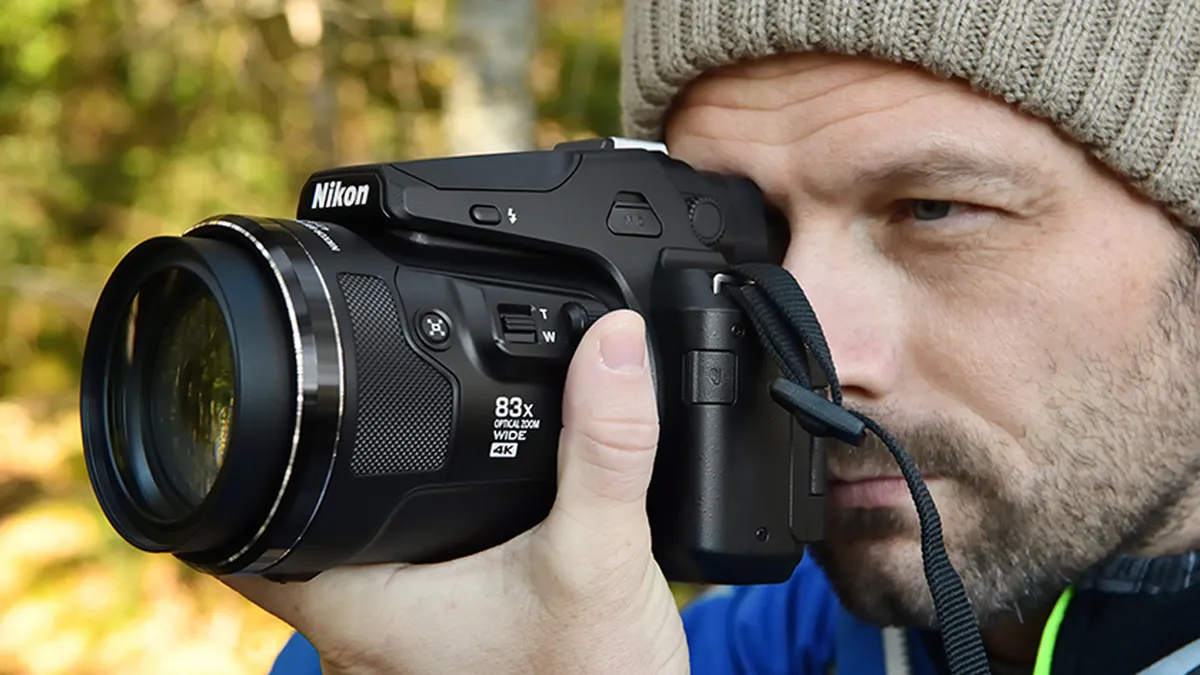


The Coolpix P950 was a successor to the P900, and showed Nikon's ambition to have the biggest zoom on a bridge camera – a record-breaking baton now held by its bigger brother, the Coolpix P1100 (above). Nonetheless, the lens on the P950 remains impressive, boasting 83x optical zoom with an equivalent focal length range of 24-2000mm, and if this somehow isn't enough for you, it can be digitally extended to 4000mm.
The P950 added a lot of features that people felt were missing or subpar on the P900: it improves the viewfinder, adds raw capture, and ups the maximum video resolution to 4K. The only reason it's not further up the list is its small sensor size – and that it now stands somewhat in the shadow of the P1100.
Read our full Nikon P950 review
Cheapest option


What's the appeal of the Kodak PixPro AZ405? Why, it's the economy, stupid – or to be more accurate, the fact that it's the cheapest bridge camera on the market by quite a margin. If you want to get hold of a superzoom camera and want to spend as little as possible, this is how you do it. The camera costs just $199 / £199 (and discounts are not infrequent), and it's powered by cheap AA batteries. The PixPro AZ405 is the definition of no-frills.
Part of a battery of low-cost cameras released under the Kodak name over the past few years, the PixPro AZ405 has some pretty standard specs on paper for a bridge camera. A 1/2.3-inch sensor is paired with a 40x zoom lens, resulting in image quality that's comparable with what you'd get from a smartphone, but zoom range that far outclasses it. If the light is very good, you will get decent shots. If it's too dark or too bright, you will quickly start to lose detail. The stabilization isn't brilliant, and autofocus struggles to keep up.
The PixPro AZ405 also does away with the electronic viewfinder that's common to bridge cameras, relying solely on the LCD screen for image playback and composition. Ultimately, the Kodak PixPro AZ405 is exactly what you'd expect from a camera at its price point. If your budget has a hard upper limit, it will do the job – hence its inclusion on this list. But if you can justify even a little more outlay, you'll get much better results from other models.
See our full Kodak PixPro AZ405 review
How to choose the best bridge cameras
Firstly, you need to decide on how to balance the size of the camera you want to carry to the range of the zoom.
Depending on what you plan on shooting most often will determine what should be more important. If you are investing in a bridge camera to take on safari, for example, it might be a good idea to opt for something with the biggest zoom range possible. But if you want something more affordable and more portable, a smaller zoom range is your answer.
Best bridge cameras: FAQs
What is a bridge camera?
The aptly named bridge camera bridges the gap between DSLRs and compact cameras. They have bigger bodies, non-interchangeable lenses with massive zoom ranges, and small(ish) sensors. Today's bridge cameras have really small 1/2.3-inch sensors, like the kind you find in the best point-and-shoot cameras. Brands such as Sony, Panasonic, and Canon used to make bridge cameras with larger, 1-inch sensors, offering better image quality and better low-light performance – but these have sadly now all been discontinued.
What's the best bridge camera to buy?
For me, the Nikon Coolpix P1100 is definitely where I'd put my money. Yes, it's only 16MP and yes it only has a 1/2.3-inch sensor, but its zoom range is an absolutely absurd 24-3000mm. After using this to photograph wild animals, trust me – you'll be sold (provided you don't need to print your images too big). If you want to save money, the older Nikon P950 with a slightly less zoom is better value, as it is now heavily discounted.
Is a bridge camera good for wildlife photography?
Bridge cameras can be some of the best cameras for wildlife photography. The incredible zoom range they offer means they are fantastic all-in-one tools that go from close-up shots in one instant to telephoto shots the next – making them more flexible than any DSLR or mirrorless camera setup, even if you could afford the equivalent lenses.
The only thing to be aware of is the sensor size of bridge cameras. Because all the current models use a small 1/2.3 in sensor, they simply can't offer the same resolution, fidelity, or performance. If you want to blow your pictures up into huge prints, especially working in low light, a traditional camera will offer better quality. But for online use, social media sharing, and photo books, bridge cameras are very formidable.
How we test the best bridge cameras
We test bridge cameras in real-world conditions – using the camera to shoot images in a range of different lighting conditions to see how they perform. Our team of reviewers has collectively tested hundreds of different models and benchmarked performance against results from current rivals and previous models. We pay particular attention to overall image quality – and to the detail captured in particular throughout the zoom range. These cameras are designed to be easy to use, so we also pay special attention to the ergonomics and handling of each of the models we test.
See more on how we test products at Digital Camera World
Today's prices compared

