Digital Camera World Verdict
The macro lens in this kit is so much fun to use and worth getting the wide adapter for. There are quality issues with the lenses, including optical distortion and vignetting, along with noticeable flare. If you’re on a budget and open to the quirkiness of these, along with editing, I’d say jump in at this easy-to-purchase price. If optical quality and automatic lens profiles are a must, then keep looking.
Pros
- +
The macro lens is a lot of fun and really expands your creative options
- +
That macro is part of the wide lens, so a 2 for 1 deal
- +
Wide lens does give you something cropping in can’t vs the telephoto lens
- +
Great weight in a lovely soft case
Cons
- -
Noticeable flare, not necessarily enhancing the photo
- -
Doesn’t have the magnet to embed focal length in Metadata as with Fujifilm lenses
- -
Heavy vignetting and optical distortions
- -
Unpredictable softness at times with the telephoto adapter
Why you can trust Digital Camera World Our expert reviewers spend hours testing and comparing products and services so you can choose the best for you. Find out how we test.
The Fujifilm X100VI is a travel wonder, giving loads of options for street, cities, and portraits with its 23mm lens (35mm Equivalent). Being a 40MP camera, I’d have no hesitation cropping in a fair bit to get the shot, so I could effectively treat it as a portrait lens if pushed. One thing I can’t do is get a wide shot. I could potentially stitch photos together, but only for shots lacking movement. Fujifilm does make lens adaptors that do wide and telephoto views. Roughly 28mm equivalent and 50mm. To be clear, Fujifilm is an APS-C format camera, so it has a 24mm instead of a 36mm wide, full-frame sensor. This means focal lengths appear 1.5 times larger.
For me, 24mm is usually where I’d consider wide for landscapes, and 70mm would still be a little wide for headshots, though shooting vertical images would approximate this. The Fujifilm WCL and TCL are not cheap, with the TCL coming in a little more expensive. Often people will just get the wide and crop for the tele look. 28mm is far better than 35 for landscapes, so it’s still a worthy investment for when I want those wider shots-and I do.
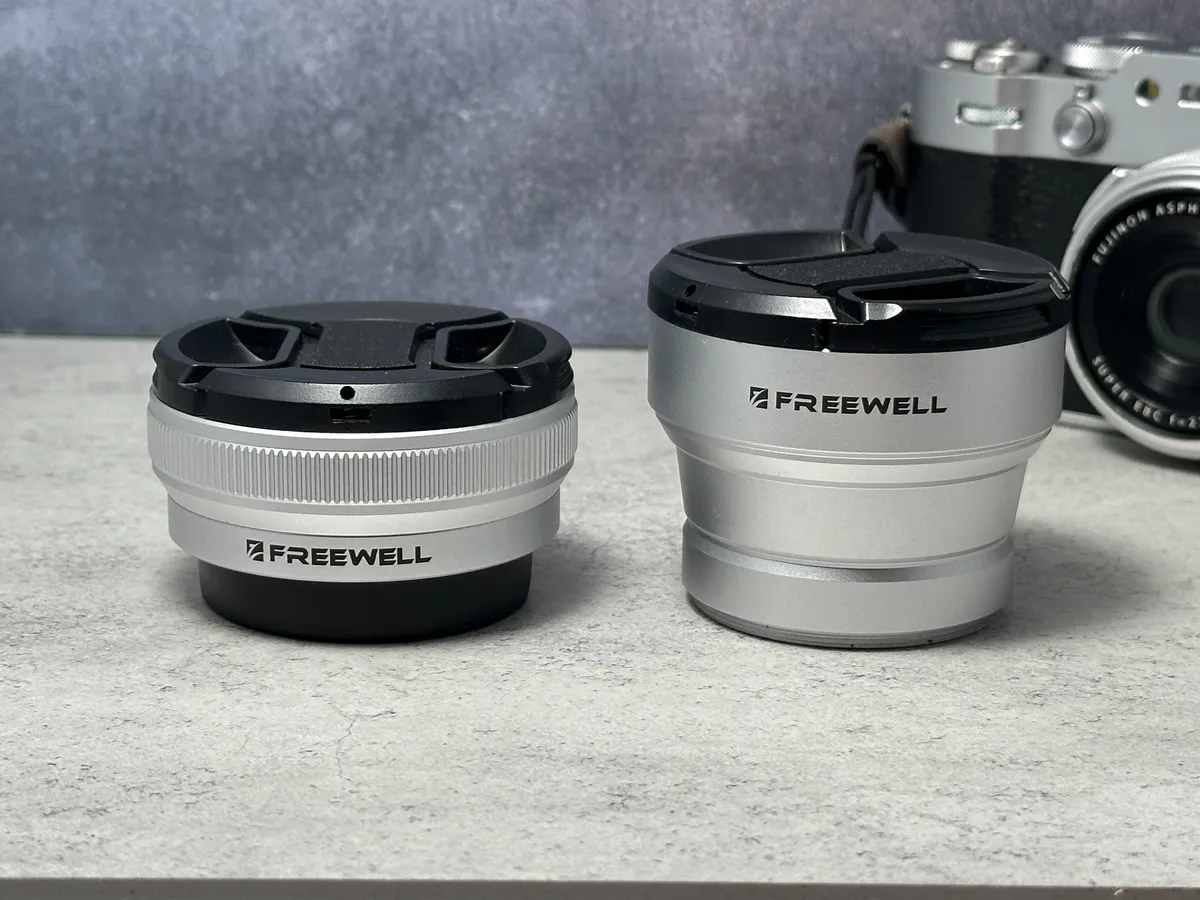
One alternative option for supplementing the camera at a better price is the Freewell lens adaptors. Freewell makes a range of goods that fit the X100 series, including Arca tripod plates, thumb grips, and even a circular polariser/mist/lens hood kit. These accessories are well loved by X100 users, including me, so it will be interesting to see how their lenses fare. These follow suit from phone camera adaptors in that the wide adaptor had two parts, the base of which works as an effective close-up lens. And I do mean close.
Freewell doesn't just make for Fujifilm. They make a huge range of filters, including film influencers' products. They’re well established, have an excellent design reputation, and produce popular and often unique products.
Specifications
| Header Cell - Column 0 | Freewell 1.5x Telephoto |
Freewell 0.75x Wide Angle + 2x Macro |
|---|---|---|
Compatible cameras |
Fujifilm X100VI, X100V |
Fujifilm X100VI, X100V |
Conversion factor |
1.5x |
0.75x wide / 2x macro |
Equivalent focal length |
Approx. 52.5mm equivalent |
Approx. 26mm equivalent (wide) |
Field of view |
Not specified |
107° (wide) |
Weight |
250g / 8.8oz |
155g / 5.5oz |
Front filter thread |
62mm |
62mm |
Adapter dimensions |
Approx. 10mm deep, 57mm outer diameter |
Approx. 10mm deep, 57mm outer diameter |
Finish |
Black or silver |
Black or silver |
Price and Availability
The Telephoto is $149 / £126, which I think compares quite well to the Fujifilm TCLX100II at £299. The Wide Angle Macro is $99.99 / £102. Again this is much cheaper than the Fujifilm WCLX100II which lists for £289. Another quality option to price against are the Viltrox set, listing at €219 and €179 respectively.
Given the feature set and the quality, the price is reasonable for these compared to both the Fujifilm and Viltrox alternatives. Atralab have similar products at €124 for a wide/macro, €81 for a wide and €99 for a telephoto, with similar issues to the Freewell.
Design
I have the silver version of these lenses, but they are also available in black. These match the tone of the silver on the X100VI perfectly and look good on it. The X100VI uses a screw thread to attach adaptors. To access this, I had to unscrew a small ring from the front of the built-in lens. Most of the adaptors I have used to date simply screw on directly, but Freewell takes a different approach. Each lens comes with a separate, beefy adapter ring. It’s an extra step in getting the lens on, which I found annoying when I was in a hurry, but it does give far more support. I did leave it on when swapping between adaptors, and it didn’t seem to affect the normal lens operation. The downside is I couldn’t cover the main lens when not using the adaptors.
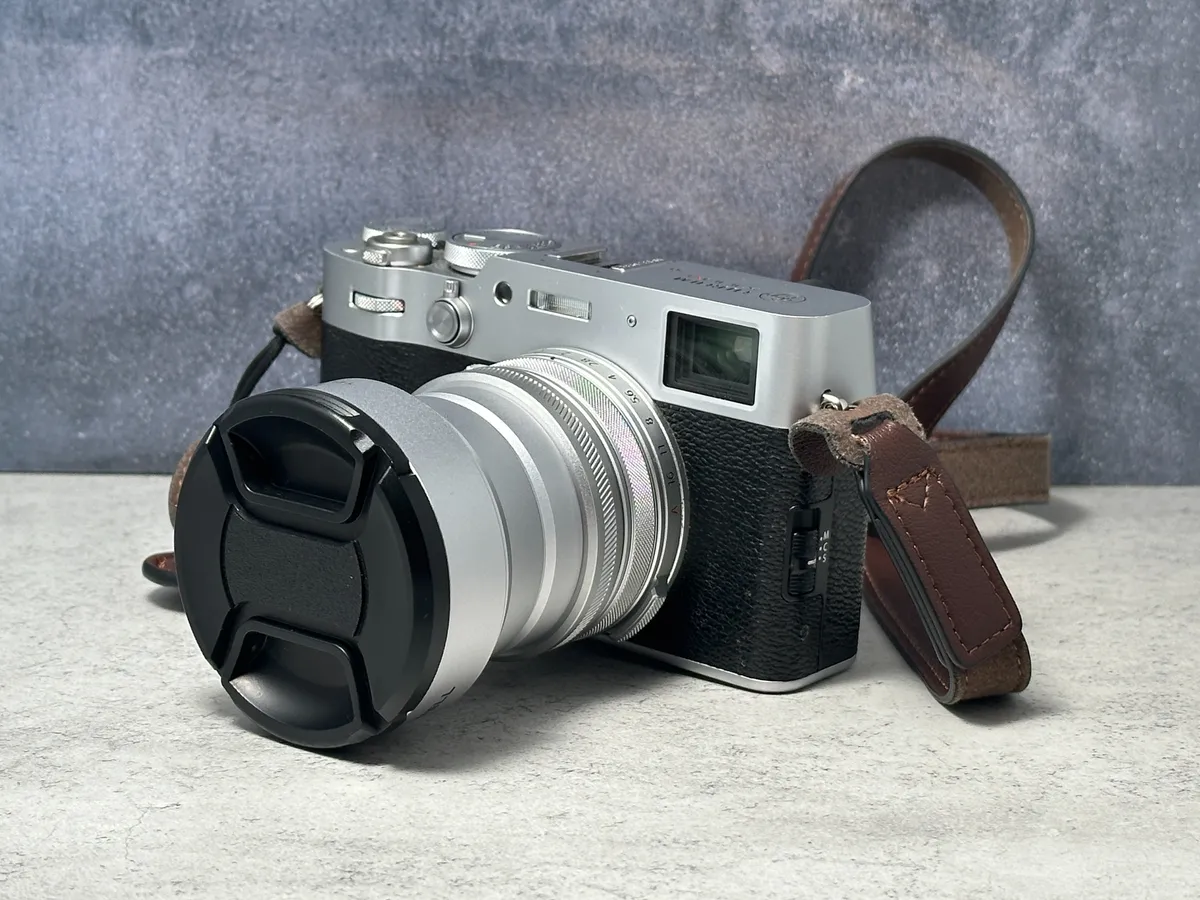
The Telephoto has quite plain styling, but I have to say that I don’t like the large text saying 1.5x Telephoto on it. It just looks tacky. Otherwise, it feels solid and not out of place, despite being a large piece of glass. The aluminium alloy material choice is reassuring that it can handle the pressure of the streets. It is a lot heavier than the Fujifilm version at 273 g, compared to 180 g. I couldn’t find any information on the element composition of the lens. It may be 5 elements in 4 groups, but that information isn’t readily available.

The Wide/Macro is similar, but smaller. Again, unnecessarily large text on the side of the lens, but generally better-looking. As the macro is part of the wide lens, I simply unscrewed the front section and stored it in the soft case. The soft case deserves a mention because of all the soft cases that come with these adaptors; Freewell’s is by far the nicest. I think it feels rather plush. The lens weighs 173 g, comparable to the Fujifilm wide lens at 150 g. It does have a macro lens and the adapter ring, so it’s reasonable.

One design choice that is a design by omission is the lack of a magnetic switch that embeds metadata about the nature of the attached adaptor. With Fujifilm and Viltrox, I can see if I’ve used the telephoto or wide adaptors in the metadata, and it will apply corrections based on this. I’d be a fool to assume that the distortion properties of the lenses match those of the Fujifilm, but currently there are no automatic corrections applied that suit either lens. And these are definitely needed. Most systems these days use metadata as a way to instruct my processing software to apply a lens correction. I have to manually work out something that’s close and use a preset to attempt this correction, which isn’t optimal as I prefer to not spend my life editing.
Each lens has a standard, plastic lens cap with no branding, and a push-on rear cap. I’ve mentioned the soft case already. The box is beautifully designed, something I rarely think about, but this was notable.
Overall, these look good, and the knurled effect on the adapter ring reminds me a little of the design of the Viltrox lenses. They match the X100VI well, in both shades, looking made for the camera.


Performance
The good looks only get a lens in the door; I need it to perform to keep it in my bag for use. I was really excited to use these lenses, and I have to say I felt a little disappointed by them. My first time using them centred mostly around location shooting with Tink Kaos. I was making use of the leaf shutter of the X100VI to get higher shutter speeds with off-camera flash. Normally I’d have to use high-speed sync to achieve this, which means full power, slow recycle times, and a faster-draining battery. Not so with the X100VI.
I chose to focus mainly on using the Telephoto for this to allow shallower depth of field and more subject in frame. I did choose to use the Wide lens for a few quick shots as a rough test of flare based on my experience with the telephoto. Being a sunny day, I opted to use the sun as a rear light with more controlled soft light from the front. Once the sun hit the lens, the flare was immediate and very obvious. Now I like flare and often add it using Boris FX Optics, but there I have control. This just gives a double cyan and orange spot. I had to use my hand to block the sun in lieu of an appropriate lens hood.

The other issue I had that day was that, despite using the rather excellent eye focus, there were far more misses than hits. Usually this is quite rare, but it did leave me distrusting the lens for critical shots. The flash was firing, so it should freeze motion, and 1/160 at f2.8 should be enough for this on static shots. But it wasn’t. And as I wasn’t doing anything different from shot to shot, there was no way to predict when it wasn’t focusing. I should add that, as it was a bright enough day, I had 3 points of contact-two arms and my face using the viewfinder instead of the screen; the camera should be steady.


The lens does have green chromatic aberration, which I easily fixed with a click in Lightroom.


The final thing that I found noticeable, especially with the sky in the shot, was a vignette on the shot, with a visible darkening in the corners. I used the manual section of Lightroom with an amount of 50 and a midpoint of 30 to correct for this. Both of these Lightroom settings could be saved as a preset and applied to the shots as a batch fix.

I did shoot a lot more with the lens, though, and found that it could be very sharp, like with this exhibition installation as part of our international arts festival.

My first shots using the wide were disappointing. Even at f5.6 with eye focus on, the focus was on the dress and the face was soft. Even if the actual focus point was the dress, I’d expect the face to be in focus at f5.6 at 28mm equivalent.


I made a trip to a location where I often shoot the Milky Way for some shots at sunset. The friary itself looked crisp and clear even at f5, though the contrast seems to have suffered from mild flare. I did wipe the lenses in advance of shooting just in case.

I also shot a few exposure brackets to create HDR photos for more dynamic range. Processing these did reveal some edge vignetting that wasn’t really visible in unedited shots. The bottom corner shows a flare that I suspect is light reflecting off the filter threads, and it wasn’t there in every shot with the sun.


I’m not convinced by the wide adapter. The other part of this is the Macro. And folks, this is fun. I’ve seen people express worry that this lens causes the camera lens to throw a wobbly when, in reality, this lens needs to be REALLY close to the subject. So close that, in sunlight, the lens can cast a shadow on the subject if you’re not careful. Once you’ve accepted that you need to be close, then this does become fun, giving very abstract images, and even high apertures still give very shallow depth of field.


Verdict
I wanted this set to be much better. I really did. There are quality issues with the lenses. The telephoto can be quite sharp, but when it’s not, it really misses. I couldn’t, in the time I had, figure out the cause that made the difference between sharp and soft. Even from shot to shot it could vary.
At its best I found the wide adapter to be soft. Both lens adapters are prone to flaring, even with multi layer coatings. There is chromatic aberration and some optical distortion in the lenses. Yes, they look great, yes they match the system, but as a wide and telephoto, there is better for slightly more money.
The macro is a saving grace though. While the design is very limited in depth of field, the resulting in-focus areas are quite sharp, allowing beautiful abstract art to be created. I would buy the wide adapter just for this. Yes, I could buy a close up filter, but there’s a lot more glass in this than the usual filter. And there’s the fun factor. I’d happily print my favourite results shot using this lens.
Some of the things that aren’t great, like the aberration, distortion and vignette, are fixable in software, and are usually fixed automatically with other lenses. I could make presets for these and even increase sharpening and detail for the wide lens. If I was happy to do that and I was on a limited budget, then these adaptors would work for me.
Features ★★★★☆ |
With these compact, and complementary lenses, I can expand the focal range of my X100VI and add a very fun macro to my travel and location system. |
Design ★★★½☆ |
Overall looks match the camera well, bar the oversized text and while annoying the adaptor ring does give better support and prevents threading. |
Performance ★★½☆☆ |
I just had issues with these lenses, bar the macro, which I loved-the optical distortions, aberration and vignetting, along with unpredictable sharpness made me lose faith. |
Value ★★★★☆ |
If I was on a budget and didn’t mind extra steps in processing, then these are great value, especially given that they’re between ⅓ and ½ the price of the Fujifilm equivalents |
Overall |
★★★½☆ |
Alternatives