

Digital Camera World Verdict
The Leica APO-Macro-Elmarit-SL 100 f/2.8 might have macro written into its name, but after spending time with it I came away thinking Leica has created something far more versatile than a specialist close-up lens. At 100mm, it is an excellent medium telephoto that can comfortably turn its hand to portraiture, sport, nature and general detail photography, while still delivering the kind of performance that makes it a genuinely serious macro lens. Paired with the Leica SL3-S, I found the combination practically flawless. Image quality is exceptional, the build quality is exactly what I would expect from Leica, and the ability to move from a conventional telephoto image to an incredibly detailed close-up without changing lenses makes this far more useful than its macro designation might initially suggest. It will undoubtedly sit outside some photographers' budgets, but for anyone looking for an excellent f/2.8 medium telephoto and a high-end macro lens rolled into one, the APO-Macro-Elmarit-SL 100 f/2.8 could be something of a godsend.
Pros
- +
Exceptional image quality
- +
Superb macro performance
- +
Excellent build quality
- +
Useful focus limiter
Cons
- -
Expensive
- -
Focus can hunt at times
- -
Quite heavy for a prime
Why you can trust Digital Camera World Our expert reviewers spend hours testing and comparing products and services so you can choose the best for you. Find out how we test.
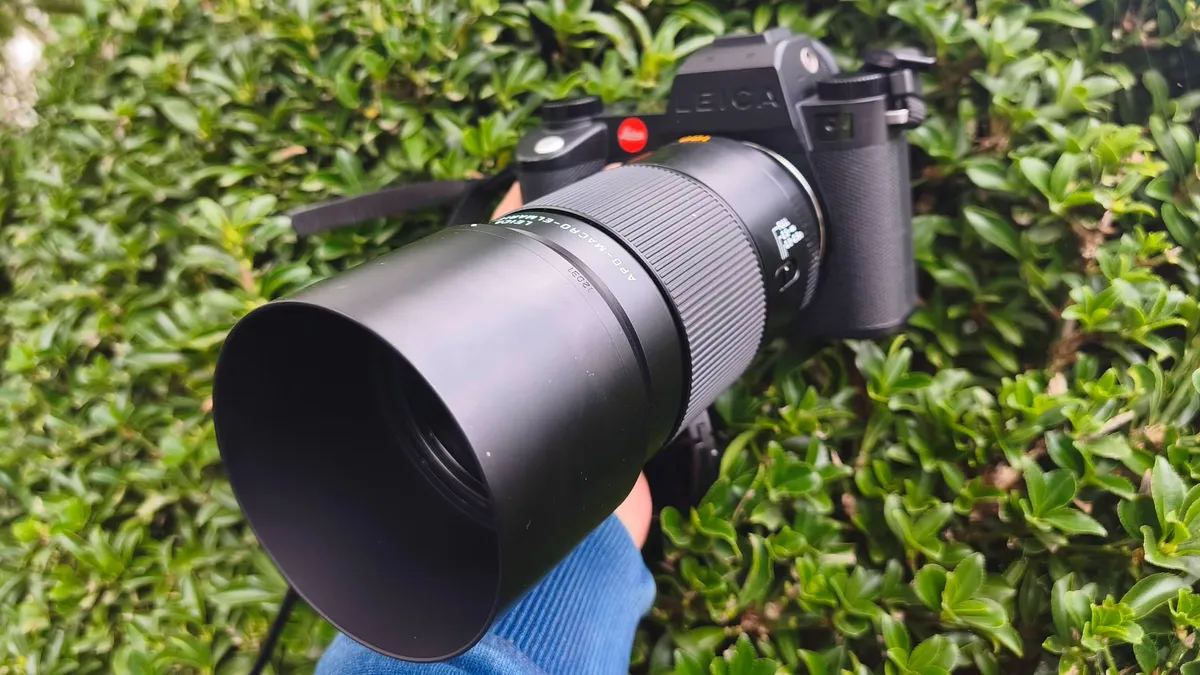
The Leica APO-Macro-Elmarit-SL 100 f/2.8 is the kind of lens that makes its intentions clear from the moment you pick it up. This is a serious piece of glass, designed not only to deliver exceptional macro performance, but also to serve as a highly capable medium telephoto for portraits, sport and general detail work.
Paired with the Leica SL3-S, the Leica's first L-mount macro lens feels every bit as premium as its price suggests, with the sort of build quality, balance and attention to detail I would expect.
Leica APO-Macro-Elmarit-SL 100 f/2.8 Specifications
Mount: L-mount
Full frame: Yes
Autofocus: Yes
Image stabilization: No
Minimum aperture: f/2.8
Minimum focusing distance: 0.95" / 2.41 cm
Optical deisgn: 17 Elements in 12 Groups
Dimensions: 5.4 x 3.03" / 137.2 x 76.96mm
Weight: 28.25 oz / 800.89 g
Leica APO-Macro-Elmarit-SL 100 f/2.8 Build and handling
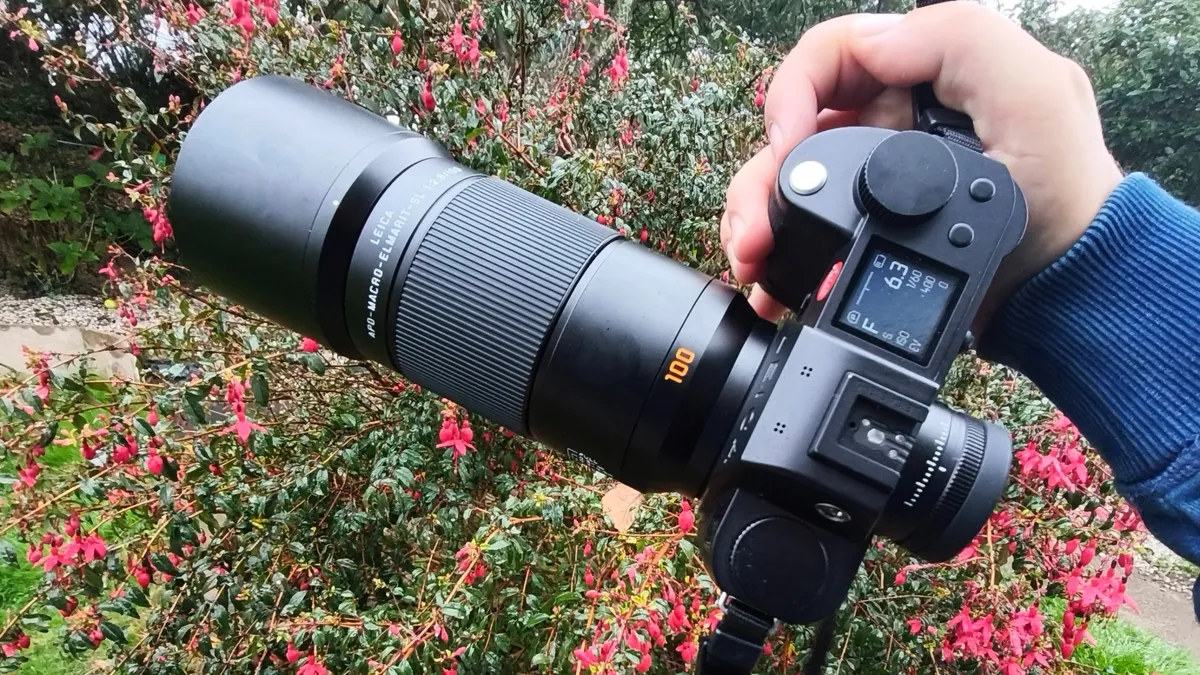
There is very little about the APO-Macro-Elmarit-SL 100 f/2.8 that does not feel Leica-like. The construction feels reassuringly substantial, the controls are beautifully finished, and the lens has the sort of solidity I would expect from an optic designed to spend its life attached to a professional SL body.
Mounted on the Leica SL3-S, it feels extremely well balanced. This is not a tiny or particularly lightweight lens, but neither does it feel unnecessarily cumbersome once attached to the camera. If anything, the additional weight suits the SL3-S nicely and makes the combination feel like a serious professional setup rather than an oversized lens hanging from a smaller body.

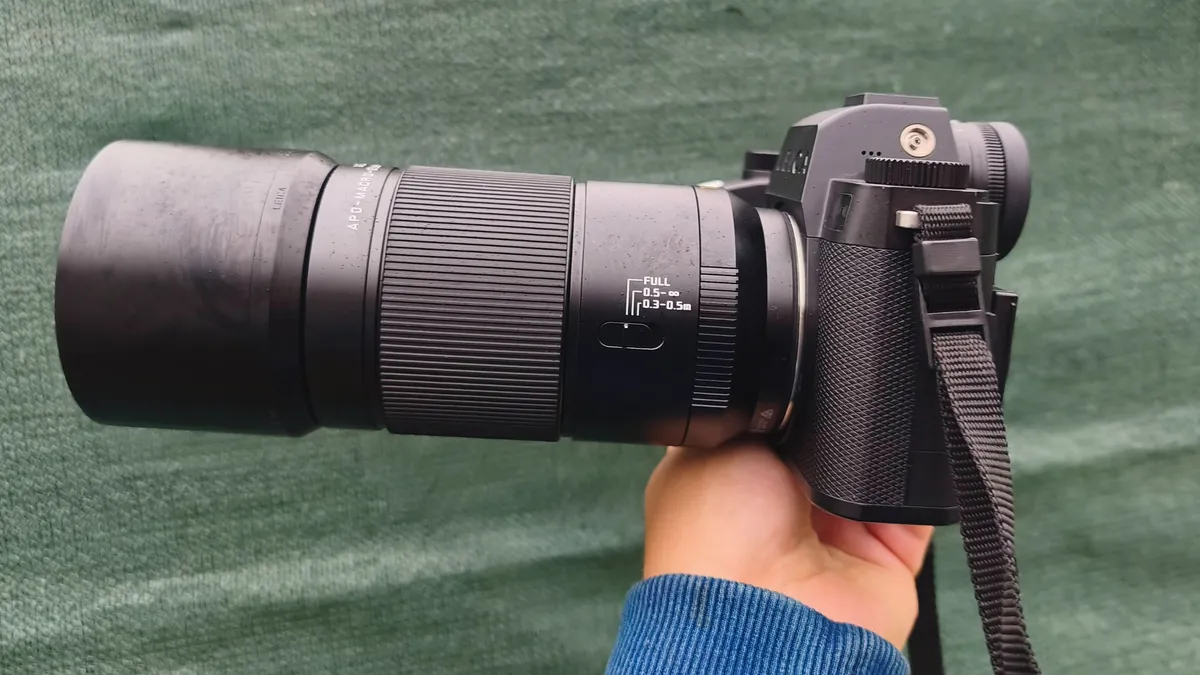
One of the most useful controls is the focus limiter positioned on the left-hand side of the barrel. During most of my testing, I initially left the lens operating across its full focusing range, which works perfectly well under normal circumstances.
However, when moving quickly from photographing something in the distance to attempting to focus on a subject very close to the ground, I occasionally found that the lens would hunt as it searched through its enormous focusing range.
Switching the limiter into its 0.3-0.5m close-focus range solved that slight issue almost immediately. Once the lens knew roughly where I wanted it to focus, autofocus became much faster and more decisive, and I experienced none of the hesitation I had encountered while leaving it unrestricted. It is a small control, but one that makes a noticeable difference when working quickly with macro subjects.
Leica APO-Macro-Elmarit-SL 100 f/2.8 Performance
This is where the APO-Macro-Elmarit-SL 100 f/2.8 really begins to justify itself. Image quality paired with the SL3-S was outstanding, and I frequently found myself surprised by just how much fine detail the lens was able to resolve.
Even when photographing macro subjects at f/2.8, some of the resulting images appeared at first glance as though they had been shot using something closer to an f/1.4 prime. Backgrounds dissolve beautifully, giving close-up images an almost dreamlike quality, while the subject remains impressively well defined.
It is only when you begin zooming into those files that the real character of the lens becomes apparent. The fine texture of a petal, tiny imperfections on a leaf, and minute surface detail are all reproduced with remarkable clarity. There is a tremendous amount of information within the plane of focus, even when the depth of field itself is extremely shallow.
That combination is what impressed me most. There are plenty of lenses capable of creating attractive background blur, and there are plenty of macro lenses capable of capturing fine detail, but the APO-Macro-Elmarit-SL 100 f/2.8 manages to combine the two exceptionally well. Images can look soft and atmospheric from a normal viewing distance while simultaneously containing an extraordinary amount of sharp detail exactly where the lens has focused.
The 100mm focal length also makes considerably more sense once you stop thinking exclusively about macro photography. For portraits, it provides pleasing compression and excellent subject separation, while sports and documentary photographers could equally use it as a conventional medium telephoto before moving immediately into close-up detail shots.
That versatility could prove particularly valuable for photographers trying to tell a wider story. A sports photographer could photograph an athlete from a distance before moving in to capture the texture of their equipment, the stitching of a glove, or another smaller detail. A portrait photographer could move between headshots and close-up images, while nature photographers could switch effortlessly from wider compositions to the intricate patterns found within plants and flowers.
Sample images: Leica APO-Macro-Elmarit-SL 100 f/2.8




Leica APO-Macro-Elmarit-SL 100 f/2.8 Lab results
We run a range of lab tests under controlled conditions, using the Imatest Master testing suite. Photos of test charts are taken across the range of apertures and zooms (where available), then analyzed for sharpness, distortion and chromatic aberrations.
We use Imatest SFR (spatial frequency response) charts and analysis software to plot lens resolution at the center of the image frame, corners and mid-point distances, across the range of aperture settings and, with zoom lenses, at four different focal lengths. The tests also measure distortion and color fringing (chromatic aberration).
Sharpness:

Sharpness is excellent in the center of frame, from f/2.8 right through to f/11. Equally impressive is how well the lens maintains this sharpness into the corners of the image frame at all apertures.
Fringing:

Fringing is kept consistently low, at all apertures - you won't see any aberrations in real-world shooting.
Distortion: 0.05
This is as close to a zero-distortion lens as you'll find.
Leica APO-Macro-Elmarit-SL 100 f/2.8 Verdict

The Leica APO-Macro-Elmarit-SL 100 f/2.8 is one of those lenses that becomes considerably more interesting once you stop looking at the name on the barrel. Yes, it is an exceptional macro lens, but reducing it to that description would seriously undersell what Leica has produced.
I found it to be an excellent f/2.8 medium telephoto in its own right, capable of producing superb portraits, sports images and detail shots before turning almost instantly into a highly capable macro optic. Paired with the Leica SL3-S, image quality was exceptional, and the resolving power of the combination was, at times, astonishing.
The occasional focus hunting I experienced when moving rapidly between distant and very close subjects was the only real weakness I encountered, but it was also incredibly easy to correct using the focus limiter on the side of the lens. Once set appropriately for close-up work, the autofocus became fast, confident, and reliable.
Price will naturally be the biggest barrier for many photographers; coming in at $2,700 / £2110, there are certainly more affordable macro lenses available. However, I would argue that the APO-Macro-Elmarit-SL 100 f/2.8 should not be judged purely as a macro lens. For photographers who want one extremely high-quality 100mm f/2.8 telephoto capable of portraits, sport, and general photography, while also being able to produce extraordinarily detailed close-up images, this new Leica could be a genuine godsend.
You might also like
Best Leica cameras
Leica SL3-S review
Lecia SL3-P review
Best Leica SL lenses

