
The best Hasselblad lenses are among the best lenses in the world. Indeed, one of the optics on this list is the single sharpest lens we've ever tested. So if you've invested in one of the best medium format cameras, you'll want to make sure that you buy the tip-top optics to get the most out of it.
The XCD glass comprises some of the best Hasselblad lenses ever made. Designed for the X system, these optics are designed specifically for the new Hasselblad X2D II 100C, the older X2D and X1D cameras, and the Hasselblad 907X 100C. All the cameras have a crop factor of 0.79... so will need this to work out the equivalent focal length if you want to know what the lens gives you in 35mm SLR or full-frame terms.
The Hasselblad X camera family is now ten years old and has been rapidly developed a full range of lenses and can now be reviewed as a mature camera system. From portrait lenses to ultra and wide-angle lenses and even a macro lens, Hasselblad now has 18 different lenses to choose from - the newest of which are split into three familes E, P or V (standing for Exclusive, Portable, and Versatile).
In addition, you can even make use of official mount adapters to use your existing glass. The Hasselblad XPan Lens Adapter enables you to mount XPan optics, the Hasselblad XH Lens Adapter fits HC and HCD lenses, while the Hasselblad XV Lens Adapter can attach C, CB, CF, CFI, CFE, F, and FE-type lenses.
Still, as far as the latest XCD glass is concerned, these are the best Hasselblad lenses to pair with your X system camera…
Hasselblad XCD 4/21 Ultra-Wide-Angle

In non-Hasselblad nomenclature, the XCD 4/21 Ultra-Wide-Angle is a Hasselblad XCD 21mm f/4 lens. In 35mm / full-frame terms, that's an equivalent 16.59mm angle of view, meaning that this really is an ultra-wide optic.;
By far the widest native lens available for the XCD mount. That makes it a must-have choice for shooting sweeping landscapes, capturing interiors, and even astrophotography (even though that can be a challenge with the f/4 aperture on medium format).
Hasselblad XCD 25V f/2.5 Wide Angle

The Hasselblad XCD 25V is easily the best wide-angle I’ve used for the X System. While the lineup is already a bit crowded at the wide end, this is the one I’ve been waiting for. It joins the 35V, 55V, and 90V to round out the V-series, finally bringing some much-needed consistency to the range with that sleek, unified aesthetic and matching 72mm filter threads.
What really sold me is the speed; having a fast f/2.5 aperture is a game-changer compared to the older f/4 options, letting me shoot handheld in dim woods without cranking the ISO. The central sharpness is incredible, and the manual focus clutch feels fantastic in practice. It’s a sharp, sexy, and swift performer that has quickly become my go-to.
See my full Hasselblad XCD 25V f/2.5 review
Hasselblad XCD 3,5/30 Wide Angle

Again, 30mm may not actually seem that wide on paper. However, the Hasselblad XCD 30mm f/3.5 is actually a 23.7mm lens in full-frame terms – so it's tailor-made for shooting landscapes and architecture.
While it's susceptible to barrel distortion like any wide lens and suffers more fringing than any other XCD lens, it still delivers outstanding center sharpness and is a valuable part of a professional toolkit.
Hasselblad XCD 4/45P

There are a pair of 45mm lenses available for Hasselblad X1D cameras, the other one being the slightly faster XCD 3,5/45. However, that extra sliver of speed can't compare to the ultra-compact size and extraordinary engineering of the Hasselblad XCD 45mm f/4P – the world's smallest medium format lens with AF.
Delivering an equivalent 35mm angle of view and f/3.16 depth of field, the 45P produces the least fringing we've ever tested and is as close as you can get to a distortion-free lens. Perfect for street, travel, reportage, events, and environmental portraits.
Hasselblad XCD 2,8/65

The Hasselblad XCD 65mm f/2.8 is actually a nifty fifty – a 51.35mm f/2.21, to be precise – equivalent in full-frame terms. Moreover, it is literally the sharpest lens we've ever tested (outperforming the previous champion, the Sony FE 20mm f/1.8 G) that sustains sensational sharpness from the center right out to the corners of the frame.
It's also virtually aberration- and distortion-free, making it the best optical performer of any Hasselblad lens – and maybe the best (if most expensive) nifty fifty ever, great for everyday shooting, street photography, and three-quarter portraits.
Hasselblad XCD 3,4/75P

The Hasselblad XCD 75P is basically a "nifty fifty" on steroids. With a 59mm full-frame equivalent focal length, it’s a killer all-rounder. I raved about its "glass-cutting" sharpness in my review – it actually out-resolved Hasselblad's sharpest lens (the XCD 90V) in some lab tests!
I’m a bit surprised it’s labeled "Portable." It’s chunkier than its P-series siblings and even some "Versatile" V-series lenses – but compared to the old 65mm beast it replaces, it’s a featherweight. It lacks a focus clutch, but for daily street photography or portraits, it’s a total win.
See my full Hasselblad XCD 75P review
Hasselblad XCD 1,9/80

The fastest lens available for the X1D, the Hasselblad 80mm f/1.9 is the system's best option for low-light photography – and of course, it renders beautifully blurred backgrounds with its equivalent f/1.55 depth of field.
In 35mm terms it has a 63.2mm angle of view, so it sits in an awkward space between a standard and portrait prime, but it's versatile enough to be used for either application with a bit of practice and consideration. If you have the need for speed and prefer lenses with a bit of length that don't stray too far into tele territory, this is the one for you.
Hasselblad XCD 2,5/90V
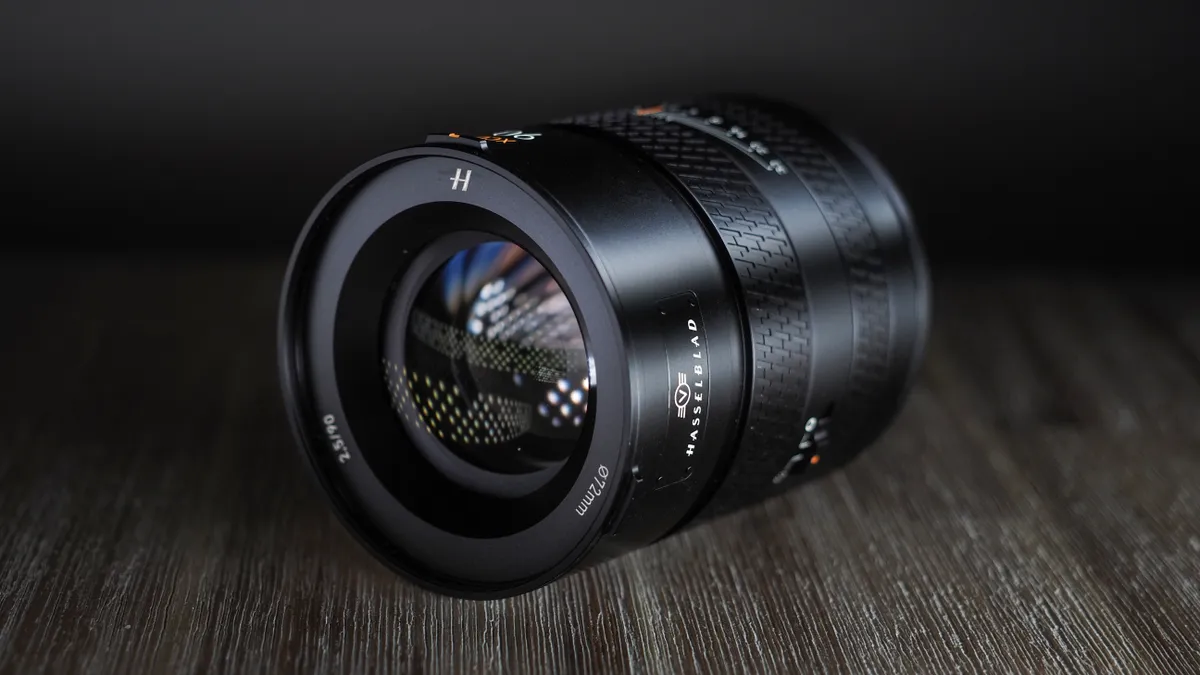
The XCD 90V isn’t just a "good" lens; it’s being hailed as quite possibly the sharpest piece of glass ever lab-tested. With a 71mm full-frame equivalent focal length and a fast f/2.5 aperture, it’s basically a portrait photographer’s fever dream.
It’s got that cool retro-modern vibe with a tactile manual focus clutch and a customizable control ring. The bokeh is described as sublime, and it’s virtually distortion-free. The only real catch is the understandably high price.
See my full Hasselblad XCD 90V review
Hasselblad XCD 3,5/120 Macro

If you specialize in people and close-up work, the double-duty Hasselblad XCD 120mm f/3.5 is an absolute no-brainer. As the manufacturer's lone macro lens, it's your only choice for magnifying super-small subjects.
While it's not a true 1:1 macro, its 1:2 reproduction ratio still yields fantastic results (especially on medium format scale). It's equivalent to 94.8mm and f/2.77 full-frame performance also makes it a formidable portrait lens – though if you don't care about macro, there is a superior option for portraiture…
Hasselblad XCD 2,8/135

A portraiture powerhouse, the Hasselblad XCD 135mm f/2.8 is the ultimate lens for headshot hunting. Its 106.65mm equivalent angle of view is firmly in the territory of portrait focal lengths.
While its f/2.21 equivalent aperture renders sublimely shallow depth of field. However, like the 120mm, this is a portrait lens with an extra trick up its sleeve; it can be combined with the X Converter 1,7 to become a 229.5mm f/4.8 lens (181.31mm f/3.8 in full-frame terms) for longer telephoto work.
XCD 2,8-4/20-35E Zoom
Why you can trust Digital Camera World Our expert reviewers spend hours testing and comparing products and services so you can choose the best for you. Find out how we test.
XCD 2,8-4/20-35E Zoom

Hasselblad’s first ultra-wide zoom is a total game-changer for the X System. I was honestly blown away by how this 20-35mm f/3.2-4.5 handles. It covers a 16-27mm equivalent range, making it the widest lens in the lineup—perfect for those sweeping landscapes or tight architectural shots.
The center sharpness is just ridiculous; it actually rivals Hasselblad’s best primes, which is wild for a zoom. I even took it out handheld for some aurora hunting and it performed beautifully at f/3.2. It’s a bit of a beast in price, and you’ll want to stop down to f/11 to really crisp up those corners, but the build quality and internal zoom feel incredibly premium.
See my full Hasselblad XCD 20-35E review
Hasselblad XCD 3,5-4,5/35-75 Zoom

The Hasselblad XCD 35-75mm f/3.5-4.5 is just shy of being a medium format version of a standard 24-70mm zoom, with an equivalent 27.65-59.25mm focal range. This gives the X1D a versatile multi-purpose optic, and effectively an everyday lens if you'd like to use your Hasselblad as as a walkabout camera.
It handles beautifully and the internal focusing mechanism maintains the premium feel – though it does make the non-constant aperture (rendering an equivalent f/2.77-3.56 depth of field) feel a little out of place for an otherwise uncompromisingly engineered optic.
See our Hasselblad XCD 35-75mm f/3.5-4.5 review
Hasselblad XCD 2,8/35-100E Zoom

The Hasselblad XCD 35-100E is makes some seriously bold claims, and honestly, it seems back them up! It covers an essential 27-78mm equivalent range. I’m usually a "prime lens or bust" kind of person, but the idea that this one piece of glass could replace seven different primes – saving you a cool $20,000 in the process – is a total game-changer. Even though it isn't a constant f/2.8, the f/2.8−4 variable aperture still makes it impressively fast for a zoom with this range.
Beyond just raw speed, the lens delivers insane sharpness that holds its own against dedicated primes across the frame and features a snappy autofocus motor that pairs perfectly with the X2D II. I was particularly impressed to see that even at f/4 on the long end, the medium format sensor provides gorgeous bokeh and subject separation for portraits. The only real trade-offs are the lack of a constant aperture and some mild corner softness at 100mm, but for a professional workhorse that balances luxury with utility, this looks like a dream. This gets my vote as the "desert island" lens!for the X System.
See our Hasselblad XCD 35-100mm f/2.8-4 review
How we test lenses
We test lenses using a mix of both real-world sample images and lab tests. Our lab tests are carried out scientifically in controlled conditions using the Imatest testing suite, which consists of custom charts and analysis software that measures resolution in line widths/picture height, a measurement widely used in lens and camera testing. We find the combination of lab and real-world testing works best, as each reveals different qualities and characteristics.
Read more:
Hasselblad X2D II 100C review
Hasselblad X2D 100C review
Hasselblad X1D II 50C review
Hasselblad X1D 50C review
Hasselblad 907X 100C review
The best medium format camera: big sensor cameras for experts and pros

