
The best lenses for the OM System OM-1 and OM-1 Mark II are, perhaps unsurprisingly, almost all professional lenses.
After all, the OM System OM-1 Mark II is the company's current flagship camera – and while it's been superseded, the original OM System OM-1 is still flagship-caliber. So they deserve tippy top glass to get the most out of them!
Nowhere is this more relevant than weather sealing. Both OM-1s are IP53-certified, so the best lenses for the OM-1 family should likewise be sealed for all-weather shooting.
With the exception of the super tele option, they all have constant apertures as well – which means that the diaphragm is fixed throughout the zoom range, for equal exposure.
So, without further ado, here are the best lenses for the OM System OM-1 and OM-1 Mark II to supercharge your shooting…
Best lenses for the OM System OM-1 and OM-1 Mark II
Why you can trust Digital Camera World Our expert reviewers spend hours testing and comparing products and services so you can choose the best for you. Find out how we test.
Best standard zoom
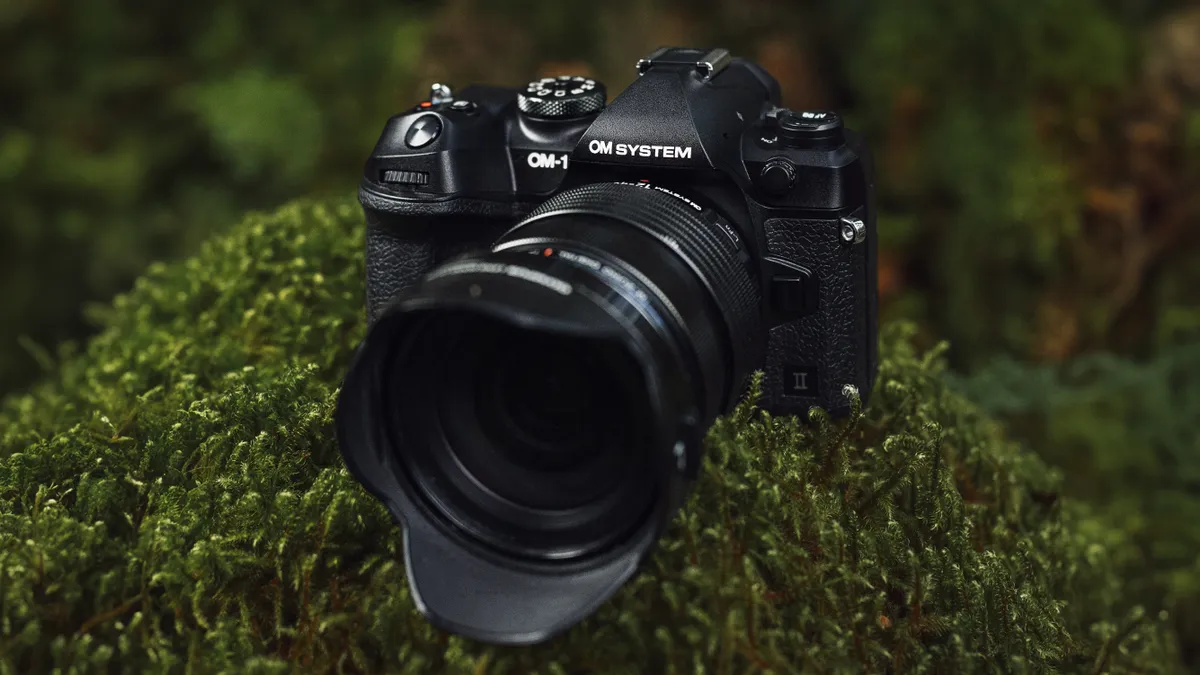
Every photographer needs a go-to standard zoom, and this is the one for OM System users. The M.Zuiko 12-40mm f/2.8 Pro II offers a 24-80mm equivalent focal range, so goes a little further than a full-frame equivalent but is of course smaller and lighter – and cheaper.
This new version has the same excellent optical formula as the original lens, but with improved IP53 weather sealing to make the most of the OM-1 family’s outdoor strengths. It’s an excellent lens which you can use at any focal length or aperture without worrying about its sweet spot – it’s all sweet!
It focuses pretty close, too, so it can also be effective for small-scale nature shots.
See our full OM System M.Zuiko 12-40mm f/2.8 Pro II review
Best extended range zoom

Travel and landscape photographers might prefer a little extra reach in their standard zoom to avoid having to swap lenses (it’s always at exactly the wrong time, isn’t it?). The M.Zuiko 12-100mm f/4 IS Pro certainly delivers on that, with a huge 24-200mm focal range but also with a constant f/4 maximum aperture.
Long-range zooms usually lose some definition at long range, but not this one – it delivers excellent results throughout.
What’s more, it incorporates its own IS, so that in combination with the OM-1 Mark II’s in-camera IBIS, it provides up to 8.5 stops of stabilization – we’ve seen some ridiculously good handheld long exposures from this combination.
Best wide-standard zoom

The OM System M.Zuiko 8‑25mm f/4 Pro is among a handful of hybrid wide-standard zooms on the market.
While it might seem like an odd focal range (as a 16-50mm equivalent), it’s incredibly useful for travel photography, where you’re often having to swap from a wide to a standard zoom just from stepping out of a building and into the street.
It does seem like quite a big lens for a modest amount of glass, and it’s bigger still when its retracting mechanism is extended for shooting, but the results are excellent and this focal range is just so darned useful!
See our full OM System M.Zuiko 8‑25mm f/4 Pro review

Best ultra-wide
The M.Zuiko 8-25mm f/4 is a great lens but, if you like your focal ranges traditional, the M.Zuiko 7-14mm f/2.8 Pro is the best choice for your OM-1 Mark II.
It’s one of the three ‘trinity’ f/2.8 zooms for the OM system, and while it’s not especially cheap, the optical quality alone makes it worth it, together with that constant f/2.8 maximum aperture.
The highly convex front element and fixed lens hood mean that you can’t fit regular filters to the front (the 8-25mm f/4 would be better for that) but you could argue that, with the OM-1 Mark II’s Live ND and Live GND modes, you may not need even filters!
See our full OM System M.Zuiko 7-14mm f/2.8 Pro review
Best trinity telephoto lens

On a full-frame camera system, you would choose a 70-200mm f/2.8 lens. On OM System, up until a year ago, you would choose the M.Zuiko 40-150mm f/2.8 Pro – a trinity-busting lens that delivers an equivalent 80-300mm range.
Now, however, you can go even bigger and better: the M.Zuiko 50-200mm f/2.8 Pro might be the single best OM System / Olympus lens. The world's only 100-400mm f/2.8 equivalent, this is an astonishingly versatile lens – and it's optically outstanding.
Boasting 7 stops of image stabilization on the OM-1 Mark II (5.5 stops on a non-stabilized body) and support for 50fps bursts, focus stacking and Pro Capture, it's fantastic for birding and sports.
It's also brilliant for macro and telemacro, combining a 0.78m minimum focus distance with 0.5x magnification – but add a 2x teleconverter and you get 1:1 reproduction for true macro.
It's big for a Micro Four Thirds lens, but pairs perfectly with an OM-1 – and might just be the best lens you can buy for the flagship.
See our OM System M.Zuiko 50-200mm f/2.8 Pro review
Best super-telephoto zoom

OM System users have a couple of choices when it comes to super-telephoto zooms (there’s also a cheaper M.Zuiko 100-400mm f/5.0-6.3 IS lens), but the M.Zuiko 150-600mm f/5.0-6.3 IS is the one with serious reach. In full-frame terms it’s equivalent to a 300-1200mm lens!
You can extend the range even further with teleconverters up to a 600-2400mm monster, but I probably wouldn’t do that because it looks as if the optics are stretched to the limit already, as our lab tests produced somewhat disappointing resolution results.
Having said that, super-telephotos aren’t designed for close-range test charts – and out in the field the M.Zuiko 150-600mm f/5.0-6.3 IS produces impressively crisp and detailed images.
See our full OM System M.Zuiko 150-600mm f/5.0-6.3 IS review
Best super-telephoto prime

It’s well understood in sports and wildlife photography that you’re going to get the best image quality (and the widest maximum aperture) from a prime lens – and that’s exactly what you get with the M.Zuiko 300mm f/4 IS Pro.
It’s not a cheap lens, but remember this is equivalent to a 600mm f/4 in full-frame terms. For context, the Canon RF 600mm f/4L IS USM retails for $12,999, weighs 3,090g and is 472mm long.
By contrast, this M.Zuiko equivalent is almost $10,000 less, is half the weight and is almost half the length! And it's compatible with OM's 1.4x teleconverter, which will take it right up to an equivalent 840mm f/5.6.
Best macro lens
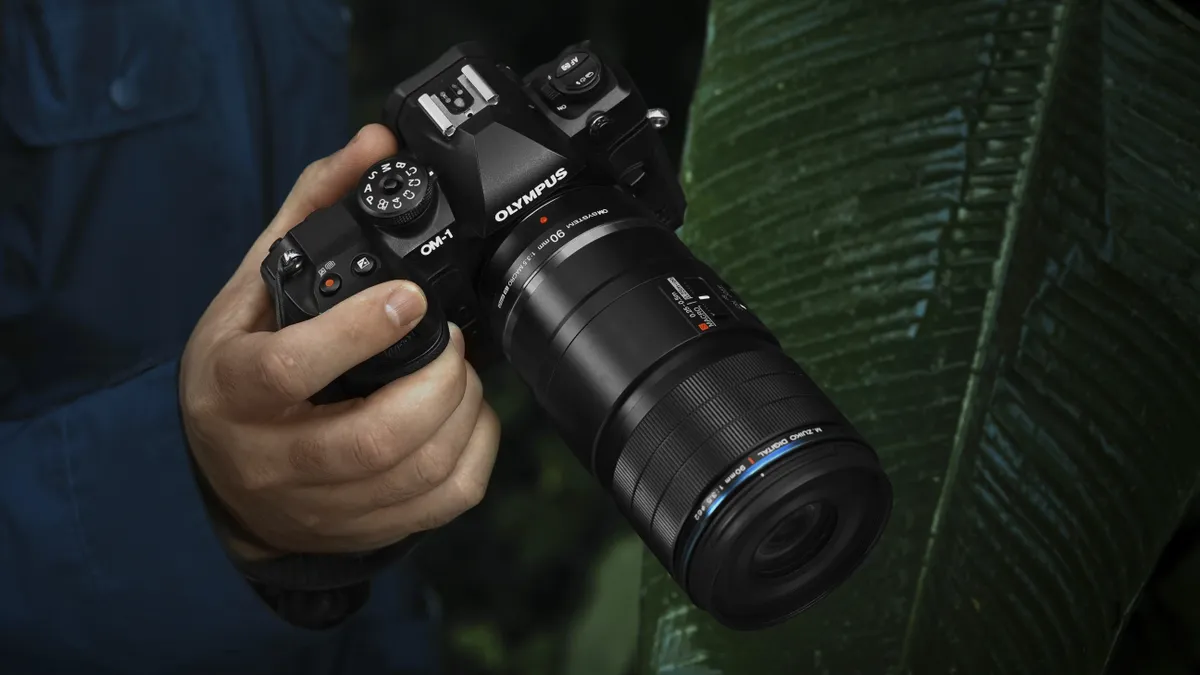
OM macro photographers are spoilt for choice. There’s the classic M.Zuiko 60mm f/2.8 Macro lens, which looks odd but performs brilliantly, and a veruy budget-friendly M.Zuiko 30mm f/3.5 Macro that boasts 1.5:1 magnification.
The star of the show, though, is the M.Zuiko 90mm f/3.5 Macro, especially for timid subjects like insects – where its 180mm effective focal length enables you to shoot from further away.
On top of that, it boasts a 2:1 reproduction ratio – which is an equivalent 4:1 in full-frame terms, so you're able to supersize your subjects!
Just be aware that you might find this focal length a bit ‘long’ for some subjects, especially in confined spaces, and the size, weight – and the precise focusing needed – mean this is probably going to work better on a tripod than handheld.
See our full OM System M.Zuiko 90mm f/3.5 Macro IS Pro review
You might also like
Take a look at the best Micro Four Thirds lenses from all manufacturers. And don't forget that everything on this list will work on the best Micro Four Thirds cameras from every brand!

