





Slow motion is one of those video techniques that can make even a fairly ordinary moment suddenly look spectacular. Water splashing, a bird taking flight, someone landing a trick, or even something as simple as hair moving in the wind can reveal an extraordinary amount of detail once time is slowed down.
But not all slow motion is created equal. Plenty of cameras advertise 120fps recording, but the resolution, image quality, autofocus, and crop can vary enormously. Some cameras can maintain 4K resolution at high frame rates, while others require a drop to Full HD or even lower. And the faster I push the frame rate, the more light I need, which makes sensor size and low-light performance increasingly important.
For this guide, I am looking specifically at cameras that give me genuinely useful high-frame-rate recording rather than simply ticking a slow-motion box on a specification sheet. Let's dive in.
The best slow-motion cameras in 2026
Why you can trust Digital Camera World Our expert reviewers spend hours testing and comparing products and services so you can choose the best for you. Find out how we test.
Best slow-motion camera overall

The GoPro Mission 1 Pro takes the top spot for me because it offers a combination of frame rate, resolution and practicality that is very difficult for any other camera to match.
The headline figure is 4K at 240fps. If I deliver my finished video at 30fps, that gives me an 8x slowdown while retaining full 4K resolution. Drop to 1080p and the Mission 1 Pro doubles that frame rate again to 480fps, while specialized burst modes can push things as far as 960fps for particularly extreme effects.
I think 4K240p is the sweet spot, though. Extremely high frame rates sound impressive, but once resolution starts dropping significantly, I often find the extra slowdown isn't worth the reduction in image quality. Having 240fps available at 4K means I can capture something genuinely dramatic while still producing footage that sits comfortably alongside material from much larger cameras.
The switch to a 1-inch sensor is another major reason the Mission 1 Pro stands above previous GoPros. High-frame-rate filming forces me to use faster shutter speeds, which means less light reaches the sensor. That makes slow motion particularly demanding in cloudy conditions, indoors or around sunset. The larger sensor gives GoPro considerably more room to work with than older Hero cameras, and our review found the footage among the best we've seen from an action camera.
Then there is stabilization. High-frame-rate footage often involves sport or movement, exactly where having a tiny stabilized camera I can mount almost anywhere becomes incredibly valuable. The Mission 1 Pro is waterproof to 20m without an additional housing and retains GoPro's enormous mounting ecosystem.
The downside is cost. At $699.99, this is expensive enough that I would think carefully about whether I actually need its maximum slow-motion capabilities. It is also slightly bulkier than a regular Hero.
But if slow motion itself is the priority, I think the Mission 1 Pro makes the strongest case here. I can get higher-end cinematic image quality from a full-frame mirrorless camera, but none gives me 4K240p, this degree of stabilization and a body I can strap to almost anything.
Best pocket slow-motion camera

The DJI Osmo Pocket 4P is almost absurdly capable for something I can put in a jacket pocket. It matches the Mission 1 Pro's most useful slow-motion headline – 4K240p – but combines that with a proper three-axis mechanical gimbal.
That makes a real difference. Digital stabilization has improved enormously, but there is still something particularly clean about footage from a physical gimbal. If I'm following a skateboarder, filming someone running or simply moving the camera around a subject while recording high-frame-rate footage, the Pocket 4P makes smooth movement dramatically easier.
DJI has also added a second camera this generation. The primary camera combines a 1-inch sensor with a 20mm-equivalent lens, while the second uses a 1/1.28-inch sensor and a much tighter 60mm-equivalent f/1.8 lens. I particularly like that second focal length for slow motion because it gives action a more compressed and cinematic perspective than the ultrawide view I usually associate with pocket cameras.
Maximum resolution remains 4K rather than the Luna Ultra's 8K, but for this guide I don't think that matters very much. The Pocket 4P reaches 240fps at 4K, whereas the Insta360 tops out at 120fps in 4K. For genuine slow-motion shooting, I would take the extra frames.
Image quality is excellent too. Our reviewer found the Pocket 4P's dynamic range striking, while DJI's color science produces natural-looking footage straight out of camera. There is 10-bit D-Log recording for grading, although one frustration is that DJI's newer D-Log 2 profile isn't available across every camera and recording mode, including some slow-motion options.
I also like having 103GB of built-in storage in addition to microSD. High-frame-rate video devours card space, so having substantial internal memory is genuinely useful rather than merely convenient.
However, the Pocket 4P isn't waterproof or designed for impacts, which is why I would still choose the GoPro for extreme sports. And if I just want a straightforward gimbal camera, the cheaper Pocket 4 provides much of the same core technology.
Best slow-motion camera for low light

The Sony A7S III is getting on a little now, but if I'm shooting slow motion in difficult light, I would still trust it over almost anything else here.
Its 12.1MP resolution looks remarkably modest beside today's 30MP, 40MP and 50MP cameras, but Sony made that decision deliberately. Those relatively few pixels are spread across a full-frame sensor, giving each photosite a great deal of area to collect light. That translates into exceptionally clean high-ISO video – exactly what I want when high-frame-rate recording forces me toward faster shutter speeds.
The A7S III records 4K up to 120fps, internally in 10-bit 4:2:2, while Full HD can reach 240fps. For a 24fps timeline, 120fps gives me a clean 5x slowdown without sacrificing 4K resolution.
That doesn't sound as spectacular as the GoPro's 240fps 4K, but resolution and frame rate aren't the whole story. A full-frame sensor paired with a fast f/1.4 or f/2 lens can produce much cleaner, richer footage than an action camera once the available light starts falling. Sony's E-mount selection is enormous, and that flexibility is one of the major reasons I would choose an A7S III for controlled production rather than a fixed-lens camera.
Autofocus is excellent too. Sony's tracking remains extremely dependable, and critically it continues working in the high-frame-rate video modes where I need it. Our review described the autofocus as one of the camera's standout strengths for filmmakers.
There are clear disadvantages. This is not a particularly useful high-resolution stills camera, and its lack of 6K or 8K recording increasingly looks dated alongside newer hybrids. Sony also still charges a substantial amount for what is now an older body.
But slow motion creates unusually demanding lighting conditions, and that plays directly into the A7S III's greatest strength. If I wanted beautiful 4K slow motion at night, indoors or under difficult event lighting, this is still the camera I would choose.
Best versatile pocket gimbal

The Insta360 Luna Ultra isn't quite as fast as the DJI Pocket 4P, but I think it is the more versatile pocket filmmaking tool. For this particular guide, however, DJI has the technical advantage. But the Luna Ultra gives me 8K.
Where the Luna really wins me over is the detachable OLED screen. The display can be removed and used as a wireless remote monitor, which means I can position the camera away from me and still check composition and operate it. For anyone shooting themselves, that is one of those features that sounds gimmicky until you actually use it.
Slow-motion recording reaches 4K120p, while dropping to 1080p unlocks 240fps. That is plenty for most creative work: 120fps gives me a 5x slowdown on a 24fps timeline, and 240fps doubles that again. Insta360 also offers 8K30p for normal-speed footage, something DJI's Pocket series currently doesn't match.
Like the Pocket 4P, the Luna Ultra combines two focal lengths. The main 1-inch camera uses a 20mm-equivalent f/1.8 lens, while the second 1/1.3-inch camera provides a 60mm-equivalent view. I like having a real telephoto camera rather than relying entirely on digital cropping, particularly when I want slow-motion close-ups of a subject without physically getting in the way.
The mechanical gimbal is excellent, and for moving footage this is a different proposition from an ordinary mirrorless camera. I can follow a subject, walk alongside them or make small sweeping movements while the camera automatically absorbs most of my hand movement.
Image quality from the 1-inch main camera is very good, particularly compared with smaller action cameras, and the bright f/1.8 aperture helps when high frame rates start demanding more light.
Best slow-motion camera for creators

The Canon EOS R6 V records 4K up to 120fps and Full HD up to 180fps, but its wider specification is what really makes those modes useful. The same camera can shoot internal 7K60p RAW, 7K30p open gate and beautifully detailed oversampled 4K60p, so I can move between high-quality normal-speed footage and 4K slow motion without changing systems.
Canon has also built the R6 V specifically around video rather than simply taking a conventional stills camera and adding more codecs. There is active cooling, a prominent video record button, a power-zoom rocker, vertical mounting, a vertical user interface and quick access to tools such as zebras and peaking.
The active cooling is particularly useful. High-resolution and high-frame-rate video puts enormous demands on a sensor and processor, and heat can become a limiting factor on smaller fanless mirrorless bodies. Canon's fan means the R6 V can keep going much longer under demanding recording conditions.
Autofocus is based around Canon's Dual Pixel CMOS AF II system and is excellent for tracking moving people, animals and vehicles. That's exactly what I want when filming at 120fps, because the sorts of subjects that benefit most from slow motion aren't usually standing still.
I also get in-body stabilization, rated up to 7.5 stops in the review, making handheld slow-motion shooting far easier than with a cinema camera such as Canon's C50.
The 32.5MP full-frame sensor makes this a capable stills camera too, although Canon's video-first design removes both the EVF and mechanical shutter. If photography is equally important, the sibling R6 Mark III makes more sense.
There are also a few professional video omissions, including timecode and anamorphic desqueeze. Those are the things that separate the R6 V from a true Cinema EOS body.
But for creators who need a single camera capable of 7K production footage, excellent autofocus, stabilization and high-quality 4K120p slow motion, I think the R6 V strikes one of the best balances in the guide.
Best smartphone for slow motion
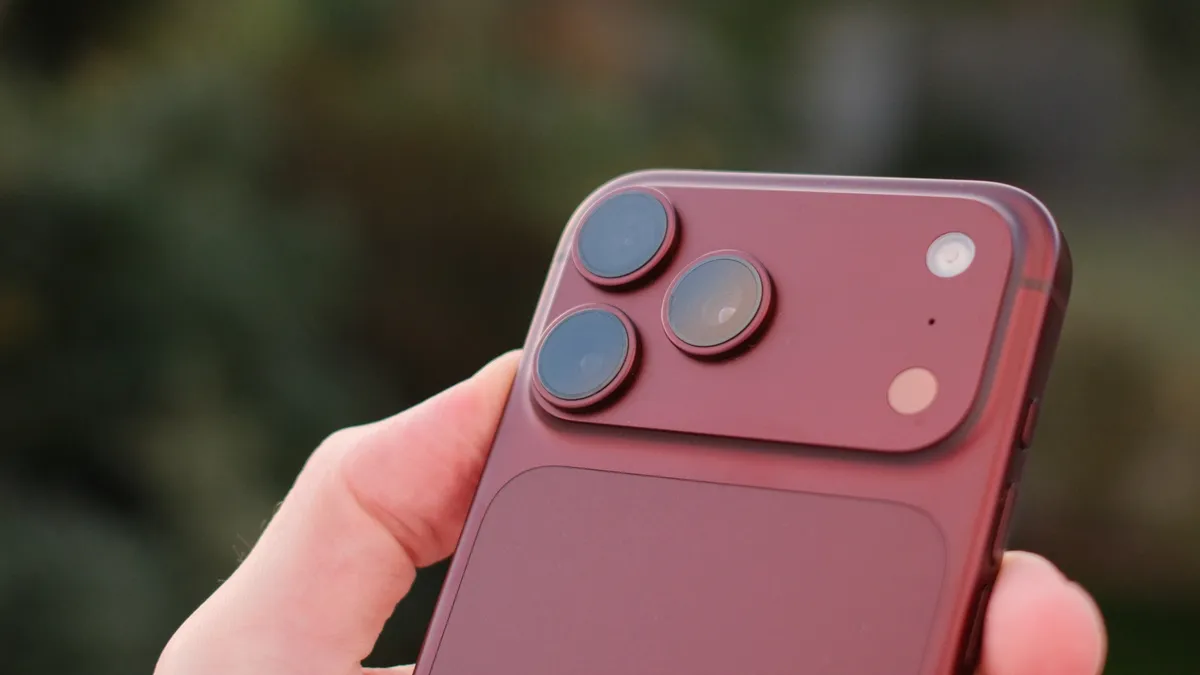
The iPhone 18 Pro Max is the easiest slow-motion camera to use here, and its one you're already likely carrying in your pocket.
Apple now supports 4K Dolby Vision at up to 120fps from its Fusion Main camera, while 1080p slow motion can reach 240fps, and the iPhone 18 Pro Max's 4K120p looks good enough that I can mix it into much more serious projects.
Video quality more generally remains the reason I rate the iPhone so highly. Color and exposure are extremely consistent, stabilization is excellent and autofocus requires almost no thought. In my review, I found the iPhone still offered the most consistently excellent overall smartphone video experience, even though some Android rivals have pushed ahead for stills photography.
Apple's professional video options have expanded too. There is ProRes RAW, Apple Log 2, genlock support and external ProRes recording, making the phone much easier to incorporate into serious productions than it was only a few generations ago.
The limitation for slow motion is lens choice. The headline 4K120p mode is tied to the main Fusion camera, so I don't have the same high-frame-rate flexibility across the full ultrawide and telephoto system.
The small sensor also inevitably suffers when high frame rates force shutter speeds upward in poor light. An A7S III with a fast lens will absolutely destroy it indoors or at night.
But I don't carry an A7S III everywhere. The iPhone is always with me, requires no setup, stabilizes itself, and can edit and publish the finished clip without transferring a file anywhere. For spontaneous slow motion, particularly for travel, journalism, and social content, that convenience is difficult to overstate.
Best all-round hybrid for slow motion
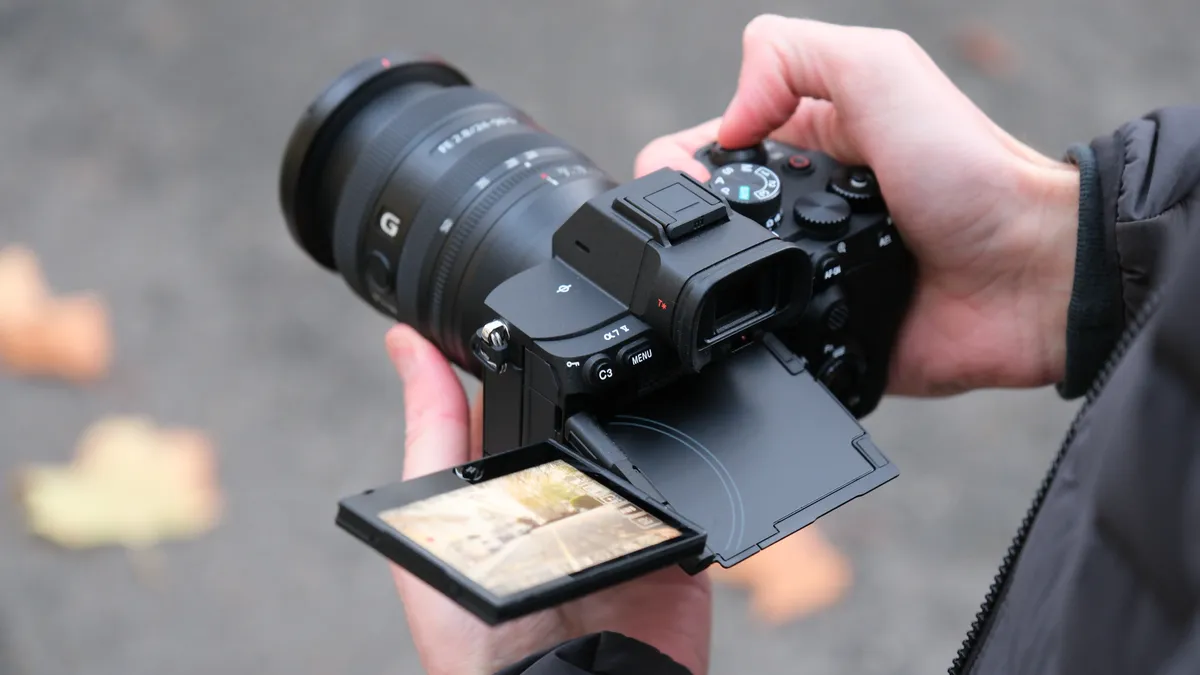
The Sony A7 V isn't the most impressive video camera in this guide on paper, but it might be the one that makes the most sense for someone who shoots almost equal amounts of photography and video.
The major slow-motion upgrade over the A7 IV is the addition of 4K120p. The catch is that it isn't full frame: switching to 120p imposes a Super35 crop, effectively using an APS-C-sized area of the sensor. That means my lenses become noticeably tighter, so I need to plan accordingly if I'm shooting indoors or want an especially wide view.
I don't love the crop, particularly when cameras such as the Canon R6 V and R6 Mark III can deliver uncropped full-frame 4K120p. But the actual footage is excellent. Sony oversamples its lower-frame-rate 4K from a higher-resolution readout, and the new partially stacked sensor substantially improves readout speed compared with the A7 IV.
That reduction in rolling shutter is particularly relevant to slow motion. Fast-moving subjects and rapid camera pans are exactly where skewed vertical lines become obvious, and in my testing the A7 V controlled rolling shutter impressively well.
Autofocus is arguably the camera's biggest strength. Sony's latest Bionz XR2 processor integrates the company's AI subject-recognition technology, and I found focusing lightning fast and exceptionally sticky. If I'm trying to capture a runner, animal or vehicle at 120fps, that dependability is extremely valuable.
The 33MP sensor is what really separates this from the A7S III. The A7 V produces much more detailed still photographs and shoots them at up to 30fps, so this is a genuine all-round camera rather than a video specialist.
Sony has made some odd video choices, though. There is still no open-gate recording, no resolution above 4K, and no internal RAW, all of which make competitors look more advantageous.
So I wouldn't buy the A7 V purely for slow motion. I would buy it because I want an excellent 33MP stills camera, superb autofocus and very good everyday video – with 4K120p ready whenever I want to slow the action down.
Best premium slow-motion camera

The A9 III was the first full-frame mirrorless camera to use a global shutter. A conventional CMOS sensor reads an image line by line from top to bottom, and when something moves very quickly during that readout it can become bent or skewed. A global shutter captures the entire frame simultaneously.
For slow-motion footage of extremely fast sport, machinery, propellers or rapid camera movement, that is a major advantage. Every one of those 120 frames is captured without the rolling-shutter distortion that can otherwise make straight objects appear to lean or bend.
The A9 III can record 4K120p without a crop, another important advantage over something like the A7 V. Its lower-frame-rate 4K60p can be oversampled from 6K for additional detail.
Autofocus is equally serious. Sony's AI-powered recognition can identify people, animals and other subjects, and the camera was designed from the outset for professional sports work. Our reviewer found tracking extraordinarily capable, although even this system could occasionally become confused by unusual athlete body positions.
Then there is the stills side, where the camera can shoot full-resolution 24.6MP RAW and JPEG images at an absurd 120fps. For someone covering sport professionally, being able to switch between 120fps stills and 120p 4K video in one body is unique.
There is a downside to global-shutter technology. The sensor has a higher native sensitivity than conventional rivals, and ultimate dynamic range and high-ISO quality aren't quite as impressive as the best standard full-frame sensors. And the price puts the A9 III firmly into professional territory.
If all I want is very slow footage, the Mission 1 Pro gives me twice the 4K frame rate for a fraction of the money. But if I need 4K120p footage of genuinely extreme movement without rolling-shutter distortion, the A9 III has an advantage no conventional sensor can completely reproduce.
Best high-resolution professional hybrid

The Nikon Z8 slow motion reaches 4K120p, which gives me the same core high-resolution slowdown as the Sony A7S III, A7 V and A9 III. But unlike any of those cameras, the Z8 can also record 8K at up to 60p, including sophisticated internal RAW options.
That makes it particularly appealing for high-end productions where slow motion is only one part of the job. I can shoot 8K establishing shots, switch into 4K120p when I need action slowed down and record Nikon's 12-bit N-RAW without relying on an external recorder.
The 45.7MP stacked full-frame sensor is taken essentially straight from the flagship Z9. Readout is fast enough that Nikon dispensed with a mechanical shutter entirely, and the Z8 is capable of 20fps RAW stills, 30fps full-resolution JPEGs and even 120fps reduced-resolution JPEG shooting.
That stacked architecture also helps video. Rolling shutter is much better controlled than on slower conventional sensors, which is exactly what I want when filming fast action.
Nikon's autofocus is excellent, with sophisticated recognition for people, animals and vehicles, although I still find Sony's latest systems slightly more intuitive and sticky in the most demanding tracking situations.
Where the Z8 differs most dramatically from the A7S III is resolution. The Nikon is a genuinely high-end stills camera capable of huge files and detailed cropping, while also offering video specifications that would once have required a dedicated cinema body.
The trade-off is size. At around 910g before I add a lens, this isn't something I casually throw into a small bag, and its four-axis tilting screen isn't as convenient for filming myself as a fully articulating display.
I also wouldn't pick the Z8 above the A7S III specifically for dark indoor slow motion. Packing 45.7 million pixels onto the sensor means its individual photosites are much smaller than Sony's 12MP video specialist.
But if I need one professional camera that can shoot detailed 45MP photographs, 8K60p video and excellent 4K120p slow motion, very few cameras give me as complete a package as the Nikon Z8.
How to choose the best slow-motion camera
The number I look at first is not simply the highest advertised frame rate; it is the highest frame rate available at the resolution I actually want to use.
A camera advertising 960fps sounds incredible, but if that mode produces very low-resolution footage, I may find 4K120p or 4K240p far more useful in a finished project.
For context, if I'm editing on a 30fps timeline:
- 60fps gives me 2x slow motion
- 120fps gives me 4x slow motion
- 240fps gives me 8x slow motion
- 480fps gives me 16x slow motion
The next thing I think about is light. If I follow the conventional 180-degree shutter rule, 24fps footage might use approximately 1/48 sec, whereas 240fps pushes me toward roughly 1/480 sec. That is around three and a third stops less exposure before I've changed anything else.
That is why the Sony A7S III can outperform cameras with much more spectacular frame-rate specifications in dark environments. A large full-frame sensor and a fast lens give me much more light to work with.
Autofocus matters too. A fast frame rate is pointless if the subject goes out of focus halfway through the action. Sony and Canon are particularly strong here, although all the modern cameras in this guide perform well.
Finally, I think about how the camera will actually be positioned. For extreme sport, a tiny waterproof GoPro makes far more sense than a mirrorless camera. For walking shots, a mechanically stabilized DJI or Insta360 gimbal camera is incredibly useful. For controlled professional work, an interchangeable-lens camera gives me much greater control over focal length, depth of field and lighting.
Is 120fps enough for slow motion?
For most filmmaking, yes. I use 120fps far more often than ultra-high frame rates because it gives a dramatic slowdown while maintaining excellent image quality on modern cameras.
On a 24fps timeline, 120fps becomes 5x slow motion. That is enough to transform most human movement, sports and wildlife action. Going to 240fps becomes useful for much faster events – water splashes, impacts, tricks and fast sport – while 480fps and beyond gets into specialist territory.
The other advantage of staying at 120fps is image quality. Cameras such as the Sony A7S III, Canon R6 V, Sony A9 III and Nikon Z8 can all retain 4K resolution at that speed, while extremely high-frame-rate modes often require dropping resolution.
Why does slow-motion footage need so much light?
High frame rates require very short exposure times. If I record at 24fps, I might use a shutter speed around 1/50 sec. At 120fps, I am more likely to be around 1/250 sec, while 240fps pushes that toward 1/500 sec. Each increase reduces the amount of light reaching the sensor.
The camera then has to compensate by opening the lens aperture, increasing ISO or adding more lighting. Once the lens is already wide open, ISO is often the only option, which is why noise becomes much more obvious in poor-light slow-motion footage.
This is where larger sensors have a real advantage. The Sony A7S III doesn't record 4K240p, but its full-frame sensor produces much cleaner 4K120p footage in difficult light than I would expect from a tiny action-camera sensor.
If I'm planning a controlled slow-motion shoot indoors, I would also prioritize lighting almost as highly as the camera.
Does shutter speed matter for slow motion?
Absolutely. Using an extremely slow shutter speed at a high frame rate can produce smeared, blurry motion, while an excessively fast shutter can make movement look unnaturally crisp and staccato.
A common starting point is the 180-degree shutter rule, which means using a shutter speed approximately twice the frame rate: around 1/250 sec for 120fps or 1/500 sec for 240fps.
For particularly fast sports or scientific-style motion analysis, I might deliberately choose an even faster shutter speed to freeze detail within every individual frame.
How we test slow-motion cameras
I look first at the actual recording options. A camera offering 120fps is one thing, but I want to know what happens when I turn that mode on. Does the resolution fall? Is there a crop? Does autofocus still work? Can I retain 10-bit color? Is Log available? Does the camera overheat after a few minutes?
Image quality becomes particularly important because high-frame-rate video is demanding. I look at fine detail, noise, dynamic range and color, particularly as available light falls.
Rolling shutter is another major consideration. Fast movement makes sensor-readout problems much easier to see, so I look for bending vertical lines, distorted objects and other artifacts. Cameras with stacked sensors perform particularly well here, while the Sony A9 III's global shutter eliminates the problem at the sensor level.
Autofocus has to keep up with the subject throughout the high-speed recording, while stabilization needs to remain effective if the camera is being moved.
And finally, I judge the slow-motion footage as part of a complete video workflow. A spectacular 480fps mode is much less useful if the rest of the camera is frustrating to use.

