



First Person View (FPV) drones are getting a radical overhaul thanks to the new Antigravity A1 system, but FPV is not as well understood by many as it should be already.
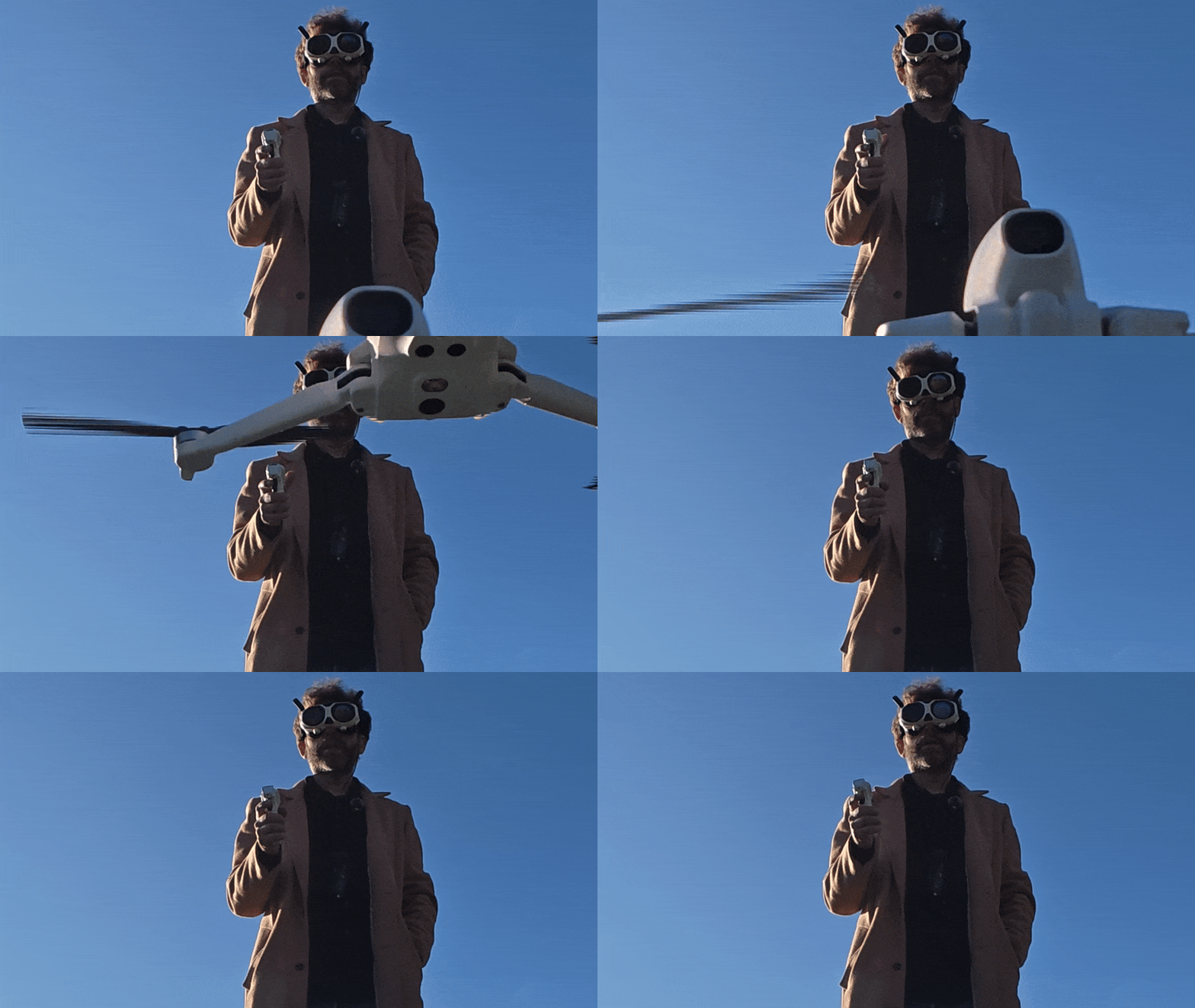
Wearing my new steampunk Antigravity Vision goggles, I realize that I'm actually experiencing a new version of FPV drone, which is exciting for me. I also realize that many people find the term FPV off-putting, when it's where the most fun, and most dynamic drones can often be found. So here's an explanation of "traditional" FPV, how it differs from a 'normal' camera drone, and how Antigravity has moved things into a whole new sphere (you'll understand that pun by the end...)

What is the difference between FPV drones and normal drones?
An FPV drone offers the pilot a 'First Person View' as if they were sat in the cockpit. Now since a drone is usually roughly the same weight as something you'd buy in a bakery, you're unlikely to actually be sat in it – so being 'inside' is actually achieved by wearing goggles that allow you see the view from a camera mounted at the front of the drone (just as a pilot sits at the front of a plane).
FPV goggles, as they're known, as the more elegant version of this technology, but some also use it to refer to the view from the camera at the front of a drone that is fixed looking forward, even when that view is seen on an ordinary monitor.
For example, the DJI Inspire 3 has a high-quality camera for the videographer that can be rotated in any direction underneath, and a relatively simple camera at the front that is fixed to the drone's frame. Two operators (one for the camera, one for the drone) can control the aircraft. It makes sense to call the pilot's camera the 'FPV camera', but when people talk about FPV drones it is more likely to be about a drone piloted with goggles.
Not all FPV goggles are the same
Some FPV goggles are 'box' like (these tend to be cheaper) and others have integrated optics for each eye (DJI, Fatshark). The other key distinction is between analog and digital.

Analog video transmission has the advantage that there is no encoding or decoding delay, and that the tech is decades old so had become relatively cheap. It did, of course, have all the grain – old-school static – of 1970s TV if your antenna wasn't pointing the right way, but even this had advantages. As you flew away the signal would drop off gradually – not just fail – and you could see the degradation as a pilot as your distance got too far and take precautions.
Modern drones tend to use digital video, which is cleaner, like high definition TV (until it fails) but – for a while – there was too much lag to do this with FPV. Video needs to be encoded into 1s and 0s and decoded at the other end and even a fraction of a second was is an issue when you're flying, making sharp, rapid turns, a big part of the style of FPV flying, which is often through obstacle courses or narrow gaps (and much less of an issue for aerial photography and other mainstream drones, which is why they were all digital first).
Eventually, digital technologies came along (DJI, Walksnail, and now Antigravity), but they still tend to cost more.

You can do different things with FPV?
If you think of a traditional camera drone, with tiltable camera, as designed for classic drone photography and videography – slow, cinematic shots and tracking or orbiting subjects – the FPV shot tends to be the more exciting chase or follow stuff.

That's basically because FPV pilots tend to cross over with the enthusiast groups who built their own drones and spent weekends learning the art of flying very precisely. Now it's a bit easier for everyone with devices like DJI's Motion controller and Antigravity's Grip controller to fly in a similar way – precisely and directly. With DJI's most recent FPV drone the camera is still at the front but it can be tilted.
The Antigravity A1, of course, has added an altogether new option of flying the route and then changing the camera angle later, thanks to the 360-camera. That's a step further than FPV has allowed until now, so it'll be interesting to see how creatives use it.

So how does the Antigravity A1 change FPV drones?
The Antigravity A1 doesn't have a front camera. It has two collision sensors at the front, but that's it. Just above and below the front of the drone are the cameras it 'sees' – and that the FPV pilot sees – through. The system has the smarts onboard to assemble this into a spherical image, and present just the amount that an FPV pilot would see through the goggles.
Actually anyone with them can see through them too by looking in their eye, because one of the 'eyes' of the Vision goggles is a OLED display, and bright enough to see outdoors at that.

The system gives you a magical invisible eye in the sky, and the FPV control system is the most logical because it is the most powerful. Why? Because you can look anywhere and charge in that direction in the speed you want.
The system handles the details for you, and, later, if you decide you weren't looking in the right direction – or even had the 'camera' at the right framing, no problem. Shoot first, frame later.
FPV is a social activity
Not everyone knows it, but FPV drones are best flown with a buddy. In some places, like the UK, that's actually in the rules because you need someone to keep 'line of sight' eye contact with the drone and – when you're wearing goggles – you can't actually physically see the drone.
Enjoying tech with friends, family, siblings etc. is a great way to share the fun, and FPV is generally thought of as a more fun and more closely associated with the hobby end of things.

