
Early Verdict
Part mirrorless camera, part action camera, the GoPro Mission 1 Pro ILS is an unusual camera that mixes the best GoPro features with a swappable lens. The ILS packs in the same 8K30 open gate and 960fps 1080p slow motion on a one-inch sensor as the fixed-lens Mission 1 Pro. The ILS packs in GoPro's HyperSmooth, which is a big boost for handheld footage but can show some wobble with significant camera movement. While a one-inch sensor is oversized for action cameras, it's small by mirrorless standards, which shows most in low-light footage. There are also several sacrifices the ILS makes to enter the mirrorless category: focus is manual only, autofocus lenses aren't supported even in manual focus mode, lenses over 250g need added support, and there's a delay for taking still photos. For a niche, mountable compact filmmaking tool, the ILS has a lot to offer, but the manual focus design, limited lens support, and 3x crop factor may dissuade a lot of creators.
Reasons to buy
- +
Affordable
- +
Excellent 8K open-gate quality
- +
HyperSmooth stabilization
- +
Tiny Design
- +
960fps slow-motion
- +
Built-in audio is solid
Reasons to avoid
- -
1-inch sensor is large for action cams but small for mirrorless
- -
Manual focus only
- -
Needs support for lenses over 250g
- -
Doesn't support focus-by-wire lenses
- -
No Horizon Lock
- -
Delay for taking photos
Why you can trust Digital Camera World Our expert reviewers spend hours testing and comparing products and services so you can choose the best for you. Find out how we test.
GoPro has sliced off its longstanding ultra-wide lens and given a GoPro a Micro Four Thirds Mount. The GoPro Mission 1 Pro ILS is the action camera giant’s first venture into the world of mirrorless cameras – and it’s unlike any other camera that I’ve tried.
The ILS feels as if GoPro sliced off the lens of the Mission 1 Pro and gave it a Micro Four Thirds Mount. GoPro’s first mirrorless carries the same body design, handling, 8K60 sensor, and GP3 processor as the fixed-lens Mission 1 Pro.
But the ILS also carries the same price point as the Mission 1 Pro, making GoPro’s first mirrorless camera one of the cheapest 8K mirrorless cameras available.
GoPro’s move into mirrorless carries a set of features that feel very GoPro, including HyperSmooth and a familiar double-screen design. But there are some unusual sacrifices made to get such a small camera, making the ILS a bit more of a niche shooter.
GoPro Mission 1 Pro ILS Review: Price
The GoPro Mission 1 Pro ILS launches at the same price as the fixed-lens Mission 1 Pro: $699 / £599 / AU$1099 / CA$949 – but you will also need to budget for a lens.
That makes the Mission 1 Pro ILS one of the most affordable 8K-capable mirrorless cameras.
But, as a GoPro, expect to be heavily tempted by the accessories, as the ILS feels almost like a modular camera. That list price doesn't include a lens. The point-and-shoot grip is a huge help for shooting handheld; then there's the Media Mod for added mic ports or the GoPro wireless mic.
Heavier lenses over 250g are going to need a third-party support system to help the tiny camera support the weight of the lens. And while the ILS has the classic GoPro mounting fingers, most GoPro mounts are only designed for lightweight setups – GoPro recommends using the tripod mount and third-party accessories made for larger cameras when mounting in a high-vibration scenario or with heavier lenses.
GoPro Mission 1 Pro ILS Review: Specs
Sensor |
One-inch |
Resolution / Frame rate |
Up to 8K60p, up to 8K30p with open gate |
Slow motion |
16x (480 fps in 1080p), or ten-second burst mode at 32x (960 fps 1080p) |
Color |
8 bit, 10 bit, GP-LOG2 with LUT |
Stabilization |
HyperSmooth (NO Horizon Lock) |
Still photos |
12MP / 50MP, standard, SuperPhoto or RAW |
Audio |
4 built-in stereo mics, with 24-bit PCM, 32-Bit Float |
Battery |
Swappable 2150mAh Enduro 2 Battery |
Dimensions |
89.6 W x 58.7 H x 46.1 D (mm) |
Weight |
197g |
GoPro Mission 1 Pro ILS Review: Build and Handling

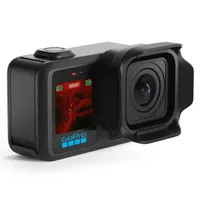
The GoPro Mission 1 Pro ILS may be GoPro’s first mirrorless, but the camera still feels quintessentially GoPro. The ILS feels like GoPro took the Mission 1 Pro and just swapped out the lens for a Micro Four Thirds mount.
The main part of the ILS body uses the same design as the fixed-lens Mission 1 cameras, making the camera the smallest mirrorless camera available. The lens mount juts out from the body a bit, increasing the depth and height of the camera’s dimensions, but the ILS can use the same Point-and-Shoot Grip and the same Media Mod as the fixed-lens Mission 1 cameras.

The ILS’s small size makes it possible to get some unusual perspectives from angles that a mirrorless camera wouldn’t normally fit, although this, of course, depends on the size of the lens.
The small size isn’t great to hand-hold, but GoPro also launched a point-and-shoot grip that gives the hand a decent-sized grip to wrap around for handheld shooting.

But there is a downside to the small design. GoPro says that lenses that weigh over 250g should be used with an external lens support, which means buying the support, a base plate, and rods. This not only increases the cost of the camera but also the size by adding in all those accessories.
Users should also take care when choosing mounts. GoPro’s mounts were designed for action cameras, not mirrorless cameras. GoPro recommends using third-party mounts and the camera’s tripod mount rather than the mounting fingers when working with heavier lenses or mounting scenarios with higher levels of shock and vibration.

The size isn’t the only thing the ILS has in common with earlier GoPros – the user interface will also feel very familiar to anyone who has used a recent Hero camera. Like the Mission 1 Pro and the Hero13, there are just two buttons on the ILS: one at the top to start a recording and the on-off button at the side (which also swaps modes).
That leaves most of the GoPro ILS adjustments through the touchscreen. I love that there’s the option to build your own modes, so you can save frequently used settings inside of its own custom mode (and you can delete the standard modes that you don’t want).

One key step that ILS users can’t skip? The ILS requires telling the camera body what lens you are using – if you skip this step, HyperSmooth won’t look smooth without that essential data.
Like recent Hero cameras, the ILS has a large screen on the back as well as a smaller screen on the front, but large lenses will partially block that front screen a bit.
A door at the side of the camera opens up for the battery and the microSD card slot. That Enduro 2 battery is rated for around 3 hours of 4K30, but the battery levels did drop fairly quickly when shooting 8K60.
Like GoPro’s action cameras, there are both the mounting fingers and a ¼-20 threaded mount at the bottom of the camera.
While the ILS has the same build as the Mission 1 Pro, the lens mount makes GoPro’s usual waterproofing impossible. The GoPro Mission 1 Pro ILS is not submersible without underwater housing, though the camera body is splash-resistant if paired with a weather-sealed lens.
GoPro Mission 1 Pro ILS Review: Lens Compatibility

The GoPro Mission 1 Pro ILS uses a Micro Four Thirds mount – but not every MFT lens is compatible. The ILS doesn’t have any electronic communication between the body and the lens. This means that the ILS uses manual focus only.
But, this also means that focus-by-wire lenses won’t work on the GoPro ILS. Autofocus lenses with a focus-by-wire lens require electronics to move the lens pieces to focus; these lenses aren’t capable of adjusting the focus by a twist of the focus ring if there’s no communication between the camera and lens.
That means that most autofocus MFT lenses, like those from OM System and Panasonic, are not compatible with the Mission 1 Pro ILS. That does limit the number of available options quite a bit and is particularly disappointing because it eliminates a lot of weather-sealed lenses.
Lenses that weigh more than 250g will also require an external support in order to avoid putting too much stress on the small camera’s mount.
For this review, I used the Laowa 7.5mm f/2.0 Dreamer, which is one of a few dozen manual focus lenses that GoPro recommends (and is under 250g).
GoPro Mission 1 Pro ILS Review: Performance


Like GoPro’s action cameras, the Mission 1 Pro ILS leans heavily towards cinema and video rather than still photos, though the ILS is still capable of 50MP still photos.
For video, the Mission 1 Pro ILS packs much of the same specs as the fixed-lens Mission 1 Pro, including the same one-inch sensor, GP3 processor, 8K60, 8K30 open gate, and 1080p 960fps slow motion.
One of the biggest advantages of the ILS is the combination of HyperSmooth with swappable lenses. I spent most of my time with the ILS shooting handheld, yet the footage was surprisingly steady – not quite as good as from the fixed-lens Mission 1 Pro, but I was impressed that HyperSmooth even seemed to work on close-ups.
With HyperSmooth, handheld footage looks solid – not tripod solid, but usable footage that still has enough movement to feel like a POV shot. Occasionally, I did detect a bit of a wobble towards the edges when handheld and (attempting) to hold fairly still.
There was a noticeable fish-eye edge wobble when trying to do fast movement handheld, however, so I think true run-and-gun filmmakers actually running are going to want to pair the ILS with a gimbal.
The other key advantage the ILS has is how tiny it is. That makes it possible to get shots from tight angles. I even tucked the camera into a jar for one shot.
The Mission 1 Pro ILS's small size also makes the camera more mountable – however, dedicated GoPro fans will notice that the interchangeable lens model doesn’t support GoPro’s horizon lock to keep the horizon in the same place.
Mounting the camera on a bicycle with HyperSmooth on, footage was naturally not as steady as the handheld shots, but still impressive for a camera without any mechanical stabilization.
The 8K open gate resolution in 4:3 offers a lot of crop-ability for social videos, while still keeping a high level of detail. Naturally, the sharpness comes from the lens, not the camera, but the 3x crop factor means the ILS is going to be using the sharpest center of MFT lenses.
While the Mission series one-inch sensor is larger than that of a typical GoPro, it’s smaller than a typical cinema camera, which comes into play in low-light scenarios. I recorded some fireflies as dusk turned to dark. The ILS managed to capture some tricky shots at dusk that I don’t think a typical GoPro would have captured.

But, the ILS only stretches to ISO 1600 – which is still quite noisy – and I think the low-light shots hinted at some of the biggest limitations compared to a larger sensor cinema camera.
The ILS has a few color profiles built in, ranging from vibrant to cinematic. I spent much of the time in the cinematic color profiles, and I thought colors looked good, but a little too muted at times. But, the ILS is also equipped with GP-Log2 for the most color flexibility in post.

Much of the image quality coming from the ILS is going to depend on what lens is twisted on the front. But unlike any GoPro before it, that interchangeable lens mount means creators can pick a lens with the right vantage point and sharpness for the project. I loved that I was actually able to get some excellent lens flare and bokeh not typical of a GoPro with the Laowa 7.5mm that I tested.
Mixing a one-inch sensor with an MFT mount gives the ILS a 3x crop factor. That means that the ILS is using the sharpest center of the lens. That will give extra telephoto reach and even turn lenses that aren’t really macro into close-up-capable shooters.
But, that also makes getting an ultra-wide angle far trickier. The lens that I used with the ILS is technically a fisheye, but with the 3x crop, it didn’t have that typical fisheye look and instead functioned more like a 22mm lens.
The audio coming from the built-in array of 4 mics was surprisingly solid for a built-in mic, with minimal wind noise and decent volume for close subjects. GoPro includes the option to record 32-bit float to a separate file for editing. While fantastic for a built-in mic, serious videographers will want an external mic system. The Media Mod offers more ports for mics, while GoPro also launched its first wireless mic alongside the Mission 1 series.
The Mission 1 Pro ILS is a compact cinema camera, so still photos come secondary. The camera can shoot 50MP or 12MP shots with single shot, burst mode, and interval shooting for time lapses available.
There’s a slight one-second countdown before each photo, and after each shot, there’s a short processing period where you can’t shoot another photo until the camera is finished. Bursts are also limited to a pre-set number; you can’t hold the shutter button down until you want the camera to stop shooting.
This setup is one of the reasons the ILS doesn’t feel like a stills camera – you can take photos with it, but the Mission 1 Pro ILS doesn’t operate like a typical mirrorless camera geared for stills. Outside of the small size, the biggest perks of the ILS, like HyperSmooth, all lean towards video.
GoPro Mission 1 Pro ILS Review: Initial Verdict
The GoPro Mission 1 Pro ILS feels like a cross between an action camera and a mirrorless camera. The small size, stabilization, and 8K open gate are key perks that create a novel filmmaking tool.
There's really nothing like the GoPro Mission 1 Pro ILS, at least not in the same price range. 8K60 and 8K30p open gate at this price point with swappable lenses is a rare beast.
But while the Mission 1 Pro ILS is GoPro's first mirrorless camera, it's more of a niche filmmaking tool – the Mission 1 Pro ILS isn't designed to go up against the longstanding mirrorless brands like Canon, Sony, and Nikon. For starters, it's built for filmmaking and not stills, but it's also manual focus only and requires external support for heavier lenses.
With a manual focus design and video-first skillset, I wouldn't recommend the Mission 1 Pro ILS for beginner vloggers or still photographers.
And while the one-inch sensor may be large by action camera standards, it's small by mirrorless standards – so I don't see serious filmmakers using the Mission 1 Pro ILS as their primary camera.
But the small, mountable design with the ability to swap lenses is unusual. I can see filmmakers loving the Mission 1 Pro as a secondary purpose-built camera for shooting in tight spaces, mounted rigs, and run-and-gun setups where mobility is key.
GoPro Mission 1 Pro ILS Alternatives
You may also like
Browse the best GoPro cameras or the best cameras for filmmakers.

