
When putting together my list of the best lenses for the Sony ZV-E1, I kept its intended purposes firmly in mind. This camera may be used on a tripod, but is more likely to be used handheld, on a gimbal, or on a grip.
The Sony ZV-E1 is one of the best 4K cameras for filmmaking, as well as one of the best vlogging cameras, but it’s not as simple as reeling off a list of the best Sony lenses all around. Many Sony lenses are big, heavy, and designed for stills performance and reach, rather than for video. The ZV-E1, however, is incredibly compact and designed for portability and speed of operation in the field.
Despite its small size, the ZV-E1 follows suit with Sony’s other full-frame Alpha models by incorporating in-body stabilization. There’s therefore no need to seek out Sony’s OSS-stabilized lenses – these are mainly of interest for sports and wildlife photography, or Sony’s unstabilized APS-C E-mount cameras, and first-generation A7 full-frame cameras.

Rod is an independent photography journalist and editor, and a long-standing Digital Camera World contributor, having previously worked as DCW's Group Reviews Editor. He has used practically every interchangeable-lens camera launched in the past 20 years, from entry-level DSLRs to medium-format cameras, so he has the expertise to select the best Sony lenses for you.
Best lenses for the Sony ZV-E1
Why you can trust Digital Camera World Our expert reviewers spend hours testing and comparing products and services so you can choose the best for you. Find out how we test.
Best standard zoom for the ZV-E1


The Sony FE 20-70mm f/4 G is a standard zoom with a difference. It follows a new-ish trend in standard zoom design, with a wider-than-usual minimum focal length so that it can also do much of the work of an ultra-wide zoom, which means less lens swapping and more versatility.
20-70mm is a terrific zoom range for all-around filming, and the constant f/4 maximum aperture will help in low-light interiors. The 20mm minimum focal length would make this a great lens for selfie vlogging on a grip or a gimbal, too – although, at 488g, this lens is no lightweight. Rounding all this off are a declickable aperture ring and dual Linear XD AF motors for fast and silent autofocus. If the bulk doesn’t bother you, this is a terrific and versatile standard zoom for the Sony ZV-E1.
Read more: Sony FE 20-70mm f/4 G hands-on review
Features ★★★★★ |
It’s a standard zoom that goes a lot wider than most, with a neat range of handling exotica. |
Design ★★★★★ |
Typical G series attractions include an aperture control ring, function buttons and great build quality. |
Performance ★★★★★ |
Fast autofocus, great image quality and a big zoom range make this lens a top performer. |
Value ★★★★☆ |
It’s good value for a lens with an epic zoom range that stretches out to ultra-wide-angle viewing. |
Best wide-angle zoom for the ZV-E1
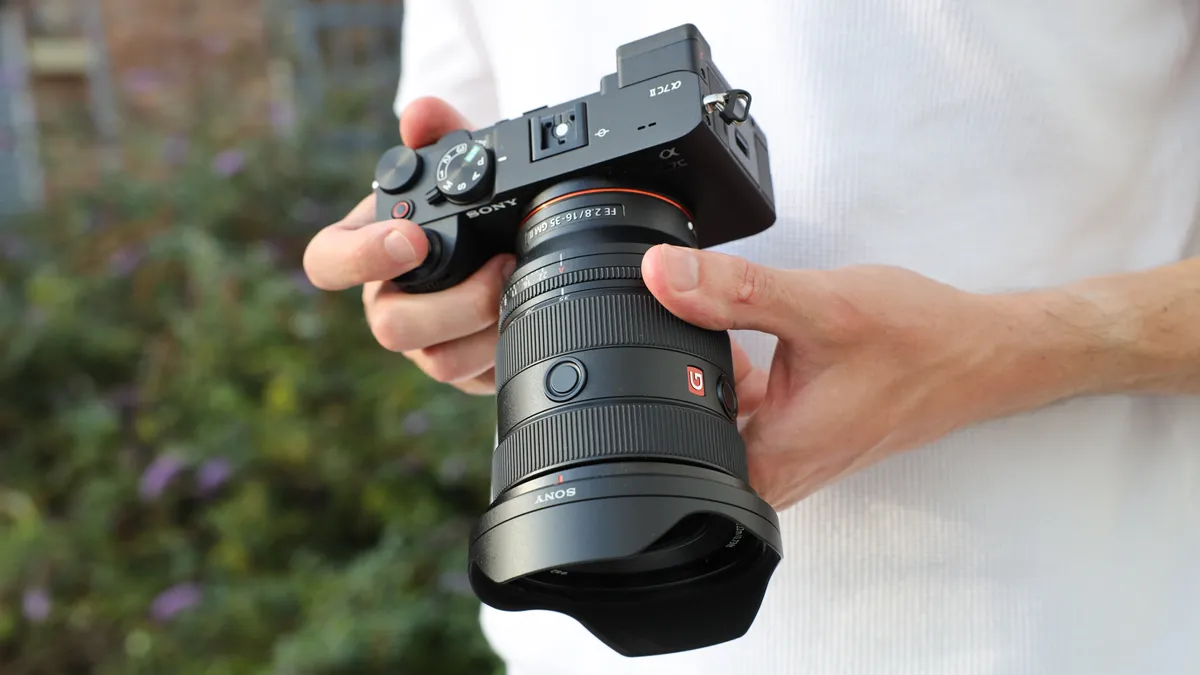


Sony’s G Master lenses have a reputation for optical quality, so it’s no surprise that this second-generation version of Sony’s 16-35mm f/2.8 zoom comes with a hefty price tag. If this is your favored focal range for stills and video, this lens will be your dream buy; otherwise, take a look at the Sony FE PZ 16-35mm f/4 G, which is less than half the price.
You might also want to check out third-party alternatives. The Sony FE 16-35mm f/2.8 G Master II justifies its cost, however, with no fewer than four Linear XD focus motors and suppressed focus breathing. It really is quite a lens with stunning pictorial quality and all-around performance, and a lens that you'll probably want to keep for a lifetime.
Read more: Sony FE 16-35mm f/2.8 GM II review
Features ★★★★★ |
There are no less than four XC autofocus motors, a click/de-click aperture ring with locking switch and dual function buttons. |
Design ★★★★★ |
The clever design is 20% lighter and 10% smaller than the previous edition of the lens. |
Performance ★★★★★ |
Image quality is excellent, as is the speed and consistency of autofocus. |
Value ★★★★☆ |
You get what you pay for to some extent but third-party options can cost a lot less. |
Best wide-angle prime for the ZV-E1


If you want to film a wider angle of view and don’t want the bulk of the Sony FE 20-70mm f/4 G or the cost (especially the cost!) of the Sony FE 16-35mm f/2.8 GM II, the Sony FE 20mm f/1.8 G is a compelling alternative. It offers a wide enough angle of view for self-filming, and it’s fast enough for filming in low-light interiors. It’s not one of Sony’s G Master lenses, but the optical quality is sensational, with serious edge-to-edge sharpness, especially when you stop down slightly.
Sure, it's not the most compact and lightweight lens you can buy, nor is it the cheapest. But the image quality and overall performance make it well worth the investment. It's also a great next step in wide-angle coverage when switching from a standard zoom lens.
Read more: Sony FE 20mm f/1.8 G review
Features ★★★★★ |
An ultra-wide viewing angle and fast aperture come with a click/de-click aperture ring and function button. |
Design ★★★★★ |
It’s a high-end design that’s refreshingly compact and lightweight, complete with weather-seals. |
Performance ★★★★★ |
Image quality is fabulous, even when shooting wide-open at f/1.8. |
Value ★★★★☆ |
It’s typically pricey to buy for a Sony G series lens but well worth the money. |
Best street prime for the ZV-E1


I’ve come to expect a lot from Viltrox lenses, and for comparatively little outlay compared with equivalent own-brand Sony lenses. Even so, the Viltrox AF 35mm f/1.8 Evo II really comes up trumps with excellent all-metal build quality despite its compact and lightweight construction, along with advanced handling characteristics that include a click/de-click aperture ring and a customizable function button.
More importantly, as far as I’m concerned, the autofocus mechanism is fast, near-silent, and consistently accurate, while image quality is superb in terms of sharpness and clarity, smooth bokeh, and a minimum of unwanted aberrations. Everything’s packed into a compact and lightweight package that helps with remaining inconspicuous when you’re out and about, shooting on the streets.
Read more: Viltrox AF 35mm f/1.8 Evo II review
Features ★★★★★ |
There’s a fine feature set for such a budget-friendly lens, including a click/de-click aperture control ring and a customizable function button. |
Design ★★★★★ |
The all-metal casing and mounting plate feel robust and well-engineered, there are weather-seals and the design is nicely compact and lightweight. |
Performance ★★★★½ |
Autofocus is fast and reliably accurate, while image quality is highly impressive in all respects. |
Value ★★★★★ |
Like other Viltrox lenses, this one is standout value for money and you get a great deal for your outlay. |
Best portrait lens for the ZV-E1


Viltrox lenses have impressed me over the last few years and recently they’ve been going from strength to strength. That said, most recent offerings have been either from the ‘Air’ line-up and are very compact and lightweight but also fairly basic, or from the ‘Pro’ and ‘Lab’ series, which are relatively chunky but packed full of features and handling exotica.
This lens is the first in a new ‘Evo’ range, and I love it. It’s like having the best of both worlds. It’s compact, lightweight, and easy to live with, yet it also boasts plenty of handling finery, including an aperture control ring with a click/de-click switch, an AF/MF focus mode switch, and a customizable function button.
The lens feels solid and robust, with a metal barrel and weather-sealed mounting plate, complete with a USB-C port for applying firmware updates if and when needed. Best of all, image quality is superb and, although the f/2 aperture might not seem overly fast, the lens is perfectly capable of combining excellent sharpness with soft and dreamy bokeh. It’s also incredible value for money.
Read more: Viltrox AF 85mm f/2 FE Evo review
Features ★★★★★ |
Advanced features include an aperture control ring with a click/de-click switch, customizable function button and an AF/MF focus mode switch. |
Design ★★★★★ |
The design is a delight. Sophisticated handling extras are shoehorned into a remarkably compact and lightweight metal build with a weather-sealed mount. |
Performance ★★★★★ |
The lens can’t deliver the wafer-thin depth of field of an 85mm f/1.4 lens but still combines superb sharpness and clarity with beautiful bokeh. |
Value ★★★★★ |
It’s naturally pricier than low-budget Viltrox ‘Air’ series lenses but still exceptional value considering the additional features and handling extras. |
Best telephoto lens for the ZV-E1


I love that this lens is much more compact, lightweight, and affordable than conventional 70-200mm f/2.8 ‘trinity’ telephoto zooms. Sure, it doesn’t quite stretch to 200mm at the long end, but it comes pretty close, while retaining that all-important constant f/2.8 aperture throughout the entire zoom range. It works a treat for weddings and events and even for sports and wildlife photography, while keeping the weight off for long periods of handheld shooting.
The original Tamron 70-180mm was a great lens, but I love that the G2 adds optical image stabilization, uprated handling, and revamped optics. And it delivers all this at a more inexpensive launch purchase price than the original lens. I find that any camera's in-body image stabilization is second-best with telephoto lenses, so the addition of optical stabilization is particularly welcome.
Autofocus is super-fast, based on a VXD (Voice-coil eXtreme-torque Drive) system, and well able to do justice to the Fast Hybrid AF, Eye AF, and advanced tracking options in Sony’s recent mirrorless cameras. The proof of the pudding is in the image quality, and I'm very impressed that the lens's many optical upgrades translate into fabulous pictorial excellence. It’s simply a terrific lens at a bargain price.
Read more: Tamron 70-180mm F2.8 Di III VC VXD G2 review
Features ★★★★★ |
Fancy features in the ‘Generation 2’ include a three-pole Custom switch, function button and USB-C port. |
Design ★★★★★ |
The design gives you almost the same zoom range as a classic 70-200mm f/2.8 telephoto zoom but in a much smaller, lighter package. |
Performance ★★★★★ |
From super-fast and highly accurate autofocus to great image quality and effective optical stabilization, it’s a cracker. |
Value ★★★★★ |
It’s less than half the price of many ‘trinity’ telephoto zooms, making it a standout bargain. |
Lab data and comparisons
The graphs below show the comparative performance of the lenses in this guide, based on our in-house lab tests. The cut-price Viltrox 35mm prime leads the way for sharpness, but the Tamron 70-180mm f/2.8 Di III VC VXD G2 does particularly well for a zoom lens. The latter is the least impressive for control over distortion, but automatic in-camera correction is available.
Scores for sharpness and color fringing are averaged from data taken across the entire image frame, from the center to the edges and corners, throughout the aperture range. For zoom lenses, the scores are also averaged from data measured at all marked focal lengths, and the same applies to distortion.
Bear in mind that these average values don't fully reflect specific areas of performance. For example, a zoom lens might have noticeable barrel and pincushion distortion at its shortest and longest focal lengths, respectively, which tends to average out when looking at the data overall. For more detailed graphs of each lens's performance, which give the full picture, check out the graphs in our full standalone lens reviews.
How to choose the best lens for the Sony ZV-E1
The ZV-E1 uses the Sony E lens mount. Sony’s own E-mount lenses have either FE or E in their model names: all work on the ZV-E1, but the image from an E lens will be cropped, so FE lenses are by far the better option. If you are buying a third-party E-mount lens, check whether the lens is designed for use with full-frame Sony cameras like the ZV-E1, or only with APS-C Sony cameras like the ZV-E10.
The ZV-E1 can also use Sony A-mount lenses with the aid of a mount adapter, but you should check that the A lens is suitable for full-frame cameras.
Check out our guide to the best Sony lenses if you want to know more
How we test lenses
The lens experts in our testing lab run a range of tests under controlled conditions, using the Imatest Master testing suite. Photos of test charts are taken across the range of apertures and zooms (where available), then analyzed for sharpness, distortion, and chromatic aberrations.
We use Imatest SFR (spatial frequency response) charts and analysis software to plot lens resolution at the centre of the image frame, corners, and mid-point distances, across the range of aperture settings and, with zoom lenses, at four different focal lengths.
There's more to it than just the technical side, though! Beyond the lab, our reviewers test lenses in real-world environments – and sometimes on professional shoots! We work with lenses both indoors and outdoors, in studio conditions and in natural light, with as many different subjects as possible (or appropriate – there's no point testing a landscape lens' ability to shoot a portrait!).
We take into account everything from handling and ease of use to speed of autofocus and the overall quality of the images produced.
Find out more about how we test and review on Digital Camera World

