Digital Camera World Verdict
I’d like to say that the Sigma 20-60mm f/2.8-4 DG Contemporary has been an absolute revelation to me, but it hasn’t. That’s because I tested a pioneering Panasonic S lens with the same zoom range a few years ago, and enjoyed it so much that I couldn’t believe other manufacturers didn’t make something similar. Now Sigma does, and it’s a little beauty for anyone and everyone who wants extravagant ultra-wide-angle coverage at a less than extravagant price, and isn’t so fussed about telephoto reach. It’s a little cracker.
Reasons to buy
- +
Ultra-wide-angle ability
- +
Nice and sharp
- +
Compact and lightweight
- +
Good close-up potential
- +
Fairly fast apertures
Reasons to avoid
- -
Limited telephoto reach
- -
Only two mount options
- -
Extending inner barrel
- -
Heavy uncorrected distortion
Why you can trust Digital Camera World Our expert reviewers spend hours testing and comparing products and services so you can choose the best for you. Find out how we test.
Jump back in time six years and Panasonic surprised me (and everyone else) by launching something genuinely new and different among full-frame ‘standard zoom’ lenses. It came in the diminutive, lightweight and reasonably priced guise of the Panasonic Lumix S 20-60mm f/3.5-5.6, which gave photographers a whole new option. Crossing the boundary from standard to ultra-wide-angle coverage at the expense of extra telephoto reach, the zoom range is ideal for landscapes, cityscapes and any other time you need so shoehorn more into the image frame. The trade-off is limited telephoto reach but the formula worked so well that Panasonic more recently followed up with the even wider (and less telephoto) Panasonic S 18-40mm f/4.5-6.3, although that’s arguably more of an out-and-out (but still very compact) wide-angle zoom lens.
In direct response to the Panasonic S 20-60mm zoom, Sigma has now launched the Sigma 20-60mm f/2.8-4 DG Contemporary that I’m reviewing here. As one of Sigma’s Contemporary line of lenses, it’s again built with lightweight compactness at its core, and is similarly simple and straightforward to use, compared with the Panasonic lens. Ultimately, the Sigma seeks to be a small and convenient lens for walkabout photography, not only as one of the best standard zooms, but also one of the best travel lenses and best landscape lenses.
And it doesn’t stop there! With its ultra-wide maximum viewing angle, the Sigma 20-60mm is also a contender as one of the best lenses for vlogging, for when you’re presenting to camera and want to include some background to set the scene. On top of that, the combination of a 20mm focal length and f/2.8 aperture (faster than the Panasonic lens) also has the potential to be one of the best astrophotography lenses if you’re on a tight budget. And unlike the Panasonic, the Sigma is available in a Sony E (FE) mount option as well as in L-mount, but sadly not in any other fitments.

Sigma 20-60mm f/2.8-4 DG | C: Specifications
Mount options |
Sony E (FE), L-mount |
Full frame |
Yes |
Autofocus |
Yes |
Image stabilization |
No |
Lens construction |
15 elements in 13 groups |
Angle of view |
94.5-39.6 degrees |
Diaphragm blades |
9 |
Minimum aperture |
f/22-32 |
Minimum focus distance |
0.2m (W) 0.25m (T) |
Maximum magnification |
0.43x at 35mm |
Filter size |
67mm |
Dimensions |
72x88mm / 2.8x3.5in |
Weight |
375g / 13.2oz |
Sigma 20-60mm f/2.8-4 DG | C: Price
The Sigma 20-60mm f/2.8-4 DG Contemporary is competitively priced at $849 / £749 / AU$1,179. Of course, it’s a zoom lens and when it comes to primes, Sigma can’t really compete with relatively cheap Chinese brands and unlike most ‘Japanese’ manufacturers, still makes its lenses in Japan rather than China or an alternative Far East location. That said, zoom lenses from Chinese brands are very few and far between.
To the best of my recollection, the Panasonic Lumix S 20-60mm f/3.5-5.6 that I reviewed back in 2020 was made in China and undercuts the Sigma with a price tag of $598 / £619 / AU$1,149. Conversely, the closest own-brand E-mount comparison is the Sony FE 20-70mm f/4 G, which has a larger overall zoom range but is considerably more expensive than the Sigma, especially in the UK and Australia, at $1,099 / £1,233 / AU$1,999. All in all, I think the Sigma 20-60mm is very fairly priced.
Sigma 20-60mm f/2.8-4 DG | C: Design & Handling
The Sigma 20-60mm f/2.8-4 DG | C is from the Contemporary line-up of Sigma’s ‘Global Vision’ lenses. As such, it’s designed to be thoroughly modern yet compact, lightweight, affordable and easy to live with. And while it’s designed to deliver thoroughly satisfying performance with straightforward handling characteristics, it doesn’t have the fully pro-grade aspirations of Sigma’s Art and Sports lines of lenses.
For an everyday lens, I love that it measures just 72x88mm / 2.8x3.5in and weighs in at a mere 375g / 13.2oz, at least for the Sony E-mount version. The L-mount edition is marginally shorter but heavier, but not enough in either respect that you’d notice the difference. The lens certainly feels right at home on the very compact Panasonic Lumix S9 full-frame body, with which I tested it.
And here’s another thing. While the Sigma is a full-frame compatible lens, I feel it’s sufficiently compact and lightweight to be equally desirable for use with APS-C format bodies, on which it gives an ‘effective’ zoom range of 35-90mm. That’s a bit of a moot point for L-mount cameras but serves up an interesting supplement for Sony shooters.

I’ve emphasized the compact, lightweight nature of this lens for a full-frame compatible zoom but there are a couple of caveats. The f/2.8 aperture looks relatively fast at the short end of the zoom range but slows to f/4 at the long end. Even so, the variable f/2.8-4 aperture is significantly faster than many mirrorless zooms, which shrink to f/6.3 at the long end, and the equivalent Panasonic 20-60mm lens is rated at f/3.5-5.6, making it about an f/stop slower throughout most of its zoom range (two-thirds of an f/stop at the short end).

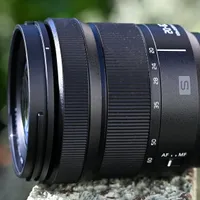
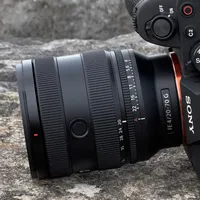
The other factor that impairs compactness is that the lens has an extending inner barrel that adds to the physical length as you stretch from 20mm to 60mm through the zoom range. The net result is that it’s noticeably longer at 60mm than it is at 20mm, as you can see in my product images above and below.

Back on the downsizing trail, one thing that keeps size and weight to a minimum is the inclusion of three aspherical elements in the optical path. Each of them can effectively replace multiple regular elements. The Sigma also includes three SLD (Special Low Dispersion) elements, to enhance clarity and to minimize chromatic aberration.
Autofocus is courtesy of an HLA (High-response Linear Actuator), which is essentially a linear stepping motor by another name. Typical of those used in most modern mirrorless lenses, it enables speedy and accurate autofocus, along with smooth and near-silent focus transitions when shooting video. Furthermore, the lens itself is optimized for video as well as stills, ensuring minimal focus breathing when altering the aperture.

Fitting right in with the ‘keep it simple’ approach of Sigma Contemporary lenses, this one doesn’t feature an AF/MF focus mode switch, nor an aperture control ring. That said, pretty much all of Sigma’s recent full-frame Contemporary prime lenses do actually feature an aperture control ring. Unlike the zoom mechanism, focusing is fully internal so the front element neither extends nor rotates, the latter being a bonus when using filters like circular polarizers and ND grads, as well as enhancing the lens’s overall handling.
Like the aperture rating, the minimum focus distance is variable throughout the zoom range. It kicks off at 0.2m at the wide-angle end and stretches to 0.25m at the telephoto end. This puts close-up photography well within the remit of the lens and its maximum magnification factor of 0.43x is actually attained at an interim focal length of 35mm.

A petal-shaped hood is supplied with the lens so, unlike with budget lenses from some manufacturers, you don’t have to buy it as an ‘optional extra’. It’s well worth the inclusion as it further reduces the risk of ghosting and flare, as well as giving physical protection against knocks and scrapes to the front lens element.

Another typical design feature is that the front lens cap has a pinch-style lock/release mechanism. This makes it possible to fit and remove the cap even when the hood is fitted in its forward-facing orientation, as shown below. A drawstring soft carrying pouch is also supplied with the lens.

Whereas some budget-friendly lenses from various manufacturers including Canon and Nikon feature plastic, rather than metal mounting plates, Sigma resists the temptation. This lens has a sturdy metal mounting plate that features gold-plated electronic contacts and a weather-seal gasket to reduce the risk of dust and moisture entering through the joint between camera and lens. Other weather-seals are incorporated throughout the lens barrel to ensure a dust/splash-resistant overall construction.

Sigma 20-60mm f/2.8-4 DG | C: Performance
It sometimes seems to be a rule of thumb that increasingly ultra-wide-angle lenses suffer from decreasing levels of sharpness towards the extreme edges and corners of the frame – laws of physics and all that. The Sigma surprised me by being very sharp at its shortest 20mm focal length, right out to the edges and corners, significantly easing ahead of the Panasonic S 20-60mm zoom in this respect. For photographic evidence, just check out the image below. And by the way, highly impressive sharpness is maintained across the whole image frame even when combining the widest-angle focal length with the widest aperture of f/2.8.

To give a sense of scale, or at least zoom potential, the sample shots above and below were taken of the same scene from the same vantage point, at the shortest and longest focal lengths of the lens. You’ll see a very substantial difference, although that’s mostly down to the extreme wide-angle ability of the lens rather than any serious telephoto reach. Either way, the 3x zoom range gives you a lot to play with, marginally outstretching the 2.9x zoom range of a 24-70mm standard zoom. In our lab tests, edge/corner-sharpness dropped off a little in the long half of the zoom range but the following test shot looks plenty sharp enough to me, right from edge to edge.

Compared with truly fast prime lenses, the ability to deliver a tight depth of field isn’t one of this zoom lens’s strongest points but it can still do a pretty good job, especially when shooting close-ups. And even so, the variable aperture range is an f/stop or more ‘faster’ than with many zoom lenses, as I mentioned earlier. The shot below is of my granddaughter’s teddy bear against the backdrop of Bristol Docks and shows that background bokeh is entirely feasible and of a pretty decent quality.

The Sigma exhibits good control over color fringing but like many modern lenses for mirrorless cameras, especially those designed with compactness and a lightweight build in mind, it relies fairly heavily on automatic in-camera correction for distortions. When enabled, the correction takes distortions completely out of the equation, as shown in the sample image below.

Sigma 20-60mm f/2.8-4 DG | C: Sample Images
I shot the following gallery of sample images at the floating harbor of Bristol Docks in the UK, on an afternoon of mixed but mostly sunny weather conditions. I used a variety of focal lengths throughout the entire zoom range, at various apertures, to give a good idea of the overall picture.


Sigma 20-60mm f/2.8-4 DG | C: Lab Results
We run a range of lab tests under controlled conditions, using the Imatest Master testing suite. Photos of test charts are taken across the range of apertures and zooms (where available), then analyzed for sharpness, distortion and chromatic aberrations.
We use Imatest SFR (spatial frequency response) charts and analysis software to plot lens resolution at the center of the image frame, corners and mid-point distances, across the range of aperture settings and, with zoom lenses, at four different focal lengths. The tests also measure distortion and color fringing (chromatic aberration).
Sharpness:


Sharpness is highly impressive at the center and intermediate areas of the image frame, throughout the entire zoom range, even when shooting at the widest available apertures. Sharpness at the extreme edges and corners of the frame also bears up particularly well at the most wide-angle zoom setting, less so at mid to long zoom settings at wide apertures.
Fringing:

Color fringing is entirely minimal at the wide-angle end of the zoom range, even out at the edges and corners of the frame. It can be a little more noticeable at mid to long zoom settings but is nevertheless easily within the remit of automatic in-camera correction, which effectively eliminates the appearance of any fringing.
Distortion:

There’s heavy optical barrel distortion at 20mm, minimal pincushion at 35mm and noticeable pincushion distortion in the 50-60mm sector of the zoom range. Bear in mind though that the Sigma is typical of most modern lenses designed for mirrorless cameras with compactness and a lightweight build in mind, relying on automatic in-camera correction for distortions. When enabled, in-camera correction effectively counters distortions at all zoom settings.
Sigma 20-60mm f/2.8-4 DG | C: Verdict
For walkabout, street and travel photography, I often find that I want to squeeze more into the frame than my 24-70mm standard zoom will allow. The result is that I’ll need to carry an additional ultra-wide-angle lens and endure the chore of swapping between lenses more often than I’d like to. I love that the Sigma 20-60mm f/2.8-4 DG Contemporary gives me all the extra viewing width that I crave, without lopping too much off the long end, compared with a more typical 24-70mm zoom lens.
I’m really impressed that Sigma has been able to design this lens with its ultra-wide-angle potential, while delivering excellent image quality in a package that’s refreshingly compact and lightweight. Sure, the inner barrel extends at longer zoom settings but that’s only natural. And although it has a variable aperture rating, it’s faster than is often the case. All in all, I think this Sigma lens is a small wonder, and a bargain at the price.
Features ★★★★☆ |
All the basics are covered but the feature set doesn’t include any fancy frills, like an aperture control ring, customizable function buttons or even an AF/MF switch. |
Design ★★★★½ |
Sigma’s clever design manages to shoehorn plenty of ultra-wide-angle coverage into a compact and lightweight zoom lens that’s well built with a metal mounting plate and multiple weather-seals. |
Performance ★★★★½ |
Autofocus is fast and consistently accurate, ensuring a great hit rate. Image quality is very impressive in all respects, particularly in ultra-wide-angle sharpness. |
Value ★★★★☆ |
The Sigma is pricier than the equivalent Panasonic zoom but is a little faster in terms of aperture rating, and made in Japan rather than China. It’s priced very fairly. |
Overall |
★★★★½ |

Alternatives