Digital Camera World Verdict
Typical of Venus Optics, the Laowa 24mm f/2 Zero-D Tilt-Shift is a specialist lens with plenty of talking points. I love the generous tilt and shift ranges, and the full 360 degrees of axis rotation, so that you can use tilt or shift in both landscape and portrait orientation photography, and anything else that takes your fancy. The 24mm focal length in conjunction with the shift function makes the lens ideal for architectural photography, both indoors and out, complete with a relatively fast aperture. It’s a fully manual lens, but really delivers on image quality and build quality, at a reasonable price.
Reasons to buy
- +
Useful architectural focal length
- +
Tilt, shift & axis rotation
- +
Many mirrorless mount versions
- +
Impressive build and performance
Reasons to avoid
- -
No electronics
- -
No lens-based EXIF data
- -
No DSLR mount options
- -
Handle with care!
Why you can trust Digital Camera World Our expert reviewers spend hours testing and comparing products and services so you can choose the best for you. Find out how we test.
Tilt-shift, or ‘perspective control’ lenses are often regarded as essential tools by architectural and landscape photographers, and more besides. Shift is arguably the killer feature of these lenses, especially for architectural shots. Shoot a tall building from ground level and you’re likely to have to point your camera upwards to fit it into the image frame. This makes the walls appear to lean inwards towards the top. The shift function can correct this, so your verticals stay vertical.
The tilt function shouldn’t be underestimated either. This gives you control over depth of field (of sorts), customizing which areas of a composition are focused or defocused. And that’s independent of focal length, aperture setting and focus distance. It’s all down to the ‘Scheimpflug principle’, Scheimpflug tripping off the tongue as my all-time favorite word in the vocabulary of lenses. Landscape photographers can take advantage, ensuring that everything from the close foreground to the distant horizon stays sharp. At the opposite end of the scale, you can create the trick ‘toytown’ or ‘miniature’ effect, with only a sliver of your composition in focus.

These optics really are amazing tools, so where are all the tilt-shift lenses for mirrorless cameras? Big hitters Canon, Nikon and Sony don’t make any tilt-shift lenses for their mirrorless cameras, and Fujifilm only makes them for its medium-format GFX system. There are still a few Canon and Nikon tilt-shift lenses around that are designed for DSLRs, which you can use via mount adapters. But that puts me in mind of another problem with older Nikon examples of the breed. These had no rotational axis so, for example, you could only use the shift function in landscape orientation and the tilt function in portrait orientation, unless you had the lens reengineered to swap the axes.
With all that in mind, the Laowa 24mm f/2 Zero-D Tilt-Shift that I’m reviewing here looks a very desirable lens for owners of many makes of mirrorless camera. It’s a fully tricked-up tilt-shift lens with 360-degree axial rotation, as well as being the fastest ever 24mm TS lens in the history of the breed. And it’s available in a wide range of full-frame compatible Canon RF, Nikon Z, Sony E and L-mount options, as well as in medium-format Fujifilm GFX and Hasselblad XCD versions. All in all, it aims to be one of the best tilt-shift lenses for mirrorless cameras.
Laowa 24mm f/2 Zero-D Tilt-Shift: Specifications
Mount options |
E, RF, Z, L, GFX, XCD |
Full frame |
Yes |
Autofocus |
No |
Image stabilization |
No |
Lens construction |
13 elements in 10 groups |
Angle of view |
84 degrees |
Diaphragm blades |
14 |
Minimum aperture |
f/22 |
Minimum focus distance |
0.25m |
Maximum magnification |
0.19x |
Filter size |
77mm |
Dimensions |
93x119mm / 3.7x4.7in |
Weight |
860g / 30.3oz |
Laowa 24mm f/2 Zero-D Tilt-Shift: Price
The Laowa 24mm f/2 Zero-D Tilt-Shift costs $1,249 / £1,299 (AU$ TBA). So how does that compare? Well, it’s exactly the same price as the rather excellent Laowa 100mm f/2.8 Tilt-Shift 1x Macro that I reviewed a while ago. The 100mm is less useful for architectural and landscape photography, but the tilt function is definitely a useful add-on to the full macro facility, enabling you to gain some much needed depth of field in extreme close-ups.
Relatively old designs of 24 tilt-shift lenses for DSLRs include the Canon TS-E 24mm II f/3.5L at $2,199 / £2,199 and the Nikon PC-E 24mm f/3.5D ED at $2,197 / £2,199. Both of them are getting on for twice the price of the Laowa. In the medium-format camp, there’s the fabulous Fujifilm GF 30mm f/5.6 T/S but it has a hugely hefty price tag of $4,499 / £3,899. On the face of it, the Laowa looks great value for money.
Laowa 24mm f/2 Zero-D Tilt-Shift: Design & Handling
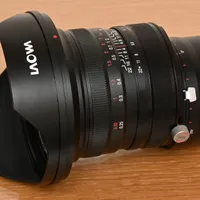
Any tilt-shift lens is something of a mechanical marvel. Watch it go about its business, with the front section of the barrel literally shifting up and down, or tilting at significant angles to the left and right, and it’s a sight to behold. With all the complex couplings and gearings to enable the extensive range of movements, as well as the full 360 degrees of axis rotation in this case, it’s no surprise that there are no tilt-shift lenses that feature autofocus. It’s simply a bridge too far.
On the plus side, accurate manual focusing is relatively easy with mirrorless cameras, as I’ll come back to in a moment. For now, I’ll just say that any tilt-shift lens is quite a handful and can seem pretty tricky to manipulate, but at least the Laowa is relatively compact and lightweight for its type, despite stealing a lead for aperture speed.

Getting back to focusing, the Laowa is typical of manual-focus lenses in having a generous throw in its mechanically coupled focus ring. The ring operates very smoothly and enables very fine and precise adjustments. DSLRs are notoriously troublesome when it comes to accurate manual focusing, lacking the split-image focus screen or microprism of their 35mm film forebears. With mirrorless cameras, however, you can employ focus peaking or a magnified preview (my personal preference) in the viewfinder or rear screen for critical adjustments.

Sometimes classed as a ‘dumb lens’, the Laowa is of the type that has no internal electronics at all. You therefore need to adjust the aperture via the onboard control ring and this can’t be done from a command dial in the host camera body. It also means that you can only effectively shoot in aperture-priority or fully manual modes. Even so, automatic exposure metering is still available. The aperture control ring itself works effectively, with full f/stop click steps all the way from f/2 to f/22. The actual aperture diaphragm is particularly well-rounded, based on no less than 14 blades.

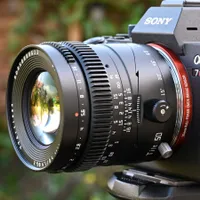
The control rings for aperture as well as focusing are calibrated and clearly marked, with the bonus of depth of field markers at f/4, f/8, f/16 and f/22. That said, DOF markers become largely irrelevant when you employ the tilt function. In its native 0-degree axis rotation, the tilt function directs the forward section of the lens barrel by up to 10 degrees to the left or to the right. The knob for adjustment is up on top in this orientation and clearly marked in single degree increments.

Sticking with the same default orientation, the shift knob is on the left hand side of the lens. 12mm of upward and downward travel is available, totaling 24mm in all. Again, there’s a calibrated and clearly marked scale, this time in individual millimeters with longer marker lines at the central 0mm position and at 5mm increments.

Like all tilt-shift lenses, the Laowa is a precision instrument and you generally need to exercise an equal degree of precision in setting it up effectively. As such, both of the tilt and shift functions have independent locking screws, which are placed directly opposite the control knobs on the other sides for the assembly. You can use these to ensure there’s no unwanted movement in either mechanism after careful setup.

The optical path is complex in its own right, even without putting all of the mechanical adjustments into the equation. There are 13 elements arranged in 10 groups, including two glass molded aspherical elements, five ED (Extra-low Dispersion) elements and four UHR (Ultra-High Refractive) elements. The combination aims to deliver optimum sharpness and clarity, along with the minimum of unwanted aberrations. Those aberrations include color fringing and distortion, and for the latter, the Laowa claims to be a zero-distortion lens.

The lens isn’t really heavy enough to demand a tripod mounting collar but one is supplied anyway, sometimes alternatively referred to as a ‘shift foot’. It’s of more practical use to ensure that the lens stays fixed in position when making shift adjustments. In practice, it’s the camera body that shifts in position, relative to the lens which is fixed in place on a tripod. The tripod collar enables a full 360 degrees of rotation but its calibrated scale only extends as far as 90 degrees clockwise and anti-clockwise.

The more important ‘rotation’ aspect is that the complete tilt-shift assembly can be rotated through 360 degrees in relation to the camera body, rather than just the combined lens and camera rotating as one within the tripod collar. This essentially means that either tilt or shift functions, or a combination of both are available in every conceivable orientation of the lens. The axis rotation function is marked in 45-degree increments, on a scale at the rear of the lens. In most situations, you’d merely be selecting whether to use tilt or shift in either landscape or portrait orientation shooting.

Like the lens, the supplied hood is also pretty trick. It has an efficient petal-shaped profile, and there’s nothing unusual in that. What’s more unusual is that once you fasten the hood in place with its locking screw, you can then rotate it on the front of the lens in 15-degree increments, so it can offset any axis rotation of the lens barrel in relation to the camera body.

The hood is fairly short so I tend to leave it attached to the lens permanently. It’s easy to fit or remove the pinch-style front cap with the hood in place, where it helps to combat ghosting and flare as well as offering physical protection against bumps and scrapes to the front glass element. The only downside is that you need to be careful not to accidentally nudge the hood a click or two in its rotational adjustment, as this can cause severe vignetting in one corner of the image frame when you’re using a large amount of shift.

Moving from front to back, the lens has a sturdy metal mounting plate, in keeping with the metal build of the lens barrel and tilt-shift assembly. With no internal electronics, the physical shape of the mounting plate is the only significant difference between different mount options of the lens, engineered for various types of camera system.

Laowa 24mm f/2 Zero-D Tilt-Shift: Performance
At its core, the lens delivers impressive sharpness, clarity and contrast, along with natural color rendition. Bokeh looks nice and smooth in defocused areas, and remains of good quality when stopping down, helped by the very well-rounded 14-blade aperture. Naturally, some effort is required in manual focusing, as well as applying tilt and/or shift. Both of these adjustments tend to wander unless the locking mechanisms are tightened. I found the rotating petal-shaped hood to be more of a problem, accidental nudges along its rotational click-step path resulting in vignetting when using a lot of shift.

The shift mechanism works as advertised, giving a generous overall range of +/-12mm. For comparison, the image above was taken of the intricate front façade of Wells cathedral in South West England, using no shift at all. Consequently, the camera is pointed upwards to fit the entirety of the architecture into the frame, and the perspective error is clear to see with the outer walls appearing to lean inwards towards the top.

By contrast, the second image immediately above was shot with a few millimeters of shift, sufficient to frame the façade with the camera remaining completely level. The result is that the perspective error is corrected and the outer walls remain parallel all the way up from bottom to top.

Tilt is the other main arrow in the Laowa’s quiver. The +/-10 degrees on tap gives plenty of scope for playing around with areas of a composition that are focused or defocused. The close-up shot above shows the effect of using tilt to align the plane of focus approximately parallel to the side of the model car. Focusing on the front fender, you’ll see that the passenger seat behind the gullwing door is equally sharp, and the back end of the car isn’t too blurry either. For the shot below, I used the opposite extreme of tilt, which throws the plane of focus more at odds with the side of the car. Focusing on the same spot, the passenger seat is now defocused, the back of the car more so. Conversely, the far side of the front of the car has come back into focus. Such is the magic of tilt-shift lenses.

Laowa 24mm f/2 Zero-D Tilt-Shift: Sample Images
The following collection of example shots was taken in and around Wells Cathedral, in the city of Wells in South West England. Most of the images are in pairs, taken of the same subject, first without and then with shift applied for perspective correction. There’s also a couple of pairs with tilt being applied in opposite directions, so you can see the effect that this has on relative areas that are either focused or defocused.


Laowa 24mm f/2 Zero-D Tilt-Shift: Lab Results
We run a range of lab tests under controlled conditions, using the Imatest Master testing suite. Photos of test charts are taken across the range of apertures and zooms (where available), then analyzed for sharpness, distortion and chromatic aberrations.
We use Imatest SFR (spatial frequency response) charts and analysis software to plot lens resolution at the center of the image frame, corners and mid-point distances, across the range of aperture settings and, with zoom lenses, at four different focal lengths. The tests also measure distortion and color fringing (chromatic aberration).
Sharpness:

Sharpness in the central region is excellent, even wide open at f/2. Sharpness is less impressive as you move out towards the corners of frame, but these scores are to be expected from a lens with a relatively short focal length positioned close to our large test chart. Real world corner sharpness is better than these lab results imply.
Fringing:

Fringing is well controlled at all apertures. It is only just visible in real world images, and even then only in the corners of frame.
Distortion: -0.3
There's a trace of barrel distortion, but the lens is still worthy of its 'Zero-D' name.
Laowa 24mm f/2 Zero-D Tilt-Shift: Verdict
As I said in my news piece about this lens, Venus Optics doesn’t really do ‘ordinary’. Most of the company’s catalog comprises oddball lenses, like the Laowa 8-15mm f/2.8 FF Zoom Fisheye, Laowa 24mm f/14 2x Macro Probe and Laowa Aksen 5-10x Ultra Macro APO. This tilt-shift lens is of a similarly ‘off the wall’ nature compared with regular lenses, and actually does a stellar job of photographing walls in an architectural context.
The Laowa has generous tilt and shift ranges, plus a full 360 degrees of axis rotation. The upshot is that you can correct perspective when shooting tall buildings, either inside or out, and use the tilt function to govern which areas of a scene appear focused or defocused within images. The axial rotation completes the picture, enabling either tilt or shift, or both functions, in landscape, portrait or any other orientation you choose to use.
Unlike the Laowa 100mm f/2.8 Tilt-Shift 1x Macro lens, this 24mm lens is pretty much perfect for architectural and landscape photography. The fast f/2 aperture makes it similarly ideal for low-light photography indoors or at twilight, and even puts astrophotography on the agenda. Build quality and image quality are both excellent, making the lens a bargain at the price. Meanwhile, the wide variety of mount options spreads the love.
I found that the tilt and shift mechanisms moved a little too freely for my liking when ‘unlocked’, but that’s what the locking knobs are for. Similarly, the rotating petal-shaped lens hood seemed to have a habit of getting nudged to a random angle, giving rise to vignetting when large amounts of shift were applied. However, if you exercise an appropriate level of care and attention to detail when setting up the lens for tilt-shift photography, it’s capable of delivering excellent results that simply can’t be replicated with a regular lens.
Features ★★★★★ |
Although a manual lens (typical of the tilt-shift variety) the Laowa us fully featured with tilt, shift and 360-degree axial rotation, complete with a class-leading f/2 aperture rating. |
Design ★★★★½ |
The design and build quality are both top-notch. I feel that the tilt-shift mechanisms move a little too freely when they’re not locked in place but it’s an excellent design overall. |
Performance ★★★★½ |
There’s plenty of sharpness on tap, combined with all the tilt, shift and rotation you could wish for, and without any noticeable distortion. |
Value ★★★★★ |
Compared with own-brand tilt-shift lenses, if you can actually find any for your mirrorless camera, the Laowa is excellent value for money. |
Overall |
★★★★½ |

Alternatives