
More photographers are relying on their camera’s performance in low lighting than ever before, thanks to huge advancements in both high dynamic range and high ISO performance, not to mention the game-changer that is AI-powered noise-reduction software. But no camera is infallible when it comes to high-contrast or low-light extremes, and wedding photographers know this more than most.
Dank church interiors, back-lit sunset portraits and receptions that last long into the night mean that wedding photographers simply cannot rely on even the latest camera’s performance in ambient light, entirely. The answer is artificial light and I’m willing to bet that the most commonly used artificial lighting solution for wedding photographers is the humble speedlite (or flashgun) like the Neewer Z2PRO 76Ws TTL HSS Round Head Flash Speedlite. But before I get onto this particular device’s specs, let’s discuss why speedlites are so useful for weddings and events.
Speed and versatility
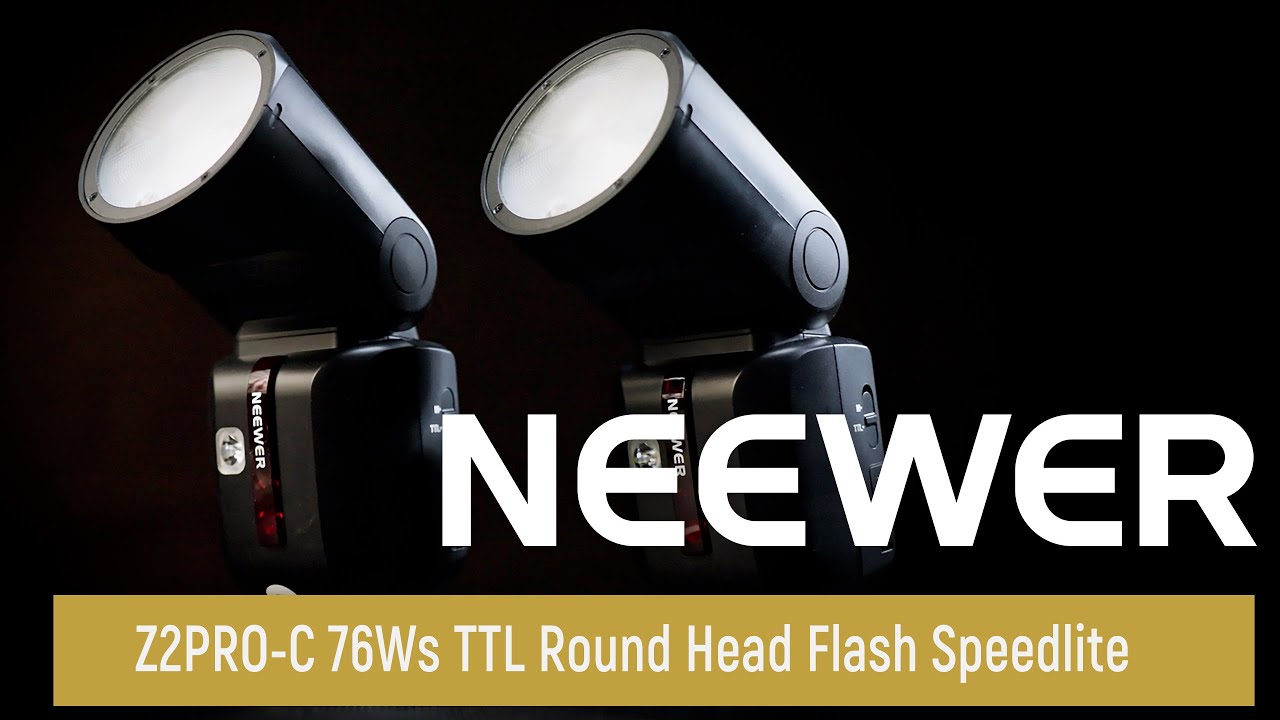
There are two types of artificial lighting: continuous and flash. Increasingly portable and powerful LED light panels and monolights, not to mention the rise of the hybrid video/photo content creator have made continuous lighting extremely trendy. First and foremost, this is because a constant beam of light can be used for photography and videography, whereas flash is only suitable for the former.
But there’s a catch. Continuous lighting simply isn’t as powerful as strobe lighting. This means that highly portable continuous lighting often isn’t powerful enough for bright outdoor conditions, while also having to be placed close to the subject in any situation, in order to provide enough illumination. For wedding, event or even highly mobile commercial photographers, this is problematic.

Getting lights close to the subject can be intrusive, especially during the happy couple’s big day, while the set up time that off-camera lighting requires simply isn’t agile enough for the fast, reactive nature of a wedding or many event situations. And finally, continuous lighting that can provide enough power to be set a little further back, tends to be extremely bulky.
Flash photography fixes both the power and proximity problems, but even highly portable strobes like the Neewer Q120, are designed for off-camera use. This is where the old reliable speedlite comes in. A device such as the Neewer Z2PRO is small enough to be mounted on a camera’s hotshoe, but can still be set up off-camera on a light stand and used with modifiers for controlled setups, such as group portraits.
You might be thinking that direct, on-camera flash has a reputation for producing harsh, flat and overall ugly lighting. And while you’d not necessarily be wrong, a skilled wedding photographer can not only overcome those shortcomings via technique, but the Neewer Z2PRO gives them a helping hand…
Attractive on-camera flash

Most wedding and event photographers will tell you that even flat, on-camera flash is better than a missed moment or a poorly illuminated image. However, the Neewer Z2PRO is built to help reduce your chances of capturing unflattering lighting. Instead of a traditional, rectangular flash head, its rounded head is designed to provide a softer and more natural beam of light. It’s also compatible with the Neewer CRM2 Magnetic Flash Accessory Kit and can be adapted via the CRB1 Adapter to fit Bowens mount light modifiers, enabling you to add a range of accessories such as diffusers, barn doors and a honeycomb grid to further shape the flashgun’s 76Ws output.
A skilled photographer will often angle on-camera flash away from the subject in order to bounce the light off of the ceiling or walls. This avoids a straight-on beam of light hitting the subject, while creating softer and more attractive lighting in the process. The Neewer Z2PRO enables this via its 330-degree swivel and -7 / +120-degree tilt. Another light-boosting feature is the speedlite’s ability to adjust the beam to automatically match focal lengths from between 28-105mm.
And of course, for those highly reactive situations where you simply want to get the shot, this speedlite features TTL, automatically adjusting flash power on the fly. You also get ±3EV compensation, so you can retain control while using TTL, should you need it. To make matters even easier, there’s a physical TTL ‘Quick Switch’ on the side of the device, allowing you to switch between TTL and manual control in an instant. The speedlite also comes with a pair of onboard 2W modelling lights (3300K) so you can preview your lighting or find your focus.
A feature-rich design

The Neewer Z2PRO has a 1.5-second fast-recycling time and supports a flash duration of 1/180 and 1/20,000 sec, with up to 1/8000 sec high-speed sync (HSS). This is an important feature for wedding photographers, due to the popularity of ethereal portraits with shallow depths of field. HSS allows you to add a pop of flash when using wider apertures in brighter conditions, without using an ND filter, which is normally required at standard sync speeds of 1/200 or 1/250 sec. HSS also comes in handy when you want to freeze moments of high-intensity action.
The speedlite’s 3000mAh lithium battery is rated for 600 full-power flashes and features an onboard USB-C port, so you can charge it within the device or remove it for charging externally. So, if you’re embarking on an all-day wedding shoot, you can invest in additional batteries and have them ready to swap in at a moment’s notice.

The beauty of a speedlite is that it’s not just fixed to your camera’s hotshoe, you have the opportunity to pair it with a wireless trigger, so it can be set up on a light stand for off-camera bursts of light. The Neewer Z2PRO can also be used as a transmitter to fire other off-camera flashes. In this capacity, it’s compatible with both Neewer’s Q system and Godox’s X system.
Finally, when it comes to the light’s ‘pro’ moniker, it stands out from the original Z2 thanks to its advanced cooling technology that’s designed to prevent overheating, allowing for 100 consecutive full-power flashes, as well as an upgraded quartz lamp tube that is rated for a lifetime of up to 100,000 flashes.
If you’re a wedding, event or highly mobile commercial photographer, a speedlite is a fantastic lighting solution in a pinch, while also affording you the ability to set up controlled off-camera lighting. And at just 1.27lb / 580g, the Neewer Z2PRO is light enough to become a permanent fixture in your camera bag. The Neewer Z2PRO is priced at $259.99 / £179.99 / AU$299.99 / CAD$259.99 / €259,99.

