







Digital Camera World Verdict
Reasons to buy
- +
12GB unified memory; excellent RAW performance
- +
M4 performance is seriously impressive
- +
Large 13-inch workspace
- +
Portable enough to take on location.
Reasons to avoid
- -
Glossy 600-nit display rather than the Pro's OLED.
- -
Restrictive base storage but expensive upgrades
- -
Still very much Apple pricing
Why you can trust Digital Camera World Our expert reviewers spend hours testing and comparing products and services so you can choose the best for you. Find out how we test.
I've had the pleasure of using the iPad Air M2, and now we have the M4 version to replace the previous iPad Air M3. If you put the three next to each other, you're not exactly going to fall off your chair with excitement. The M4 version still looks like an iPad Air; it's still a thin aluminum rectangle. But inside, it's a rather different story.
The model I tested is the 13-inch iPad Air M4 with 12GB of unified memory. For this review, I'm less interested in how quickly it opens Safari or whether Netflix looks nice. I want to know what happens when you throw proper photography work at one of the best tablets for photo editing.
My main test camera was the Sony A7R V. Its high-resolution RAW files are exactly the sort of thing that can expose the difference between a tablet that feels fast and one that can actually cope with a heavy photographic workload.

So, Let's load the tablet with photographs and start editing. I’m a working creative and lecturer who uses one of the best iPads every day, so I’m in a great position to put the iPad Air M4 through its paces. The biggest question I have is how this latest Air shapes up against the flagship Apple iPad Pro M5 and last-gen Apple iPad Pro M4. Let's find out...
Apple iPad Air M4: Specifications

CPU |
Apple M4 (8 cores) |
NPU |
Apple 16-core Neural Engine |
Graphics |
Integrated, 9 cores |
Memory |
12GB |
Storage |
128GB / 256GB / 512GB / 1TB |
Screen |
13-inch Liquid Retina display 2732 x 2048 resolution |
Ports |
USB-C |
Connectivity |
Wi-Fi 7, Bluetooth 6, (optional Cellular ) |
Size |
280.6 x 214.9 x 6.1mm / 11.04 x 8.46 x 0.24in |
Weight |
616 g / 1.36 lbs (Cellular: 617 g / 1.36 lbs) |
Apple iPad Air M4: Price & Availability
The iPad Air M4 starts at $749 / £749 for the 11-inch model and $949 / £949 for the 13-inch model, both Wi-Fi only and with 128GB of storage. Add cellular connectivity, and you’ll pay $899 / £899 and $1,099 / £1,099, respectively. With storage maxed out at 1TB, each model will set you back $1,349 / £1,349 and $1,549 / £1,549 (Wi-Fi) or $1,499 / £1,499 and $1,699 / £1,699 (cellular).
This is a notable increase over the iPad Air M3, which started at $599 / £599 and $799 / £799 for the 11-inch and 13-inch versions, respectively. However, the consumer tech industry as a whole has been hit with rising costs due to a number of factors, with Apple raising prices across the board.
The iPad Air doesn’t come cheap, but it’s no longer a premium tablet for casual users. As I’ll explain later, its spec list is so good that it’s increasingly closing the gap between Apple’s flagship iPad Pro M5 and can outpace some older generations.
Apple iPad Air M4: Design
There isn't a huge amount to say about the physical design because Apple hasn't tried to reinvent anything. I put this review model next to my older iPad Pro M1, and unless I stop and look properly, they are remarkably similar.
Apple has gotten extremely good at making thin aluminium rectangles, and there probably aren't many more ways of doing it. For photographers, though, the 13-inch format makes a lot of sense, and at 617g, it’s an attractive alternative to the best MacBooks for photo editing if you regularly travel.
Lightroom benefits enormously from the extra screen space compared to the smaller model, and you have room for an image, editing controls and filmstrip (for example). The Liquid Retina display is 2732 x 2048 and color reproduction is excellent. Photographs do look superb on it.

There is, however, an important distinction between this and the current iPad Pro M5 or last-gen iPad Pro M4. The Air doesn't have the Pros' OLED display. It doesn't have the same HDR brightness capability, and there isn't their nano-texture option, which basically is microscopic etching on the glass to scatter ambient light, reducing glare and reflections and preserving image clarity and colour accuracy. So they say!
I've used Apple's nano-texture display since it was released, and once you've got used to reduced reflections, going back to glossy glass is noticeable. Would that stop me editing photographs on the Air? Not at all. If your work revolves around critical HDR grading or you're regularly editing outside in bright sunlight, the Pro display is one of the genuine reasons for spending more money.
In that scenario, you need to try both side by side before committing. The Air tops out at around 600 nits, whereas the Pro can go considerably brighter for HDR content. For my kind of work, that isn’t so important, although it might be the deciding factor for a hardcore photographer.
Apple iPad Air M4: Performance
My review machine is the Space Grey Wi-Fi + Cellular model with 1TB storage. On paper, the 12GB of unified memory is probably the specification photographers should pay particular attention to. My previous Air M2 had 8GB (as did the M3 version), so we're looking at a 50% boost before we even consider the jump in processor performance.
That extra memory doesn't magically make every button in Lightroom work 50% faster – that's not how RAM works. What it gives you is breathing room. Large files, multiple applications, complex edits and big batches of photographs are where that headroom becomes useful.
The Sony A7R V is particularly good at testing it. Its 61-megapixel RAW files aren't exactly tiny. Import a decent batch of them and you very quickly discover whether a device is genuinely comfortable with high-resolution photography or merely pretending. The Air didn't seem particularly bothered.

RAW editing is probably the most important section of the review for me. I imported Sony A7R V RAW files and worked with them in Lightroom, treating the iPad as I would a normal (desk-bound) editing machine rather than deliberately babying it because it's a tablet.
Zooming into 61MP files, making exposure adjustments, recovering highlights and shadows, adjusting color, cropping and moving between images all felt responsive. I wasn't sitting there waiting for the machine. That's probably the biggest compliment I can give it. Once a computer becomes fast enough, you stop thinking about the computer and start thinking about the photograph.
The Air M4 crossed that line very quickly for me. I could move around large RAW photographs, zoom into fine details and make edits without the experience feeling compromised simply because I wasn't sitting in front of my desktop machine.
That 12GB of unified memory is important here, too. I deliberately left other applications running while editing and didn't notice any significant deterioration in performance. You don't need to religiously close everything before opening Lightroom. That's how it should be in 2026.

The Sony A7R V produces the sort of files that would have made tablet photo editing sound slightly ridiculous not that many years ago. Today, it's surprisingly normal. A RAW 61-MP photograph gives you huge amounts of detail, but all of that information has to be decoded, displayed and manipulated every time you make an adjustment.
I deliberately zoomed right into images to check fine detail, focus and noise. Moving around the photographs remained fluid, and the M4 had no obvious difficulty rendering the files. That makes the Air particularly interesting as a location machine.
You can come back from a shoot, connect the camera or card reader, import your RAW files, make a first selection, edit some hero images and potentially deliver photographs without needing to get the laptop out. That's a big change from the early days of the iPad when photography often meant importing a JPEG and pretending that was enough.

Adobe Lightroom for iPad is an obvious starting point, but the bigger story is how mature photo editing on the iPad has become. Photoshop and other editing applications make much better use of the hardware than they did in the past, and the iPad Air M4 has enough performance that the hardware isn't normally the limiting factor.
We're increasingly at the stage where the question isn't: Is the iPad powerful enough? It's: Does the iPad version of my software do everything I need? If a particular desktop feature you rely upon isn't available on iPadOS, another 20% of processor performance isn't going to help you. But when the software supports the workflow, the M4 Air has plenty of horsepower to run it.

I use Affinity Photo on the iPad these days, really for two reasons: cost and combining focus-stacked images. In case you don’t know, focus stacking is a technique where you take several pictures of the same subject, each focused on a slightly different part of it. Software then combines the sharpest areas from each photograph into one image, making everything appear in focus from front to back. It’s perfect for macro work where the focal range is very limited.
This iPad plays well with Affinity software, and importing large sets of images in a stack was simple. I tested JPGs first, and they imported and were processed in seconds. Not ideal with the compression, but a good test. The RAW files did take significantly longer, but it takes a while on a Mac with HeliconFocus or Photoshop, so I was ready for a little wait.
The results were on par with Photoshop outputs. There were the occasional bloom errors where the software couldn’t quite get the correct focus, but this was nothing a few minutes of the clone or heal brush couldn’t solve. Overall, a very pleasant experience and something I’ve started to do on the iPad more frequently since writing this review.

There is, of course, a camera built into the iPad Air M4. It's fine. Spec-wise, you have a 12-MP rear camera with an f/1.8 aperture, autofocus, Smart HDR 4, and 5x digital zoom. The front-facing 12-MP ultra-wide camera has an f/2 aperture and Apple's Center Stage technology.
Both cameras are perfectly adequate for everyday photography, but the iPad's real strength lies in editing photographs rather than taking them. I can't imagine many photographers putting down their mirrorless camera and thinking, hang on, I'll shoot this on the iPad instead. Especially when almost everyone has a very capable camera phone in their pocket.
For me, the iPad's camera is a utility. It's useful for scanning documents, grabbing reference material, video calls, and the occasional quick image. The iPad Air isn't interesting to photographers because it's a camera. It's interesting because of what happens after you've taken the photograph. That's where the M4 chip earns its money.
Storage deserves more consideration for photographers than it perhaps does for most buyers. My test model has 1TB, which is lovely, but it isn't cheap. RAW files from cameras like the A7R V eat up storage remarkably quickly, so I wouldn't automatically buy the cheapest 128GB model if photography is going to be one of the main uses.

The good news is that USB-C makes external storage and card-reader workflows perfectly practical. Photographs don't need to live permanently on the iPad. I want the iPad to be the machine that lets me work with them. There's an important difference.
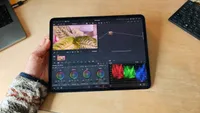
I also edited some video during testing and the results reinforced the same basic conclusion: the iPad Air M4 is no longer a lightweight machine pretending to be powerful. It can handle serious media. I edited 2K footage and a little 4k in LumaFusion, added transitions, audio, and color adjustments, and had no stability problems.
It can also handle ProRes footage, and there are now some serious editing applications, including Final Cut Pro and DaVinci Resolve, available for iPad. I'm still not personally convinced that mobile video editing is always the nicest way of working, but that's a workflow preference rather than a performance problem. The Air coped very well.
I always run Geekbench because it gives me something repeatable to compare between the machines that I've tested. Benchmarks aren't photographs, obviously, and I would never recommend buying a machine purely because one number is bigger than another. But they do explain why editing high-resolution RAW photographs feels so effortless. There's a lot of performance sitting underneath Lightroom.
- Geekbench 6 single-core: 3,712 Multi-core: 13,168 Metal GPU: 53,071
- Compared with my previous M2 Air results, that's roughly a 42% improvement in single-core performance and 44% in multi-core.
- More interestingly, the Metal score jumped from 30,563 on the M2 Air to 53,071 on this machine. The iPad Pro M4 I previously tested scored 53,252. That's close. Really close.
Apple claims up to 10 hours of battery life, although as always, what you actually get depends entirely on what you're doing. Editing RAW files at high screen brightness is obviously rather different from browsing the web. The Air does warm up when you're pushing it. I noticed this much more during demanding video work than ordinary photographic editing, but it never became something I was particularly concerned about.
When it comes to the iPad Air M4's place within Apple's ecosystem, it's becoming a genuinely difficult question. When I reviewed the iPad Air M2, it was the first Air that made me question whether I actually needed an iPad Pro. The iPad Air M4 (and the iPad Air M3 before it) makes that argument even stronger.
For photography, the Pro's biggest advantage isn't necessarily processing power anymore. It's the display. If you need the OLED panel, higher refresh rate, substantially greater HDR brightness, or other Pro-specific features, then there's your answer. But don't buy the iPad Pro M5 simply because you assume an iPad with the word Air on the box won't cope with professional RAW files. It will. My Sony files certainly didn't frighten it.
If you're coming from an older, pre-M-series iPad, the difference is going to be enormous. If you already have an M1 or M2 iPad Pro, things get much more interesting. This Air may actually feel like the natural replacement for it. If you already own an M2 Air, though, I'd keep your wallet in your pocket unless you have a particular reason to upgrade.
The M2 and M3 are still very capable machines in 2026, and externally these things look virtually identical. The other issue is price. My 1TB Wi-Fi + Cellular review model is very much not an entry-level tablet once you start adding accessories. If you're deciding between an Air and a Pro, I'd strongly recommend configuring them side-by-side and asking one simple question: What does the Pro give me that I'm going to use or need? If you've got a good answer, buy the Pro. If you haven't, the Air suddenly makes an awful lot of sense.
Apple iPad Air M4: Final Verdict

The M2 iPad Air changed my opinion of Apple's Air range. The M4 version with 12GB of unified memory pushes things further than its M-chip predecessors. For photographers, this has become a genuinely capable mobile workstation.
My Sony A7R V was a useful reality check. Throwing 61MP RAW files around is considerably more demanding than opening a few holiday JPEGs, and at no point did I feel as though I'd brought the wrong machine to do the job.
I'd still choose the iPad Pro M5 if its superior display was essential to my work. But in terms of raw processing performance, Lightroom editing, image management and general photographic workflow, the gap has become surprisingly small. And perhaps that's the biggest problem for Apple. It's getting increasingly difficult to justify the iPad Pro M5 in a world with the still exceedingly powerful iPad Air M4.
Apple iPad Air M4: Alternatives
Check out our full guide to the best iPads for photographers

