Digital Camera World Verdict
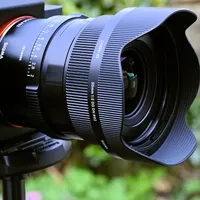
I like that the Sirui Swift 20mm f/2.4 gives an expansive ultra-wide viewing angle, but with a compact and lightweight build. It’s an easy add-on to a camera outfit with a standard zoom lens, giving you a much wider perspective without having to carry a big, heavy extra lens around with you. Landscape and architectural photography are on the lens’s can-do list, as well as vlogging and astrophotography. Although it’s a full-frame compatible lens, the X-mount version of the Sirui is ideal for street photography with APS-C format Fujifilm cameras, on which it has a 35mm ‘effective’ focal length. The price tag is similarly lightweight, making the lens great value for money.
Reasons to buy
- +
Compact and lightweight
- +
Ultra-wide viewing angle
- +
Aperture ring and Fn button
- +
Comprehensive weather seals
- +
Rock-bottom price
Reasons to avoid
- -
No click/de-click switch
- -
No aperture ring lock
- -
Limited mount options
Why you can trust Digital Camera World Our expert reviewers spend hours testing and comparing products and services so you can choose the best for you. Find out how we test.
As I put pen to paper, or at least start tapping away on my computer keyboard, I’ve just finished testing and reviewing three Sirui supports and tripod heads. That’s nothing new to me, as I’ve been reviewing Sirui tripods for a long time now, since the Chinese company launched back in 2001. The camera lens that I’m reviewing here is a much fresher pick from the Sirui product catalog.
Although starting out as a tripod manufacturer, Sirui branched out into anamorphic and cine lenses in 2015, and subsequently started making photographic lighting kits in 2022. Sirui camera lenses for stills as well as video capture are a relatively new departure. I actually reviewed the fast, relatively high-end Sirui Aurora 35mm f/1.4 and Sirui Aurora 85mm f/1.4 a few months ago, both of which are full-frame compatible and available in Sony E (FE), Nikon Z (FX), L-mount and Fujifilm X versions, despite the last of these being an APS-C format system.
The new Sirui ‘Swift’ 20mm and 40mm lenses are again full-frame compatible but are designed for photographers wanting really compact, ultra-lightweight primes. As it turns out, these two lenses are virtually identical in size, weight, and handling characteristics. They’re also ultra-affordable, aiming to offer exceptional value for Sony E, L-mount and Fujifilm X shooters, although there are no Nikon Z versions as yet. Even so, the Sirui Swift 20mm aims to be one of the best wide-angle lenses and best vlogging lenses on the market for those on a tight budget.
Sirui Swift 20mm f/2.4: Specifications
Mount options |
Sony E (FE), L-mount, Fujifilm X |
Full frame |
Yes |
Autofocus |
Yes |
Image stabilization |
No |
Lens construction |
11 elements in 9 groups |
Angle of view |
91.5 degrees |
Diaphragm blades |
9 |
Minimum aperture |
f/16 |
Minimum focus distance |
0.2m |
Maximum magnification |
0.14x |
Filter size |
58mm |
Dimensions |
70x62mm |
Weight |
207g / 7.3oz |
Sirui Swift 20mm f/2.4: Price
Sirui bills this lens as a high-value, entry-grade prime, and the selling price of $149 / £129 / AU$242 is completely in keeping with that. Alternatives include the Sigma 20mm f/2 DG DN Contemporary, which also includes a dedicated aperture ring and is available in Sony E and L-mount versions for $769 / £589 / AU$1,200. As such, the Sigma is much pricier, catering to a more high-end market and featuring an all-metal build, including a metal hood and magnetic front cap.
At a more comparable price to the Sirui, the full-frame compatible Viltrox AF 20mm f/2.8 Air is available in Sony E and Nikon Z mount options and costs $168 / £165 / AU$240. There’s also the APS-C format Viltrox AF 25mm f/1.7 Air, which comes in Sony E, Nikon Z and Fujifilm X mount versions at $179 / £139 / AU$282. However, while they’re extremely compact and lightweight, these Viltrox ‘Air’ lenses have relatively basic handling characteristics, with no AF/MF switch, customizable function button, or aperture ring, making the Sirui look like great value.
Sirui Swift 20mm f/2.4: Design & Handling
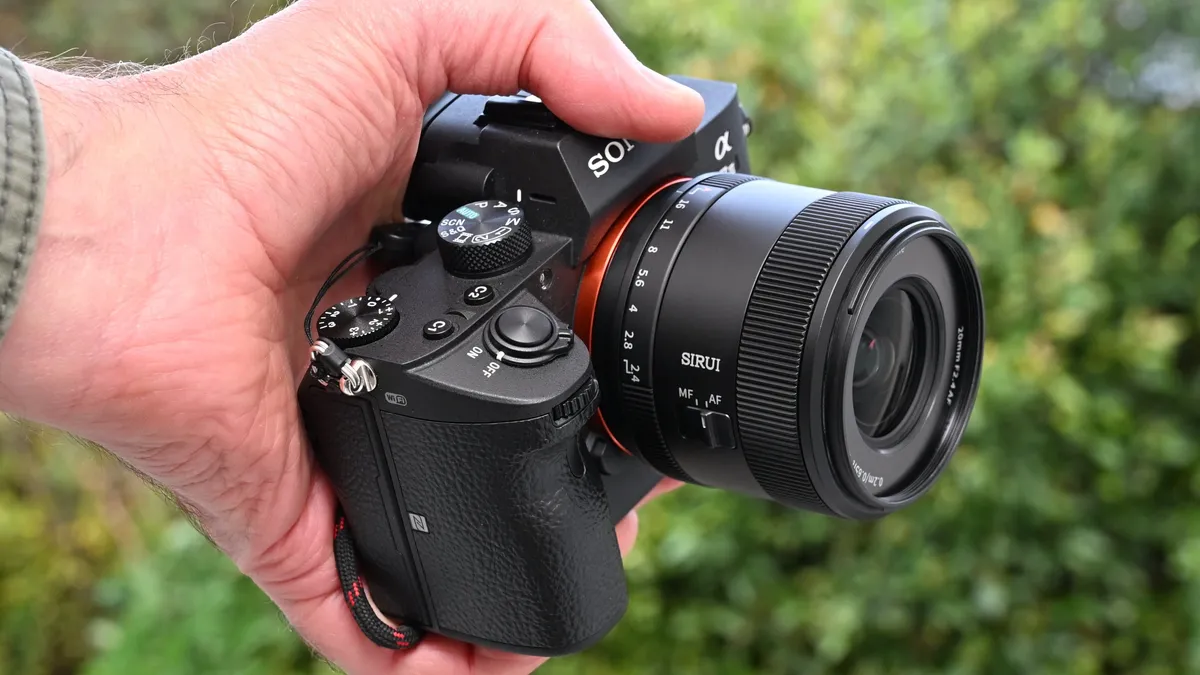
If I had to describe the design and handling of this full-frame compatible Sirui ultra-wide-angle prime lens in one word, it would be ‘compact’. For a two-word description, I’d add ‘lightweight’. It measures just 70x62mm / 2.8x2.4in, weighs a mere 207g / 7.3oz and has a relatively small 58mm filter thread.
By comparison, that Sigma 20mm f/2 lens that I mentioned earlier is getting on for twice the weight, despite being designed as one of Sigma’s relatively small ‘Contemporary’ lenses. For further comparison, the Nikon Z 20mm f/1.8 S is nearly 2.5x the weight at 505g / 17.8oz and has a 77mm filter thread, although naturally the Sigma and Nikon lenses both have a faster aperture rating than the Sirui.
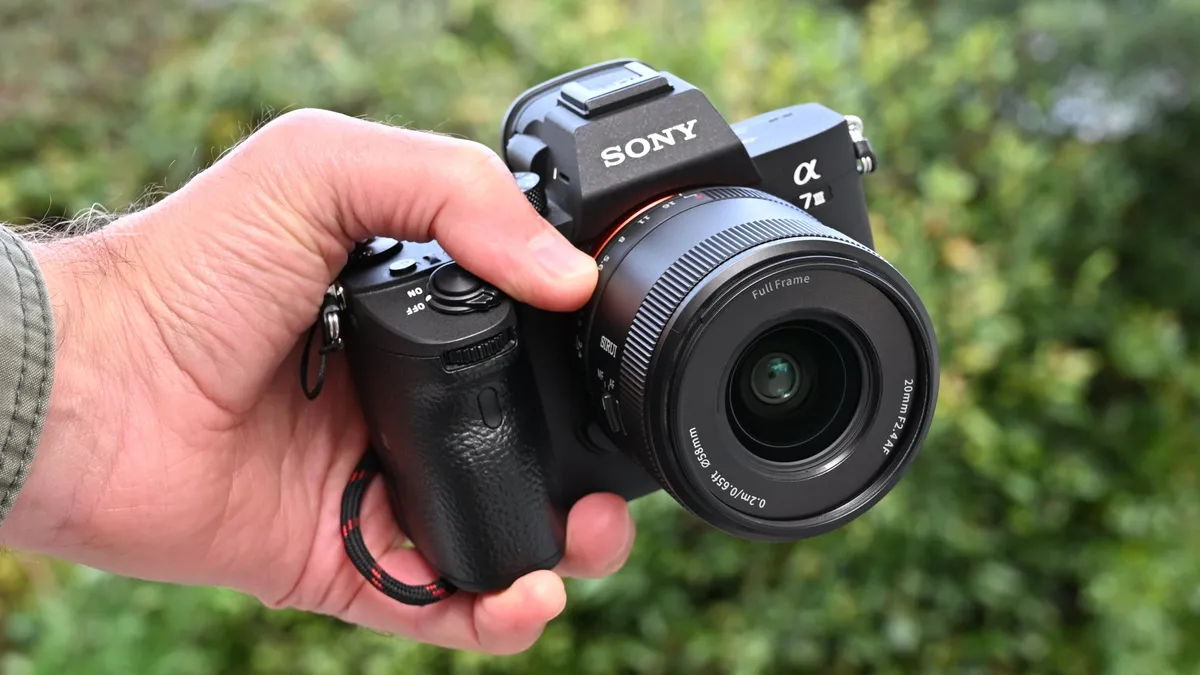
Packed into its diminutive build, there are 11 elements arranged in 9 groups, and they’re all glass elements rather than featuring any plastic in the optical path. Furthermore, the layout includes two aspherical elements, two ED (Extra-low Dispersion) elements, and two HRI (High Refractive Index) elements. Sirui says that the aspherical elements reduce overall weight while correcting spherical aberration and distortion, the ED elements suppress dispersion and chromatic aberration, and the HRI elements boost light transmission and reduce stray light for enhanced contrast and depth. The front element has a fluorine coating to repel moisture and greasy finger marks.
For focusing, the lens features a linear stepping motor. That’s typical of most recent autofocus lenses designed for mirrorless cameras. Advantages include swift performance for stills and smooth, virtually silent transitions when shooting video. The lens is actually designed with video as well as stills in mind, with the intention of keeping focus breathing to a minimum. The minimum focus distance itself is 20cm / 7.9in, as measured from the image sensor at the heart of the host camera body. This results in a maximum magnification factor of 0.14x. Suffice it to say that the Sirui isn’t a ‘macro’ lens but is definitely capable of capturing close-ups, ideal for vlogging if you’re presenting to the camera at arm’s length.
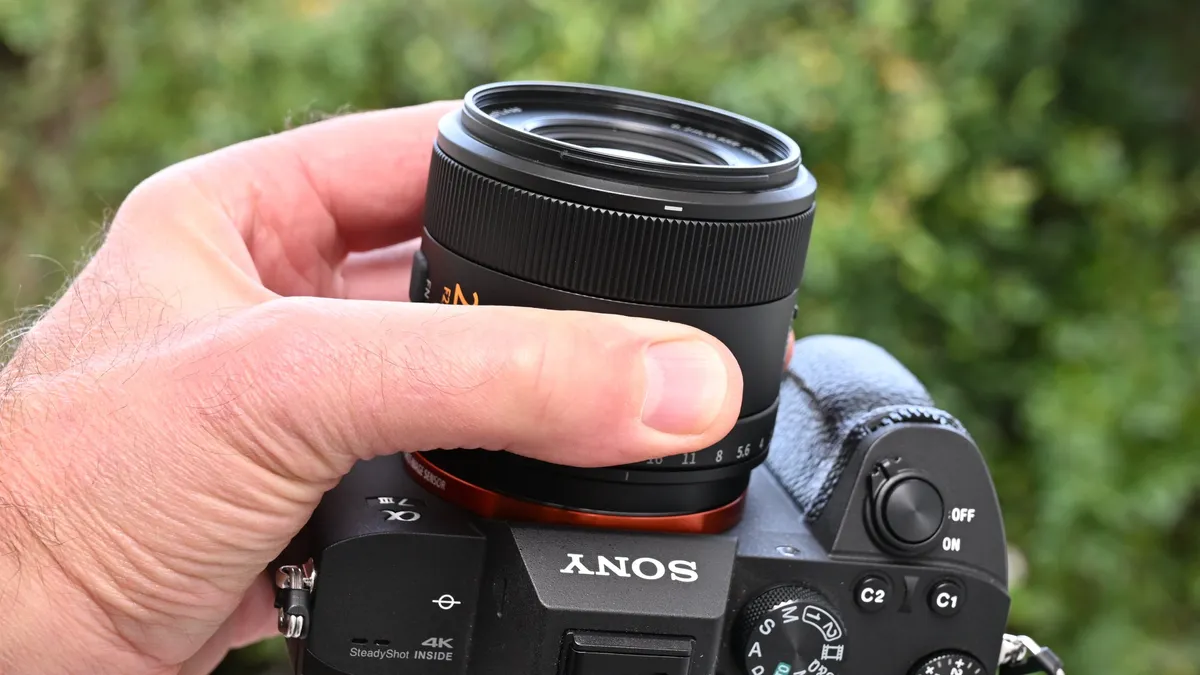
Whereas the even more lightweight Viltrox AF 20mm f/2.8 Air has relatively basic, bare-bones handling characteristics, the Sirui adds some useful extras. First up, there’s an AF/MF (auto/manual focus) mode switch. Unusually, this is positioned on the right hand side of the lens barrel rather than on the left, but I’m pleased to see its inclusion. It enables you to switch modes while keeping ‘in the moment’, without needing to delve into camera menus to make the change.
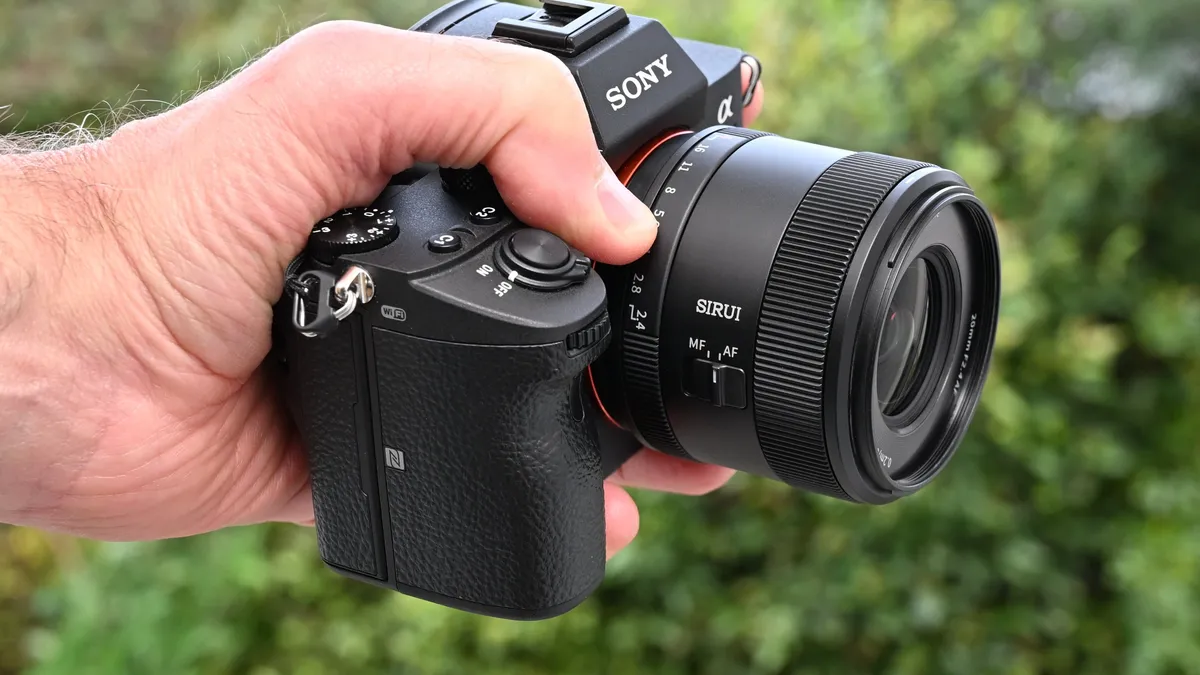
Next up, there’s a customizable function button. More conventional in terms of placement, this is positioned on the left side of the barrel so that it falls naturally under the thumb, at least in landscape orientation shooting. Depending on the camera body, you can assign various functions to the button, but AF-hold is generally a favorite.
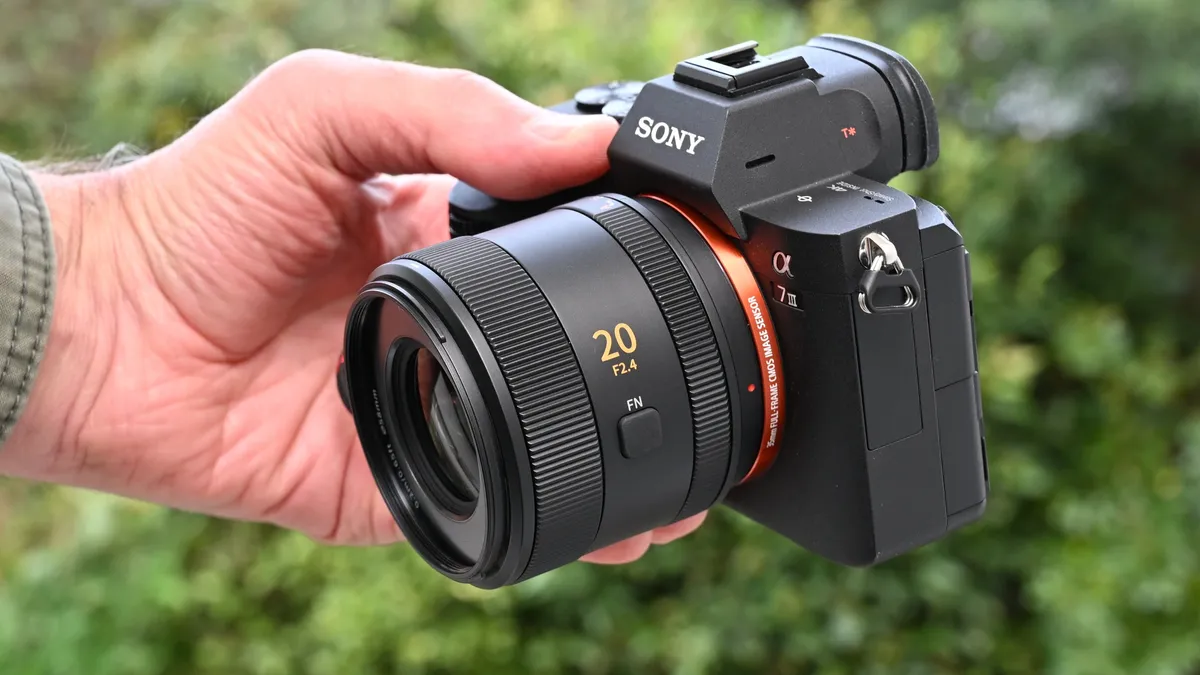
The third handling extra that I’m particularly surprised to see, considering the compact, lightweight build and low-budget price tag of the lens, is a dedicated aperture control ring. It operates in one-third f/stop click steps all the way from the widest to the narrowest apertures of f/2.4 and f/16, respectively.
There’s the usual ‘A’ (Auto) position just off the narrowest end of the aperture scale. This allows for control of the aperture from the host camera and ensures compatibility for Program and Shutter-priority shooting modes.
However, while the aperture ring is a useful addition, it lacks both a click/de-click switch and a locking button for its Auto position. Back on the plus side, the aperture diaphragm is well-rounded, based on nine curved iris blades.
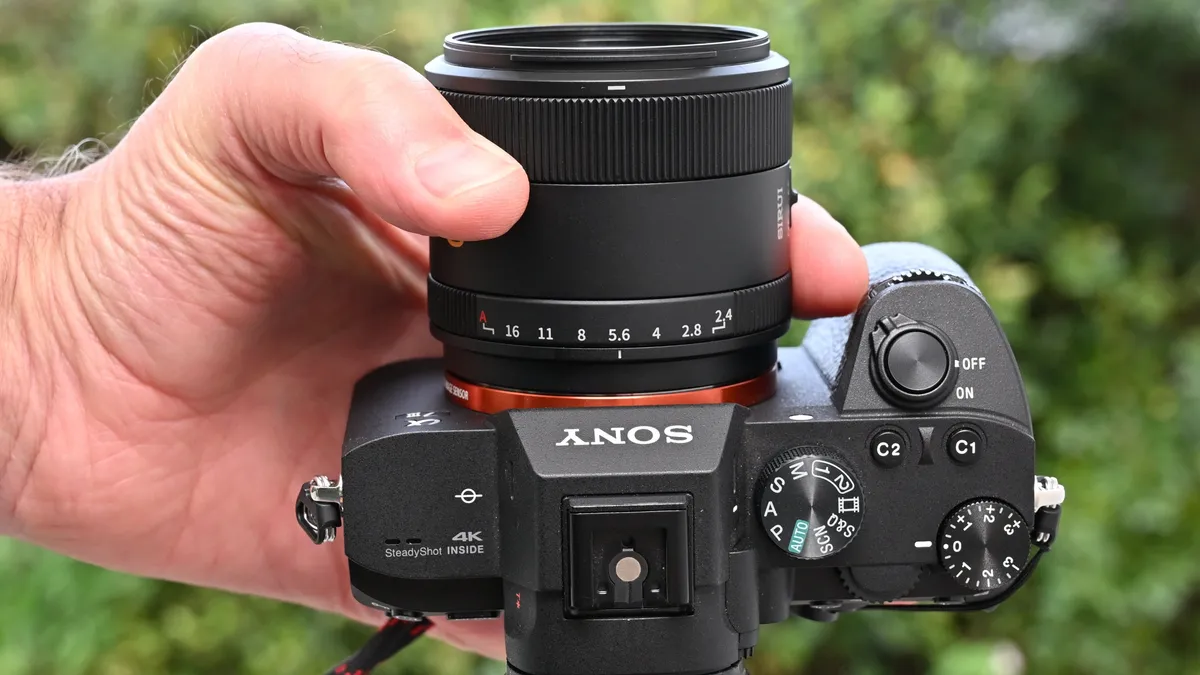
Unlike low-budget lenses from some camera manufacturers, the Sirui comes complete with a hood. In this case, it has an efficient petal-shaped design and the usual bayonet-fixing mount. Also typical of its type, you can reverse the hood when fitting it to the lens for compact stowage.

The hood adds little to the overall length of the lens and, typically for ultra-wide-angle lenses, it’s physically quite short. That said, Sirui supplies exactly the same hood with its 40mm Swift lens.

Something else that’s very typical nowadays is that the lens comes with a pinch-style front lens cap. This enables you to fit or remove the lens cap even when the hood is fitted in its front-facing orientation.

Yet another surprise, considering that the Sirui is so ‘affordable’ to buy, is that it features an extensive set of weather seals around its various joints and switches. These include a rubber gasket on the mounting plate, which itself is made of metal rather than plastic, and features a USB-C port for applying firmware updates, if and when needed.

Ticking the last box on the inclusion list, the lens comes with a neat drawstring pouch for carrying it around. It’s not flimsy but, like the lens itself, has a space-saving, lightweight design. And for adding a little peace of mind, the lens also comes with a three-year warranty.

Sirui Swift 20mm f/2.4: Performance
As with any ultra-wide-angle lens, performance gets off to a good start as soon as you put your eye to the viewfinder (if your camera has one). The truly expansive field of view shoehorns a lot into the image frame, enabling you to literally see the bigger picture for landscape and cityscape shots.
At medium to long focus distances, you also get a big depth of field, courtesy of the short focal length, so that you can keep near and far objects in a scene simultaneously sharp. And the Sirui does this very well. In my real-world tests at medium to narrow apertures, I found that sharpness proved excellent in the central region of the frame and held up pretty well right out to the edges and corners.

Not just for sweeping outdoor vistas, the ultra-wide viewing angle also comes in useful for architectural interiors, when you’re trying to fit everything in and your back is literally up against the wall. The Sirui works well in this scenario as well, demonstrating good control over distortion and color fringing, so that architectural elements don’t take on bloated shapes from barrel distortion, and there’s minimal fringing around high-contrast transitions, like window frames.

Another plus point is that the lens can focus down to very close distances. This gives the opportunity to exaggerate the perspective between foreground and background areas. The reasonably wide f/2.4 aperture also allows for a fairly tight depth of field when shooting close-ups, despite the short focal length, so that you can throw the background out of focus if you desire.

The lens impresses in terms of clarity, contrast and color rendition. I found these facets of image quality remained appealing even when shooting indoors under relatively low ambient lighting levels.

Fairly fast lenses with reasonably wide apertures often suffer from longitudinal or axial chromatic aberration, also known as ‘bokeh fringing’, when shooting at or near their widest available apertures. This shows up as color fringing around high-contrast transitions just in front of or behind the plane of focus. Unlike lateral chromatic aberration, it can occur anywhere in the image frame, rather than generally being limited to the edges and corners. The Sirui does well to keep both types of chromatic aberration under control.

Sirui Swift 20mm f/2.4: Sample Images
The example shots in the following gallery were taken in the English city of Wells, starting at the Bishop’s Palace and Gardens, then moving on to the neighboring Wells Cathedral. There’s a combination of autumnal outdoor shots and architectural interiors, taken at various aperture settings. I used a 33-megapixel Sony A7 V camera body throughout for testing the lens.


Sirui Swift 20mm f/2.4: Lab Results
We run a range of lab tests under controlled conditions, using the Imatest Master testing suite. Photos of test charts are taken across the range of apertures and zooms (where available), then analyzed for sharpness, distortion, and chromatic aberrations.
We use Imatest SFR (spatial frequency response) charts and analysis software to plot lens resolution at the center of the image frame, corners, and mid-point distances, across the range of aperture settings and, with zoom lenses, at four different focal lengths. The tests also measure distortion and color fringing (chromatic aberration).
Sharpness:

Sharpness is very good in the center of frame, and remains so as you move towards the mid frame. Only in the extreme corners does image quality get noticeably softer.
Fringing:

Fringing is just about noticeable in the corners of frame throughout the aperture range, but not distractingly so.
Distortion: -1.19
The lens produces minor barrel distortion.
Sirui Swift 20mm f/2.4: Verdict
The Sirui Swift 20mm f/2.4 ticks a lot of boxes on my wish list. I like to have an ultra-wide-angle lens to hand for landscapes, cityscapes, architectural interiors, and any other time my standard zoom runs out of viewing width. The reasonably fast aperture also puts astrophotography on the remit, while the lens’s close-focusing ability makes it good for vlogging, when you’re presenting to camera at arm’s length. Naturally, the lens doesn’t work out ‘ultra-wide’ in its Fujifilm X mount version, as the APS-C crop factor gives an ‘effective’ focal length of 35mm, making the lens more ideal for the likes of street photography and environmental portraiture.
What I don’t like so much is having to carry around big, heavy additional lenses, especially if I’m only going to be using them occasionally. The Sirui gives me the ultra-wide perspective that I crave, but in a seriously compact and lightweight build. Better still, the actual build quality feels pretty robust for such a lightweight lens, featuring a metal rather than plastic mounting plate and an extensive set of weather seals. Handling extras include an AF/MF switch, a customizable function button, and a dedicated aperture control ring.
Performance is good in all respects. I found autofocus to be swift and consistently accurate. The lens also fares well in terms of sharpness, clarity, contrast, and color rendition, while doing a decent job of suppressing distortion, color fringing, ghosting, and flare. To seal the deal, the Sirui is surprisingly inexpensive to buy and terrific value at the price.
Features ★★★★½ |
As well as combining a 20mm focal length with a fairly fast f/2.4 aperture rating, the lens has an aperture control ring, customizable function button and AF/MF switch. |
Design ★★★★½ |
Refreshingly compact and lightweight, the lens is designed to be very travel-friendly, yet has a sturdy feel to its build quality, complete with extensive weather-seals. |
Performance ★★★★½ |
From fast and consistently accurate autofocus to pleasing image quality in all respects, performance is very satisfying. |
Value ★★★★★ |
Taking the features, design, build quality and performance into account, this full-frame compatible lens is amazingly excellent value for money. |
Overall |
★★★★½ |

Alternatives