



Digital Camera World Verdict
I feel that the Sirui Aurora 24mm f/1.4 needs to deliver something special to make it worth buying, in addition to my existing 24-70mm zoom. And sure enough, while it doesn’t offer anything different in terms of focal length, its f/1.4 aperture rating is a major selling point. It gives me faster shutter speeds under low lighting and greater control over depth of field, along with a host of handling extras and impressive all-round performance. To seal the deal, it’s very good value for money.
Reasons to buy
- +
Impressive image quality
- +
Fast f/1.4 aperture
- +
Click/de-click aperture ring
- +
AF/MF switch and Fn button
Reasons to avoid
- -
Onion ring effect can be noticeable in bokeh disks
- -
Only two mount options initially
- -
Aluminum barrel can feel cold to the touch
Why you can trust Digital Camera World Our expert reviewers spend hours testing and comparing products and services so you can choose the best for you. Find out how we test.
What’s in a name? In mythology, Aurora was the Roman goddess of the dawn, bringing on the sun. It’s more commonly become the name of the colorful light displays that adorn the Earth’s north and south poles. And in the context of Chinese manufacturer Sirui, who originally made their name in tripods, Aurora is a line-up camera lenses catering to hybrid photographers, aiming to be equally adept at capturing stills and video.
First out of the traps were the Sirui Aurora 35mm f/1.4 and Sirui Aurora 85mm f/1.4, which I reviewed a few months ago. There was then a ‘Swift’ departure, and I’ve just reviewed the two new Sirui Swift 20mm f/2.4 and Sirui Swift 40mm f/2.2, which are designed with a more entry-level target in mind, and are incredibly budget-friendly, despite featuring some of the same handling exotica as the Aurora lenses. Getting back on the more high-end Aurora track, there’s the new 24mm f/1.4 that I’m reviewing here, plus a 15mm ultra-wide-angle lens with a slightly slower f/1.6 aperture rating.
Like the original 35mm and 85mm Aurora lenses, the 24mm has been announced in Sony E (FE), Nikon Z (FX), L-mount and Fujifilm X versions. However, the Sony and L-mount editions are first to arrive, and there’s a bit of a wait for the Nikon and Fujifilm versions, scheduled for launch in Q1 2027. To be clear, the lens is full-frame compatible, despite the Fujifilm X-series of cameras being APS-C. Either way, the Aurora 24mm aims to be one of the best wide-angle lenses on the market.

Sirui Aurora 24mm f/1.4: Specifications
Mount options |
Sony E (FE), L-mount, Nikon Z (FX), Fujifilm X |
Full frame |
Yes |
Autofocus |
Yes |
Image stabilization |
No |
Lens construction |
14 elements in 11groups |
Angle of view |
82.9 degrees |
Diaphragm blades |
11 |
Minimum aperture |
f/16 |
Minimum focus distance |
0.26m |
Maximum magnification |
0.15x |
Filter size |
62mm |
Dimensions |
76x106mm / 3.0x4.2in |
Weight |
550g / 19.4oz |
Sirui Aurora 24mm f/1.4: Price
There’s not a massive difference in price between the four Sirui Aurora lenses that have been launched thus far, but the 24mm is the least expensive at $499 / £439 / AU$820. By way of comparison, the E-mount Sony FE 24mm f1.4 G Master is much pricier at $1,598 / £1,159 / AU$1,699 and the slower L-mount Panasonic Lumix S 24mm f/1.8 is still roughly twice the price of the Sirui at $998 / £799 / AU$1,499.
The Sigma 24mm f/1.4 DG DN Art undercuts the Sony lens at $879 / £819 / AU$1,596, but even the slower Sigma 24mm f/2 DG DN Contemporary lens costs more than the Sirui at $719 / £509 / AU$1,100. Both Sigma lenses are available in E-mount and L-mount options but ultimately, the Sirui looks great value for money, if the performance is up to scratch.
Sirui Aurora 24mm f/1.4: Design & Handling
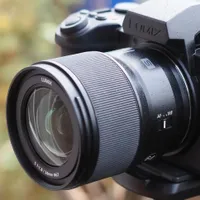
The size and weight of the Sirui are modest for a 24mm f/1.4 prime, measuring 76x106mm / 3.0x4.2in and 550g / 19.4oz. It’s actually a very close match to the other Sirui Aurora 15mm, 35mm and 85mm lenses in the current range, in physical dimensions, weight and handling characteristics. That’s a plus point in that you can swap between different lenses in the line-up and they all feel the same and operate in the same way, rather than putting obstacles in the way of your creative flow.

The optical path is based on 14 elements, arranged in 11 groups. Specialist glass includes three aspherical elements, four ED (Extra-low Dispersion) elements and three HRI (High Refractive Index) elements. The overall aim is for a compact build while still maximizing sharpness, clarity, contrast and color rendition, as well as keeping unwanted aberrations to a minimum. The now typical type of linear stepping motor is used to power both autofocus and manual focusing, the latter via an electronically coupled control ring.

As with Sirui’s other Aurora and Swift camera lenses, this one is designed to cater to both stills photography and videography. Again, the choice of linear stepping motor is a good one, as it enables swift performance for stills, along with smooth and near-silent autofocus transitions when shooting video. The lens is also engineered to minimize focus breathing, so you don’t suffer a change in apparent perspective when altering the focus distance. Handling extras for focusing include an AF/MF focus mode switch and an AF-Hold button. The latter can be assigned to alternative functions, depending on what’s available in the menus system of your host camera body.

The aperture is based on a well-rounded 11-blade diaphragm, which helps to maintain the quality of bokeh when stopping down a little, especially when it comes to the roundness of bokeh disks caused by lights and bright spots. For aperture adjustments, there’s a dedicated aperture control ring on the barrel of the lens, with the usual A (Auto) position for when you want to set the aperture direct from your camera body instead. This is essential when using a camera in Program or Shutter-priority shooting modes.

A little luxury that’s often absent in modern lenses is that you get an iris locking switch. This enables you to lock the aperture control ring in its Auto position, so that you can’t nudge it away from this setting accidentally. I’m all in favor. A little oddly, the locking switch is featured in three out of four current Aurora lenses, but not in the 85mm lens.

Getting back to the hybrid nature of the lens, it features a click/de-click switch for the aperture ring. This gives you the option of precisely controlled aperture adjustments in one-third f/stop click steps, ideal when shooting stills. The alternative is smooth, click-free and relatively silent aperture control, more ideal when shooting video.

The lens comes complete with a petal-shaped hood that has a bayonet-style fitment. Typically, you can mount the hood in its forward-facing orientation ready for action as well as reversing it on the lens for compact stowage. A nice extra touch is that the hood has a locking button to keep it in place, in either orientation.

When mounted on the lens facing forward, the hood helps to minimize the risk of ghosting and flare, as well as protecting the front element of the lens from accidental knocks and scrapes.

Build quality of the lens feels very solid. It has a metal mounting plate and an aluminum rather than plastic barrel. Moreover, the lens features an extensive set of weather-seals to guard against the ingress of moisture and dust. These include a rubber gasket on the mounting plate.

To complete the package, the lens is supplied with a high-quality, padded soft case. It gives good protection to the lens when in transit, and features D-rings at the side for adding a shoulder strap, as well as a Velcro-fastening strap at the rear, so you can hook it over a belt or something similar.

Sirui Aurora 24mm f/1.4: Performance
Although the Sirui Aurora has plenty of neat handling extras, it’s main attractions to my mind are its 24mm focal length and f/1.4 aperture. The wide but not ultra-wide viewing angle comes in useful for expansive vistas but also when shooting in tight, contained spaces, like the interiors of anything from vehicles to real estate properties and architectural spaces on a grander scale.
Meanwhile, the f/1.4 aperture enables usably quick shutter speeds for handheld shooting or for freezing motion, even under very low lighting, without the need to bump up a camera’s ISO setting too far. In my ‘real-world’ tests, mounting the L-mount version of the lens on a Panasonic Lumix S5 IIX camera body, I found sharpness to be impressive, right out to the edges and corners of the image frame.

Despite its fairly short focal length, the lens’s fast aperture allows for a fairly tight depth of field, at least when shooting close-ups. Here, I found that sharpness remained very good when shooting wide-open, while bokeh looked nice and smooth. The well-rounded 11-blade aperture diaphragm helps to maintain circular bokeh disks when stopping down a little.

The only issue with the quality of bokeh that I sometimes encountered was that bokeh disks produced by bright defocused lights sometimes suffered from what’s commonly called the ‘onion ring effect’, displaying noticeable concentric lines within the disks, as shown in the small cropped section of an image below.

Bokeh looks nice and smooth in the defocused background area of this image taken at f/1.4, less so if you enlarge the candle flame.
Image credit: Matthew Richards

This tight crop around the defocused candle flame from upper left shows that the ‘onion ring effect’ can sometimes be noticeable in bokeh disks.
Image credit: Matthew Richards
There’s fairly minimal color fringing, even out at the edges and corners of the frame, and the lens does well to keep distortion down to a low level. That’s a marked difference to many modern lenses designed for mirrorless cameras, which often rely very heavily on automatic in-camera correction for distortion.

Sirui Aurora 24mm f/1.4: Sample Images
The following gallery contains example images that were shot at Wells Cathedral and the adjacent Bishop’s Palace & Gardens, in the country of Somerset in South-West England. I used a Panasonic Lumix S5 IIX camera body and a variety of aperture settings for the lens, catering to interior and exterior shots of different types.


Sirui Aurora 24mm f/1.4: Lab Results
We run a range of lab tests under controlled conditions, using the Imatest Master testing suite. Photos of test charts are taken across the range of apertures and zooms (where available), then analyzed for sharpness, distortion and chromatic aberrations.
We use Imatest SFR (spatial frequency response) charts and analysis software to plot lens resolution at the center of the image frame, corners and mid-point distances, across the range of aperture settings and, with zoom lenses, at four different focal lengths. The tests also measure distortion and color fringing (chromatic aberration).
Sharpness:

Sharpness is very good rather than entirely great when shooting wide-open at f/1.4. Center-sharpness becomes thoroughly excellent when stopping down even very slightly, to f/2, while extreme edge/corner-sharpness follows suit at f/4.
Fringing:

Color fringing can be slightly noticeable out at the extreme edges and corners of the image frame but will generally go unnoticed even with automatic in-camera correction disabled. Switch this on and there’s no visible fringing at all.
Distortion: -0.38
There’s the slightest touch of barrel distortion but you’ll be hard-pressed to spot it in real-world shooting. As with color fringing, it can be completely eliminated by automatic in-camera correction, or when processing RAW files in software that has the correct lens profile.
Sirui Aurora 24mm f/1.4: Verdict
The Sirui Aurora 24mm f/1.4 has a tough act to follow, and the tough act in question is my extremely capable and versatile 24-70mm zoom lens. The 24mm prime doesn’t have quite the same standout benefits of, say, the portraiture potential of the Sirui Aurora 85mm f/1.4, or the stunningly ultra-wide perspective of the Sirui Aurora 15mm f/1.6, that make them more desirable additions to a standard zoom in my kit bag. Even so, the 24mm lens still has a lot going for it.
The main attraction as far as I’m concerned is the relatively fast f/1.4 aperture rating, compared with a standard zoom. It puts a relatively tight depth of field on the menu, at least when shooting close-ups. The faster aperture also enables quicker shutter speeds under low lighting, ideal for handheld shooting and for freezing motion, without bumping up my camera’s ISO setting too much.
Some ‘fast’ lenses leave me cold, because I find their image quality when shooting ‘wide-open’ is somewhat lacking. I feel that can pretty much negate the whole point of a fast prime lens. I’m happy that the Sirui maintains very pleasing image quality even at its widest aperture, delivering very good sharpness, clarity and color rendition, while also efficiently suppressing distortion and color fringing. It also has excellent handling characteristics and build quality, making the lens very good value at the price.
Features ★★★★★ |
High-end features include a fast aperture, AF/MF focus switch, customizable function button, and an aperture control ring with a click/de-click switch and Auto iris lock. |
Design ★★★★½ |
The lens isn’t overly big or weighty and has a robust construction, based on an aluminum barrel and metal mounting plate, complete with extensive weather-seals. |
Performance ★★★★½ |
Image quality combines impressive sharpness and clarity with good control over unwanted aberrations, while autofocus is fast, near-silent and consistently accurate. |
Value ★★★★½ |
The Sirui is very good value for money, especially considering its features, build quality and performance. |
Overall |
★★★★½ |

Alternatives