Digital Camera World Verdict
The Sirui Aurora 15mm f/1.6 has a real wow-factor that becomes immediately apparent when you put your eye to your camera’s viewfinder. The expansive viewing angle shoehorns an awful lot into the frame, ideal for anytime you need a really wide perspective. Meanwhile, the fast aperture makes the lens equally useful day or night, indoors or out. It’s an impressive lens with high-end handling and performance, at a very reasonable price.
Reasons to buy
- +
Ultra-wide perspective
- +
Fast f/1.6 aperture
- +
High-end handling
- +
Good performance
- +
Quality, weather-sealed build
Reasons to avoid
- -
Noticeable vignetting when uncorrected
- -
Only two mount options, initially
- -
Aluminum barrel can feel cold to the touch
Why you can trust Digital Camera World Our expert reviewers spend hours testing and comparing products and services so you can choose the best for you. Find out how we test.
Sirui is a Chinese company that started out making tripods back in 2001. Anamorphic and cine lenses followed in 2015, but more general camera lenses aimed at hybrid stills and video photographers are a relatively new venture. The Aurora line-up started with the Sirui Aurora 35mm f/1.4 and Sirui Aurora 85mm f/1.4, which I reviewed a few months ago, and next up were a brace of Swift lenses, the Sirui Swift 20mm f/2.4 and Sirui Swift 40mm f/2.2 designed to be more compact, lightweight and ultra-affordable ‘entry-grade’ lenses.
The Sirui Aurora 15mm f/1.6 that I’m reviewing here follows suit with the original Aurora lenses, pitched at a more enthusiast-grade market sector than the Swift lenses, packing high-quality glass into an all-metal build. Whereas the original pair, as well as the new 24mm Aurora lens that launched at the same time as this one, have an f/1.4 aperture rating, the ultra-wide 15mm is a wee bit slower at f/1.6, but there’s very little in it.
A bigger difference in the short term is that the original 35mm and 85mm were launched in Sony E (FE), Nikon Z (FX), L-mount and Fujifilm X versions, whereas the 15mm and 24mm lenses are initially only available in Sony E and L-mount versions, with Nikon and Fujifilm editions coming further down the line, probably in Q1 of 2027. Even so, the 15mm aims to be one of the best wide-angle lenses, one of the best vlogging lenses and one of the best lenses for astrophotography on the market.

Sirui Aurora 15mm f/1.6: Specifications
Mount options |
Sony E (FE), L-mount, Nikon Z (FX), Fujifilm X |
Full frame |
Yes |
Autofocus |
Yes |
Image stabilization |
No |
Lens construction |
17 elements in 12 groups |
Angle of view |
109.3 degrees |
Diaphragm blades |
11 |
Minimum aperture |
f/16 |
Minimum focus distance |
0.3m |
Maximum magnification |
0.08x |
Filter size |
77mm |
Dimensions |
82x106mm / 3.2x4.2in |
Weight |
550g / 19.4oz |
Sirui Aurora 15mm f/1.6: Price
The Sirui Aurora 15mm f/1.6 costs $599 / £529 / AU$984. I expect Chinese lenses to offer good value for money and that’s certainly the case here, taking the features and build quality of the lens into account. For the sake of fairly close comparison, the Sony FE 14mm F1.8 G Master weighs in at $1,698 / £1,199 / AU$1,649 and the Sigma 14mm f/1.4 DG DN Art costs $1,839 / £1,499 / AU$2,695. Naturally, both of these lenses are a millimeter shorter in focal length and the Sigma is also faster, but they’re also about two or three times the price.
Unlike the Sirui with its regular 77mm filter attachment thread, both of the Sony and Sigma lenses have integral hoods, which makes it difficult to use the kind of filters that are often favored in landscape photography. Chinese alternatives include the up-market Viltrox AF 16mm f/1.8 at $580 / £530 / AU$999 and the extremely compact, lightweight and budget-friendly (but slower) Viltrox AF 14mm f/4 Air at $199 / £190 / AU$349.
Sirui Aurora 15mm f/1.6: Design & Handling
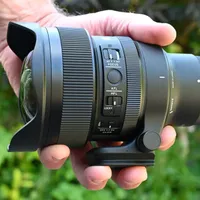
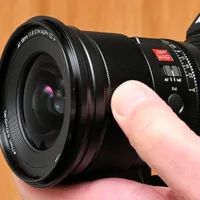
Compared with various ultra-wide-angle heavyweights, the Sirui feels compact, lightweight and easily manageable, despite its fast f/1.6 aperture rating. Talking numbers, it measures a mere 82x106mm / 3.2x4.2in, weighs just 550g / 19.4oz and has a fairly standard 77mm filter attachment thread at the front. That’s a bonus for landscape photography, where you might want to use the likes of an ND Grad or ‘big stopper’ high-density neutral filter. As per the Sigma and Sony lenses I mentioned above, many ultra-wide-angle prime and zoom lenses have built-in, integral hoods that preclude the easy use of filters.

Although small and lightweight for its type, the lens packs no less than 17 optical elements, arranged in 12 groups. These include three aspherical elements, aiming to reduce the overall size while correcting distortion and spherical aberration, three ED (Extra-low Dispersion) elements to enhance clarity and minimize color fringing, and three HRI (High Refractive Index) elements to again enable a compact build while correcting aberrations. Autofocus is taken care of by a linear stepping motor, well suited to both stills and videography, and for the latter, the lens is designed to keep focus breathing to a minimum.

The complete focusing range stretches from 0.3m to infinity. The minimum focus distance of 30cm, or just under 12 inches (as measured from the image sensor in the camera body) enables you to get really close to subjects. This has the benefit of exaggerating perspective, courtesy of the ultra-wide field of view, for creative effect. It also makes the lens a good choice for vlogging, when you want to present to camera while holding it at arm’s length, while also getting a sizeable amount of the background into the frame, to set the scene. Handling extras include an AF/MF focus mode switch and an AF-Hold button, the latter of which can be assigned to different functions depending on the camera body.

The f/1.6 aperture rating has its own advantages. According to Sirui, it ‘theoretically’ transmits about 27% or approximately one-third of an f/stop more light than an f/1.8 lens. This enhances the suitability of the lens for astrophotography, as well as enabling faster shutter speeds under low-lighting conditions, like for shooting architectural interiors in cathedrals, museums and other venues where tripods are prohibited. It also enables a fairly tight depth of field when shooting close-ups, despite the short focal length of the lens. The aperture itself is based on a well-rounded 11-blade diaphragm, which comes complete with a dedicated aperture control ring.

Call me clumsy but I sometimes get into a bit of a pickle with aperture control rings. When carrying cameras around, putting them into or getting them out of bags or backpacks, as well as actually using them, I find it all too easy to nudge the aperture control ring of a lens. It then tends to go from its Auto position, where the aperture is controlled direct from the camera body, to a really narrow aperture that I didn’t want to use. I’m glad that the Sirui features an aperture ring locking switch, which can be used to lock the ring in its ‘A’ (Auto) position.

Further reinforcing the lens’s credentials for videography as well as for stills, the aperture control ring has a click/de-click switch. This gives you the choice of precise, one-third click steps when shooting stills, or smooth, silent and stepless aperture transitions when shooting video.

As I mentioned at the start, the lens has a separate hood, rather than featuring one that’s permanently fixed in place. Typical of hoods for wide-angle lenses, it has an efficient petal-shaped profile. It also has the usual bayonet mounting mechanism that enables reverse fitment of the hood for compact stowage.

Due to the ultra-wide viewing angle of the lens, the hood needs to be physically short to avoid vignetting. It therefore adds very little to the overall physical length of the lens, as shown below.

The lens has a solid, sturdy feel to it, with an all-metal design that combines an aluminum barrel with a metal mounting plate. The mounting plate itself features a rubber weather-seal gasket, just one of an extensive set of weather-seals that are fitted throughout the lens. The mounting plate also hosts a USB-C port, which you can use for applying firmware updates, if and when required.

Everything’s literally wrapped up in a quality soft case that has an attractive design, generous padding and shoulder strap D-rings at the side. There’s also a two-section strap at the rear with a Velcro fastener, which you can use for hanging the soft case on a belt or on an external loop of a camera bag or backpack.

Sirui Aurora 15mm f/1.6: Performance
At the time of writing this review, the Sirui Aurora 15mm f/1.6 had just been launched in Sony E and L-mount options. I tested the L-mount version with a Panasonic Lumix S5 IIX camera body. I found that autofocus was quick, virtually silent and consistently accurate. In out lab tests, ultra-wide-angle lenses often look pretty poor in terms of edge/corner-sharpness and distortion, due to the standard sized test charts needing to be shot at an extremely close distance. Despite this, the Sirui sailed through lab tests for sharpness and I found that it delivered excellent sharpness across the whole image frame in real-world shooting.

The above shot was taken at a medium aperture of f/5.6, whereas the interior shot below was taken wide-open at f/1.6. You’ll see that edge/corner-sharpness holds up well and that clarity and contrast remain good even under relatively low indoor lighting. Vignetting can be noticeable at very wide apertures but automatic peripheral illumination correction is generally available in the camera bodies for which the lens is designed. And to be fair, vignetting is pretty minimal considering the ultra-wide view and fast aperture of this reasonably compact lens.

Comparing the images above and below, you’ll see that the lens delivers a generous depth of field at medium focus distances, even at its widest aperture of f/1.6. That’s thanks to the short 15mm focal length. However, at or near the shortest focus distance of 0.3m, you can get a relatively tight depth of field for blurring the background, and a seriously wide area of background at that, as shown in the image below. The quality of bokeh and roundness of bokeh disks caused by lights and other bright spots is enhanced when stopping down a little, courtesy of the well-rounded 11-blade aperture diaphragm.

I’m impressed by the lens’s control over distortion. Many lenses designed for mirrorless cameras, especially wide-angle lenses that are made with compactness in mind, rely massively on automatic in-camera correction for distortion. You’ll often find that correction can’t even be disabled in the menu system of the host camera body. There’s relatively little distortion from the Sirui, and it also exhibits good control over color fringing.

Sirui Aurora 15mm f/1.6: Sample Images
The following gallery contains example images that were shot at Wells Cathedral and the adjacent Bishop’s Palace & Gardens, in the country of Somerset in South-West England. I used a Panasonic Lumix S5 IIX camera body and a variety of aperture settings for the lens, catering to interior and exterior shots of different types.


Sirui Aurora 15mm f/1.6: Lab Results
We run a range of lab tests under controlled conditions, using the Imatest Master testing suite. Photos of test charts are taken across the range of apertures and zooms (where available), then analyzed for sharpness, distortion and chromatic aberrations.
We use Imatest SFR (spatial frequency response) charts and analysis software to plot lens resolution at the center of the image frame, corners and mid-point distances, across the range of aperture settings and, with zoom lenses, at four different focal lengths. The tests also measure distortion and color fringing (chromatic aberration).
Sharpness:

Sharpness is excellent even when shooting wide-open at f/1.6. Shooting at very close range, to fill the ultra-wide viewing angle with a standard sized lab chart, edge-sharpness still holds up well and becomes excellent at apertures between f/4 and f/11.
Fringing:

Color fringing is absolutely negligible, even out at the extreme edges and corners of the image frame.
Distortion: -2.89
As with edge-sharpness, close-range shooting of standard sized test charts makes distortion look rather worse than it tends to be in real-life shooting. Even so, barrel distortion is of a relatively low order, with very little reliance on in-camera correction, compared with most modern wide-angle lenses.
Sirui Aurora 15mm f/1.6: Verdict
The Sirui Aurora 15mm f/1.6 gets a big thumbs up from me. I love its seriously expansive field of view, coupled with its fast f/1.6 aperture. The combination makes the lens a real go-to prime for ultra-wide-angle shots day and night, and in-between. It works really well for grand vistas in landscape and cityscape photography, and shoehorns a lot into the frame for architectural interiors. The addition of a short minimum focus distance puts handheld vlogging on the menu, and the fast aperture comes into its own for astrophotography.
I also love that the Sirui is easily manageable with a compact, lightweight build, but that its still strongly built with an all-metal, weather-sealed construction. That said the aluminum barrel can feel quite cold to the touch in chilly weather. The design also features plenty of handling exotica, including a dedicated aperture control ring with an iris lock and click/de-click switch, plus an AF/MF focus mode switch and customizable function button.
Last but definitely not least, performance is impressive, from fast and consistently accurate autofocus to lovely image quality in all respects. It’s sharp with good clarity and color rendition, along with effective control over distortion, color fringing, ghosting and flare. All in all, this Sirui is a very appealing lens at a very attractive price.
Features ★★★★★ |
Desirable features include an ultra-wide perspective, fast aperture, AF/MF focus switch, customizable function button, and an aperture control ring with iris lock and click/de-click switches. |
Design ★★★★½ |
Strong build quality is based on an aluminum barrel and metal mounting plate, complete with extensive weather-seals, and a separate hood that allows for a filter attachment thread. |
Performance ★★★★½ |
Autofocus is fast, accurate and near-silent. Image quality combines impressive sharpness and clarity with good control over unwanted aberrations. |
Value ★★★★½ |
It’s very good value for a feature-rich lens of this quality and performance. |
Overall |
★★★★½ |

Alternatives