




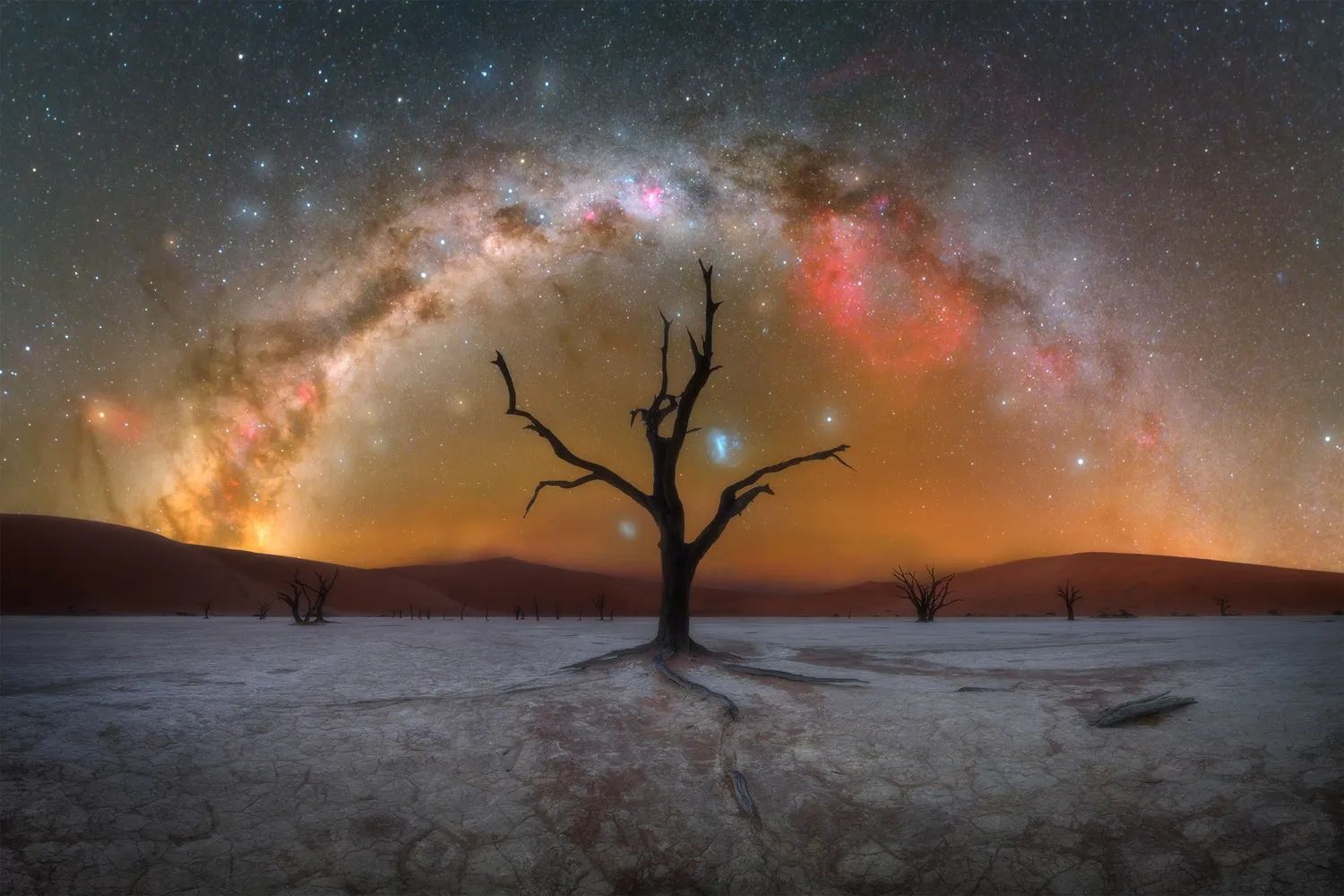
If you’re a landscape photographer and make your way to Deadvlei, one of Namibia’s most famous landscapes, you’re in for a treat. A white clay pan ringed by towering red dunes and dotted with blackened, long-dead camel thorn trees, it’s quite an incredible sight.
There’s just one problem: you’re not supposed to be there when it gets dark.
Deadvlei sits inside Namib-Naukluft National Park – and day visitors must leave by sunset. Even guests staying inside the park have to be back through the inner gate an hour after sunset, long before the sky is dark enough for the Milky Way.
That’s what makes the picture above, Deep Roots by Alexander Seleznyov, so arresting.
We see the majestic arc of the Milky Way, glowing with pink and red nebulae, spread across the sky from dune to dune, with a single dead tree right beneath it. No wonder it won gold in the Non-Professional Landscapes category of the 1839 Awards 2026.
So how did the Israel-based photographer manage to shoot it? By his own admission, he “cheated”.
Planning the impossible
“Park authorities strictly prohibit staying in Deadvlei after dark, so you have to cheat,” he explained in his statement for the Global Lens awards, which had previously honored the picture.
“Either by breaking rules, manipulating photos, or leaving a camera behind and hoping for the best.”
In his case, Seleznyov relied on planning rather than luck.
“Thankfully, modern night-sky tracking apps allow you to precisely predict where the Milky Way will align over the trees,” he says. “Even if it’s a bit of post-processing magic, it brings a dream vision to life.”
This particular image, he says, relies on “precise astronomical forecasting and multi-exposure planning”. In other words, that means this is a carefully built picture rather than a single frame.
“You don’t take a photograph, you make it,” he wrote, quoting Ansel Adams, when he shared it on Instagram.
“This may well be my strongest work to date, though that took a while to sink in,” he says of the photo, which is dated May 17 2026. “My serious shots usually end up as desktop wallpaper: that’s the best way to spot mistakes and see where to grow.”
For this one, he says, the longer he looked, the more he fell in love, adding that it had taken him four years to beat his previous best. “How long will the next one take, and what shot will that be?”
Deep Roots is one of dozens of category gold winners announced by the 1839 Awards, which is named after one of the most formative years in photography’s history.
The top honors went to Giacomo Marchione, named International Photographer of the Year for The Invisible, a series about the nightly vertical migration of plankton, and Dammy Twitch, named International Discovery of the Year for What If We Lived Among Gods, a medium-format film series that blends myth with everyday Nigerian life.
You can see all the winning images on the 1839 Awards website.
You might like...
Looking for competitions to enter? Here are 10 global photo contests now open for entries from November 2026 to January 2027.

