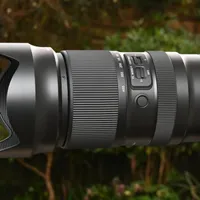
Digital Camera World Verdict
I love that the Sony FE 100-400mm f/5.6-8 OSS is so much more compact, lightweight and affordable than the other two 100-400mm zooms in Sony’s current catalog of E-mount lenses. It’s a joy to use for pain-free handheld shooting, even for long periods of time, with mostly sharp image quality helped along by fast, accurate autofocus and effective optical stabilization. However, edge-sharpness could be better and downsizing comes at the expense of a relatively slow long-zoom aperture rating.
Reasons to buy
- +
Fast, accurate autofocus
- +
Optical image stabilization
- +
Impressive center-sharpness
- +
Compact and lightweight
- +
Great value for money
Reasons to avoid
- -
Modest long-end aperture
- -
Mediocre edge-sharpness
- -
Extending inner barrel
Why you can trust Digital Camera World Our expert reviewers spend hours testing and comparing products and services so you can choose the best for you. Find out how we test.
Think Sony FE 100-400mm super-telephoto zoom lenses and if you’re like me, you’re thinking of ‘great whites’ with a big, hefty build and similarly heavyweight price tags. The white paint job aims to minimize the sun-induced build-up of heat in these big lenses, while their Gold Master designs aim to go large on build quality, handling exotica and all-round performance. That’s all very well if you have strong arms to handle the load, and deep pockets to make the purchase. However, we don’t all fall into either or both of those categories.
Independent lens makers have come to the market with more compact, lightweight and affordable alternatives. An appealing option is the Sigma 100-400mm f/5-6.3 DG DN OS | C, which measures 86x199mm / 3.4x7.8in and weighs in at 1,140g / 2.51lb. Then there’s the Tamron 50-400mm f/4.5-6.3 Di III VC VXD, which is physically shorter and lighter at 89x183mm / 3.5x7.2in and 1,115g / 2.46lb, despite having a greater overall zoom range. Even so, the new Sony lens that I’m reviewing here seriously undercuts both third-party options with a size of 78x165mm / 3.1x6.5in and a relatively featherweight 654g / 1.44lb build.
The Sony is two-thirds of an f/stop slower at the long end than the Sigma and Tamron lenses, which helps with downsizing to some extent, but there’s more to it than that. Cutting-edge design aims to make the Sony one of the best 100-400mm lenses on the market, as well as one of the best telephoto lenses for Sony cameras, especially for the budget-conscious and lovers of lightweight lenses.

Sony FE 100-400mm f/5.6-8 OSS: Specifications
Mount options |
Sony E (FE) |
Full frame |
Yes |
Autofocus |
Yes |
Image stabilization |
Yes |
Lens construction |
15 elements in 10 groups |
Angle of view |
24-6.2 degrees |
Diaphragm blades |
9 |
Minimum aperture |
f/32-45 |
Minimum focus distance |
1.13m (W) 0.86m (T) |
Maximum magnification |
0.41x |
Filter size |
67mm |
Dimensions |
78x165mm |
Weight |
654g / 1.44lb |
Sony FE 100-400mm f/5.6-8 OSS: Price
What price an own-brand Sony 100-400mm super-telephoto zoom? At $849 / £799 / AU$1,399, the FE 100-400mm f/5.6-8 OSS only costs about a third or even a fifth of its more glamorous G Master siblings. Indeed, the long-standing, stalwart Sony FE 100-400mm f/4.5-5.6 GM OSS costs $2,798 / £2,149 / AU$3,289, whereas the newer, constant-aperture Sony FE 100-400mm f/4.5 GM OSS is a seriously big-money option at $4,298 / £4,399 / AU$6,899.
As it turns out, the budget-friendly Sony lens also costs less to buy than the independent Sigma 100-400mm f/5-6.3 DG DN OS | C (Australia aside) at $1,049 / £899 / AU$1,377, and the Tamron 50-400mm f/4.5-6.3 Di III VC VXD at $1,299 / £999 / AU$1,899. It’s actually very similar in size, weight, aperture rating and price to the popular Canon RF 100-400mm f/5.6-8 IS USM, which sells for $749 / £799 / AU$1,319. However, there’s a bit of a sting in the tail with the Canon lens, in that the ET-74B hood is sold separately, at a pricey $50 / £76 / AU$90, whereas the Sony comes complete with a hood. All in all, it looks quite the bargain.
Sony FE 100-400mm f/5.6-8 OSS: Design & Handling
Let’s get a sense of perspective. Without wanting to labor the point, this is a seriously small and featherweight lens for a full-frame compatible 100-400mm zoom. It actually looks and feels more like the 70-300mm lenses of old. Weighing less than 1.5lb, it’s easy to carry and a doddle to use on both full-frame and APS-C format Sony mirrorless cameras. On the latter it has a boosted ‘effective’ zoom range of 150-600mm, and the same applies if you select APS-C crop mode on a full-frame camera. Getting back to that sense of perspective in terms of size, the lens has a relatively small 67mm filter attachment thread, compared with the Sony FE 100-400mm f/4.5 GM OSS that has a massive 95mm filter thread at the front, plus a 40.5mm drop-in filter holder at the rear.

If you feel the need to boost the telephoto reach of the lens with or without switching to APS-C crop mode or using an APS-C format camera body, the lens is compatible with Sony’s E-mount 1.4x and 2.0x tele-converters. The usual catch applies however, in that you’ll suffer a 1-stop or 2-stop aperture reduction, respectively. At the long end of the zoom range, a resulting f/11 aperture might not be an insurmountable problem with the 1.4x tele-converter, but f/16 with a 2.0x tele-converter might feel a bridge too far.

Before we get too carried away with how small the lens is, it’s important to bear in mind that it has an inner barrel that physically extends as you zoom from 100mm to 400mm. The overall extension is considerable as you stretch towards the 400mm mark. The images above and below show the difference in operating length at the shortest and longest zoom settings, respectively.

The action of zooming is taken care of by a conventional rotary control ring. It works smoothly without any stiff spots or jerkiness, enabling easy-gliding, precise control. It also has a calibrated scale, marked off at 100mm, 135mm, 200mm, 300mm and 400mm focal lengths.

Diving right in, the optical path comprises 15 elements arranged in 10 groups. These include two large aspherical elements at the front and two ED (Extra-low Dispersion) elements further back, aiming to enhance clarity and reduce both size and unwanted aberrations. The elements moved for focusing are also towards the rear, which helps with speed and efficiency, as well as ensuring that the front element neither extends nor rotates during focusing. That’s a bonus for handling and makes rotation-specific filters like polarizers and ND grads easier to use.

Autofocus is driven by dual linear stepping motors. As well as aiming for speed and accuracy when shooting stills, the system enables smooth and near-silent operation when shooting video. The minimum focus distance is unusually shorter at the maximum rather than minimum focal length, equating to 1.13m at 100mm and shrinking to 0.86m at 400mm. This enables a generous maximum magnification factor of 0.41x at 400mm, standing at the gate of genuine macro territory.
Keeping a lock on autofocus, most up-market 100-400mm lenses often have a rank of four customizable AF-hold buttons towards the front, whereas some lenses in this price bracket have none at all. The Sony compromises by featuring a single customizable function button, to which most photographers would assign the option of AF-hold.

Another difference between this lens and Sony’s real high-flyers is that there are relatively few switches at the rear. You still get a pair of useful switches on the left hand side. One neatly combines access to AF/MF (auto/manual focus) modes with an additional position for an autofocus range limiter. When engaged, this locks out the autofocus distances shorter than 3 meters, or just under 10 feet.
The other switch is for optical steady-shot on/off. While handy to have, it lacks the additional options often featured in more up-market lenses, like switchable static/panning modes and a tertiary mode that helps with tracking erratically moving objects.

As I’ve mentioned, there’s a smooth action to the zoom control ring. That’s despite there being no hint of zoom creep. I found that I could shoot at extreme upward or downward angles with zero movement of the extending inner barrel. Even so, the lens features a zoom lock switch on the right hand side of the barrel, which is useful to keep it locked in its shortest configuration while carrying it around, if it’s mounted on a camera body that’s slung around your neck or over your shoulder.

Nearly all Canon lenses that don’t make the company’s luxurious (expensive) L-series cut are supplied without a hood, and you have to buy one separately as an ‘optional extra’. I’m pleased to see that Sony supplies a hood with the lens. Typical of super-telephoto lenses, the companion hood has a circular rather than petal-shaped profile.

The hood fits to the lens via the usual bayonet-fit mechanism and can be reversed on the lens for compact stowage. To be effective, hoods for telephoto lenses need to be comparatively long, as this one is. As well as minimizing ghosting and flare, the hood gives physical protection against knocks and scrapes to the front optical element.

Weather-seals used to be a real rarity on budget-friendly lenses but are now featured much more frequently. The Sony has a sturdy metal rather than plastic mounting plate, along with a rubber gasket which is one of several weather-seals fitted throughout the lens. Despite the extending inner barrel, the lens has good built-in protection against the ingress of moisture and dust.

Sony FE 100-400mm f/5.6-8 OSS: Performance
From a performance standpoint, the lens has plenty of pulling power, stretching to serious telephoto reach at its longest zoom setting. The overall zoom range of 100-400mm makes for excellent versatility with both full-frame and APS-C format cameras. In our real-world tests and under laboratory conditions, we found center-sharpness in the 100-300mm sector of the zoom range to be very good, even shooting wide-open at f/5.6. Indeed, lab test results for center-sharpness were slightly better than those we recorded for the pricier Sony FE 100-400mm f/4.5-5.6 GM OSS lens, within the same 100-300mm range.

The images above and below demonstrate the comparative telephoto reach when stretching from the shortest to longest available zoom settings. There’s a slight dip in center-sharpness at the long end of the zoom range but even here, the lens matches the lab results of the pricier lens mentioned above. There’s a caveat, however, as sharpness is less impressive away from the central region of the frame. It’s merely average in the ‘middle’ area surrounding the central region and becomes comparatively mediocre out at the edges and corners of the frame.

Autofocus speed is swift, able to snap onto subjects very quickly and track moving targets effectively. Although it doesn’t have the super-fast quad XD (extreme dynamic) linear motors of the top-end Sony FE 100-400mm f/4.5 GM OSS, Sony says that the dual linear motors featured in this lens are compatible with burst shooting at up to 120fps, when mounted on the Sony A9 III camera body. I found that autofocus also worked well in conjunction with the various subject recognition and tracking options of the Sony A7 V.

An unexpected bonus is that the lens has a pretty short minimum focus distance for its class, especially towards the long end of the zoom range. This enables comparatively close-up shooting, with a maximum magnification factor of 0.41x. As such, small objects can be reproduced on the image sensor at nearly half life size, enabling huge enlargements when viewing the resulting images on screen or in print.

In my tests, I stuck to using the widest available apertures nearly all of the time. I think that wide-open performance is a crucial factor, simply because the aperture rating of this lens is fairly ‘slow’ at f/5.6-8. Super-telephoto zooms are favored for action, sports and wildlife photography, which often demand fast shutter speeds to freeze motion. With that in mind, I wouldn’t generally want to go narrower than the widest apertures this lens has to offer, otherwise I’d have to start bumping up my camera’s ISO setting in anything other than bright sunlight.
On the plus side, while f/8 is only a medium aperture width, its combination with a focal length of 400mm does enable quite a tight depth of field when shooting at anything less than long focus distances. The resulting bokeh in defocused areas looks pleasantly soft.

The lens exhibits good control over color fringing and distortion, which look pretty negligible even with automatic correction disabled. With in-camera correction applied, these aberrations become complete non-issues.

Sony FE 100-400mm f/5.6-8 OSS: Sample Images
The example shots in the following gallery were taken in the English city of Wells, in and around the Bishop’s Palace and Gardens. Autumnal weather conditions ranged from overcast to direct sunlight. I used the widest available apertures throughout, coupling the lens to a 33-megapixel Sony A7 V camera body for testing.
If you’re feeling particularly eagle-eyed and fancy a quick game of ‘spot the difference’, some of these images were taken in pairs, at the shortest and longest zoom settings, for the sake of comparison.


Sony FE 100-400mm f/5.6-8 OSS: Lab Results
We run a range of lab tests under controlled conditions, using the Imatest Master testing suite. Photos of test charts are taken across the range of apertures and zooms (where available), then analyzed for sharpness, distortion and chromatic aberrations.
We use Imatest SFR (spatial frequency response) charts and analysis software to plot lens resolution at the center of the image frame, corners and mid-point distances, across the range of aperture settings and, with zoom lenses, at four different focal lengths. The tests also measure distortion and color fringing (chromatic aberration).
Sharpness:


Even when shooting wide-open, center-sharpness is excellent in the 100-300mm sector of the zoom range and only drops off a little at the longest focal length of 400mm. Wide-open sharpness is an important consideration, due to the modest f/5.6-8 aperture rating of the lens. Away from the central region, sharpness is merely average, and becomes fairly mediocre at the extreme edges and corners of the frame.
Fringing:

Color fringing peaks at the 300mm zoom setting but remains pretty negligible and will usually be hard to spot, even out at the edges and corners of the image frame. It’s entirely within the remit of automatic in-camera correction, which eliminates lateral chromatic aberration completely.
Distortion:

Unusually for telephoto zoom, the Sony exhibits mild barrel distortion rather than pincushion at most focal lengths, apart from at the 200mm mark where there’s very minimal pincushion. Distortions at all zoom settings are fairly minimal with little reliance on automatic in-camera correction.
Sony FE 100-400mm f/5.6-8 OSS: Verdict
There’s a lot to love about the Sony FE 100-400mm f/5.6-8 OSS but the thing I love most is that there’s so little of it. It’s amazingly small and a relative featherweight for this type of super-telephoto zoom lens. Indeed, I’ve had standard 24-70mm zoom lenses that weighed nearly twice as much. The upshot is that the lens is easy to carry and a joy to use, for even long periods of handheld shooting.
The aperture rating of f/5.6-8 is relatively sluggish but optical steady-shot does well to ensure a good hit rate, even with fairly slow shutter speeds, especially when working in tandem with the in-body stabilizers of recent Sony cameras. However, you’ll often find that you need to bump up your camera’s ISO setting to enable sufficiently fast shutter speeds for freezing action, rather than overcoming camera-shake. Ultimately, the modest aperture rating is simply the price you pay for the relatively compact and lightweight build.
And sticking with ‘the price you pay’, the lens is remarkably affordable for an own-brand Sony 100-400mm lens, also undercutting the cost of competing Sigma and Tamron 100-400mm zooms, in most world regions. The Sony’s handling, weather-sealed construction and performance are impressive in almost all respects, except that edge/corner-sharpness could be a little better.
Features ★★★★½ |
Smart features include dual linear stepping motor-driven autofocus and optical steady-shot, an AF/MF mode switch with range limiter and a customizable function button. |
Design ★★★★½ |
The construction is remarkably compact and lightweight, yet robust with an extensive set of weather-seals. As expected, however, the lens has an inner barrel that extends considerably through the zoom range. |
Performance ★★★★½ |
Autofocus is fast, OSS is effective and clarity, contrast and center-sharpness are excellent, as is control over color fringing and distortion. The only slight drawback is that edge/corner-sharpness could be better. |
Value ★★★★★ |
This lens is not only way less expensive than Sony’s 100-400mm G Master zooms, but it also generally undercuts independent Sigma and Tamron alternatives, making it standout value for money. |
Overall |
★★★★½ |

Alternatives