
As far as I’m concerned, buying the ‘best’ lenses for the Sony A7 III means getting the most bang for your buck. As a full-frame camera body, the A7 III is a terrific all-rounder but it has also become very reasonably priced. Some things really do get better with age. So if you’re being realistic about the cost of your camera body, it’s only natural that your choice of lenses will follow suit. Sony makes a wealth of fabulous G Master lenses, but you'll need deep pockets. That’s somewhat at odds with the price of the A7 III, so I reckon that most of us with this camera will want to keep an eye on the budget when buying lenses.
Since it was launched, the Sony A7 III has been one of the best full-frame mirrorless cameras for the growing number of ‘hybrid shooters’ because it performs admirably for video as well as for stills. With that in mind, top-choice lenses are often those that cater to both disciplines, boasting smooth focusing and silent operation.
In this guide I’ve tried to cater to a wide range of shooting scenarios, so I’ve included ultra-wide angle lenses for landscapes, cityscapes, and real estate photography, as well as fast primes ideal for portraiture and still life photography, able to isolate subjects by blurring busy backgrounds. Then there are long telephoto lenses for wildlife, sports and action shots, when you really need to cover the distance. Many of these lenses are equally ideal for other Sony full-frame cameras, and some are equally viable for use with Sony's APS-C format bodies.

Rod is an independent photography journalist and editor, and a long-standing Digital Camera World contributor, having previously worked as DCW's Group Reviews Editor. He has used practically every interchangeable-lens camera launched in the past 20 years, from entry-level DSLRs to medium-format cameras, – and he is the author of our Sony A7 III review.
Best wide-angle zoom

Sony makes some great ultra-wide zooms of its own, but they cost a packet. This wide-angle Tamron zoom puts its money where its mouth is and competes well against all other lenses in its class at a much lower price.
A useful zoom range makes it perfect for landscape photographers who need a little more flexibility when it comes to recomposing shots or wishes to shift perspectives a little. A fast, constant f/2.8 aperture also suits low-light subjects and astrophotography.
It’s not just large vistas this lens excels at though, thanks to the 19cm minimum focusing distance at 17mm it can also pick out details cleanly. A rapid eXtra silent stepping drive (RXD) produces fast, silent autofocus making it adept at video shooting too, helping to pull focus without interference.
Read more: Tamron 17-28mm f/2.8 Di III RXD review


Features ★★★★☆ |
It’s not packed with fancy features and there’s no optical stabilization but it covers all the essentials. |
Design ★★★★★ |
The lens is solidly built yet amazingly compact and lightweight for a wide-angle ‘trinity’ zoom. |
Performance ★★★★★ |
All aspects of image quality are highly impressive, throughout the entire zoom range. |
Value ★★★★★ |
The Tamron is standout value for a wide-angle zoom with a constant f/2.8 aperture. |
Best 50mm lens for the A7 III

50mm is a popular focal length because the field of view closely resembles that of the human eye, so images look natural. The Sony FE 50mm f/1.4 is a great example of what makes the ‘nifty fifty’ lens class so versatile: its center sharpness is wonderfully detailed and the aperture is wide enough to deliver really pleasing bokeh; but at the same time, it’s light and compact.
As a top-ranking Sony 'G Master' lens, it doesn't come cheap but if you're one of the many photographers around the world who love shooting with a 50mm prime, it's worth splashing out on this one.
Read more: Sony FE 50mm f/1.4 GM review


Features ★★★★★ |
It has all the features and trappings that I’d expect from a Sony G Master lens. |
Design ★★★★★ |
It’s pretty chunky for a 50mm f/1.4 lens but the build quality is excellent. |
Performance ★★★★★ |
There’s some noticeable vignetting when uncorrected in-camera but overall performance is superb. |
Value ★★★★☆ |
Sony G Master lenses tend to command a high price and this one’s no different. |
Best ultra wide-angle lens for the A7 III
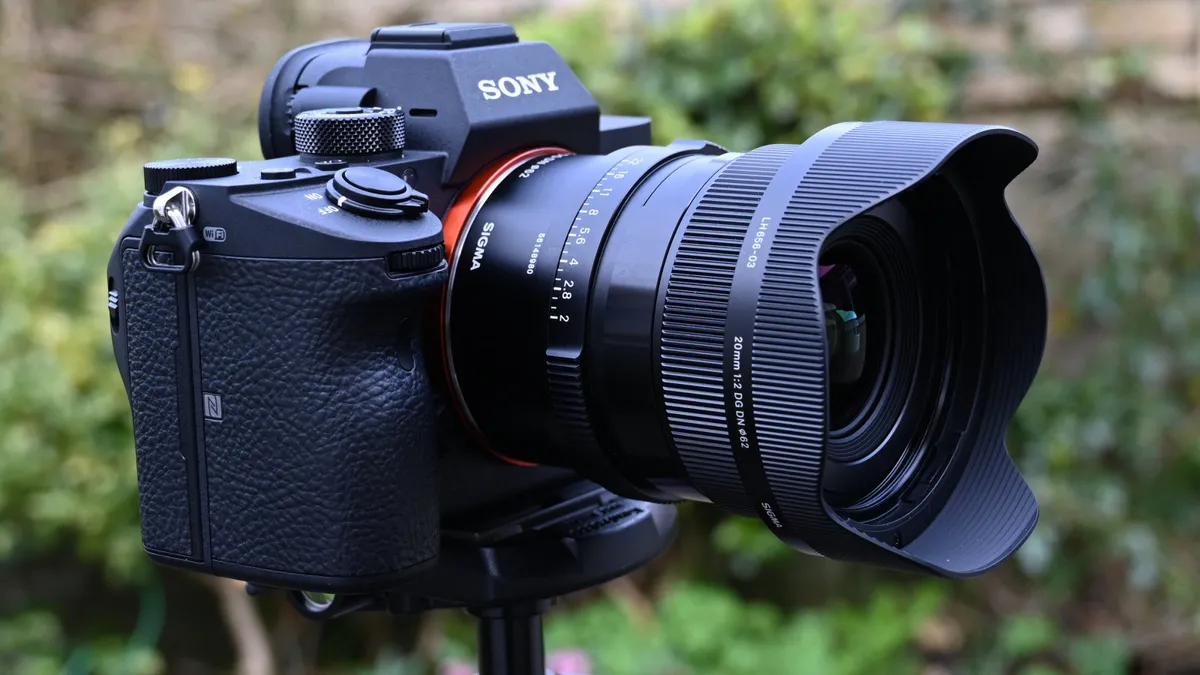
Ultra-wide zooms are great, but they also tend to be pretty bulky and expensive. Many also have a modest aperture rating. Sometimes a faster, ultra-wide prime is just more convenient. Smaller and lighter than Sony's 20mm f/1.8, yet almost as fast, Sigma's 20mm f/2 is a simply superb wide prime.
It features metal construction and a high-quality optical path, but manages to remain quite light. Handling is smooth and intuitive, with responsive, virtually silent autofocus. In my tests, I was impressed by the image quality too: sharpness is terrific from the center to the edges, even at wide apertures. It's great for everything from sunny landscapes to starry night skies.
Read more: Sigma 20mm f/2 DG DN | C review


Features ★★★★☆ |
Features include a fast f/2 aperture plus an aperture control ring, although there’s no de-click facility. |
Design ★★★★★ |
The solid build is based on a metal barrel, mounting plate and hood. |
Performance ★★★★☆ |
Edge-to-edge sharpness is very impressive even wide-open, although it relies on corrections for vignetting and distortion. |
Value ★★★★☆ |
It’s pretty pricey to buy but well worth the money. |
Best standard zoom lens for the A7 III

Back in a previous era when I had a DSLR, the Sigma 24-70mm Art was my go-to lens for everyday shooting, and I loved it. The original version of the ‘DN’ zoom for mirrorless cameras was a marked improvement and this revamped Mark II is even better. It has a redesigned optical path for greater edge-to-edge sharpness, as well as reducing sagittal coma flare, so pinpricks of light don’t take on irregular shapes. Along with excellent sharpness, the lens delivers smooth bokeh, the quality of which is enhanced by a particularly well-rounded 11-blade aperture.
I really like the handling of this lens. Additions over the original include an aperture control ring which comes complete with a click/de-click switch and a locking switch to avoid accidental operation. The de-click option is great for shooting video, and the lens has also been designed to minimize focus breathing. That’s another box ticked for shooting video. The Mark II also doubles up on AF-L function buttons, ideal for portrait as well as landscape orientation shooting, and they can be customized for other functions in camera menus, where available.
Autofocus is about three times faster than in the original lens, and well able to keep pace when tracking moving subjects, based on an HLA (High-response Linear Actuator) motor. All in all, it’s a brilliant lens for everyday shooting and I’d go as far as to say it’s pretty much as good as the Sony FE 24-70mm F2.8 G Master II which costs about twice as much to buy. This Sigma is a steal at the price.
Read more: Sigma 24-70mm F2.8 DG DN II Art review


Features ★★★★★ |
Advanced features include a click/de-click aperture ring and two Fn buttons. |
Design ★★★★★ |
The Mark II sheds a little weight while enhancing autofocus speed and quality. |
Performance ★★★★★ |
Fast and consistently accurate autofocus teams up with excellent image quality. |
Value ★★★★★ |
Compared with own-brand ‘trinity’ standard zooms, the Sigma Mark II is bargain. |
Best street photography lens for the A7 III

I’ve come to expect a lot from Viltrox lenses, and for comparatively little outlay compared with equivalent own-brand Sony lenses. Even so, the Viltrox AF 35mm f/1.8 Evo II really comes up trumps with excellent all-metal build quality despite its compact and lightweight construction, along with advanced handling characteristics that include a click/de-click aperture ring and a customizable function button.
More importantly as far as I’m concerned, the autofocus mechanism is fast, near-silent and consistently accurate, while image quality is superb in terms of sharpness and clarity, smooth bokeh and a minimum of unwanted aberrations. Everything’s packed into a compact and lightweight package that helps with remaining inconspicuous when you’re out and about, shooting on the streets.
Read more: Viltrox AF 35mm f/1.8 Evo II review


Features ★★★★★ |
There’s a fine feature set for such a budget-friendly lens, including a click/de-click aperture control ring and a customizable function button. |
Design ★★★★★ |
The all-metal casing and mounting plate feel robust and well-engineered, there are weather-seals and the design is nicely compact and lightweight. |
Performance ★★★★½ |
Autofocus is fast and reliably accurate, while image quality is highly impressive in all respects. |
Value ★★★★★ |
Like other Viltrox lenses, this one is standout value for money and you get a great deal for your outlay. |
Best portrait photography lens for the A7 III

Fast primes generally come with price tags to match, especially if you’re thumbing through the price list of Sony G Master lenses. I love that this Viltrox AF 85mm f/1.4 Pro really lives up to its ‘Pro’ aspirations, with exotic handling characteristics, a robust and weather-sealed metal construction, and most of all, gorgeous image quality, but at a much more budget-friendly purchase price.
Attractions include a rapid yet virtually silent VCM (Voice Coil Motor) autofocus, along with a top-grade optical path based on 15 elements arranged in 11 groups. These include three ED (Extra-low Dispersion) elements, no less than nine HRI (High Refractive Index) elements and one aspherical element. HD Nano multi-layer coatings are applied to minimize ghosting and flare, and a keep-clean fluorine coating is applied to the front element.
The Viltrox combines impressive sharpness and clarity with exquisitely soft bokeh. It’s simply a brilliant buy Sony E-mount cameras, if you’re into portraiture and still life, or for any time you need a fast, short telephoto prime.
Read more: Viltrox AF 85mm f/1.4 Pro review


Features |
There are plenty of features on tap, including a click/de-click aperture control ring and function button. |
★★★★★ |
Design |
The design works really well, from the robust metal weather-sealed build to the controls and VCM autofocus system. |
★★★★★ |
Performance |
The lens does well to combine excellent sharpness with soft and dreamy bokeh, ideal for portraiture. |
★★★★★ |
Value |
At less than a third of the price of the own-brand Sony 85mm f/1.4 lens, the Viltrox is outstanding value. |
★★★★★ |
Best macro photography lens for the A7 III

Sigma’s Art line is known for impressive image quality and robust construction, and this 105mm macro is no exception. With a strong, slimline profile it has weather seals all-round to protect it from the elements. Double that with a fluorine coating on the front element and it becomes a lens for taking anywhere and everywhere.
Good as a mid-telephoto portrait lens thanks to its ability to focus to infinity, it excels at macro images rendering genuine 1:1 reproduction ratios with outstanding detail. Utterly sharp throughout the frame and with an optical design that reduces color fringing that can’t be corrected in-camera, this Sigma is my top choice for macro photography with the A7 III, even more so than the Sony FE 90mm macro.
Read more: Sigma 105mm f/2.8 DG DN Macro | Art review


Features ★★★★★ |
Smart features include an autofocus range limiter and an aperture control ring with click/de-click options. |
Design ★★★★★ |
The design enables full 1.0x macro magnification with high-end handling and weather-seals. |
Performance ★★★★★ |
Sharpness is superb and the Sigma is a top performer in all aspects of image quality. |
Value ★★★★☆ |
It’s not cheap but the price is very reasonable considering the features and build quality. |
Best telephoto zoom lens for the A7 III

I love that this lens is much more compact, lightweight and affordable than conventional 70-200mm f/2.8 ‘trinity’ telephoto zooms. Sure, it doesn’t quite stretch to 200mm at the long end but it comes pretty close, while retaining that all-important constant f/2.8 aperture throughout the entire zoom range. It works a treat for weddings and events and even for sports and wildlife photography, while keeping the weight off for long periods of handheld shooting.
The original Tamron 70-180mm was a great lens, but I love that the G2 adds optical image stabilization, uprated handling and revamped optics. And it delivers all this at a more inexpensive launch purchase price than the original lens. I find that any camera's in-body image stabilization is second-best with telephoto lenses, so the addition of optical stabilization is particularly welcome.
Autofocus is super-fast, based on a VXD (Voice-coil eXtreme-torque Drive) system, and well able to do justice to the Fast Hybrid AF, Eye AF and advanced tracking options in Sony’s recent mirrorless cameras. The proof of the pudding is in the image quality and I'm very impressed that the lens's many optical upgrades translate into fabulous pictorial excellence. It’s simply a terrific lens at a bargain price.
Read more: Tamron 70-180mm F2.8 Di III VC VXD G2 review


Features ★★★★★ |
Fancy features in the ‘Generation 2’ include a three-pole Custom switch, function button and USB-C port. |
Design ★★★★★ |
The design gives you almost the same zoom range as a classic 70-200mm f/2.8 telephoto zoom but in a much smaller, lighter package. |
Performance ★★★★★ |
From super-fast and highly accurate autofocus to great image quality and effective optical stabilization, it’s a cracker. |
Value ★★★★★ |
It’s less than half the price of many ‘trinity’ telephoto zooms, making it a standout bargain. |
Best wildlife photography lens for the A7 III

Think air shows, action, sports, wildlife and bird photography and you might be thinking that your telephoto lens simply doesn't have enough reach. That's where the Sony FE 200-600mm comes to the rescue, with its huge focal length range that really covers the distance.
Though it has a slightly slower aperture range than some telephoto lenses, it’s equipped with Sony's Optical SteadyShot stabilization that pairs with the A7 III’s built-in stabilizer to deliver consistently sharp results whether you're shooting handheld or with a monopod. It has three OSS modes and customizable focus hold buttons placed around the barrel at 90-degree intervals, enhancing the handling and performance of this excellent lens.
Read more: Sony FE 200-600mm F5.6-6.3 G OSS review


Features ★★★★★ |
There are all the up-market controls, switches and handling extras you could hope for. |
Design ★★★★★ |
It’s a necessarily big lens but less of a heavyweight than some, along with robust build quality. |
Performance ★★★★★ |
Image quality is great throughout the entire zoom range, with effective stabilization and fast autofocus. |
Value ★★★★☆ |
It’s pricier than the alternative Sigma lens but not bad value for an own-brand Sony G zoom. |
How we test lenses
The lens experts in our testing lab run a range of tests under controlled conditions, using the Imatest Master testing suite. Photos of test charts are taken across the range of apertures and zooms (where available), then analyzed for sharpness, distortion and chromatic aberrations.
We use Imatest SFR (spatial frequency response) charts and analysis software to plot lens resolution at the centre of the image frame, corners and mid-point distances, across the range of aperture settings and, with zoom lenses, at four different focal lengths.
There's more to it than just the technical side, though! Beyond the lab, our reviewers test lenses in real-world environments – and sometimes on professional shoots! We work with lenses both indoors and outdoors, in studio conditions and in natural light, with as many different subjects as is possible (or appropriate – there's no point testing a landscape lens' ability to shoot a portrait!).
We take into account everything from handling and ease of use to speed of autofocus and the overall quality of the images produced.
Find out more about how we test and review on Digital Camera World
Lab test data and comparisons
The graphs below show the comparative performance of the lenses in this guide, based on our in-house lab tests. They reveal that the Sony FE 50mm, Viltrox AF 35mm and Tamron 70-180mm score particularly highly for sharpness, the latter being especially impressive for a zoom lens. Color fringing and distortions are pretty low across the board, apart from the Sigma 20mm. Either way, automatic in-camera corrections for these aberrations are available with the Sony A7 III.
For zoom lenses, we repeat our test at the widest and longest ends of the zoom range, plus intermediate 'mid-wide' and 'mid-telephoto' settings. Use the dropdown menus to select between them (for primes, the same data appears on all the graphs for comparison purposes).
For more detailed graphs of each lens's performance, which give the full picture, check out the graphs in our full standalone lens reviews.
Center sharpness
Use the dropdown menu to select between wide-angle, mid-wide, mid-tele, and telephoto zoom settings (prime lens data is replicated across all charts for ease of comparison)
| Timestamp (f-stop) | Tamron 17-28mm f/2.8 Di III RXD () | Sony FE 50mm f/1.4 GM () | Sigma 20mm f/2 DG DN | C () | Sigma 24-70mm f/2.8 DG DN II | A () | Viltrox AF 35mm f/1.8 Evo () | Viltrox AF 85mm f/1.4 Pro () | Sigma 105mm f/2.8 DG DN Macro | A () | Tamron 70-180mm f/2.8 Di III VC VXD G2 () | Sony FE 200-600mm f/5.6-6.3 G OSS () |
|---|---|---|---|---|---|---|---|---|---|
| 1 | N/A | 3078 | N/A | N/A | 2655 | 2230 | N/A | N/A | N/A |
| 2 | N/A | 3371 | 2634 | N/A | 2759 | 2359 | N/A | N/A | N/A |
| 3 | 2277 | 3488 | 3015 | 2699 | 3226 | 2884 | 2266 | 2834 | N/A |
| 4 | 2232 | 3245 | 2940 | 2535 | 2883 | 2847 | 2241 | 2713 | N/A |
| 5 | 2142 | 3052 | 2832 | 2546 | 2765 | 2429 | 2135 | 2543 | 2199 |
| 6 | 1931 | 2591 | 2577 | 2463 | 2624 | 2310 | 2036 | 2576 | 2435 |
| 7 | 1802 | 2238 | 2182 | 2147 | 2358 | 1859 | 1928 | 2261 | 2144 |
| 8 | 1535 | 1766 | 1768 | 1834 | 1828 | 1542 | 1602 | 1821 | 1759 |
| 9 | 1255 | N/A | 1373 | 1356 | N/A | N/A | 1285 | 1432 | 1348 |

Fringing @ f/8
Use the dropdown menu to select between wide-angle, mid-wide, mid-tele, and telephoto zoom settings (prime lens data is replicated across all charts for ease of comparison)
| Product | Value |
|---|---|
| Tamron 17-28mm f/2.8 Di III RXD | 0.01 |
| Sony FE 50mm f/1.4 GM | 0.44 |
| Sigma 20mm f/2 DG DN | C | 0.13 |
| Sigma 24-70mm f/2.8 DG DN II | A | 0.05 |
| Viltrox AF 35mm f/1.8 Evo | 0.32 |
| Viltrox AF 85mm f/1.4 Pro | 0.32 |
| Sigma 105mm f/2.8 DG DN Macro | A | 0.03 |
| Tamron 70-180mm f/2.8 Di III VC VXD G2 | 0.18 |
| Sony FE 200-600mm f/5.6-6.3 G OSS | 1 |
Distortion
Use the dropdown menu to select between wide-angle, mid-wide, mid-tele, and telephoto zoom settings (prime lens data is replicated across all charts for ease of comparison)
| Product | Value |
|---|---|
| Tamron 17-28mm f/2.8 Di III RXD | -0.98 |
| Sony FE 50mm f/1.4 GM | 1.06 |
| Sigma 20mm f/2 DG DN | C | -4.7 |
| Sigma 24-70mm f/2.8 DG DN II | A | -2.25 |
| Viltrox AF 35mm f/1.8 Evo | -0.35 |
| Viltrox AF 85mm f/1.4 Pro | 0.58 |
| Sigma 105mm f/2.8 DG DN Macro | A | 0.9 |
| Tamron 70-180mm f/2.8 Di III VC VXD G2 | 1.51 |
| Sony FE 200-600mm f/5.6-6.3 G OSS | 1.56 |
How to choose the best lens for the Sony A7 III
The A7 III, like all Alpha 7 cameras, uses the Sony E lens mount. Sony’s own E-mount lenses have either FE or E in their model names: all work on the A7 III. FE lenses are designed for use with full-frame Sony cameras, including the A7 III, so these should be your first choice. If you are buying a third-party E-mount lens, check that the lens is designed for use with full-frame Sonys.
Sony lenses with an E (rather than FE) prefix are designed for APS-C format cameras such as the A6000 series. On the A7 III, they produce a cropped image, so they’re not an ideal choice.
Check out our guide to the best Sony lenses if you want to know more

