
With the best camera for product photography, you'll be able to capture images of products with a significant uptick in quality compared to peers who are shooting on smartphones. Trust me!
A camera is only one piece of the puzzle when it comes to product photography. Lighting is obviously hugely important, and your lens choice matters greatly too. But getting a camera that produces consistently crisp and good-looking images is absolutely vital – and the best news is that it doesn't have to cost a fortune.
I've populated this list with what I think are the best product photography cameras at a range of price points. My selections include beginner-friendly mirrorless cameras and compact cameras, as well as the more serious professional stuff. Every camera on this list has been fully reviewed and vetted by our team – so I'm only recommending products that we personally guarantee are worth their price tags. So, here are my picks of the best cameras for product photography.

Jon is one of our go-to specialists when it comes to all aspects of photography, from cameras and action cameras to lenses and memory cards, flash diffusers and triggers, batteries and memory cards, selfie sticks and gimbals, and much more besides. Here, he has worked with our review team to select the best cameras for product photography, based on DCW's testing.
The quick list

This APS-C mirrorless camera provides pitch-perfect performance, with Sony's extensive lens selection offers plenty of options for creating shallow depth of field.

The Fujifilm X-S20 is perfect for giving your product shots some flair, with a truly excellent lens range. With dedicated Product Priority vlog mode, it's the ideal hybrid.

While it's principally a vlogging camera, the PowerShot V1 and its 1.4-inch sensor are also superb for stills, making it one of the best-value compact cameras for product photography.

Canon's EOS R50 is a beginner mirrorless all-rounder that will get the job done for product shoots. It's cheaper than most other options and produces excellent images.

In terms of bang for your buck, the Nikon Z5 II is one of the best full-frame cameras – and its comprehensive feature-set covers all you need for product photography.

With pixels to spare, the Sony A7R IVA is ideal if you're capturing product photographs for large-scale prints – and previous models in the series are cheaper alternatives.
Load the next products ↴

Medium format photography offers the ultimate in detail and image quality. The Fujifilm GFX 100S II, while still expensive, is on the affordable end of the scale.
Best camera for product photography
Why you can trust Digital Camera World Our expert reviewers spend hours testing and comparing products and services so you can choose the best for you. Find out how we test.
Best overall

A good product photography camera ideally should do a bit of everything, and do it well. As such, I’d recommend a capable all-rounder like the Sony A6700, which hugely impressed our reviewer with its rangefinder-style design and APS-C image quality. It’s a little more expensive than the competition, but it essentially delivers professional features in a compact package for a mid-range price. If you want your product photography to look professional, I would wholeheartedly recommend the Sony A6700.
The A6700 offers 26MP of resolution – more than ample for product photography on the web and all but the largest prints. It produces colors that are accurate while also being punchy and accurate, and our reviewer also appreciated how consistent images of the same subject looked from shot to shot, even when lighting conditions were changeable. This is great for product photography, where you want as much consistency as possible – especially if you’re just starting out and haven’t built your own lighting setup yet.
One of the key advantages of the Sony A6700 is the lens range. Sony's E-mount lens system is one of the most extensive in mirrorless photography, and you'll have no problem finding affordable lenses for your product shots, whether you go with a telephoto macro prime or a flexible zoom.
Also, if this camera is a little too expensive for you, Sony keeps a lot of its A6X00 line in production, meaning there are cheaper alternatives available – see for instance our Sony A6700 vs Sony A6600 comparison piece for a look at one alternative.
See our full Sony A6700 review
Best hybrid

While I’ve mostly focused on product photography in this guide, video is an increasingly important part of showcasing products online – one that consumers have come to expect. As such, a hybrid camera that will excel at both photo and video capture may be the right choice, and my pick is the Fujifilm X-S20.
Equipped with a 26.1MP APS-C sensor, it's a stylish and capable camera that gives you access to the brilliant X-mount series of lenses, which are perfect for shooting images with a shallow depth of field. Our reviewer was impressed in particular with the level of detail captured by the 26.1MP APS-C sensor, and how easily he was able to crop into images to get more detail.
On the video side, you have a number of dedicated vlogging modes, accessed via the new 'Vlog' setting on the dial. Particularly germane to our purposes here is the Product Priority mode, which is optimised to make products specifically the focus of the frame. Our reviewer felt this to be the camera’s standout feature.
While it's more expensive than the previous X-S10, I’d say the upgrades to the X-S20 make it worth the extra outlay, especially if you're shooting both photos and videos of products.
See our full Fujifilm X-S20 review.
Best compact

Sure, it’s first and foremost a vlogging camera. However, with a 1.4-inch sensor, the Canon PowerShot V1 stands head-and-shoulders above many rival premium compacts with their 1-inch sensors, and this makes it still one of the best cameras for product photography. And if once again you also want to capture product videos, then frankly it’s a very tough camera to argue with.
Canon released this camera in 2025 with the obvious intent of competing with the similarly specced Sony ZV vlogging cameras – and frankly I think it’s significantly better than any of them. Again, that larger sensor just gives you a real edge when it comes to image quality and dynamic range, and the built-in fan means you can keep on shooting 4K video for extended periods – perfect if you’re trying to nail down a tricky product vlog or demo video. When James took it outside for our review, he was shooting in blazing sunshine, and was still unable to get the thing to overheat!
The Canon PowerShot V1 is a dynamic and capable product shooter across both video and stills. It’ll absolutely blow your smartphone away, even if you’ve got a recent flagship phone (which would actually in many cases be more expensive). The fact that it’s a vlogging camera does mean some compromises which may not be to your taste, such as the lack of a viewfinder, but otherwise, it’s a slam-dunk for product shoots in my opinion.
Read our full Canon PowerShot V1 review
Best beginner mirrorless
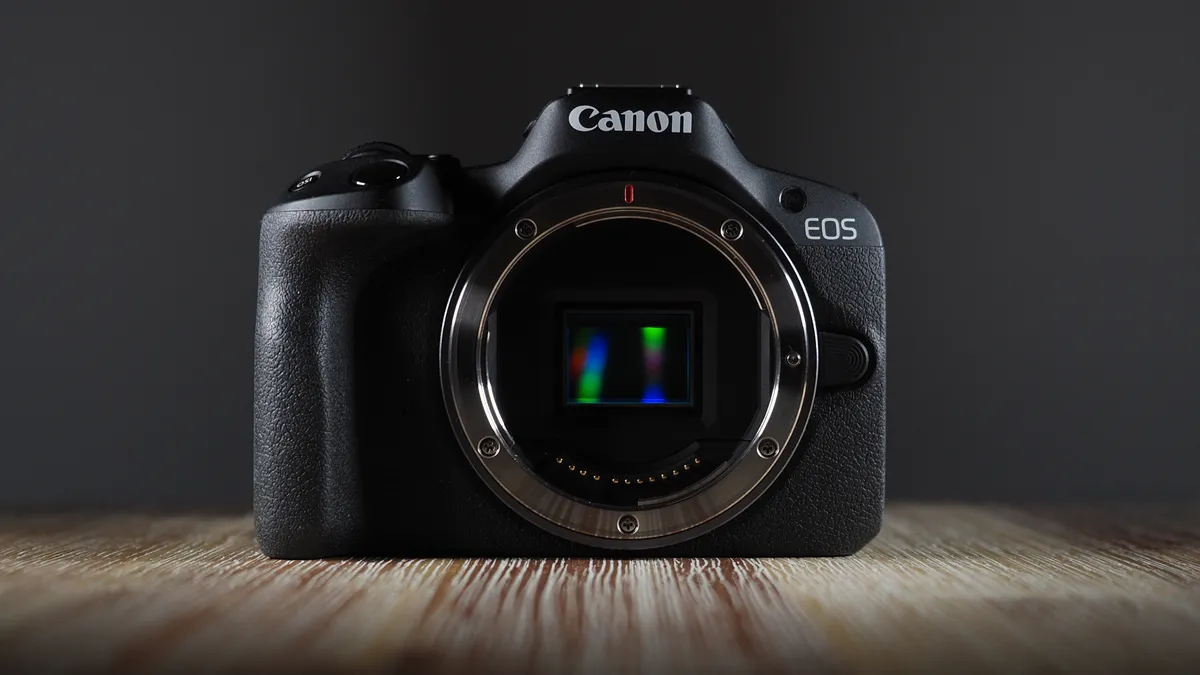
For a long time I had both the popular mirrorless EOS M50 Mark II and the entry-level Rebel SL3 (or EOS 250D) DSLR on this list. However, Canon has called time on the EOS M series and is no longer producing new DSLRs, and the replacement for both is the superb entry-level mirrorless Canon EOS R50.
This is a solid and inexpensive all-rounder that is well-suited for product photography, delivering excellent image quality from its APS-C sensor. The EOS R50 scored well in our review, with James heaping praise on its guided-UI that helps new shooters get their heads around the basics.
Lens-wise, the EOS R system benefits from being able to make use of both native RF lenses and older EF DSLR lenses, the latter attaching via a separately purchased adapter. This provides enormous flexibility in terms of building a lens setup, especially on a budget – the initial cost of the adapter can easily be recouped via the savings you'll make through buying cheaper DSLR lenses instead of expensive mirrorless ones.
The light build of the EOS R50 is a boon in some respects, though it does mean it balances a little awkwardly with some lenses. This is less of an issue in the studio shooting products than it would be for street or wildlife photography, but it's worth mentioning. Otherwise, this is a camera that has hugely impressed us, and for the price it offers great value for the product photographer.
Read our Canon EOS R50 review.
Affordable full-frame
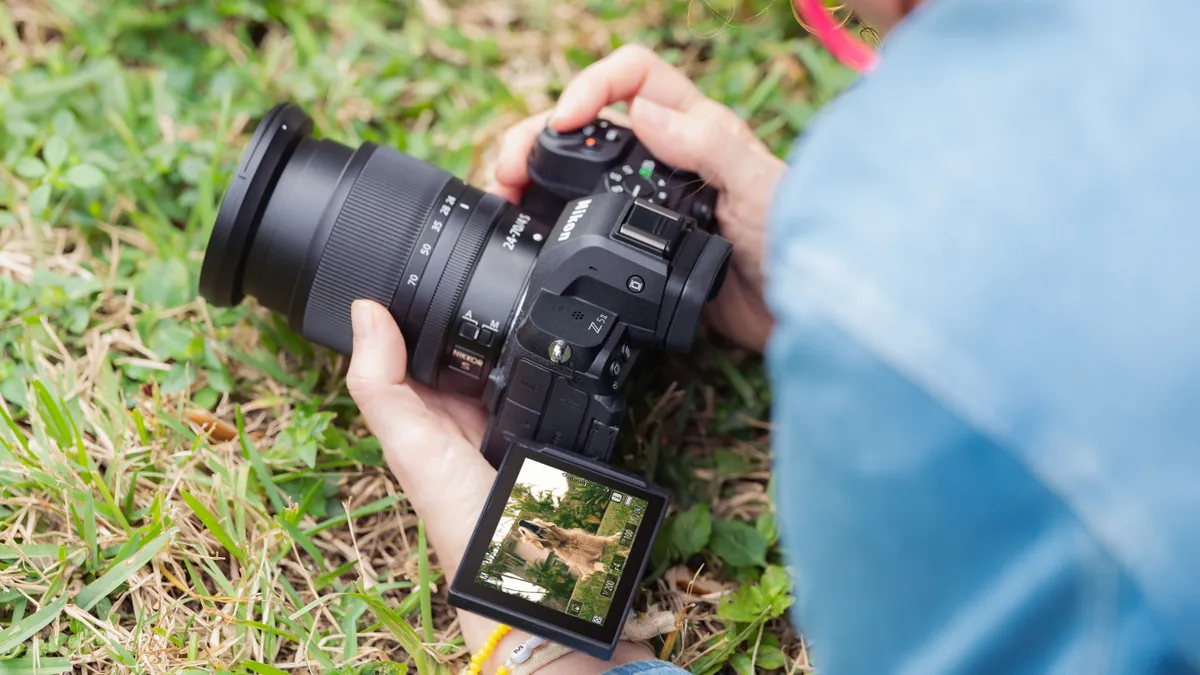
If you want to use a full-frame camera for product photography, the Nikon Z5 II is an excellent option – one of the best-value full-frame cameras on the market right now, in my view. It packs in features and innovations from Nikon's top-end professional cameras and fits them into a lightweight, easy-to-handle body, and while you won't necessarily need features like fast burst rates for product photography, what you get overall is a camera that blends straightforward usability with fantastic image quality.
With a resolution of 24.5MP, the Nikon Z5 II has enough pixels for most forms of product photography, and it's only those who are shooting for ultra-large print formats who are going to find it wanting. Then there's also the price. As Adam mentioned in our review, the Nikon Z5 II may not be the out-and-out best camera that Nikon produces, but it's definitely the best-value. It significantly undercuts rivals at this level, like the Canon EOS R6 III or the Sony A7 V – and for product photography, those cameras don't really offer anything that this one doesn't.
The Nikon Z-mount range of lenses has been expanding nicely, with plenty of great macros and short telephotos that are excellent for product shooting. You can see our full Nikon Z lens guide for some suggestions, though I'd say you can't go wrong with the Nikon Z 28-75mm f/2.8 or the Z MC 105mm f/2.8 VR S. Also, just as with Canon's mirrorless system, you can use an adapter to pair Nikon F-mount DSLR lenses with the Z5 II, which can be a great way to save some cash.
Read our full Nikon Z5 II review.
Best pro full-frame

If you're looking for a professional-grade camera for product photography, your priority is likely going to be resolution – pixels, pixels, pixels. This will give you the detail you need for your images to be able to be printed and displayed in large formats. The Sony A7R V, with its 61MP sensor, is one of the highest-resolution full-frame mirrorless cameras you can buy – getting more pixels than this requires delving into larger sensor formats, which costs considerably more.
In addition to this, the Sony A7R V also boasts a Pixel Shift Multi Shooting, which can combine multiple images to create images up to 240MP in size. This is ideal for product photography, as products don't move, and a studio-based setup allows you to lock off the camera securely on a tripod to ensure that all of the multiple exposures are taken from the exact same position.
This also means that the handling niggles of the A7 series – their slightly boxy construction and balancing issues with big lenses, which we regularly have noted in our reviews – aren’t such an issue. Once again, you have the enormous E-mount lens range to choose from, with a stunning variety of high-quality primes and zooms. The Sony A7R V is not a cheap option, but as far as full-frame mirrorless goes, it's top of the pile for product photography.
See our full Sony A7R V review
Best medium format

Many professional product photographers use large-sensor medium format cameras for the sheer resolution and quality they offer. The main disadvantage of medium format (other than the cost) is that the systems tend to be big, bulky and heavy – however, this isn't a problem when you're shooting in the studio. If you're looking to jump into a medium format system for product photography, I'd recommend Fujifilm's fantastic GFX system, and specifically the GFX 100S II.
While it may look pricey, in medium-format terms the GFX 100S II is actually on the affordable end. Producing spectacular 102MP images, the GFX 100S II can also use a new low ISO setting of 80, allowing you to get as much clarity and quality in your shots as possible. As you might expect, the images our reviewer achieved with the GFX 100S II were simply dazzling – full of colour and detail. If you think your product photography might need to be printed big, this camera is an outstanding bet.
We also found that stabilization and autofocus have been improved compared to the original GFX 100S, and as time has gone on, the superb GF lens range has expanded. The only real sticking point in our review was the middling battery life – and again, this will be much less of a problem in a product photography studio than it was for us out in the field.
See our full Fujifilm GFX 100S II review
How to choose a camera for product photography
For product photography, getting the exact right type of camera isn't as important as it is in other disciplines. As you're effectively shooting still-life, likely in a fairly well-controlled environment, there are quite a few camera comparison features you don’t really have to worry about – autofocus speed, for instance, isn’t much of a concern when your subjects don’t move. Nor is burst speed, and stabilisation is less essential when you can easily pop up a tripod.
You need a camera that captures images at a decent resolution – 24MP is fine, though you'll want more if you're photographing for print. Ideally, you also want to be able to shoot with a shallow depth of field – this means having the main subject of an image sharply in focus, and the background artfully blurred. This is more to do with the lens than the camera; you want a long-ish lens with a wide maximum aperture. So if you're choosing a system camera (mirrorless or DSLR), it's a good idea to have a look at the lens selection before committing.
How we test cameras
When we test cameras – as we have tested every model on this list – we put them through a series of benchmarks in carefully controlled lab conditions. We measure resolution, dynamic range, and signal-to-noise ratio. Resolution is measured using ISO resolution charts, dynamic range is measured using DxO Analyzer test equipment and DxO Analyzer is also used for noise analysis across the camera's ISO range.
However, this is only half the story, as we also look at how cameras perform in the real world for tasks like product photography. Our reviewers take cameras out into different shooting situations and put them through their paces with a range of subjects. This helps give us a complete picture of how a camera performs, and how suitable it is for specific applications like product photography. See more about how we test and review at Digital Camera World.
FAQs
What type of lens is best for product photography?
A longer lens is best for product photography, ideally in a focal range of between 50mm and 200mm. This will allow you to get nice and close for detail shots, and also make it easier to throw out the background for attractive, shallow depth-of-field images. Many manufacturers offer macro lenses in the 100-120mm range with maximum apertures of f/2.8 or so – this is ideal.
However, these lenses can be quite expensive, and you don't need to spend that much to get great shots. A 50mm f/1.8 lens is one of the most affordable configurations of lens around, and you can definitely get great product shots with one of these.
How do I get better at product photography?
If you're just starting out, the key things to think about are: lighting and background. You want a nice, soft, even source of light to clearly illuminate the products you're shooting without causing glare, and you want a neutral, clean background to make sure your images aren't filled with unnecessary distractions (no need to overthink this part; a white wall can work just fine).
The real key thing is lighting. While getting dynamic and interesting shots of products can be done using natural light, you’ll find you have an easier time if you get your own lighting. Our guide to the best LED lights might be of help there.
Read more:
Best camera for low-light photography
Best camera for beginners
Best camera for real estate photography
Best YouTube camera
