





Mobile World Congress 2026, the annual Barcelona trade show where the phone industry gathers to unveil its biggest ideas, has a habit of producing one announcement per year that makes everyone else's look incremental by comparison. This year, that announcement is from a company most people in the UK would struggle to name.
Chinese brand Honor holds around 3% of the European smartphone market. In a category dominated by Apple and Samsung, it is, for most consumers here, somewhere between an unfamiliar name and an invisible one.
That could be about to change, though. Not because Honor has made a slightly better phone, but because it has identified and solved a consumer problem that nobody else has properly addressed to date.
The problem Honor wants to solve
The modern smartphone has done something remarkable for photography: it's genuinely democratised it. The quality gap between a quick snapshot taken on a mid-range phone and one taken by a competent photographer with a expensive DSLR has narrowed to the point where many people can't tell the difference.
Video, however, is a different matter. Good video has always demanded skills that don't come bundled with the hardware. Stabilisation. Subject tracking. Smooth camera movement. The discipline to pan slowly, to hold a frame, to follow a subject without lurching or losing focus.
A shaky, poorly framed video clip looks amateurish in a way that a slightly imperfect photograph simply doesn't. And yet right now, social media is shifting decisively toward video; with Instagram openly imitating TikTok, YouTube Shorts competing with Reels, and every platform prioritising the moving image. Which means the gap between what people want to create and what they're technically equipped to produce has never been more visible or more frustrating.

Honor's Robot Phone, unveiled today at MWC in Barcelona, is a serious attempt to close that gap. And if it succeeds, it won't just be a remarkable piece of engineering. It could be the device that finally puts Honor on the map in Europe.
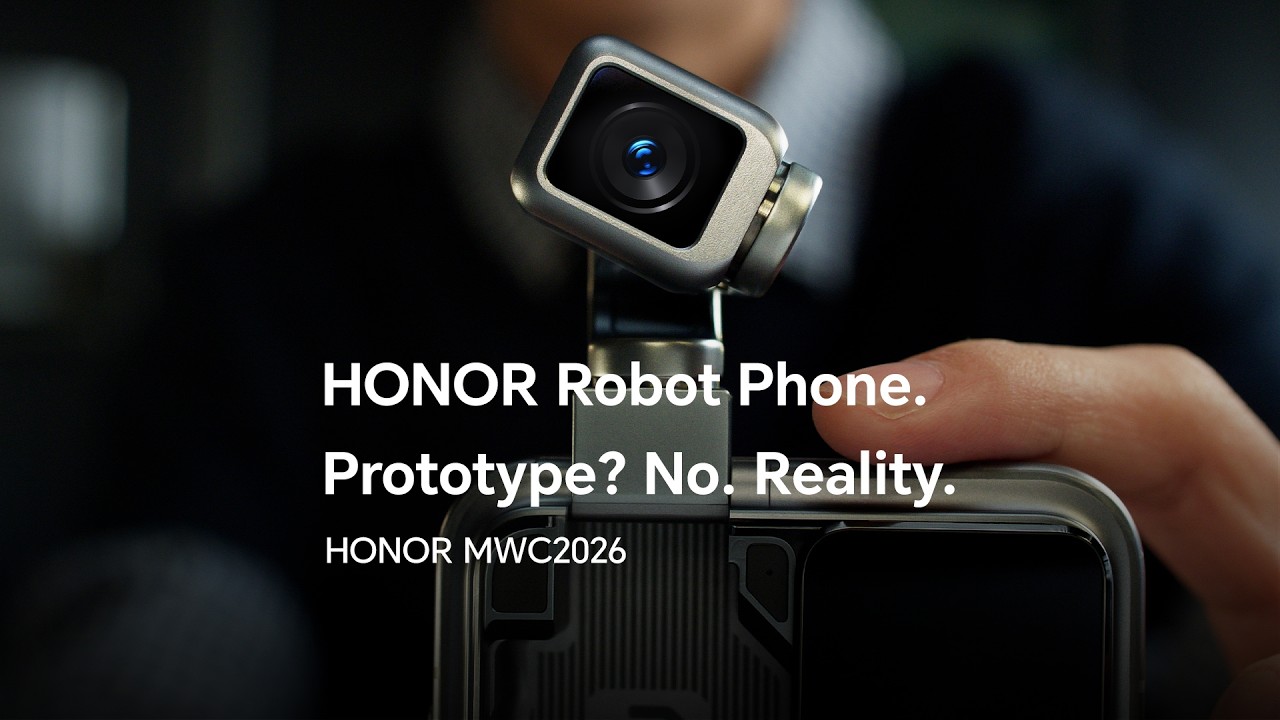
The Robot Phone looks, at first glance, like a well-made smartphone. Slim, premium, the kind of device you'd walk past without a second thought. But the rear camera module sits within a housing that slides open to deploy a robotic arm, tipped with a camera, on a four-degrees-of-freedom gimbal system. That arm rotates, tilts, tracks and reframes (autonomously, in real time) driven by a self-developed micro motor that Honor has miniaturised to a remarkable degree.
The engineering challenge this presented was immense. Inside a smartphone, every millimetre is accounted for. Fitting a mechanical arm into that space meant building a micro motor 70% smaller than anything currently used in mainstream devices; roughly the size of a one euro coin.
Honor used the same high-performance steel and titanium alloys developed for the Magic V6's hinge, and the same simulation tools, to optimise every component. Seven millimetres of internal space was the target. They hit it.
The camera riding on that arm is a 200MP sensor, attached to a three-axis gimbal stabilisation system that Honor claims delivers the best stabilisation performance currently available on any smartphone. AI Object Tracking follows a chosen subject automatically in real time. AI SpinShot produces smooth 90 and 180 degree rotational camera movements: the kind of cinematic transitions you'd normally only achieve in post-production or with a considerably larger and more expensive rig.
At the Barcelona event, Honor also touted a partnership with ARRI – the professional cinema camera company whose name appears on the side of cameras used on major film sets – to bring cinematic-quality video processing to the Robot Phone from launch.

To understand why all of this matters, picture a few familiar situations. You're travelling, trying to film a sunrise from a moving vehicle, but every bump and jostle shows up in your footage, and keeping the horizon straight requires constant attention.
You're at a party, trying to capture your friend dancing. Every time they move out of frame you have to readjust the phone, breaking the moment. Or maybe you're filming yourself and need a slow, controlled pan that would normally require a tripod and a gimbal head.
The Robot Phone addresses all of these in hardware rather than software. The gimbal corrects motion in real time. A double tap on the screen locks onto a subject and tracks them automatically. The arm can execute cinematic camera movements that the user simply couldn't produce by hand.
Honor's own framing is that the Robot Phone is designed to help people move from capturing moments to telling stories. And that's not marketing language, it's a genuine distinction.
Great video has always required skills that are genuinely hard to master. The Robot Phone is a serious attempt to put those capabilities in everyone's pocket.
The tracking and stabilization are the core of the Robot Phone's appeal for video creators. But there's another dimension that only becomes clear in person, and which Honor has been somewhat coy about in its pre-show marketing: this phone has something very close to body language.

The robotic arm doesn't just move functionally; it responds expressively. It nods. It shakes its head. When asked a yes or no question, it answers in gesture rather than words. It tracks you during a video call, following your movement around a room. It can even do a backflip. And (the detail that prompted genuine laughter at the Honor stand), it dances to music, detecting a beat and moving in time with it. You can also chat to it ("Do you like my outfit?") and it will 'nod' or 'shake its head' accordingly.
It's absurd. It's also completely charming, and in a market saturated with phones that are essentially identical rectangles, charm is not nothing.
The Robot Phone is not yet available. Not available to buy, not available to review, and the journalists at the event weren't even able to get hands-on with one. Instead, a couple of models were demonstrated by Honor staff behind a rope. So, although no one said this out loud, it seems pretty clear that the device is not quite finished yet.
As for release dates, Honor says that it is targeting the second half of the year, launching in China first and international markets to follow. No pricing has been announced, and the units on show at MWC were demonstrations rather than hands-on prototypes.
Analysts have already questioned whether the robotic arm can survive the real world (pockets, bags, drops), and that remains a fair concern until the finished product is in reviewers' hands. At the same time, the confirmation that this is a real commercial product rather than a concept is significant.
What's already clear is that Honor has built something that does things no other phone can do, at a moment when video has never mattered more. Photography was democratised years ago. If the Robot Phone delivers on its promises when it ships, video might be next. And a brand that currently holds 3% of the European market could find itself with a great deal more to say for itself.

