Not so long ago, the European common hamster was well named: it was so ubiquitous in German fields that farmers treated it as a pest. Today, though, its name feels very outdated: thanks to intensive agriculture, it's actually become one of the continent's most threatened mammals.
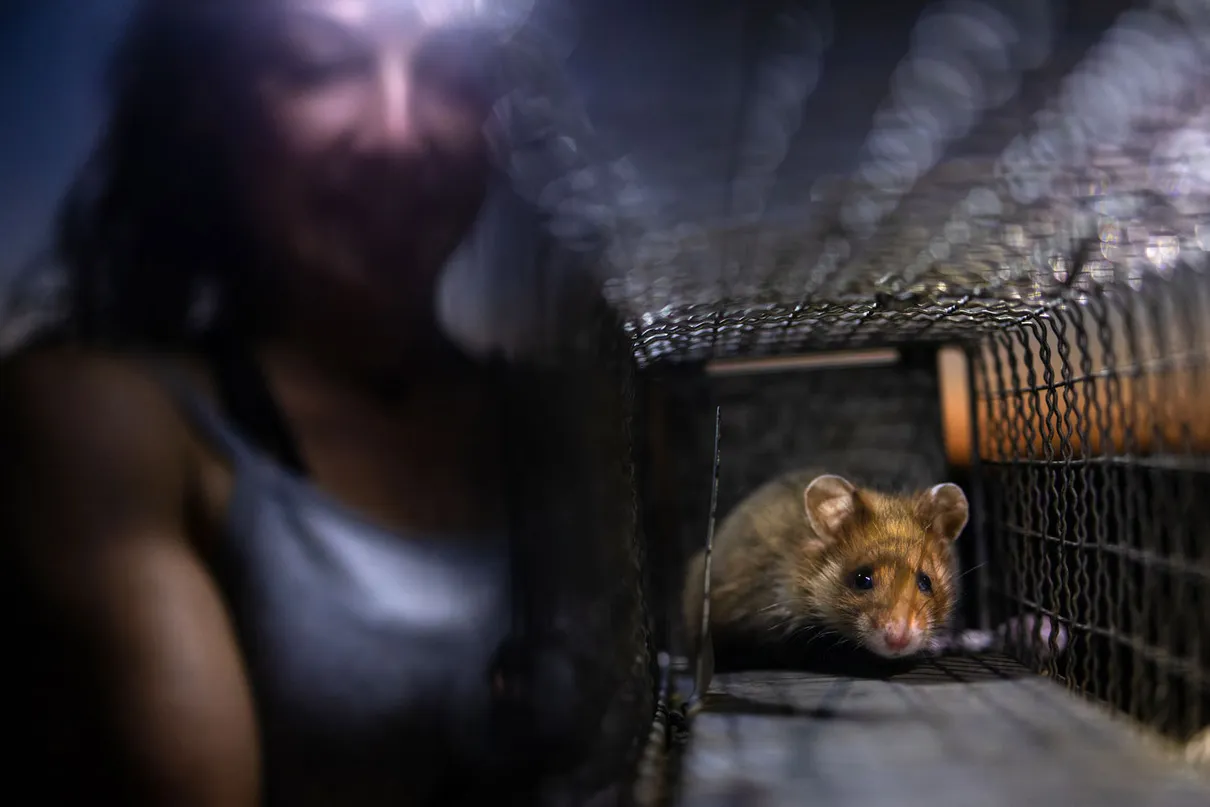
Christoph Kaula's photograph, Managed revival, runner-up in the Rewilding Europe Award, highlights the hard work now underway to bring it back.
The collapse of the European common hamster hasn't just been a tragedy for the species itself; more broadly, it's become a symbol of the collapse in biodiversity across farmland in general. There is, though, cause for hope,
Specialists from the Hamster Conservation Working Group at the Hessian Society for Ornithology and Nature Conservation are using targeted captive breeding, along with burrow mapping and genetic sampling, to trace the animals' movements.
That way, they can identify where habitats are connecting up and where more work is needed.
How it was shot
Managed revival shows a young European hamster pausing at the mouth of a wire trap, whiskers forward, eyes fixed on the camera. Behind it, out of focus, a researcher smiles. It's a small moment, but simultaneously a powerful one too.
Kaula shot with a Canon EOS R5 with an RF 35mm f/1.8 prime at ISO4000. Focusing through wire mesh in low light is the kind of thing that can send autofocus spinning, so the R5's animal eye detection is a real asset here.
The camera's 45MP sensor also handles ISO4000 comfortably, which matters when your subject is mostly active after dark.

In terms of composition, this is a picture of two halves. On the left, the researcher is soft and anonymous but smiling. On the right, the hamster is sharp and alert, framed by the tunnel of the trap, whose wire lines draw the eye straight to its face. A warm glow at the back of the trap balances nicely against the cool blue tones on the left.
The key decision here, to my mind, is to keep the human out of focus; you feel her presence, but she avoids overwhelming the animal subject. And that neatly mirrors the broader message.
"Bringing a species back is never the work of a single organization or individual," Kaula stresses. "It's a collective effort. And that also means raising awareness and communicating the importance of conservation to a much wider audience."

