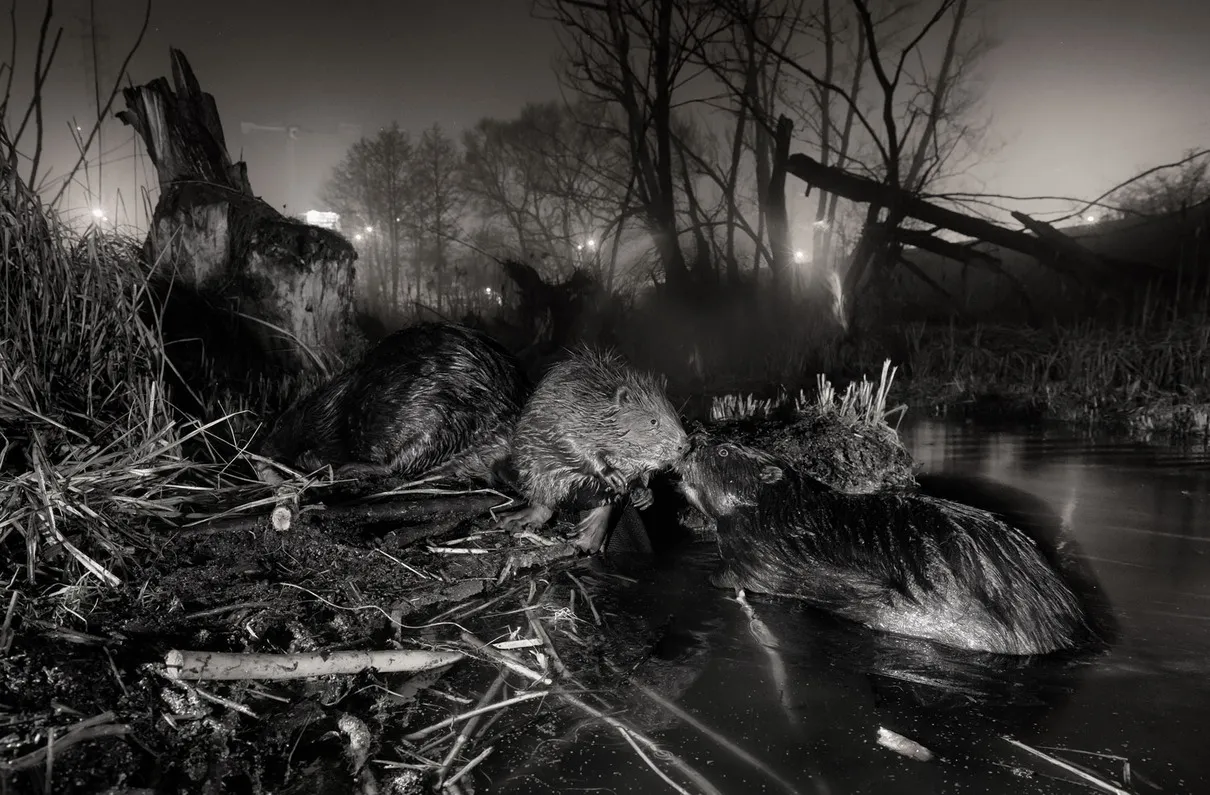
Think of the word "rewilding" and you'll probably imagine remote valleys and wide open spaces, far off in the countryside. But rewilding can be just as impactful in urban environments, and the winning image in this year's Rewilding Europe Award is a great example.
Captured by Jan Wieczorek in 2025, the night-time shot features three beavers lurking in the shallows, two of them nose-to-nose.
They're surrounded by gnawed stumps and stripped branches, the unmistakable signs of beaver engineering. And roads and railway lines cross their territory, and new housing going up nearby, support from local residents and the city authorities means the animals are thriving.
Wieczorek, who has been observing these beavers for around 15 years, explains why that matters.
"The story behind the photograph shows that nature doesn't always exist somewhere far away," he says. "It can thrive right next to our homes, beneath our bridges, and in the centres of our cities. By framing the housing development alongside the wetland created by the beavers, I wanted to show that it is possible for humans and wildlife to share space."
How it was shot
His kit list is short: a Sony A7R III, a 16-35mm f/4 lens, a tripod and an infrared sensor. The framing is wide, low and close, allowing the lens to pay proper attention to the animals in the foreground, without losing that city background.
The A7R III is gaining in years now, having launched in 2017, but its 42.4MP sensor delivers plenty of detail, and the setting of ISO 1600 is well within its comfort zone.
Monochrome is a smart choice, too. A night scene like this typically might mix orange streetlights, cool skylight and the hues of whatever lit the foreground. Opting for black and white instead nullifies such potential clashing colors, and turns the mist into a soft, glowing backdrop.
Why it won
Rewilding Europe Award, now in its fifth year, is a special category within the GDT's European Wildlife Photographer of the Year competition. It's run in partnership with Rewilding Europe, a non-profit organization dedicated to making Europe a wilder place.

"The winning and commended images capture the essence of how humans and wildlife can live side by side," says judge Viktoria Pezzei. "Photography like this translates the complex relationships between humans and wildlife, ultimately helping us understand them better."
Wieczorek will be honored at the European Wildlife Photographer of the Year ceremony on October 23, 2026.

