





Film photography has been undergoing a resurgence, and the best film cameras are more popular than ever. A new generation is discovering the tactile, thoughtful world of shooting on film. There’s an unmistakable romance to it – a character and depth that digital has never quite managed to replicate.
But which camera to choose? Having spent years shooting film both professionally and for pleasure, I’ve curated a selection of film cameras that remain well worth seeking out. From compact point-and-shoots to fully manual classics, they span a wide range of formats, budgets, and shooting styles. Whether you’re discovering film for the first time or returning after a long break, there’s a camera here ready to reignite that familiar sense of nostalgia.
Naturally, the world of film photography has a very active second-hand market – but all the recent interest in the format has seen a number of new cameras entering the fray from manufacturers like Lomography and Pentax. I've divided the guide up, first covering new film cameras, then moving on to outstanding models that are plentifully available second-hand...

For nearly two decades, Sebastian’s photography has appeared in publications around the world, but it is film that has always remained at the heart of his work. A lifelong devotee of the medium, he has explored its possibilities through 35mm, medium, and large format systems, working with names such as Leica, Nikon, Pentax, Phase One, Hasselblad, Alpa, and Sinar. His love for black and white film endures to this day, and it’s not unusual to find him on the street with his Leica M2, capturing the world in its most honest and timeless form.
The Quick List

The Lomography MC-A is the best new film camera you can buy right now – a premium, metal-bodied compact with proper settings control, a genuinely sharp lens and generally excellent handling. It's at the expensive end of the budget scale, but well worth it.

The Pentax 17 heralded the return of film to the mainstream, as the first brand-new film camera from a major brand in decades. The 17 is a half-frame point-and-shoot, an easy-to-use camera with exceptional consistency.

Providing the same level of half-frame value as the Pentax 17, but at a much cheaper starting price, the Kodak Ektar H35N is a capable point-and-shoot for squeezing 72 shots out of a 36-frame roll.

A compact so streamlined that it winds the film on for you, the Kodak Snapic A1 is the ideal way to make film photography simple. Its 3-element glass lens is also a cut above many cheaper point-and-shoots, with a two-zone focusing system.

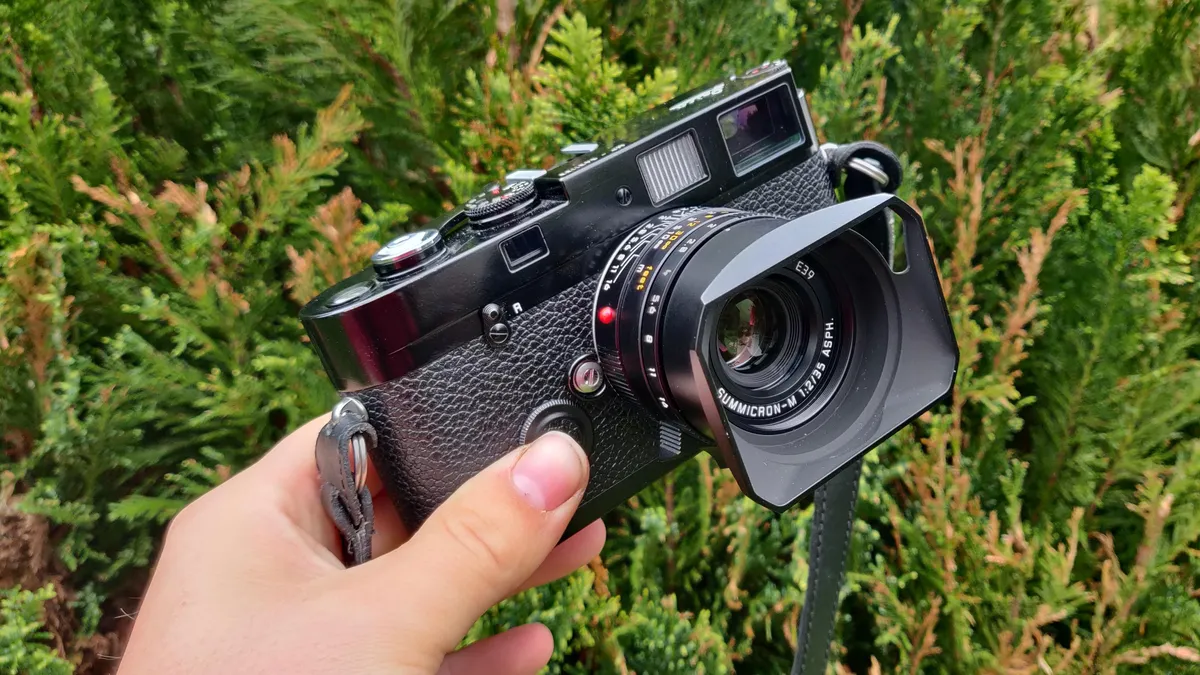
The Leica MP's iconic design, manual controls, exceptional performance, and immersive shooting experience make it a timeless and valuable choice for film photography enthusiasts and professionals.

If you want to shoot on larger 120 film without spending a fortune, then Lomography Diana F+ is a very affordable starting point. Just be aware that it's a plastic toy camera – the focus here is firmly on fun and creativity rather than pin-sharp image quality.
View the full list...

Canon AE-1's molded construction and new electronics made it one of the most successful cameras of all time – and today it is still going strong. Thanks to its popularity there are still lots of good quality copies out there on the secondhand market, which can be picked up for a very reasonable price.

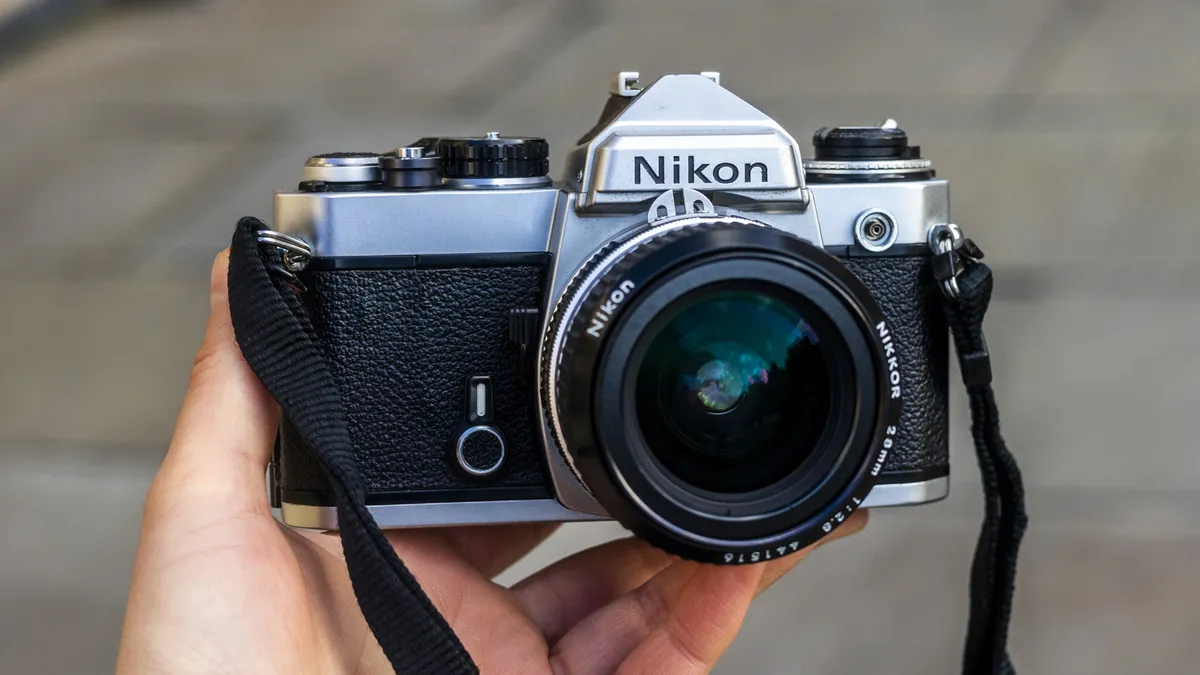
The Nikon FE is an advanced semi-pro 35mm SLR camera from 1978 to 1983 that has inspired the retro Nikon camera bodies of today. Easy to use, well-built, and also stunning to behold, this is one of the most iconic Nikon SLR cameras to have in your collection.

If you want a film camera that is an affordable but high-quality bit of kit to learn the basics of photography, then the Pentax K1000 has been the top choice for film students for decades and is still one of the best all-mechanical cameras to learn how t shoot film with.

Rangefinders take some time and practice to master, so they’re not to everyone’s taste – but for fans of the design, this is one of the all-time classic rangefinders, with a fixed 40mm lens that delivers superb image quality. There’s an issue to be aware of when it comes to batteries, though...

While some film cameras test your photography skills, others set out to make taking a shot as simple as possible – and this is certainly one of the latter. The only setting you need to think about is whether you want the flash turned on or off – then frame your shot in the high-quality f/1.9 lens.

You get a scant eight shots from each roll of film you put into the GW690, so you need to choose your shots with care – but that restriction opens up a new way of thinking about your photography, if you let it, and the f/3.5 90mm lens yields sumptuous results.
The best film cameras in 2026
Why you can trust Digital Camera World Our expert reviewers spend hours testing and comparing products and services so you can choose the best for you. Find out how we test.
• NEW FILM CAMERAS
Best film camera overall

Sample images


✅ You want a new, capable film camera: The Lomo MC-A is one of the few film cameras that offers autofocus and settings control, and can be bought new
✅ You want a camera that feels premium and sturdy: Unlike the many plastic point-and-shoots out there, the Lomo MC-A is a metal-bodied camera.
❌ You want interchangeable lenses: This is a fixed-lens compact, like all new film cameras – you'll need a used SLR if you want multiple lens options.
❌ You're on a budget: This isn't a hugely expensive camera, but it isn't cheap either, and there are point-and-shoots at a quarter of the price.
The Lomography Lomo MC-A was a delightful surprise for the analog photography community. Announced in late 2025, it quickly garnered enormous praise from reviewers and Instagrammers alike – and went on to pick up the EISA Analog Camera of the Year 2026/27 Award.
Why? Because the Lomo MC-A isn't just a new film camera – it's a proper new film camera. Unlike most of the new film cameras that debut in the 2020s, which tend to be plastic point-and-shoots, the MC-A is a proper compact with manual control of settings, an autofocus system and a premium metallic body that doesn't feel like it's about to fall apart.
As Gareth said in our full review, the MC-A is a surprisingly premium compact film camera. Its glass lens produces images that are sharp and vivid – not at the level of a proper SLR with its own lens, but still pretty damn good in a variety of situations. The zone-based autofocusing system really works, even if it is a little loud, and having the option to manually select zones for yourself further opens up creative opportunities.
Initial samples of the MC-A did suffer from some overlapping frames – Lomo assures us that this has been corrected for the latest batches. The lens does produce a little vignetting, but not enough to seriously compromise images, and it mostly just feels like the camera's character.
And that's what this camera really nails – feel. It's a fun, addictive camera to shoot with; its wind-on action is snappy and satisfying, and its slight but substantive-feeling build sits well in the hands. It can be easy to use on full auto, or more dynamically controlled with manual settings inputs. A triumph, and the best new film camera you can buy right now. I can't wait to see what Lomography does next.
Read our full Lomography Lomo MC-A review for more details

Final thoughts
The Lomo MC-A blends genuine style with bags of substance, and I'm very comfortable recommending it as the best new film camera you can buy. Its lens delivers both sharpness and character, and it nails a balance between ease of use and depth of control. If it's within your budget – which, at $499 / £499, it might well not be – it's a brilliant choice.
Best half-frame film camera

Sample images


✅ Ongoing cost of film is a concern: The half-frame format allows users to capture 72 images on a single roll of 36-exposure film, making it cost-effective.
✅ You want great results: The camera's lens delivers impressively sharp results and achieves incredible results out of its half-frame format.
❌ You want something more advanced: The minimal manual controls may limit creative control for seasoned photographers.
❌ You want something cheap: This is quite an expensive camera, and you can pick up second-hand classics for far less money.
The Pentax 17 was the first new film camera to come from a major brand in over 20 years, before the Lomo MC-A followed a year or so later, and the first camera to come out of Pentax's film project. While many might have expected something more akin to a Pentax K1000 or SLR camera – the Pentax 17 is a half-frame film camera, and is designed with a blend of nostalgic appeal and modern practicality, targeting both film enthusiasts and newcomers to analog photography.
The Pentax 17 excels in leveraging the half-frame format, allowing you to capture 72 images on a single roll of 36-exposure film – making expensive rolls of film stretch that little bit further.
Half-frame haters might well have to have a serious rethink after taking a look at what the Pentax 17 is capable of. The camera's lens, despite its modest appearance, delivers impressively sharp results and achieves incredible results out of its half-frame format. The 17's exposure system is also extremely consistent, and I got an incredibly good hit rate of usable photos which is a significant thing to consider given the rising costs of film and development leave little room for mistakes.
As a point-and-shoot, the Pentax 17 has minimal manual controls, which is ideal for those who prefer a straightforward shooting experience. However, the camera's simplicity might be a double-edged sword for seasoned photographers who desire a little more creative control. The lack of detailed feedback from the camera during exposure adjustments and the manual ISO setting could be limiting for those accustomed to more advanced features. On the flip side, these same attributes make it perfect for those who want a reliable, no-fuss camera.
Ultimately, the Pentax 17 strikes a balance between simplicity and performance, making it an attractive option for both casual photographers and those looking to dive into film photography without the complexity of fully manual cameras. Or for anyone looking for a film camera, but desperate to avoid the murky waters of the second-hand market.
Read our full Pentax 17 review for more details

Final thoughts
The Pentax 17 is a stylish and compact half-frame film camera that blends retro charm with modern usability. Its sharp 25mm f/3.5 lens, zone focusing, and vertical format make it fun and creative to shoot, while offering twice the exposures per roll. Though not fully manual, its thoughtful design and solid build make it a standout for anyone looking to enjoy film photography with a fresh twist.
Best budget half-frame film camera

Sample images


✅ You're on a tight budget: Not only is the half-frame format very cost-effective, but the camera itself is also very affordable.
✅ You want easy operation: The point-and-shoot settings of the Kodak Ektar H35N make it a very easy camera to pick up and use.
❌ You want top-notch image quality: The glass lens is better than the plastic lens in the original Ektar H35, but it's still not fantastic.
❌ You want to take control of your images: This is a very simple point-and-shoot – you can activate the flash or the star filter, but that's it.
If you like the sound of the half-frame Pentax 17 but find it to be way over your budget, then the Kodak Ektar H35N is a compelling alternative. An all-plastic point-and-shoot, the Ektar H35N costs around $52 / £67 and is a very simple affair. There are no settings controls and focus is fixed. However, I've found that it's capable of producing good-looking images – quite an improvement on the original Ektar H35.
The difference is in a glass lens: Kodak's (well, technically Kodak licensee Reto Project's) first run at this camera used an all-plastic lens, and its image quality was pretty poor. Getting 72 images out of a 36-frame roll of film may sound great, but if most of the images are fuzzy and indistinct, have you really made a saving? The glass lens on the newer version of the camera considerably ups its hit rate, as Jon found in our full review.
The Ektar H35N also has a built-in flash for close-quarters indoor shooting, and one interesting addition is the 'Star' filter. This creates a ‘four-beam flare’ when photographing strong light sources. A bit of a gimmick, maybe, but it adds a bit of intrigue to a camera that is otherwise a pretty simple affair.
Read our full Kodak Ektar H35N review for more detail

Final thoughts
The half-frame Kodak Ektar H35N is cheap to run like the Pentax 17 – and unlike the Pentax 17, it's also cheap to buy. It's a very limited camera, but its small, lightweight dimensions and ease of use make it a great choice for travel, parties and a more relaxed approach to film photography. It brings the vibes.
Best film camera for simplicity

Sample images


✅ You're new to film photography: With auto wind-on and point-and-shoot settings, this is one of the simplest film cameras around.
✅ You want something to take everywhere: The slim, attractive design of this camera makes it easy to slip into a pocket for everyday carry.
❌ You want settings control: This is another point-and-shoot affair.
❌ You like the physical action of winding film on: The Snapic A1's auto-winding is convenient, but many film photographers enjoy the physical action of a wind-on lever.
The slim, stylish Kodak Snapic A1 is film photography on easy mode. It's a point-and-shoot camera so streamlined that it even winds the film on for you, and features an LCD shot counter on the top plate that keeps count of your exposures. Once you're done, it'll take care of the rewind.
Necessary? Arguably not. But it does make for a satisfying smooth film photography experience. The Kodak Snapic A1 isn't the world's most sophisticated camera, but its glass-element lens with a two-zone focusing system produces images that are a cut above those of cheaper point-and-shoots, but its starting price of $99 / £99 still keeps it firmly within the affordable category.
There is also a multiple-exposure mode, though it's a bit confusing to activate, requiring the pressing of multiple different buttons labelled 'M.E.' in a specific order. The Snapic A1 also sports a built-in flash, as well as a pronounced textured grip on the right-hand side for an easy hold.
Interestingly, the lens on this camera offers a slightly wider focal length than is common on point-and-shoots – 25mm, rather than 31mm or 32mm. This provides a slightly broader perspective which can be great for frame-filling landscapes and cityscapes. Though it does mean if you're photographing a specific subject, it pays to get a little closer.
Read our full Kodak Snapic A1 review for more details

Final thoughts
The Kodak Snapic A1 is a point-and-shoot that makes shooting film very easy, but still offers enough image quality to be worth your time. Having the two-zone focusing system expands your shooting repertoire (though it takes some practice to get used to where the planes of focus sit), and the diminutive dimensions make it an easy camera to carry everywhere.
The best film camera you can buy new or old
Sample images


✅ You want a status symbol: Owning a Leica MP (new or old) has become the ultimate ‘you've made it’ symbol
✅ You love rangefinders: One of the best out there that Leica has just started to make again – with all the bells and whistles
❌ You're on a budget: To own this icon of photography, you are going to have to have deep pockets
❌ You find rangefinders tricky: For those not used to the rangefinder system, it can be a difficult thing to master
There is no denying that Leica knows how to make a stunning, iconic camera. Leica's M rangefinders are perhaps the pinnacle of that, with a world-renowned design that has proved so popular that the Leica MP is one of the few film cameras that can still be bought new.
I found the Leica MP’s shooting experience to be immersive and rewarding. The manual controls and mechanical feedback provide a tactile and engaging process, allowing photographers to feel deeply connected to their craft.
The Leica MP offers an unparalleled handling and performance experience that appeals to both analog enthusiasts and professional photographers. Its robust construction, intuitive controls, precise rangefinder, and reliable mechanical operation combine to create a camera that is both a joy to use and capable of producing outstanding photographic results.
While there are minor quirks, such as the front battery door and the absence of a shutter lock, these are easily overshadowed by the camera's overall excellence. For those committed to the art of film photography, the Leica MP is a timeless investment that promises a lifetime of exceptional performance.
Read our full Leica MP review for more details

Final thoughts
The Leica MP is a legendary 35mm rangefinder renowned for its exceptional build quality, precision, and timeless design. Fully mechanical and manual, it offers unparalleled control and reliability, making it a favorite among professional photographers and enthusiasts who value craftsmanship and classic film shooting. Compact and discreet, the MP delivers an unmatched shooting experience with Leica’s legendary optics.
Best budget 120 film camera

Sample images


✅ You want to shoot on larger-format 120 film: Providing a larger canvas than 25mm, 120 film has a distinctive character to it.
✅ You like a bit of hit-and-miss unpredictability: The Lomography Diana F+ places a firm emphasis on fun rather than pristine image quality.
❌ You want top-tier image quality: This is a camera based around distinctiveness and character, not pin-sharp images.
❌ You want something robust and sturdy: The Diana F+ is made from all plastic and creaks ominously during use – not one for rough-and-tumble adventures.
Shooting on larger 120 format film can be an expensive business, but the Lomography Diana F+ offers an affordable route in. A plastic point-and-shoot available for around $89 / £89, the Diana F+ is an all-plastic affair that puts a firm emphasis on fun rather than top-notch quality. We're a long way away from the premium metal build and sharp lens of the Lomo MC-A, that's for sure.
Inserting the film is a bit of a fiddle, but once you're loaded up and ready to shoot, you do have a few options. A four-way slider switch allows for aperture adjustments, with settings of cloudy, partially cloudy, sunny and pinhole, the latter producing a pronounced vignetting effect. A dial on the lens allows for switching between focusing zones, though given that you won't be able to see the effect previewed in the viewfinder, there's an amount of 'point-and-hope' to the process.
Still, the image quality is distinctive and quite charming, especially when you embrace the unpredictability of it all. Your final image is not going to be that similar to what you saw through the viewfinder, but that's okay. Plus, if you upgrade to the 'kit' version of the camera, you get a flashgun and a series of gels and other accessories, providing even more opportunities to get creative.
This is the cheapest way to get a new camera that shoots 120 film – though there are plenty of second-hand options comparable in price.
Read our full Lomography Diana F+ review for more detail

Final thoughts
While 120 film isn't the sort of format people normally associate with knockabout fun, if your budget can accommodate the idea of unpredictable shooting on this larger format, the Lomography Diana F+ is an enjoyable camera to use. The inclusion of a Bulb mode allows for experimentation with longer exposures, and embracing this kind of creativity is key to having a good time with this camera.
• USED FILM CAMERAS
Best iconic Canon film camera

Sample images


✅ You want to own an icon: The AE-1 is one of the most popular cameras in the film community
✅ You want automatic controls: With Shutter Priority, it's great for beginners to learn the basics
❌ You don’t like electric shutter controls: Make sure you have a spare battery: when it dies, so does your photoshoot
❌ You want solid construction: Crafted from heavy-duty plastic – I've never broken one, but it is not metal
The Canon AE-1 is one of the best-known 35mm film cameras ever made – and the first 35mm SLR to sell one million units. This was certainly no fluke: the AE-1 was a groundbreaking camera for the time. It was the first camera to include some of the electronic components that paved the way for digital cameras.
The Canon AE-1's plastic construction was also a first. New manufacturing processes meant the camera could be produced at scale, which kept the price affordable for novices and enthusiasts. However, this hasn't affected its reliability, as there are plenty of cameras still going strong (including my own) decades after release.
The AE-1 features an electronically controlled cloth focal plane shutter offering a wide and repeatable shutter speed range. This means it needs a battery to power its operation, but offers more potential consistency than mechanically operated shutters. Metering is carried out by a single silicon photocell, offering a center-weighted meter. The AE-1 was unusual for offering Shutter Priority automation at a time when most makers favored Aperture Priority operation.
The AE-1 Program was a later variant that added a fully automatic exposure mode. If you are a bit more of a novice when it comes to film photography, the Program version is a great camera to start with.
The AE-1 uses Canon's FD breech-lock bayonet mount, and also Canon's 'new' style FD lenses; there are plenty of these to pick up secondhand for cheap. It has since been superseded by the EF and RF lens mounts; adaptors are available for mounting these modern lenses, although you won't benefit from any new technology like autofocus and image stabilization.
Read our full Canon AE-1 review for more details
• Find used Canon AE1 deals on eBay (US)
• Find used Canon AE1 deals on eBay (UK)

Final thoughts
The Canon AE-1 / AE-1 Program is a classic 35mm SLR known for its blend of automation and manual control, making it great for beginners and enthusiasts alike. With versatile exposure modes and compatibility with a wide range of lenses, it offers reliable performance and creative flexibility. Durable and affordable, it remains a favorite for those wanting a proven, iconic film camera.
Best Nikon 35mm film camera
✅ You want compact: Thanks to its simple design, the Nikon FE is a great compact SLR to carry all day long
✅ You're on a budget: The FE is a great bargain, and can often be found under $200/£200
❌ You don't want to rely on batteries: For the FE's light meter and shutter to fire, you need a battery
❌ You want high shutter speeds: The highest shutter speed is 1/1,000, but others went to 1/8,000 in the same era
The Nikon FE is an icon of the film era – so much so that it has helped inspire Nikon's current range of retro digital cameras, which bear an uncanny resemblance to the Nikon Z fc. The camera has a design I can't help but fall for: with little touches of copper in the dials and faux-leather cladding on the pentaprism viewfinder, the Nikon FE is still a beauty that draws me to it.
The build of this camera is also renowned for being reliable, so some 30 years later these cameras should still be going strong (although might require some minor repairs like light seals). Our reviewer loved the viewfinder, finding it clear and bright, and the depth of field preview proved very effective.
Looks aren't everything, and thankfully the Nikon FE has the skills too. As an advanced semi-professional 35mm SLR camera with Manual and Aperture Priority shooting modes, it should suit anyone with a little camera know-how. Its shutter has a range of 1/1,000 sec to a maximum of eight seconds, while Bulb mode is mechanical and unlimited. Flash sync speed is 1/125 sec, while the ISO/ASA ranges from 12 to 3,200.
The camera can also be paired with Nikon's F-mount lenses – and luckily, this is one of the widest and best-selling lens ranges of all time, so you certainly won't have any trouble picking some up second-hand. There is a lens to suit everything from wide-angle street scenes to telephotos for wildlife and sports.
Manufactured by Nikon in Japan from 1978 to 1983, the Nikon FE is still a very capable SLR with a lovely design, and is perhaps the perfect model for those wanting to delve into film photography. Today, it's possible to pick up the Nikon FE secondhand for under $150 / £150.
Read our full Nikon FE review for more details
• Find used Nikon FE deals on eBay (US)
• Find used Nikon FE deals on eBay (UK)

Final thoughts
The Nikon FE is a durable, classic 35mm SLR that balances manual control with aperture-priority automation. Known for its solid build and compatibility with a wide range of Nikon lenses, it offers reliable performance and intuitive handling, making it a favourite for both beginners and experienced film photographers.
Best film camera for students

✅ You want mechanical: 100% mechanical - no batteries required
✅ You want reliability: The K1000 has a worldwide reputation for reliability and being built like a tank!
❌ You’re a photography beginner: Due to its manual-only operation, you need to know your exposure triangle or the Sunny 16 rule
❌ You want a timer: With no self-timer, you are limited in what shots you can take (and no film selfies)
The K1000's reputation has developed through what must have been seen at the time as simple cost-cutting. It was the cheapest of Pentax's DSLRs, and even had the self-timer and depth of field preview on other models removed, just to save money. It's an entirely manual camera, and although it does need a battery for its meter, the mechanical shutter will operate without one.
Generations of students have come to love this camera for its low cost, simplicity and durability, while generations of lecturers have chosen it for its purely manual controls and the way it forces you to learn exposure theory.
The K1000 uses the Pentax K bayonet mount still in use today (with some revisions for autofocus and electronics). This means that K1000 owners have decades of glass to choose from, giving a huge range of focal lengths and price points. Secondhand Pentax glass tends not to be overly pricey, so this adds another string to the K1000's educational bow: you can easily try out lots of different lenses without breaking the bank.
This might not be the film camera you carry through your whole life, but it is certainly one of the best cameras you can buy today to learn all about shooting film. The K1000's reputation and hipster desirability means the price has not sunk as low as some of the others on this list, though, but you should still be able to pick up a decent copy for below $150 / £150.
You may want to also consider the Pentax ME Super, a less famous but enduringly popular SLR that users an in-viewfinder metering system that's based on colored lights. I own one myself and am very fond of it.
Read our full Pentax K1000 review for more details
• Find used Pentax K1000 deals on eBay (US)
• Find used Pentax K1000 deals on eBay (UK)

Final thoughts
The Pentax K1000 is a legendary 35mm SLR prized for its simplicity, durability, and fully manual controls. With a rugged build and straightforward design, it’s an ideal choice for beginners learning film photography, while still offering the flexibility and reliability that enthusiasts appreciate. Its compatibility with a wide range of K-mount lenses makes it a timeless classic that remains popular today.
Best affordable rangefinder film camera

Sample images


✅ You value affordability: This is one of the most affordable rangefinders to try out the system - it is built well too!
✅ You like style: It has an amazing retro look that modern cameras can only dream about replicating
❌ You want a good light meter: Its original battery is now illegal, and alternatives make the meter a bit unpredictable
❌ You’re not fond of small viewfinders: It can be tricky to hit critical focus with its small viewfinder and focus patch
One of the best-selling cameras of all time, the Canonet G-III QL17 found huge success by being simple to use, offering superb image quality, and a stunning high-quality build for a reasonable price. All three of these still hold true.
In my opinion, the Canonet G-III QL17 is one of the prettiest rangefinder cameras out there, with a classic design in a small compact body – but it is built like a tank. Rangefinders aren't for everyone: they are notoriously trickier to focus on with their smaller viewfinders, but the more compact size has the benefit of being a more discreet camera when out shooting on the streets, or for slipping into a bag more easily while traveling.
The image quality from the fixed lens on the Canonet G-III QL17 is simply superb – and lives up to its reputation as ‘the poor man's Leica'. The lens is a fixed 40mm lens, which limits the camera's versatility compared with interchangeable-lens cameras – but 40mm is a useful length for day-to-day photography including travel, street and some environmental portraiture. The wide aperture of f/1.7 also means you can achieve some nice background blur and better low-light images.
Where this camera falls down today is with its ease of use – since the camera was released, the original batteries have been deemed illegal in most countries, for containing mercury. There are workarounds using zinc hearing-aid batteries, but this has led to an unpredictable light meter, requiring a bit more knowledge and practice to ensure your images are properly exposed.
Read our full Canon Canonet G-III QL17 review for more details
• Find used Canonet G-III QL17 deals on eBay (US)
• Find used Canonet G-III QL17 deals on eBay (UK)

Final thoughts
The Canon Canonet G-III QL17 is a classic compact rangefinder known for its sharp 40mm f/1.7 lens and quick-loading “quick load” film system. Lightweight and easy to use, it offers excellent image quality and manual controls in a small, pocket-friendly body - making it a popular choice for street and everyday photography enthusiasts.
Best point and shoot film camera

Sample images


✅ You want something simple: Stick in some AA batteries and enjoy the simplicity of shooting what you see - without the brain work!
✅ You’re happy to use AA batteries: Widely available all around the world, and cheap compared to camera-specific ones
❌ You want stealth: It is a rather loud camera when shooting and advancing film, so your best efforts to be stealthy could be wasted
❌ You shoot high-ISO film: Unfortunately, you can only shoot films with a max ASA/ISO of 400
The Canon AF35ML is a cheap and cheerful 35mm film camera for taking some quick snapshots without having to do all that much work. While this isn’t the coolest camera to come out of the film era, it has a following all its own.
The camera is fully automatic, including the focus, so you don't have to worry about any settings apart from whether you want the flash on or off. I think this camera is best described as the ultimate reloadable camera – the perfect camera for handing around at a party, on holiday, or even passing to a child, and knowing that you are going to get good results (providing they do a good job of framing, that is). Framing is made somewhat easier by the optical viewfinder; while it isn't the clearest viewfinder, it gives a good enough idea of the scene.
Other point-and-shoot cameras in this class can't hold a candle to the AF35ML's lens. With a f/1.9 aperture lens, it is much wider than usual, so can perform better in low light, as well as getting some nice subject separation. The lens is also higher-quality than the plastic-y build might suggest, and outputs clean and consistent photos. With built-in flash, it makes it great to take out at night as well.
This isn't a camera for capturing great artistry, but for capturing memories with ease, this is certainly a fantastic option. The AF35ML can usually be found for under $100 / £100, although sometimes decent copies can be found for half that.
Read our full Canon AF35ML review for more details
• Find used Canon AF35ML deals on eBay (US)
• Find used Canon AF35ML deals on eBay (UK)

Final thoughts
The Canon AF35ML is a compact, fully automatic 35mm point-and-shoot known for its sharp 40mm f/1.9 lens and motorized film advance. While its autofocus can be unreliable in low light and the motor is noisy, it remains a popular, easy-to-use choice for casual shooting and travel photography.
Best film camera for big negatives

Sample images


✅ You want big negatives: With 6x9cm negatives, this is the biggest you can shoot without getting into large-format
✅ You want portability: This is the most portable 6x9 camera out there – it's still massive, but it's manageable
❌ You want more than eight shots per roll: Film can be expensive, so you better make those eight shots per roll count!
❌ You prefer light over clunky: This is not a lightweight camera, and it can be rather bulky when you’re on the streets
The great thing about film, and especially medium-format 120-roll film, is that it's so flexible – both literally and metaphorically. The film rolls are 120mm wide, but it's up to the camera maker how much width they want to use.
6 x 4.5cm medium-format cameras shot rectangular images 'sideways' on a roll, whereas regular 6 x 6cm cameras shot square images so it didn't matter which way you turned the camera. Other cameras, like the RZ67 above and the Fuji GW690, shoot extra-wide images.
You get fewer exposures on a roll, but extra-large negatives and transparencies. The GW690 is a no-frills fixed-lens manual exposure camera that offers huge images in a comparatively portable package.
• Find used Fuji GW690 deals on eBay (US)
• Find used Fuji GW690 deals on eBay (UK)

Final thoughts
The Fuji GW690 is a sturdy medium-format rangefinder known for its sharp 90mm lens and exceptional image quality. While it lacks a built-in light meter and can be heavy, it delivers stunning 6×9 negatives that make it popular with landscape and large-format enthusiasts seeking top-notch results.
Best medium-format film camera

✅ You want medium-format: The 6x7 format is a fan favorite, and the RZ67 is a highly prized camera in this field
✅ You love shooting portraits: The RZ67 is renowned for being a fantastic portrait and studio camera
❌ You want something lightweight: Due to its design, the RZ67 is very bulky and rather heavy to carry around all day
❌ You want to shoot more: It only offers 10 shots per roll of 120 film; you might want to consider a 645 camera that offers a more economical 15/16 shots per roll
An evolution of the RB67, introduced in 1970, the RZ67 keeps the revolving back that gave the earlier system its name, and the just-off-square 6 x 7cm image area.
Just to put this in context, this is far larger than the 6 x 4.5cm area of the largest medium-format digital models today. Like the Hasselblad 500 C/M, the RZ67 is a modular camera with interchangeable lenses, viewing systems, and backs.
It's a bit big and heavy for extended handheld use, though, and it's best used on a tripod. High-quality medium-format film cameras are holding their prices pretty well at the moment, and you might have to shop around to get a working, affordable example.
• Find used Mamiya RZ67 deals on eBay (US)
• Find used Mamiya RZ67 deals on eBay (UK)
Final thoughts
The Mamiya RZ67 is a legendary medium-format camera prized for its modular design, rotating back, and exceptional image quality. With its large 6×7cm negatives and versatile lens options, it’s a favourite among studio and portrait photographers who demand precision and creative control. Though bulky and best suited for controlled environments, the RZ67 delivers professional-grade results that remain hard to beat.
How to choose the best film camera
Film cameras come in all shapes and sizes, from stripped-back mechanical tools to more modern bodies with electronic features baked in. The type of camera you choose depends largely on how you like to work - and what you want from your photographs. Lens compatibility, handling, and format all play their part.
Most people begin their journey with 35mm, and for good reason: it’s accessible, versatile, and firmly at the centre of film photography’s current revival. Whether you’re reaching for an SLR, a classic rangefinder, or a compact point-and-shoot (even a disposable), 35mm offers a familiar, manageable route into shooting on film.
As experience builds, the move to medium format often follows. These cameras use 120 film and produce significantly larger negatives than 35mm, resulting in crisper detail, richer tones, and greater resolution. Formats vary - from the popular 645 (6x4.5cm) through to 6x6, 6x7, 6x8, and even 6x9, as found in cameras like the Fuji GW690. The trade-off for this jump in quality is the number of shots per roll. A 645 camera will typically give you around 15 or 16 frames, while a 6x9 format might only offer 8 exposures before you need to reload.
Then there’s large format - the upper tier of analog photography. These cameras shoot on sheet film, most commonly 4x5 or 8x10 inches, and offer the kind of image fidelity and tonal range that simply can’t be matched elsewhere. With that, of course, comes a slower, more deliberate approach.
Every exposure requires a separate film holder, making this format best suited to those who value precision over spontaneity. It's not something you sling over your shoulder for a walk, but in the right hands, large format delivers images with extraordinary depth and detail.
What to look out for in a used film camera
Buying a used film camera can be challenging since warranties and the convenience of digital retailers are rarely available. Instead, you’ll need to develop a keen eye for spotting good deals among countless subpar listings. Platforms like eBay, second-hand marketplaces, flea markets, and yard sales can be goldmines - if you know what to look for.
Start by seeking out reputable sellers and dealers. Those with positive reviews or strong customer feedback are often a safer bet. Specialized dealers who focus on used cameras tend to be the most reliable, as they understand what makes a quality camera and how to avoid faulty ones. If the item is expensive, don’t hesitate to ask for additional details or photos.
One of the biggest issues to watch for is fungus. This mold thrives in humid conditions and can damage a camera’s glass elements, leaving spiderweb-like etchings that degrade image quality. Fungus inside lenses or camera bodies is difficult to remove without professional disassembly, so always request close-up images of any glass components before purchasing.
Examining the camera’s overall condition can also reveal its history. Check the film plate for scratches - many marks suggest heavy use, while fewer indicate lighter wear. Cosmetic signs of wear can also provide insight into how well the camera has been maintained.
Finally, ask for sample images taken with the camera. Seeing its output will confirm that it’s functional and meets your expectations. If everything checks out, congratulations - you’ve found a great addition to your collection!

