Digital Camera World Verdict
The clue’s in the name, as the Freewell The Real Multi Tripod 5-in-1 claims 5-way versatility. Actually, I count eight but for now, I’ll just say that this is possibly the most versatile support I’ve ever used, and I’ve used dozens of them. I’m impressed not only by the versatility, but also the speed, ease and intuitive nature of how the Freewell works. And it mostly works very well, apart from the center column becoming a bit wobbly when extended. Even so, it has a luxurious carbon fiber construction, making it a ‘real’ bargain at the price.
Pros
- +
Tripod, bipod, 2x monopod
- +
Tabletop tripod
- +
Hiking pole
- +
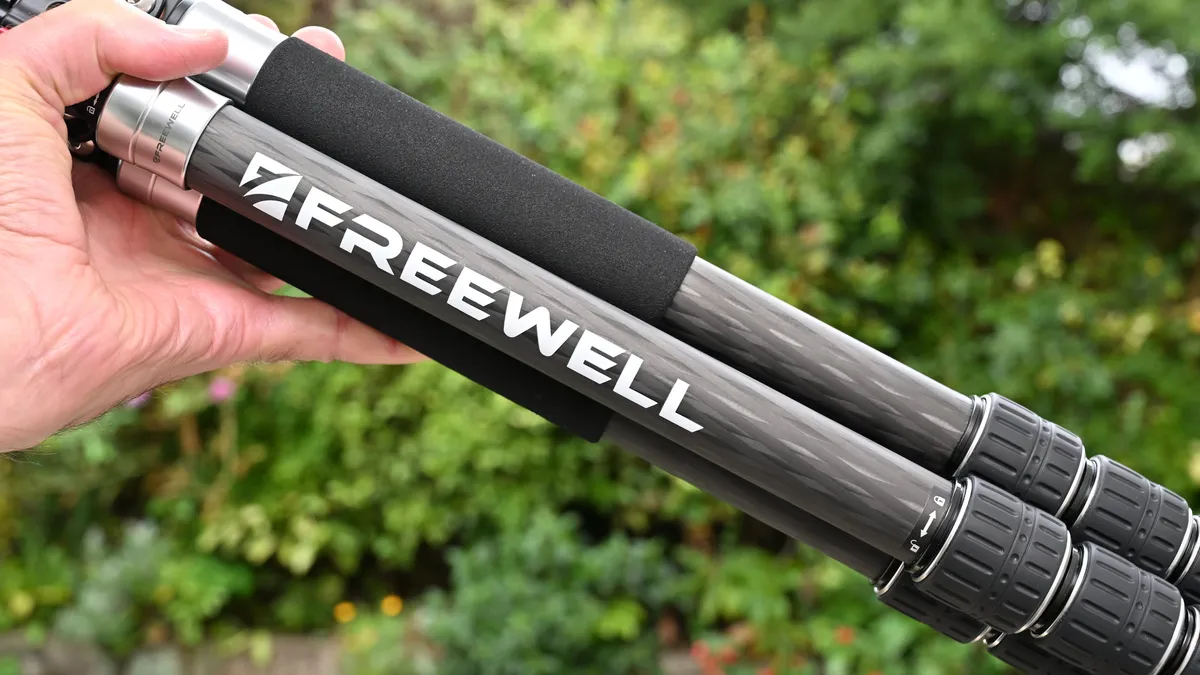
10-layer carbon fiber
- +
Dual-panning ball head
Cons
- -
Modest maximum height
- -
Center column lacks rigidity
- -
Bubble level obscured by QR plate
- -
Not particularly short when folded
- -
Lower payload rating for head
Why you can trust Digital Camera World Our expert reviewers spend hours testing and comparing products and services so you can choose the best for you. Find out how we test.
Based in Hong Kong, the Freewell company started out in 2012, aiming to entice creators and filmmakers with a range of products from camera gear, filters and lens hoods to accessories for smartphones, drones and action cameras. It launched its first tripod, ‘The Real Travel Tripod’ back in 2024 and has now followed on with The Real Multi Tripod 5-in-1.
Immensely versatile, the 5-in-1 is sufficiently compact and lightweight (and definitely slim enough) to qualify as one of the best travel tripods, while being tall and sturdy enough to be a contender as one of the best tripods for photographers. Even so, it’s not massively tall nor overly short when folded. Back on the plus side, it’s classy enough to eye up a place as one of the best carbon fiber tripods. True to its Multi Tripod name and design, it fits into multiple categories. Let’s take a closer look.
The Real Multi Tripod 5-in-1: Specifications
Material |
Carbon fiber |
Folded height |
55cm / 21.7in |
Maximum operating height |
157cm / 61.8in |
Minimum operating height |
17.5cm / 6.9in |
Folded diameter |
7cm / 2.8in |
Weight |
1.65kg / 3.64lb |
Load rating |
20kg / 44lb (10kg / 22lb head) |
Sections per leg/center column |
4 / 1 |
Section diameters |
28, 25, 22, 19mm |
Section clamps |
Twist locks |
Locking leg angles |
3 angles |
Feet |
Pads / spikes |
Case/bag included |
Padded bag |
The Real Multi Tripod 5-in-1: Price
For a complete carbon fiber tripod kit (and then some) that comes a sophisticated ball head and intriguing extras, Freewell’s The Real Multi Tripod 5-in-1 looks incredibly good value at $299 / £268 / AU$429. Another Chinese carbon fiber tripod I reviewed recently that’s actually two tripods in one, but lacks a monopod conversion, is the Heipi 3-in-1 Travel Tripod W28S, which is considerably more expensive at $399 / £349 / AU$649.
The Freewell’s space-saving center column design reminds of the Peak Design Travel Tripod carbon fiber, which is pricier again at $599 / £599 / AU$1,169, while the newer and thoroughly excellent Peak Design Pro Tripod costs a properly expensive $900 / £800 / AU$1,500. All in all, the Freewell gives you an awful lot of support for the money.
The Real Multi Tripod 5-in-1: Design & Handling
Catering to all sorts of needs and shooting scenarios, The Real Multi Tripod’s 5-in-1 remit covers use as a regular photographic tripod, a tabletop tripod, a monopod, a hands-free monopod with triple-foot base, and a walking pole. If you’re feeling generous, you could also add smartphone tripod and selfie stick to the list, thanks to the cunning Arca-Swiss quick-release plate that doubles as a phone mount. You could also use it as a tactical bipod, bringing the total up to eight and making it an 8-in-1 support. How does it do all of that? Let’s dive deeper.
Despite having a slim, travel-friendly profile, which I’ll come back to later, the 5-in-1 doesn’t claim to be a travel tripod as such. Like Freewell’s actual ‘The Real Travel Tripod’, it doesn’t have the kind of swing-up, space-saving legs that are now typical of travel tripods. I don’t mind that at all, because the business of fully extending the center column and swinging the legs up around it adds to the pack-away time, as well as the setup time next time around. And thanks to its 4-section legs, the 5-in-1 still has a reasonably small stowage height of 55cm / 21.7in.

Delivering a strong payload rating of 20kg / 44lb, the legs have chunky top-section diameters of 28mm. And because there are four rather than five sections in each leg, the bottom sections retain a fairly wide diameter of 19mm. I’m dubious about the strength of some 5-section tripods, which have relatively thin and spindly bottom sections. Releasing and locking each section is based on quick-action twist locks, and they really are quick, requiring very little rotation to release or securely lock them.

It’s similarly quick and easy to select any of the three available leg angles, which equate to 22, 55 and 85 degrees from the vertical. The lock/release mechanism is a simple pushbutton arrangement at the top of each leg. And they’re easy to see, thanks to having the same bright red coloring as the controls in the ball head. The multiple angles enable you to work around obstacles or on tricky terrain, and splaying them to wider angles aids stability in low-height setups.

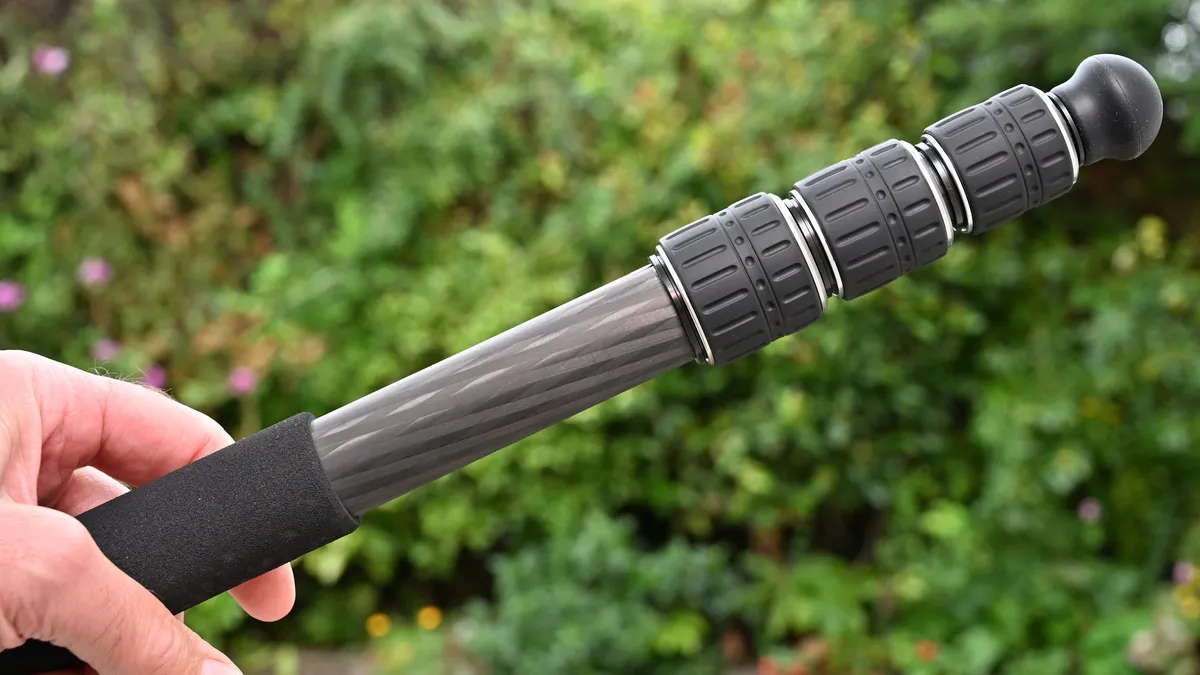
It’s quite common nowadays for tripods to feature a removable leg. The idea is generally that you can remove the leg, attach it to the (also removed) center column, and transform the tripod into a monopod. It’s a neat idea, as it adds versatility without requiring you to pack and carry an extra bit of kit. The Freewell goes one, or perhaps two better, in that you can remove any and all of the legs. Remove one leg and you can use the tripod as a bipod. You can also attach the head directly to the top of the detached leg for monopod duty. The absence of the center column in the monopod setup limits the maximum height, but you can actually join two or even all three legs together if you need extra height.

Getting back to the uncommonly slim folded size, the tripod uses the same trick that I’ve seen in Peak Design tripods. As such, the center column has a triangular cutout profile that avoids any wasted space, because the legs fold around it more tightly. Unlike in Peak Design tripods, the legs themselves still have a circular profile rather than being arc-shaped to fit even more snuggly around the center column, but the folded diameter is still remarkably slim at just 7cm / 2.8in.

Unscrew the weight hook from the bottom of the center column and it reveals a built-in allen key. With the weight hook unscrewed, you can completely remove the center column and invert it for ground-level shooting, albeit with the camera upside down.

A better option for ultra-low-level shooting is that you can use the allen key to loosen a screw in the center column and split it in two, enabling you to splay the legs and go really low without the center column digging into the ground. This way, you can still shoot with the camera the right way up.

The tripod feet are fairly large rubber pads which offer good grip and support on most surfaces. As with most parts of the tripod, they have more than one function and you can unscrew one of the pads and attach it up on top, for grip and comfort, if you’re using a detached leg or two as a trekking pole.

If you’d rather have metal spikes for digging into soft ground, all you have to do is unscrew the rubber pads to reveal them. You can also use the allen key to unscrew the spikes as well, if you want to fit alternative footwear or join two or more legs together for a longer monopod.

The chassis that connects the three legs together at the top of the tripod is made from aluminum and is suitably sturdy. Again, it goes the extra mile in terms of versatility, and includes two accessory sockets. These have a standard 1/4-inch thread, enabling you to attach magic arms, LED lights, a monitor screen or other accessories.

No tripod kit is complete without a head and the Freewell comes with a durable ball head that, yet again, is impressively versatile. However, it’s arguably not an ideal match for the legs, as it has a relatively modest 10kg / 22lb payload rating, which is only half that of the legs, the latter being rated at 20kg / 44lb.

The largest control knob in the head is the main ball joint lock/release. There’s no separate friction adjuster but it works well on its own and the socket that the ball fits into has the usual cutout on one side. This enables swapping from landscape to portrait orientation shooting in the absence of an L-bracket, as well as for shooting directly upwards or downwards.

Making the tripod suitable for panoramic sequences of stills and even videography, the head has dual panning mechanisms, one at the bottom and the other at the top. The bonus here is that if your legs are perfectly leveled, you can use the main bottom panning mechanism. You’ll soon see if they’re not perfectly leveled and you’ve compensated by just leveling the head, because your horizon will start to slant when you begin panning. As there’s no leveling base featured in the tripod and leveling the legs can be a time-consuming chore, you can simply use the head’s upper panning mechanism instead, which will keep your horizon straight and true.

As a leveling aid, there’s a bubble level built into the head’s camera platform. It’s a useful addition but it’s frustrating that you can’t actually see it when the quick-release plate is attached to the platform. You therefore need to remove your camera every time you want to use the bubble level. In fairness, I tend to use the electronic ‘virtual horizon’ instead, which is available in the vast majority of modern cameras and tends to be more accurate and precise than using a tripod’s bubble level.

Even the Arca-Swiss compatible quick-release plate is based on a crafty bit of design. It works as expected with a camera or anything else with a standard 1/4-inch treaded socket. However, it also features hinged panels at each end and spring-loaded sliding rails. The upshot is that you can also use the QR plate as a phone mount, thus attaching your phone to the tripod or monopod, or using the latter as a selfie stick.

Tools supplied with the tripod comprise an additional, carabiner-style weight hook and three allen keys. The allen keys are in addition to the one that’s built into the center-column’s fitted weight hook.

Everything’s wrapped up in a stylish, high-quality padded carrying bag. The bag comes complete with handles that lock together with a Velcro pad, plus a removable shoulder strap. The inside of the bag features a long, secondary zippered compartment for holding the various tripod accessories.

But before we grab the bag and go outside, there’s yet another tricked up design flourish. I’ve seen tabletop conversion in full-sized tripods before, mostly from 3 Legged Thing, like my trusty 3 Legged Thing Winston 2.0, for which you can buy optional Vanz footwear to make the change. The table tripod conversion legs for the Freewell are supplied ‘free’ as part of the package, and they also have a relatively high-end design, complete with dual-section extension and handy twist-action leg locks. They’re more like a miniaturized set of regular tripod legs than a cheap and basic add-on.

The Real Multi Tripod 5-in-1: Performance
Performance is mostly very good but not entirely great. Setup speed is certainly very quick, thanks to Freewell avoiding the temptation of travel-style, swing-up legs. The twist-action leg clamps also work with minimum fuss and bother, and while there are three of them in each leg, it’s easy to grasp all of them in one go when the leg sections are all retracted. The ball head also works with smooth efficiency and its dual panning mechanisms give a performance boost when shooting panoramic sequences of stills or for videography. The multiple leg angles offer greater stability for shooting at fairly short heights.

My main criticism in terms of performance is that even with four sections in each leg rather than three, the maximum height feels a little limited. Naturally, it’s a trade-off because if the maximum operating height was taller, the folded height would be less compact and the tripod would be less travel-friendly. Either way, I often found that I needed to raise the center column to achieve the shooting height that I wanted. The legs on their own are fairly but not massively resistant to vibrations. However, the center column feels relatively wobbly and lacking in rigidity when extended.

While rigidity could be better at maximum extension, the tripod delivers solid performance for ultra-low-level shooting. Splitting the center column and splaying the legs to their widest angles enables you to get right down to virtually ground level.

I’ll admit to being quite tall at 6ft 5in. As I mentioned earlier, you can’t join one of the legs to the center column for monopod duty and as a result, I found that adding the head directly to one leg didn’t give me enough height. The problem is solved by joining two or even three legs together, which enables a huge maximum height, but it’s a bit more fiddly as you have to remove both parts of the rubber pad and metal spike feet from the upper joining tripod legs.

One of the five modes on offer is described by Freewell as a ‘hands-free monopod’ monopod. I don’t feel brave enough to take my hands away for more than a second or two but the ability to connect the short tabletop legs to the chassis and use it as a base for the monopod does add a firm footing. In this respect, you get the added stability of using a three-footed pole like with the Benro A48FD Monopod.

For landscape photography in the wilds, negotiating tricky terrain can be more problematic than carefully composing the shot when you finally reach your destination. Again, the Freewell comes to your aid, serving as a trekking pole as well as a tripod or monopod. The trekking pole configuration is essentially the same as the monopod setup, except that you can attach one of the rubber feet to the top for comfort, instead of fitting the head. Down below, you can use either a rubber pad or a spike at the bottom, depending on the type of ground that you’re covering.

The Freewell can serve as a tripod, monopod or selfie stick for your smartphone. You won’t need an additional phone mount, as the supplied Arca-Swiss compatible quick-release plate converts into a self-contained phone mount. It’s spring-loaded with hinged sides, and gives a safe and secure grip.

Last but not least, this full-sized tripod works particularly well as a mini-tripod or tabletop tripod. Unlike many of its kind, it features adjustable carbon fiber legs based on dual sections with a twist-action clamp. Couple that with the three leg angles enabled by the tripod chassis and you get a generous range of adjustment.

The Real Multi Tripod 5-in-1: Verdict
There’s a lot to love about the Freewell The Real Multi Tripod 5-in-1. It definitely lives up to its claims with amazingly versatile, multiple modes. Better still, it’s highly effective in all of them, as a regular tripod, tabletop/mini tripod, monopod, monopod with feet, trekking pole and smartphone support.
The build quality looks and feels very good, based on luxury 10-layer carbon fiber and an aluminum alloy chassis. Everything works with smooth simplicity, enabling quick and intuitive setup and similarly straightforward takedown. The ball head follows suit, and I like that it has dual panning mechanisms. As an incredibly comprehensive, multi-mode tripod with a premium build, the Freewell is outstanding value for money.
I’d give it top marks, but for a few little niggles. The maximum height is fairly modest and the folded length isn’t particularly compact. I can live with that, but I found that the center column was quite wobbly at anything more than slight extension. And while the legs have a payload rating of 20kg / 44lb, it’s only 10kg / 22lb for the head. That should still prove sufficient however, as you’re unlikely to have a camera outfit that weighs more than 10kg /22lb, and the extra payload rating of the legs enables the fitment of accessories via the additional mounting ports, and hanging ballast off one or other of the weight hooks. All in all, the Freewell is a pretty remarkable tripod.
Features ★★★★★ |
The Freewell is positively brimming with features, working as a tripod, tabletop/mini tripod, monopod, monopod with feet, trekking pole and smartphone support. |
Design ★★★★★ |
It’s a really clever design, in many and varied ways. The tripod is endlessly adaptable with intuitive ease of use, and it has a luxurious 10-layer carbon fiber build. |
Performance ★★★★½ |
Performance is mostly very good but the center column is a bit wobbly when extended, which impacts on the rigidity of the tripod at or near its maximum operating height. |
Value ★★★★★ |
Compared with broadly similar tripods that don’t actually offer as many operating modes, the Freewell is standout value for money. |
Overall |
★★★★½ |

Alternatives