Digital Camera World Verdict
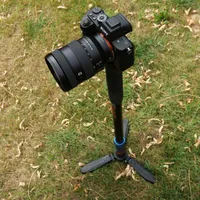
One of the little luxuries that I like about the Benro A48FD Aluminum Monopod is that it doesn’t fall over if and when I let go of it. I wouldn’t trust an expensive camera kit to that particular exercise, but this monopod with its foldout 3-leg base gives really solid support. It’s also very versatile, designed to be eminently suitable for both video and stills, beautifully built and insanely great value at the price.
Pros
- +
Ideal for video and stills
- +
Removable, 3-legged stand
- +
Solid support
- +
Quality construction
Cons
- -
Not the tallest
- -
Not the lightest
- -
Not carbon fiber
- -
No head included
Why you can trust Digital Camera World Our expert reviewers spend hours testing and comparing products and services so you can choose the best for you. Find out how we test.
Benro is a Chinese creator of pro-grade tripods and other photography and videography supports. The company has been going strong for 30 years and counting, and I’ve personally paid cash money for some of its products over the last 10 years or so. I’ve been very happy with all of my purchases, being continually impressed with the craftsmanship, quality and dependability, throughout heavy use over long periods of time. Items in my collection include the lofty but super-sturdy carbon fiber Benro TMA38CL Mach3 9X CF Series 3 Long Tripod, the Benro GH2N gimbal head for the joy of movement, the Benro SupaDupa Pro MSDPL46C carbon fiber monopod, and the highly ingenious, ultra-versatile Benro FS20PRO Hybrid Video & Foto Head.
The Benro A48FD Aluminum Monopod that I’m reviewing here might not be ‘SupaDupa’, but it’s still packed with clever tricks. Benro bills it as a lightweight flip-lock video monopod that’s ideal for small cameras, with a 3-leg locking base that includes a ball joint for smooth and stable shots, along with reverse folding legs for compact travel. I’d agree with all of that, although I really don’t feel it’s only ‘ideal for small cameras’. I think its 20kg / 44lb payload rating makes this monopod tough enough to support even the heaviest of cameras mounted with long lenses. All in all, it aims to be one of the best monopods on the market, and quite possibly the best value for money.

Benro A48FD Monopod: Specifications
Material |
Aluminum |
Folded height |
56cm / 22in |
Maximum operating height |
164cm / 64.6in |
Weight |
1.07kg / 2.36lb |
Load rating |
20kg / 44lb |
Leg sections |
4 |
Top plate |
55mm / 2.17in |
Feet |
3-leg base + rubber pad |
Case/bag included |
Padded bag |
Benro A48FD Monopod: Price
I recently tested and reviewed the rather excellent Benro MSD46CB Black Diamond SupaDupa Monopod, a heavy-duty monopod with a heavy-duty price tag of $170 / £180. I’d have bought one myself if I didn’t already have the older Benro SupaDupa Pro MSDPL46C in my supporting cast. Shortly afterwards, I spotted this aluminum monopod kit with added extras in the shape of a 3-leg base for the bargain price of just $99 / £59, and the deal was done. It seems outrageously great value, especially in the UK, and for me, it’s a worthy additional monopod that I can use for hybrid shooting. Further investigation revealed the full list price in the UK is actually £120, but even at that price, it's reasonable value.
If you’re feeling flush, there’s also the Benro SupaDupa Pro MSDPL46C carbon fiber monopod, which lists at a much more expensive $209 / £209. This kit doesn’t include a 3-leg base but does come complete with a leveling head that’s useful for panning when shooting video or stills.
Benro A48FD Monopod: Design & Handling
The full title of this monopod is the Benro A48FD Series 4 Aluminum Monopod with 3-Leg Locking Base, which pretty much gives the game away and doesn’t leave much to the imagination. Even so, it’s imaginatively designed to be genuinely supportive for both videography and stills photography. It’s a bit like the best bits of a monopod and tripod all wrapped up into one convenient package, able to stand on its own three feet while giving a helping hand to panning and tilting, so you can go steady while tracking the action.
Let me start by saying what this monopod is not… It’s not carbon fiber. Even so, it has a high-quality aluminum build. It’s just that it’s also nearly twice the weight of the carbon fiber Benro MSD46CB Black Diamond SupaDupa Monopod that I mentioned earlier, although that monopod doesn’t include a 3-leg base. Either way, the aluminum model isn’t exactly heavy, at a very manageable 1.07kg / 2.36lb, and that’s with the 3-leg base fitted.

There are four leg sections in all, enabling the monopod to rise up from a fairly compact 56cm / 22in folded length (or minimum height) to a maximum operating height of 164cm / 64.6in. Sure, it’s not the tallest monopod in the world, but I’m 6ft 5in and found that it was tall enough for me to use comfortably without stooping. Naturally, if you add a monopod/tripod head of your choosing, you’ll gain an extra few inches in maximum height. More on that later.

Each of those four leg sections is pretty beefy, with diameters of 36.2, 32.4, 28.6, and 25.2mm, as measured from fattest at the top to the thinnest at the bottom. The four sections come complete with three flip locks, again differing from the SupaDupa design, which mostly employs twist locks with just one flip lock at the top. I’m fine with flip locks throughout, especially as they work with smooth but solid efficiency.

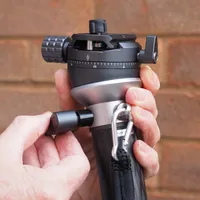
I’ll come to that 3-leg stand in a moment, but let’s start at the top and work our way downwards. The circular platform for mounting a camera or head has a sizeable diameter of 56cm / 22in. Given the monopod’s aspirations towards videography and panning for stills, I’m pleased that there are no less than three grub screws featured in the platform to securely lock a head in place if you fit one. I just hate it when a head starts unwantedly unscrewing when I’m panning in a counter-clockwise direction.

Another neat thing about the platform is that it features a reversible screw, so you can use it for mounting cameras or heads with either a standard 1/4in or 3/8in thread. A spanner is provided along with some other tools for removing, inverting, and securely refitting the mounting screw in either orientation. While that’s in process, you can also remove the platform for securing or releasing the grub screws, and detach the wrist strap on its circular metal collar if you’d rather not use it.

A plus point of aluminum compared with carbon fiber is that it’s not prone to shattering if it gets a sharp knock (accidentally, of course). A minus point is that it feels relatively cold to the touch, which can be an issue in chilly weather if you’re not wearing gloves. With that in mind, there’s a generous length of comfort padding applied to the top tube, and very comfy it feels too, being not too firm and not too squishy.

Enough beating around the bush. Let’s get onto that 3-leg stand, which is indeed a pretty standout feature of the kit. The complete assembly fixes to the bottom of the monopod in the same way that you’d attach a regular foot pad or spike, via a single threaded socket. However, each of the legs within the assembly is mounted on its own separate hinge. You can therefore rotate each of the legs down from their folded-up position, so that they stick out laterally, ready for action. They lock in place automatically when you reach full extension, thanks to the inclusion of spring-loaded pins. The head of each of the three incumbent pins has the word ‘Push’ engraved in the top, and, sure enough, you simply push them in to unlock each leg and fold it up again.

The fact that the legs fold upwards means they don’t add anything to the stowage length of the monopod, unless you extend the bottom section to enable them to fold flush with the tube, rather than over the flip locks.

A smart feature of the 3-leg assembly is that it has a ball and socket joint at the top. An anodized red twist clamp enables you to lock or release the joint. When locked, it keeps the monopod standing upright, or at your preferred angle to the vertical. When unlocked, the ball joint enables tilt and panning for shooting stills or video. There’s a full 360 degrees of panning on offer, but the tilt range is relatively limited.

Although the 3-leg base is a major feature of the kit, there are times when it’s more convenient to ditch it altogether and use the monopod in time-honored fashion, with just a single foot. With that in mind, you can simply unscrew the 3-leg base and detach it altogether, stowing it away for safekeeping.

For regular monopod duty without the 3-leg foot in tow, the kit comes complete with a regular and impressively chunky pointed rubber pad. It simply screws into the bottom of the monopod in place of the 3-leg base. A metal spike is available to buy as an optional extra if you’d prefer that for working on loose ground.

For making adjustments to any of the flip locks, removing and refitting the platform, and for other running repairs or alterations, the monopod is supplied with a spanner and three hex keys of different sizes. There’s also a clip that you can attach to the top tube, for holding the largest of the hex keys and for tethering a cable that’s running down from your mounted camera.

I’ve seen plenty of expensive, luxury tripods and monopods from certain manufacturers that are supplied without a carrying bag (stand up and be counted, Manfrotto). I’m impressed that despite the cut-price tag on this Benro monopod, it’s nevertheless supplied with a high-quality soft case, complete with an adjustable shoulder strap and an inner zippered pocket for stashing the set of tools.

Benro A48FD Monopod: Performance
The Benro monopod is short enough for me to use on my hands and knees, if I feel the need. That also means it’s not too big or heavy to carry around easily. That’s a big performance factor in my book, as unwieldy kit is likely to be left at home when I’m out and about, where it’s of no use whatsoever.

For more practical purposes in general shooting, the Benro extends to a fairly generous height so that I can use it without stooping, and I’m a pretty tall guy (well, tall if not pretty). Maximum extension is a stern test for any monopod or tripod, because it makes use of the thinnest legs and all of the joints, each of which is a potential point of weakness. I’m pleased that the Benro feels really rigid and resistant to unwanted flexing and vibrations, even at its maximum operating height.

Last but not least in the performance stakes, given the hybrid video/stills nature of the monopod, is its ability to enable tilting and panning. I’d say that the system works, but that it’s good rather than entirely great. I found the range of tilt to be a little limiting, and panning was prone to catching occasionally, rather than having a fluid and free-flowing action. The remedy for both of these niggles comes in the shape of a pan and tilt head, which you can buy separately and fit to the monopod.
I’d heartily recommend the Benro FS20PRO Hybrid Video & Foto Head, which I actually bought for use with this and other monopods and tripods, and it’s been serving me thoroughly well. It’s a ball head that also includes independent tilt and panning locks with a nice fluid action. There’s even a secondary panning mechanism up on top, which is especially useful for rotating the Arca-Swiss top clamp to suit either a long lens with a tripod mounting collar, or a camera with an L-bracket or cage.

Benro A48FD Monopod: Verdict
I really like that the Benro A48FD Series 4 Aluminum Monopod with 3-Leg Locking Base amply caters to my every whim. Sometimes I want the extra stability and secure footing of a 3-leg base. Other times, I prefer the slimline and unrestricted placement of a single foot. The Benro does both, thanks to the inclusion of a 3-leg base and an alternative chunky rubber foot, which are quickly and easily swappable.
In other respects, the Benro continues to impress, with solid and sturdy performance, fast and simple adjustments, and a good range of operating heights enabled by its chunky 4-section design. Sure, it lacks the luxury of a carbon fiber monopod, but this aluminum stick is cleverly designed, smartly finished, and works a treat. All in all, it’s great for shooting both video and stills, and it’s an absolute steal at the price.
Features ★★★★½ |
There’s a host of features, including the interchangeable 3-legged stand and single rubber foot, but the kit doesn’t come complete with a monopod head. |
Design ★★★★½ |
Crafty design makes the Benro really useful and a joy to use for both video and stills, backed up by solid build quality. |
Performance ★★★★☆ |
Performance characteristics combine effective tilt and panning with solid and secure support. Panning could be smoother but ideally you’d add a compact video head. |
Value ★★★★★ |
Not just an adjustable pole, the Benro includes interchangeable footwear, tools and a smart padded carrying case, making it standout value for money. |

Alternatives