Digital Camera World Verdict
The Vanguard Veo 5 264CO ticks every single box on my wish list for a spotting scope tripod. It’s sufficiently compact and lightweight to carry around for hours on end (complete with its own padded bag), yet extends to a generous maximum height when in use. It has a luxurious feel-good factor, and it’s quick and easy to set up, adjust, and pack away again, except that you need to remove the panning handle to fit the tripod fully into its bag. All in all, it’s a practically perfect spotting scope tripod, but it doesn’t come cheap.
Pros
- +
Lightweight and fairly compact
- +
Generous maximum height
- +
Luxury carbon fiber build
- +
Smart 2-way pan head
- +
Quick and easy to use
Cons
- -
Pretty pricey
- -
Panning handle impedes packing
Why you can trust Digital Camera World Our expert reviewers spend hours testing and comparing products and services so you can choose the best for you. Find out how we test.
Vanguard and I go back a long way. I’ve been testing and reviewing its kit for the last 20 years or so, and have generally been very impressed along the way. If you’re not so familiar, allow me to make the introductions… Vanguard is a global company with headquarters in Myanmar and branches in many countries around the world. It’s been making high-quality tripods and other photographic accessories, as well as the likes of binoculars, spotting scopes, backpacks, and gadget bags, building up an extensive catalog over the last 40 years or so.
Although Vanguard has a very diverse range of products, it’s always tripods that first spring to mind when I think of the company. The Veo 5 264CO is a case in point, but unlike most of the range, it’s designed for spotting scopes rather than for photography or videography. As such, it’s geared towards high-magnification scopes that you might use for birdwatching, wildlife and nature, target sports and hunting, surveillance and tactical use, and even for astronomy. With its upmarket carbon fiber build and 2-way pan head, the Veo 5 264CO kit aims to be one of the best spotting scope tripods on the market.
Vanguard Veo 5 264CO: Specifications
Material |
Carbon fiber |
Folded height |
58cm / 22.8in |
Folded diameter |
7cm / 2.8in |
Maximum operating height |
167cm / 66in |
Minimum operating height |
21cm / 8.2in |
Weight |
1.92kg / 4.2lb |
Load rating |
8kg / 17lb |
Sections per leg |
4 |
Section diameters |
26, 23, 20, 17mm |
Section clamps |
Twist locks |
Locking leg angles |
3 angles |
Feet |
Pads / spikes |
Case/bag included |
Padded bag |
Vanguard Veo 5 264CO: Price
The Vanguard Veo 5 264CO sells for around $399 / £280 / AU$399. As a premium carbon fiber full kit, that’s pretty reasonable compared with another of the favorite luxury kits, featured in our best spotting scope tripods buying guide. That’s the 3 Legged Thing Winston 2.0 Kit, which costs around $499 / £339 / AU$629. For my money, the Winston is more of a photographic tripod anyway, and its ball head is less ideal for spotting scopes.
If the Vanguard carbon fiber kit is beyond your budget, there’s a more ‘affordable’ Vanguard Veo 5 264AO aluminum version that costs rather less to buy, at around $349 / £220 / AU$299.
Vanguard Veo 5 264CO: Design & Handling
Even the very best spotting scopes don’t tend to be particularly weighty, unlike a camera fitted with a monster telephoto lens. Nearly all of the scopes I can think of weigh less than 2kg / 4.4lb, most are 1kg / 2.2lb or less, and some only weigh about 0.5kg or about a pound. Suffice it to say that you don’t need a tripod with a mighty maximum payload rating. Some photographic tripods, like the Winston 2.0 that I mentioned earlier, have a 40kg / 88lb payload rating, which is frankly overkill for a spotting scope.
You might think that the 8kg / 17lb payload rating of the Veo 5 that I’m reviewing here is much more than you need. However, I wouldn’t go too flimsy. Due to the high-power magnification of spotting scopes, you still need a tripod that’s going to be rigid and resistant to vibrations, which can be hugely magnified when you look through the eyepiece. The extra payload rating also gives you scope, so to speak, to add ballast, which can steady the tripod in windy conditions.
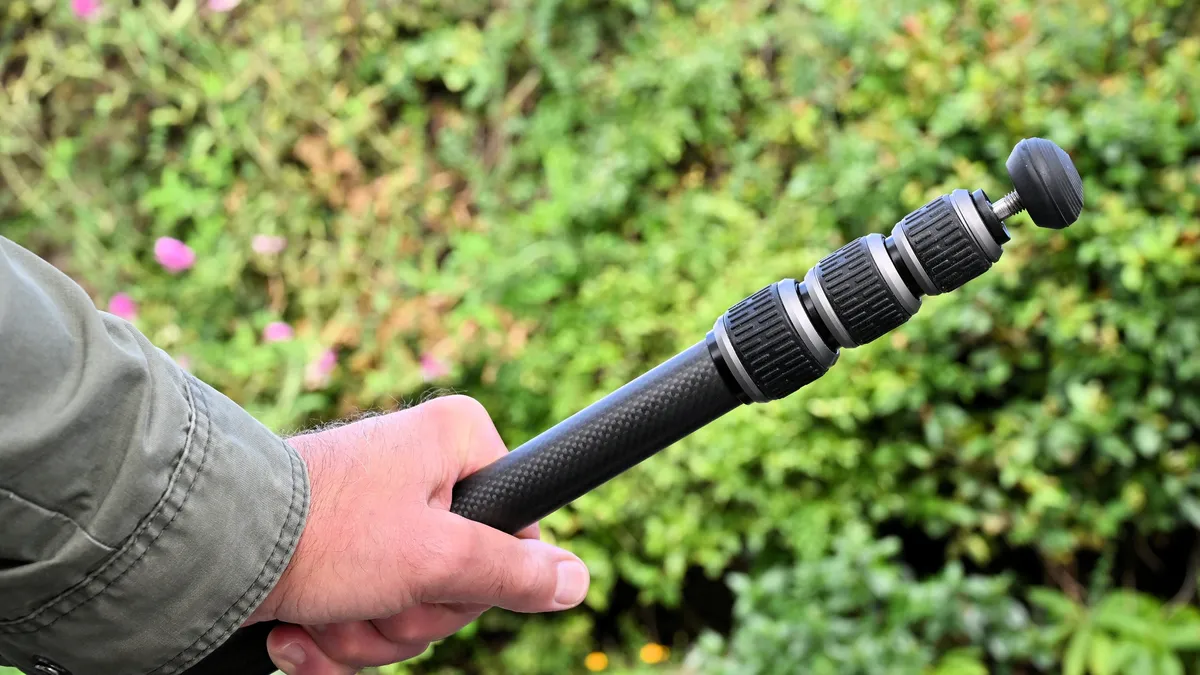
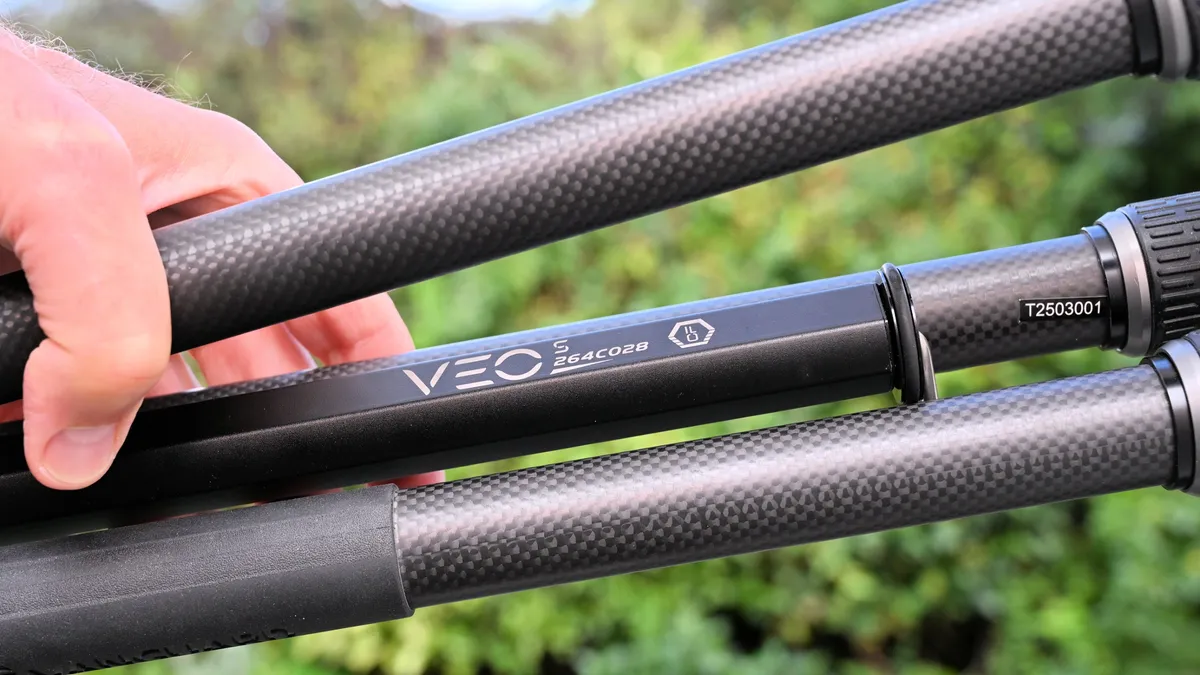
Sturdiness is enhanced by Vanguard’s decision to use a fairly chunky outer leg section with a diameter of 26mm. I think that’s a good compromise between sturdiness and not making the tripod too heavy to carry out in the wild. A little bonus is that one of the upper sections also features a rubber comfort pad, often omitted in carbon fiber rather than aluminum tripods. It not only makes the tripod more comfortable to carry, but also makes it feel less slippery in wet weather.
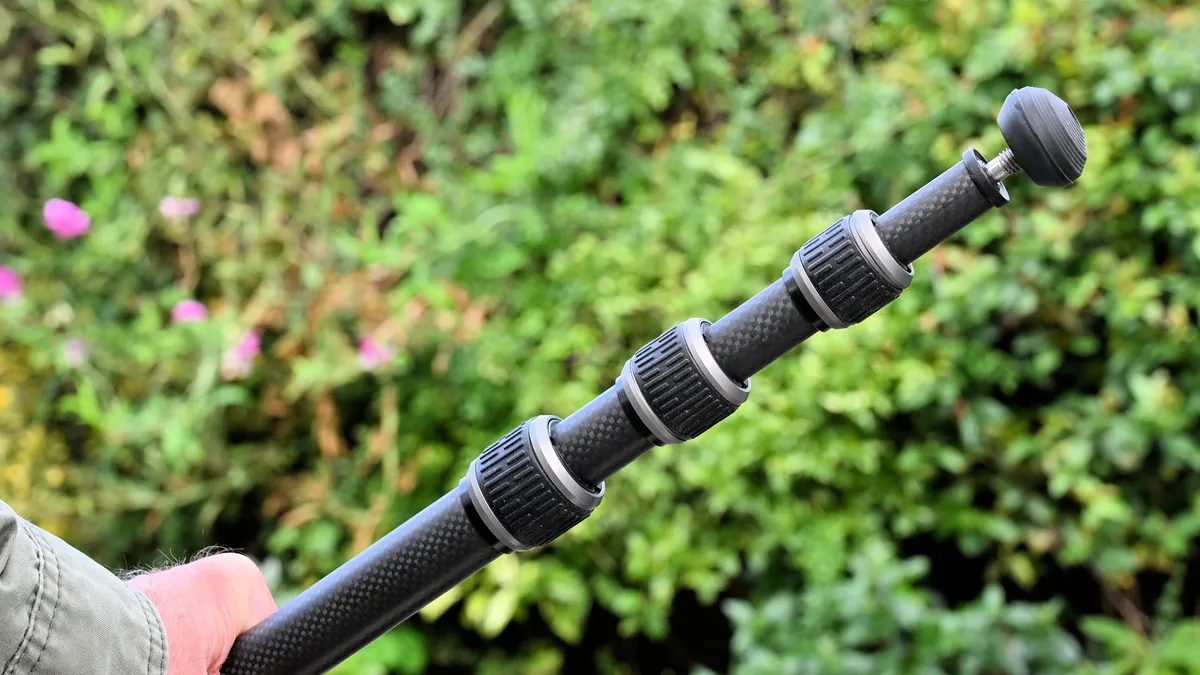
Extending the legs a little, I measured off the four sections at 26, 23, 20, and 17mm, working my way down to the bottom. Again, I think the choice of four sections per leg is ideal. It enables a fairly compact carrying size as well as a fairly generous maximum operating height. Most spotting scopes have a 45-degree angled eyepiece, so you don’t generally need a tripod to be overly tall. The Veo 5’s maximum of 167cm / 66in should more than suffice.

It’s tempting for manufacturers to include five sections in each leg, which are often featured in some of the best travel tripods, where a small folded size can be a prime consideration. I’m glad that Vanguard resisted the urge when designing this spotting scope tripod, for two reasons. Firstly, the total of 12 section clamps in 5-section tripods adds to the time and effort required for setup and takedown. Secondly, the bottom leg sections often end up being thin and spindly, lacking rigidity and robustness.
For speed and ease of use, I favor twist locks rather than flip locks, especially if they operate with minimal rotation for loosening and clamping. The twist locks featured here are designed to do just that, while being silent in operation, which can be important in the context of birding and wildlife. Moreover, the twist locks are designed to be easy to clean, so you can venture out into the mucky outdoors without being too precious about your tripod.

There are three different locking leg angles on offer: 23, 50, and 80 degrees. I really like the simple pushbutton mechanism for selecting different angles, and that you don’t need to swing them all the way up and then come down again in increments to complete the process. It’s another factor that makes the Veo 5 quick to adjust without any unwanted, audible clicks.

I’ve started to notice some manufacturers making triangular-profile center columns. This tends to enable a space-saving design, with the legs fitting more snugly around the column. In this case, Vanguard has opted for a hexagonal center column. Again, it can save a little space, but it also ensures that you can remove the center column and slot it directly into a traditional clamp, if one is available in a birding/wildlife hide. For adding stability when the center column is back in the tripod, there’s a weight hook at the bottom for adding ballast.

The ability to invert the center column is of little benefit when using a spotting scope. Of much greater value, you can split the column into two separate sections. This leaves a relatively short, stubby section at the top, so you can splay the legs and achieve an ultra-low viewing position with your spotting scope the right way up.

To ensure a firm footing on any type of surface, the tripod feet are made from rubber pads with retractable metal spikes. I’d use the rubber pads on most surfaces, but the metal spikes can give greater stability on very soft or loose ground.

On two sides of the canopy that connects the three legs together up top, there are sockets with standard 3/8in threads. You can use these to add accessories with or without magic arms for greater control over positioning. If you need a 1/4in thread instead, you can simply use a 3/8in to 1/4in adapter. Another bonus is that the sockets include bayonet slots on either side, which work with compatible accessories to avoid any unwanted twisting when fitted.

Also on the canopy is a bubble level that aids in easy leveling of the legs. If you switch from your spotting scope to using a camera for shooting stills or video, this helps to ensure that your horizon stays level in the shot if you start panning.

Moving up to the head, the kit comes with Vanguard’s VEO PH-28 2-Way Pan Head. It’s specially made for spotting scopes, with smooth panning and tilting being core design criteria. As such, it can rotate through a full 360 degrees, while also offering a tilt range of 91 degrees forward and 30 degrees backwards. Also available to buy separately, the head typically costs around $100 / £120 / AU$179 on its own.

I like that the panning handle has a retractable design and that a simple twist is all that’s needed to lock or release both the tilt and panning movements. As such, it offers a completely one-handed operation of the head, leaving your other hand free to adjust magnification and focusing controls on the spotting scope.

The head’s scope platform has an Arca-Swiss profile and comes complete with a spring-loaded safety locking pin and bubble level. The locking pin stops the quick-release plate from accidentally sliding out if the clamp becomes loose. It’s handy that if your spotting scope has an Arca-Swiss mounting plate, you can slot it straight into the platform without the need to use the supplied quick-release plate, thus taking an extra component out of the equation.

The quick-release plate is pretty standard Arca-Swiss fare and has a 1/4in treaded screw for attachment to your spotting scope or camera. You can tighten and loosen the screw with the supplied Allen key, a flat blade or coin, or by using the incorporated swiveling D-ring. Not relying on the tightness of its fit alone, the QR plate also features a spring-loaded pin that pushes up into a socket on compatible spotting scope mounting plates, ensuring that there’s no unwanted twisting when the scope is attached.

An Allen key is supplied with the kit and, unusually, it has a smaller profile at its end. This enables engagement with smaller and larger Allen screw heads with a single key. The smaller fitment is ideal for loosening or tightening the locking screws for splitting and rejoining the two-part center column. A screw-in blanking plug is also supplied for use with the upper part of the center column, once it’s been split into two.

Unlike some tripod manufacturers, Vanguard generally supplies a carrying bag with its kits, and this one’s no exception. The high-quality, stylishly designed padded carrying case features a main internal compartment for the tripod, plus an additional lengthy internal zippered compartment for accessories.
One minor niggle is that the tripod doesn’t fully fit into the bag with its panning handle attached, so you’ll need to remove this first, stash it in the bag, and reattach it to the tripod every time you pack it away and get it out again. However, thanks to the bag’s 2-way wraparound zipper, there’s the alternative of stowing the tripod with the handle sticking out through a small gap. The bag also features both a padded Velcro-closing pair of handles and an adjustable padded shoulder strap.

Vanguard Veo 5 264CO: Performance
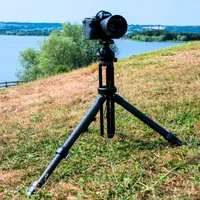
An important performance factor for any tripod is that it’s sufficiently compact, lightweight, and easy to live with, so that you’ll actually take it along for the journey rather than leaving it at home. The Vanguard completely succeeds in this respect, while also being robust and sturdy, and achieving a generous maximum operating height.
A fairly short tripod setup can often be problematic, as the feet end up covering a relatively small area on the ground, making the tripod prone to toppling over if accidentally nudged, or in windy conditions. The Vanguard’s multi-angle legs are a big help in this respect, as you can splay them a little to massively enhance stability, as well as work around obstacles or on tricky terrain, which you might often encounter when using a spotting scope in the great outdoors.

As I’ve mentioned, the maximum operating height with the center column extended is 167cm / 66in. I’m a fairly tall 6ft 5in, but found the maximum height more than sufficient for using my spotting scope. Like most of its breed, my spotting scope has a 45-degree angled eyepiece, which effectively reduces the operating height. And even if your scope has a straight-mounted eyepiece, you shouldn’t have any problems with the tripod’s maximum operating height. I’m also impressed that the tripod remains rigid and very resistant to flexing, right up to and including its loftiest setting.

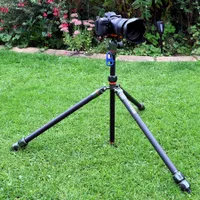
At the opposite end of the spectrum, or at least of the height range, the tripod can go really low. This can be useful if you’re trying to keep out of sight, or if there’s an elevated rocky ledge or something similar on which you’re placing the tripod. It only takes a moment to split the center column in two, after which you can just use the stubby top section to enable ultra-low-level operation, as shown below.

The tripod won me over with the intuitive elegance of its controls and its ease of use. The twist-locks for the legs work with minimal rotation, enabling smooth adjustments and solid clamping in equal measure. Importantly for wildlife scenarios, you can also make adjustments in virtual silence. The same goes for the 2-way pan head, which delivers a smooth, fluid feel for panning and tilting. The extending/retracting nature of the handle is a further bonus, enabling variable torque and tactile feedback. And finally, the dual rubber pad/metal spiked feet help to give an assured footing on virtually any surface.

Vanguard Veo 5 264CO: Verdict
The Vanguard Veo 5 264CO is everything I need and want from a spotting scope tripod, and more. When I’m taking my scope off the beaten track and into the wilds, often negotiating tricky terrain along the way, I don’t want a tripod that’s heavy, cumbersome, and awkward. The Veo 5 shrinks down pretty small when folded and is refreshingly lightweight to carry, so that’s the first box on the wish list ticked off.
On the other hand, I don’t want a lightweight tripod that’s flimsy and wobbles around in the breeze. Any movement is massively magnified when looking through a high-powered spotting scope, so rigidity is essential. The Veo 5 succeeds here as well, with a robust carbon fiber build and excellent resistance to flexing and vibration, right up to its maximum operating height with the center column fully extended. Speaking of which, you can also split the center column for ultra-low-level operation, while the multi-angle legs adapt to pretty much any situation.
Last but not least, the 2-way pan head works with smooth simplicity, enabling a fluid range of tilt and panning movements, while also locking off firmly. And it does this with a single do-it-all, retractable panning handle, leaving my other hand free for adjusting the magnification and focus setting of my scope. The Vanguard kit certainly isn’t cheap, but I think it’s perfect for the job.
Features ★★★★★ |
The multi-angle, four-section legs and the splitable center column combine with a 2-way pan head that ensures dynamic operation when using a spotting scope. |
Design ★★★★★ |
The design strikes an ideal balance between lightweight compactness for carrying around, and sturdy support with a generous range of operating heights, all with a luxurious carbon fiber build. |
Performance ★★★★★ |
From the robustness and resistance to flexing of the tripod legs and canopy, to the smooth operation of the 2-way head, performance is top-drawer in all respects. |
Value ★★★★½ |
It might seem like an expensive kit if you have a relatively cheap spotting scope, but I can’t think of a better tool for the job, so it’s very good value at the price. |

Alternatives