Digital Camera World Verdict
I love that the Peak Design Pro Tripod incorporates all the best bits of the company’s original, revolutionary (and previously its only) tripod, while adding extra height along with quicker and easier operation. I also love the high-end features, handling, build quality, and performance of the new ‘Pro’ tripod, and that it comes in three different Pro, Pro Lite, and Pro Tall options. The only real upset is that it’s hugely expensive to buy and, unlike with the original Travel Tripod, there’s no cut-price aluminum version.
Reasons to buy
- +
Smart space-saving design
- +
Luxury carbon fiber build
- +
Quick and easy operation
- +
Super-sturdy and rigid
Reasons to avoid
- -
Expensive to buy
- -
No aluminum versions
- -
Tool-operated QR plate
Why you can trust Digital Camera World Our expert reviewers spend hours testing and comparing products and services so you can choose the best for you. Find out how we test.
Think Peak Design and you’re probably thinking photo bags and backpacks, and those clever Peak Design Slide camera straps with their quick-release mechanisms. However, the company also makes general travel luggage, outdoor gear, phone cases, wallets, and even gadget mounts for cars and motorcycles. The California-based outfit was founded in 2010 with a mission to ‘build happy and meaningful lives for the people that work there', and, hopefully, some of that meaningful happiness will spill over to people who buy their products.
Fast-forward to 2020, and the company launched its first and so far only tripod, in the somewhat revolutionary shape of a very distinctive travel tripod. We’ve reviewed it very favorably in both of its Peak Design Travel Tripod (Aluminum) and Peak Design Travel Tripod (Carbon Fiber) editions. The company designed and launched its first tripod off the back of a crowdfunding campaign, which is its go-to business method, and the result is undeniably one of the best travel tripods on the market.
The new Peak Design Pro Tripods inherit the innovative design and features of the original Travel Tripod and build them into a (mostly) full-sized range of kits. As such, the new models are available in Pro, Pro Lite, and Pro Tall versions, each of them aiming to be among the best tripods for photography, as well as being among the best carbon fiber tripods. As you’ve probably guessed, though, the Pro Lite is relatively lightweight and downsized, compared with the other two more full-sized sticks.

Peak Design Pro Tripod: Specifications
| Row 0 - Cell 0 | Peak Design Pro Tripod |
Peak Design Pro Tall Tripod |
Peak Design Pro Lite Tripod |
Material |
Carbon Fiber |
Carbon Fiber |
Carbon Fiber |
Folded height |
50.1cm / 19.7in |
58.1cm / 22.9in |
48.8cm / 19.2in |
Maximum operating height |
168.4cm / 66.3in |
197.4cm / 77.7in |
162.5cm / 64.0in |
Minimum operating height |
15.9cm / 6.3in |
17.3cm / 6.8in |
15.8cm / 6.2in |
Folded diameter |
9.3cm / 3.66in |
9.3cm / 3.66in |
8.5cm / 3.35in |
Weight |
1.9kg / 4.2lb |
2.0kg / 4.5lb |
1.7kg / 3.7lb |
Load rating |
18.1kg / 40lb |
18.1kg / 40lb |
15.9kg / 35lb |
Sections per leg |
4 / 1 |
4 / 1 |
4 / 1 |
Section clamps |
Flip locks |
Flip locks |
Flip locks |
Locking leg angles |
3 angles |
3 angles |
3 angles |
Feet |
TPU Pads (optional spikes) |
TPU Pads (optional spikes) |
TPU Pads (optional spikes) |
Case/bag included |
Padded bag |
Padded bag |
Padded bag |
Peak Design Pro Tripod: Price
Full-sized, heavy-duty, carbon fiber tripod kits that are also reasonably lightweight and fold down small for the journey don’t come cheap. One of my all-time favorites is the 3 Legged Winston Pro 2.0 kit, complete with AirHed Pro Ball Head, which will set you back around $500 / £400 / AU$750. Then there’s the somewhat legendary Manfrotto MT055CXPRO3 Carbon Fiber Tripod (legs only) for around $500 / £399 / AU$850, but it’s also available in kit options with various heads.
In that context, the Peak Design Pro Tripod kit looks pretty pricey at $900 / £800 / AU$1,500, whereas the Pro Tall is understandably even more expensive at $1,000 / £900 / AU$1,700, as there’s simply more of it, and the least expensive Pro Lite is still very dear at $800 / £700 / AU$1,400. On the face of it, none of these three tripods looks like they’re going to win any ‘Great Value’ awards, but considering the innovative, no-compromise designs, they could still be very well worth the money.
Peak Design Pro Tripod: Design & Handling
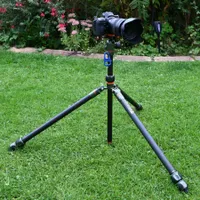
After decades of being a keen photographer, it’s very rare that a tripod walks into my studio and really grabs my attention. The Peak Design Travel Tripod did exactly that a few years ago, with sufficient wow-factor to make me actually open my mouth and say ‘wow’. Looking as super-skinny as a catwalk model, the tripod was designed with oval-profile legs that wrap around a triangular center column.

The net result is that the tripod is incredibly slim when folded, while also avoiding the time-consuming chore that you get with the vast majority of travel tripods. That’s because with the Peak Design and its integral head, you don’t need to fully extend the center column and swing the legs up to achieve a compact stowage size. All of these design facets in regard to the legs, center column, and head are inherited by the next-gen ‘Pro’ tripod range.

One notable difference is that the Pro tripods have four sections in each leg rather than five, which makes setup and takedown quicker and easier, as there are fewer leg section clamps to contend with. The leg sections themselves are made from the good stuff. Like anything else, carbon fiber isn’t all created equal, but this tripod is constructed from premium-grade 3k weave, 2x2 twill carbon fiber, along with CNC-machined and anodized 6061-T6 recycled aluminum for the ball head, hub, load hook and leg locks, rather than using any die-cast parts.

As with most tripods great and small nowadays, it’s not just the height of the legs that you can adjust, but also the angle from vertical. True to form, the Pro has three lockable leg angles when unfolded for use. The wider angles enable greater stability and resistance to the tripod toppling over when it’s set to a short operating height. Multiple angles also make it easier to work on uneven terrain and around obstacles.

The ball head is equally innovative as the tripod legs, and a crafty bit of design in its own right. The compact, integrated design helps to keep stowage size to a minimum, but it’s nevertheless full of clever tricks. A twist-action lock at the base of the head allows for super-fast release and locking of the ball and socket clamp. The only slight downside is that you have to raise the center column slightly to enable anything more than a slight range of tilting movement of the ball head, and to enable shooting at extreme angles and vertically upwards or downwards, as well as for swapping from landscape to portrait orientation shooting, unless you’re using an L-bracket.

While the ball head has a good range of adjustment if you raise the center column a smidge, there’s also a full 360-degree of independent lateral rotation, thanks to a separate panning lock. The panning mechanism has a marked scale and a lovely fluid feel, making the head well-suited to shooting video as well as stills.

One particularly nice touch is the bubble level. It protrudes from the outer circumference of the camera platform and also acts as the lock/release catch for the Arca-Swiss type quick-release plate. And to avoid any expensive accidents if you inadvertently knock the bubble assembly, there’s also a sliding safety lock with marked open and closed positions.

The QR plate itself is a fairly small, square affair, but you can use other plates if you feel the need. My only complaint about the supplied plate is that it can’t be fastened to your camera without the use of a hex key, but at least one is supplied with the tripod, as pictured below. If you'd prefer a more 'hands-on', tool-free QR plate, the Peak Design Field Plate is available as an optional extra.

There’s more trickery down below. A weight hook is featured at the bottom of the center column and, unlike those that need endless twisting on a thread to fit or remove them, this one secures or releases with a spring-loaded lock and a one-third twist.

What’s more, with the weight-hook removed, the dual-sized hex wrench tool that’s stowed inside the center column pops halfway out by a further spring-loaded mechanism, while the use of magnets stops it from falling all the way out unless you actually tug on it. If my memory serves me rightly (and I’m pretty sure it does), the Peak Design Travel Tripod comes with an additional Mobile Phone Mount, but you can buy that separately for use with the Pro, at a cost of around $20 / £20 / AU$55.

Moving further down, right to the bottom of the tripod, sturdy rubber pads are the footwear of choice. Made from non-slip TPU (Thermoplastic Polyurethane), they’re extremely durable and work well on most surfaces. For very soft or loose ground, you might be better off with metal spikes, and these are available as an optional extra, costing around $50 / £45 / AU$80.

Finishing with a flourish, the tripod kit is all wrapped up in a very nicely tailored and padded soft case with a single zippered opening and an adjustable shoulder strap.

Peak Design Pro Tripod: Performance
Peak Design points out that it developed the Pro range of tripods in collaboration with the renowned photographer and filmmaker, Jimmy Chin. It also says that they’re based on the groundbreaking architecture of Peak Design’s original Travel Tripod, but scaled up to offer significantly greater stiffness and maximum operating height. I’d say these comments are bang on and that, as I’d expect from a tripod co-developed by a photographer and filmmaker, it works well as a hybrid stick for both photography and videography. That’s mostly thanks to its clever head, which enables fluid panning as well as quick and easy ball and socket adjustments.

I’d also agree that one of the most crucial aspects of the Pro tripods is that you can shoot from a higher maximum height, as I found the Travel Tripod quite restrictive in this regard. Even so, the maximum height of the Pro tripod isn’t exactly towering at 168.4cm / 66.3 inches.
Being quite tall and liking to keep my shooting options as open as possible, I went for the Pro Tall version of the tripod, which extends to a more impressive 197.4cm / 77.7 inches.
The Pro Lite edition is certainly smaller and more lightweight for the journey, but only rises to a maximum height of 162.5cm / 64.0 inches, and has a lower payload rating of 15.9kg / 35lb, compared with the 18.1kg / 40lb of its heftier siblings.

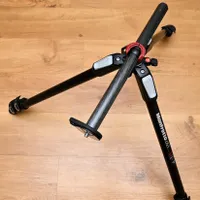
It’s not just height that I’m interested in. I also like to shoot from really low angles sometimes, for creative effect. In time-honored tradition, the Pro tripods enable you to remove and invert the center column, thus shooting out from between two of the legs with the camera inverted, right down to ground level. That’s all well and good, provided that you don’t mind shooting with your camera upside down, which definitely isn’t preferable for videography.

A more convenient but more long-winded approach to ultra-low-level shooting is that you can tilt the ball head through 90 degrees, loosen a screw, and remove all but the very top of the center column. This enables you to shoot from as little as 15.9cm / 6.3in, 17.3cm / 6.8in, or 15.8cm / 6.2in above ground level, with the Pro, Pro Tall, and Pro Lite versions of the tripod, respectively.

Those specializing in videography rather than stills photography might like to go a little further with filmmaking features. Catering to these needs, Peak Design offers a Leveling Base for an additional $120 / £110 / AU$220. This enables you to level the head even if the tripod legs aren’t precisely leveled, so that your horizon doesn’t go on the slant when you start panning. And if you want to add a fluid tilt action to the head’s existing fluid pan abilities, there’s an optional Tilt Mod for $150 / £135 / AU$300.

Peak Design Pro Tripod: Verdict
I’ve tried many and varied Peak Design products, and they always give me a real feel-good factor. The company makes bold claims regarding the design, features, build quality, and performance of its Peak Design Pro Tripod range. I love it when products live up to and even surpass their billing, and that’s my experience of the Pro Tall tripod kit that I tested and immediately fell for.
Highlights for me are that the design neatly cuts out any wasted space, the specially profiled legs snugly wrapping around the center column for incredibly slimline stowage. The integral head also helps to keep packing size to a minimum, so everything’s neat and tidy. Better still, the tripod has super-fast setup and take-down times, apart from its fiddly tool-driven quick-release plate. Best of all, the kit gives rock-solid support for stills and video shooting, with a nice fluid panning feel for the latter, and remains really steady and stable even at its maximum height with all of the leg sections and center column fully extended.
The only catch, as far as I’m concerned, is the price. It’s a very expensive tripod by any standards, but I feel that Peak Design has really gone the extra mile with its no-compromise design and build, making the Pro range of tripods well worth the money.
Features ★★★★★ |
Smart features include specially shaped legs and center column, along with a clever integral head. |
Design ★★★★★ |
Truly innovative tripods are few and far between but some really out-of-the-box thinking has gone into the design of this one, backed up by superb build quality. |
Performance ★★★★★ |
The tripod is sturdy and extremely resistant to flexing and vibrations, from ultra-low-level shooting to its maximum operating height. |
Value ★★★★☆ |
It’s a very expensive tripod by any standards but the advanced features, smart design and impressive performance make it well worth the money. |

Alternatives