Digital Camera World Verdict
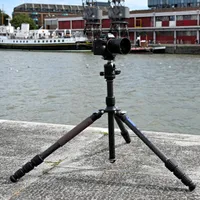
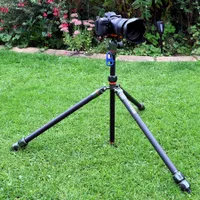
I’ve always been water-averse with camera kit but the Leofoto Poseidon Ocean LP-284C + LH-30 is taking me into new territory. I love that it’s a properly waterproof tripod, not just willing to dip its toe, rubber foot or metal spike in a pond, but with waterproof section joints all the way up to its canopy, and enough corrosion-resistance to paddle in the sea. It has a very travel-friendly size and weight, yet gives really rigid, flex-free support. However, without a center column, the maximum operating height is quite limited. It caters more to watery depths than lofty heights above ground level.
Pros
- +
Luxury carbon fiber construction
- +
Waterproof leg section locks
- +
Titanium leg mounts and feet
- +
Sturdy build and performance
- +
Fairly compact and lightweight
Cons
- -
No center column
- -
Modest maximum operating height
- -
No monopod conversion
Why you can trust Digital Camera World Our expert reviewers spend hours testing and comparing products and services so you can choose the best for you. Find out how we test.
What’s in a name? Poseidon is well known as the Ancient Greek god of the sea, although it’s perhaps not such common knowledge that earthquakes, storms, and horses also fell under his remit. The Leofoto Poseidon tripod is well named, being a waterproof and corrosion-resistant tripod, taking saltwater, stormy rainfall, and muddy puddles in its stride. I’m not so sure about earthquakes and equines.
I’m no stranger to Leofoto, having reviewed a bunch of the company’s products last year, including the Leofoto Ranger LS-365C tripod legs, Leofoto LH-36LR Ball Head, Leofoto VH-30R Two-Way Head, Leofoto G2 Geared Pan Head and Leofoto PG-1 Gimbal Head. A common theme is that the Chinese company makes high-end and fully pro-grade tripods, heads, and photographic accessories, as well as military-grade tactical equipment.
The Poseidon tripod kit that I’m reviewing here is a very sturdy carbon fiber model, while also packing down pretty small. It’s refreshingly lightweight to carry as well. All in all, it aims to be one of the best tripods for photographers, one of the best carbon fiber tripods, one of the best travel tripods, and definitely one of the few waterproof tripods on the market.

Leofoto Poseidon Ocean LP-284C + LH-30: Specifications
Material |
Carbon fiber |
Folded height |
54cm / 21.3in |
Maximum operating height |
129cm / 50.8in |
Minimum operating height |
16cm / 6.3in |
Weight |
1.55kg / 3.42lb |
Load rating |
10kg / 22lb |
Sections per leg |
4 |
Section diameters |
28, 25, 22, 19mm |
Section clamps |
Twist locks |
Locking leg angles |
3 |
Feet |
Pads / spikes |
Case/bag included |
Padded bag |
Leofoto Poseidon Ocean LP-284C + LH-30: Price
There’s a fair bit of work and some exotic materials that go into making a truly waterproof tripod, and that’s reflected in the list price of $499 / £429 / AU$825. On the plus side, the Poseidon kit is often discounted in various markets around the world, making it a little more affordable for many of us.
Even so, the Poseidon unsurprisingly costs a fair bit more than another Leofoto carbon fiber tripod kit with a professional ball head that I’ve just reviewed. The Leofoto Armour LN-284CT + NB-40 tripod kit isn’t waterproof but does convert into a classy monopod, and is particularly good value at just $225 / £175 / AU$425.
Leofoto Poseidon Ocean LP-284C + LH-30: Design & Handling
The Leofoto Poseidon Ocean LP-284C that I’m reviewing here is the smaller of two sets of legs in the range, the alternative LP-324C being taller, heavier, and having thicker leg sections. That one’s also available with three different heads in a variety of kits, whereas the LP-284C is only sold with the LH-30 ball head – and there’s nothing wrong with that, as I’ll come to later. Apart from differences in size and weight, both sets of legs are essentially the same, made from high-quality 10-layer carbon fiber.

The decision to make the tripod with 4-section legs is a good one as far as I’m concerned. It enables a more compact stowage size than 3-section legs, whereas ‘travel tripods’ with 5-section legs often have thin and spindly bottom sections, which can impair rigidity and robustness. The payload rating of the tripod is 10kg / 22lb, whereas it’s 15kg / 33lb for the larger model.

The twist locks are designed to be ‘maintenance-free’ so that you don’t need to take them apart and clean them. They feature additional seals to keep out water, sand, and dust, being a critical component of the ‘waterproof’ design. Even so, Leofoto says that it can’t absolutely guarantee that no water at all will get into the tubing. The twist locks work really well in practice, requiring minimal rotation to loosen the leg sections so that they extend and contract smoothly, and the same goes for tightening the locks again afterwards.

At the top of each leg is a latch for selecting any of three alternative leg angles. Again, they work with simple efficiency. You simply pull the latch out, rotate the leg to the desired angle, then push the latch back in again. Many tripods feature spring-loaded latches for this, but the ones featured here work equally well.

Moving up top to the canopy, it has a noticeably slim design. That’s because the tripod has no center column, which I think is both good and bad. It’s good in that the folded diameter of the tripod is very slim and compact, while also enabling easy ultra-low-level shooting without a center column getting in the way. Conversely, it’s bad that you can’t further extend the maximum operating height, which is limited to a rather modest 129cm / 50.8in. There’s also no option to unscrew any of the legs and use it with or without a center column as a monopod.

The underside of the canopy again reveals the hollowed-out design, and instead of a center column, you get a socket with a standard 1/4-inch thread. A typical use for this is to screw in the weight hook that’s supplied with the tripod. Adding ballast can steady the tripod if you’re using it outdoors in windy conditions. I’m thinking it would have the opposite effect completely if the tripod were submerged in wavy conditions!

As well as the underlying weight hook, the canopy features a 3/8-inch threaded socket on the side. This can be useful for adding a magic arm and/or accessories like an LED lamp, microphone, monitor screen or smartphone. If you need a 1/4-inch socket instead, you can simply use a 3/8 to 1/4 inch adapter.

The feet supplied with the tripod look like regular rubber pads, but they’re more specialized in that the metal parts of the assembly are made from titanium rather than stainless steel or aluminum. This makes them more resistant to corrosion from saltwater, and they also feature rubber waterproofing O-rings.

If spikes are a better option than rubber pads (when standing the tripod on loose sand on a beach, for example), the kit comes complete with screw-in metal spikes, which you can substitute for the rubber pads. Again, they’re made from anti-corrosion titanium rather than aluminum or stainless steel.

The LH-30 ball head is simple but effective and very nicely made. It has a 47mm diameter base and is classed by Leofoto as one of their ‘low-profile’ ball heads, having a height of 74mm. It’s based on a 30mm precision-engineered ball that enables smooth and precise adjustments.

The main ball joint lock/release lever has a nice, tactile feel to it. It’s spring-loaded and mounted on splines so that you can pull out the lever on its shaft and rotate it to a more convenient angle, if necessary.

As well as the main ball and socket arrangement, there’s a separate panning release/lock. This can come in useful if you want to pan your camera to shoot either stills or video while the main ball joint remains locked in place.

The camera platform is Arca-Swiss compatible and comes complete with a like-minded quick-release plate. The platform also features a bubble level, and unlike those that I’ve seen in some Leofoto heads, it’s clearly visible at all times instead of being buried under the quick-release plate when you mount your camera on the tripod.

Extras included in the kit comprise a set of three titanium foot spikes, three Allen keys, a screw-in carabiner weight hook, and a multi-tool. The multi-tool itself includes a flat blade, Allen keys of three different sizes, a keyring attachment and carabiner, and even a bottle opener. The seaworthy tripod and all of its crew are wrapped up for the voyage in a high-quality padded carrying bag.

Leofoto Poseidon Ocean LP-284C + LH-30: Performance
The tripod folds down nice and small and feels very lightweight for carrying around, which I’d call a performance benefit of sorts. After all, big, heavy tripods are often left at home, where they’re of no use at all. Unlike most modern travel tripods (not that it claims to be one), the Poseidon doesn’t have swing-up or ‘reverse-folding’ legs that surround the center column. That’s no surprise as it doesn’t actually have a center column anyway. Again, there’s a performance plus point here, in that the tripod is extremely quick and easy to set up.
Speed and ease of adjustment as well as setup are further boosted by the action of the twist locks for the leg sections. They require minimal rotation for unlocking and locking the sections, and you can easily grasp all three locks for each leg and operate them with one hand, in one gesture, when the leg sections are contracted.

When shooting at a fairly short height, the multi-angle legs enable a wider circumference for the placement of the feet. This makes the tripod more secure and less likely to topple over if accidentally knocked or in windy weather. It also adds resilience against being toppled by waves or underwater currents, given the Poseidon’s watery nature. With that in mind, I used the tripod extensively with it submerged in water, and it didn’t suffer any seepage into the twist locks or into any of the tubular leg sections.

The maximum operating height of 129cm / 50.8in can frankly feel a little disappointing. However, you could argue that the tripod is geared more to towards contending with watery depths than rising high above the land. Either way, the tripod remains sturdy and is impressively resistant to unwanted flexing and vibrations, right up to and including its maximum height.

You can split the center columns in some tripods that actually have a center column, or substitute them with a low-angle adaptor. There’s no need in this case, as the Poseidon’s multi-angle legs enable ultra-low-level shooting with no center column to get in the way. Naturally, you might be advised against doing this when you’re using the tripod in water, unless you happen to have a waterproof camera to pair with your waterproof tripod.

As with the leg section locks and leg angle locks, the ball head enables a full and free range of movement with very firm locking, and minimum fuss and bother. It doesn’t feature an adjustable friction damper but I found that the main lock/release lever worked well enough with a range of different sizes and weights of camera kits. Its payload rating of 15kg / 33lb is actually 50 per cent more than for the legs on which it stands. The panning action works nicely and smoothly as well, which is another performance bonus.
Leofoto Poseidon Ocean LP-284C + LH-30: Verdict
Water, and especially saltwater, can cramp your style as a photographer. By way of example, you might want to capture a long exposure with a 10-stop ND filter to blur the waves in a seascape shot, but worry about dipping your regular tripod in the sea. The Leofoto Poseidon Ocean LP-284C + LH-30 tripod kit can give you a new kind of creative freedom, thanks to its waterproof construction.
I like that the tripod is made from high-quality 10-layer carbon fiber, but I love that the leg-section clamps are fully waterproofed and that the metalwork in the rubber-padded feet and alternative spikes are made from corrosion-resistant titanium rather than aluminum or stainless steel. The same goes for the metal bases of the leg tubes.
The tripod is sufficiently compact and lightweight to take just about anywhere and everywhere, yet offers sturdy and solid support that’s very resistant to unwanted flexing and vibrations. The only real problem is that while the lack of a center-column pays dividends for quick-and-easy ultra-low-level shooting, the maximum operating height is rather underwhelming.
Features ★★★★½ |
The standout feature of the tripod is that it’s waterproof, sand-proof and very resistant to corrosion. I feel a beach party coming on! |
Design ★★★★½ |
The design is based on 10-layer carbon fiber and plenty of titanium metalwork, rather than aluminum or stainless steel, for a life on the edge of the ocean waves. |
Performance ★★★★½ |
Setup and adjustments are quick, easy, and intuitive, and the tripod is very sturdy, offering good resistance against flexing and vibrations. |
Value ★★★★½ |
Considering the additional or uprated components required for making this tripod waterproof, it’s very good value at the price. |

Alternatives