Digital Camera World Verdict
Capable of producing vibrant images with natural colors and fine-looking video at up to 3K resolution, the Rokid AI Glasses Style are another pair of decent camera glasses in a market that’s starting to feel busier and busier. Though I find the app to be janky and the AI features of questionable usefulness – and the privacy features are, frankly, nowhere near good enough.
Pros
- +
Vibrant image and video quality
- +
Simple but effective physical controls
- +
Comfortable fit
Cons
- -
Recording light is not visible enough
- -
AI features can be temperamental
- -
Battery drains quickly
Why you can trust Digital Camera World Our expert reviewers spend hours testing and comparing products and services so you can choose the best for you. Find out how we test.
Camera glasses with AI features have been getting a lot of press lately, and not all of it positive. While these clever devices have exploded in popularity, driven in large part by the Ray-Ban Meta Gen 2 Smart Glasses, concerns have been raised over privacy issues and the potential for non-consensual recording.
As such, it was with mixed feelings that I unboxed the Rokid AI Glasses Style, the more lightweight and affordable counterpart to the Rokid Glasses, lacking the display technology of their bigger brother. Equipped with a 12MP sensor capable of capturing stills and video, these glasses also benefit from an AI assistant you can talk to in real time via the built-in mics and speakers.
They look the part – but are they capable of capturing decent-enough imagery to be considered among the best camera glasses? I took the Rokid AI Glasses Style out for a test to find out.

Rokid AI Glasses Style: Specifications
Photo resolution |
12MP 3024 x 4032 |
Video resolution |
Max 3K 30p |
Lens aperture |
f/2.25 |
Field of view |
109° |
Autofocus |
Fixed |
Min. focus distance |
34cm |
Audio |
4 mics, 2 speakers |
Connectivity |
Wi-Fi 6, Bluetooth 5.3 |
Smart functions |
ChatGPT / Gemini |
Storage |
32GB |
Battery |
210 mAh |
Charging |
Magnetic (USB-C converter cable supplied) |
Rokid AI Glasses Style: Price & availability
The Rokid AI glasses can be bought directly from the manufacturer’s website, at time of writing for a starting price of $349 (roughly £262 / AU$500). That’s a little cheaper than the Ray-Ban Meta Gen 2s, which start at $379, but a lot more expensive than the previous gen of Ray-Ban Meta Gen 1s, which are currently sitting at around $225.
So, it’s about the standard market price for a pair of flashy camera glasses with AI features. If you just want the camera bit, don’t care about AI features and aren’t too fussed on image and video quality, then you have many, many cheaper options, such as the Oho Sunshine Camera Glasses, or any number of anonymous products on Amazon.

Rokid AI Glasses Style: Design & handling
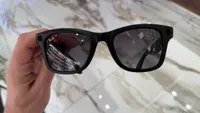
If you’ve been admiring the style of the Meta Ray Ban glasses, then you might well find the Rokid pair to be hauntingly familiar. They’re sleek, black and fairly anonymous-looking. The right arm features a function button that can be used to quickly capture photos and videos, and a touchpad that can be used to control things like music playback. I found the shutter button to be well-situated and more enjoyable to use than having to talk to the glasses or fiddle with the app – you tap it to take a photo, and long press to start/stop recording video.

Audio playback comes via two small speakers on the arms, and there is a four-mic setup for picking up your own voice as well as video sound. These are what you use to communicate with your AI assistant. I’ll talk more about this process in the next section, but as far as mic-pickup goes, I found them to be consistently pretty reliable, able to consistently pick up me saying ‘Hi Rokid’ in all but the quietest of voices.
The glasses are fairly sizeable, and I found them to be perfectly comfortable to wear for long periods, with no uncomfortable pinching or squeezing. The shaded lenses can be swapped out to clear or prescription lenses if you prefer. Charging is straightforward via the supplied magnetic charger, and the glasses come with a standard protective case – you do have the option to fork out $99 for a charging case.

The camera module is situated beside the left eye. On the other side is the recording light, and I have to say that this is one of my big issues with the Rokid AI Glasses Style. The recording light is a small, dim, white LED, a dot that is hard to see when you’re indoors, and in full daylight is all but invisible (you can see it close-up at the end of the video clip featured below).
Frankly, this is not good enough. If the light is supposed to clearly notify others that they’re being recorded, then there’s no reason for it to be so small and dim, nor for it to be white rather than red, a color that has been near-universally understood to mean ‘recording in progress’ since the days of camcorders.
Rokid’s AI claims the glasses will refuse to record when the light is covered – but in my testing, this didn’t actually appear to be true. The speakers play a warning to uncover the light, but the recording continues. As such, this tokenistic gesture makes me deeply sceptical that Rokid are particularly bothered by issues of privacy or transparency.
The light is on the other side of the glasses, so it isn’t going to interfere with the camera. I think it should be ten times brighter. Red, flashing and unmissable. And frankly, if you care about camera glasses as a technology, you should be calling for this too – because the tech is never going to shake its reputation for irresponsible use when manufacturers make irresponsible use so easy.

Rokid AI Glasses Style: Performance
AI features work via the Hi Rokid app, available for iOS and Android. The Android version is a little temperamental and prone to crashing – and it took me several attempts to establish the initial connection. Judging by the ‘made for iPhone’ slogan proudly touted on the box, I suspect the iOS experience might be smoother.
The Rokid Glasses Style’s AI assistant apparently uses a combination of both OpenAI’s ChatGPT and Google’s Gemini. I’m not entirely sure how this works in practice (though the voice replying to you often changes), but using the assistant is fun, if intermittently janky.

I took the glasses around London’s Kew Gardens, asking them to identify plants, objects, buildings and sculptures. I achieved about a 60% success rate, with the remaining 40% consisting of a range of error messages – ‘server busy’, ‘connection unstable’, ‘service error’. Thinking times also varied wildly. It’s diverting enough, but in my view, a bit too unstable to really slot into one’s life in a useful way.
More interesting is the camera module. It uses a 12MP Sony IMX681 sensor, which is the same resolution as the sensor in Meta’s glasses – in fact, I can’t fully confirm this, but I think it might well be the exact same sensor. As such, images are similarly bright and vibrant, with pleasingly natural-looking colors and a decent level of detail.

Like many images taken on these kinds of sensors, they look fantastic on a phone screen, and okay on a monitor. Images are captured in the camera’s native 3:4 aspect ratio – you also have the option of cropped 9:16 portrait or 4:3 landscape, the latter in 3K rather than 4K. Also, I do appreciate the automatic horizon calibration, as someone who naturally tilts their head quite a bit.
Video-wise, it’s a similar story – footage looks decent enough, especially on a small screen, but isn’t about to give proper vlogging cameras any sleepless nights. It shoots by default in 2.5K 30p in a 3:4 aspect ratio, and once again you have a few different aspect ratio options if you wish. It does wobble quite a bit when walking – some stabilisation wouldn’t have gone amiss – and outdoors, the audio is pretty susceptible to wind noise, so bear that in mind if you wish to record speech.
Also, Rokid claims that the 210 mAh battery will give you up to 12 hours ‘typical’ use, but I’m not sure about that – the first couple of hours of messing about in Kew Gardens knocked about 40% off my unit’s battery indicator.
Rokid AI Glasses Style: Sample images
This gallery of sample shots was taken around London’s Kew Gardens on an extremely sunny and bright day with minimal cloud cover, including both exteriors and interiors.


Rokid AI Glasses Style: Video
Above is a compilation of a few short clips captured with the Rokid AI Glasses Style using the camera's native 2.5K 30fps 3:4 mode.
Rokid AI Glasses Style: Verdict
Fundamentally, if you want a decent pair of camera glasses with AI smarts – here it is. In pure imaging terms, the Rokid AI Glasses Style don’t bring anything new to the table, with a 12MP sensor that produces images that look much like everything else. The combination of ChatGPT and Gemini powering the AI smarts certainly creates a different user experience to Meta’s AI, but also one that feels a little byzantine and unstable.
I’d feel a lot more comfortable recommending the Rokid AI Glasses Style if the privacy features weren’t so lacklustre. I’m aware this is pretty much the standard for camera glasses, but I don’t have to like it, and I don’t have to like the implications of it.
My wishlist for a future update to these glasses would be pretty straightforward. In addition to a clearer recording light, I’d love a smoother app experience on Android, and perhaps seeing some of those AI smarts put to work on features like stabilisation or noise reduction. Until then, I can only call these what they are – a perfectly adequate and fairly unexciting pair of camera glasses.
Features |
Lots of smart (but temperamental) AI tools to play with. |
3.5/5 |
Design |
Comfortable, but the dim recording light is inadequate. |
2.5/5 |
Performance |
Image quality is perfectly fine without being exceptional. |
3.5/5 |
Value |
Would make sense as a cheaper version of Meta's – but aren't much cheaper. |
3/5 |
Rokid AI Glasses Style: Alternatives