Digital Camera World Verdict
Eastman Kodak’s new ‘sub-brand’ of an existing film doesn’t exactly offer a brand new experience, but it’s still an enjoyable 200-ISO film in its own right. The soft, muted look gives images a vintage feel, and maybe I’m imagining things, but I felt there was a tad more saturation to my images compared to ColorPlus that made them more impactful.
Pros
- +
200 speed is nicely versatile
- +
Soft but naturalistic colors
- +
Nice, smooth grain
Cons
- -
Basically the same as ColorPlus
- -
A bit pricey outside US
Why you can trust Digital Camera World Our expert reviewers spend hours testing and comparing products and services so you can choose the best for you. Find out how we test.
Released as part of a pair with its 100-rated sibling, Kodak Kodacolor 200 supposedly represents the beginning of a new chapter for Eastman Kodak. After a struggle over the rights to distribute its own films, the manufacturer has managed to bring some of those rights back in-house, and has celebrated with two new color film stocks. Well, new-ish.
I went over this in my Kodacolor 100 review, so I’ll be brief – the new films are listed as ‘sub-brands’ of existing Kodak films. So they’re not brand new stocks in the vein of something like Harman Phoenix, but instead are very mildly modified (or, possibly, not really modified at all) versions of existing Kodak films.
Still, Kodacolor 200 is available at a pretty affordable price, and affordable color film is always a welcome sight. How does it perform? I took it for a test drive in London to find out.

Kodak Kodacolor 200: Specifications
Brand |
Kodak |
Introduced |
2025 |
Type |
Color negative |
Speed |
200 |
Process |
C41 |
Format |
35mm |
Price & availability
Kodak Kodacolor 200 is currently priced identically to Kodacolor 100. In the US, it’s available at the very reasonable price of $8.99 for a roll of 36 exposures. Elsewhere, the price is noticeably higher – in the UK we’re paying around £15 for the privilege from select retailers, and in Australia the price is AU$18. I’m not really sure of the reasoning behind this price discrepancy, but I’ve spent large portions of my life being confused about Kodak prices so I’m trying not to let it affect me too much. It’s available in 35mm format only.
Performance
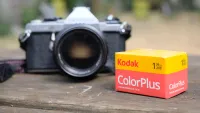
Once again, we can do some very basic detective work to figure out which film stock this is based on. It’s a 200 ISO film, so in the Kodak stable we’ve got two likely candidates: the honey-warm Gold 200, a beautiful film for sunsets and golden hours, or the soft-colour, lo-fi ColorPlus 200. Spoilers: it’s ColorPlus.

Speculation is currently rife in the film community as to whether the two stocks are literally exactly the same, or if Kodacolor 200 has been tweaked a little with a minor production change. Looking at my fresh batch of images alongside an old roll of ColorPlus, I feel like there are slight differences. The grain structure looks a little different – fine, but not overbearing – and the colors look a tiny bit more saturated. But these things could also easily be caused by variances in development or scanning, and let’s make no mistake – the two are extremely similar.

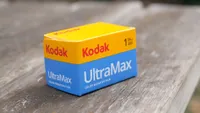
What we end up with is a pleasant, fairly lo-fi look to images, one that isn’t especially striking the way that Kodak’s sunny Ultramax 400 stock can be striking, but has its own charm. The grain is fairly fine, not quite as chunky as the grain you can get with Gold 200. Like all good modern films, the grain is noticeable enough to make the analog bona fides of an image very obvious, without being so overbearing that it crushes away details.
The exposure latitude seems pretty flexible, with the film only starting to lose details in some extremely high contrast scenes caused by the angular winter sun. Highlights have a nice-looking glow to them, and shadows retain a good amount of detail.
ISO 200 is possibly my favourite film speed. It’s easy to shoot in variable light conditions, less restrictive than ISO 100 or the lower sensitivities, but it doesn’t have the slightly cheap and gritty look you can get with 400 films (or the dizzying expense of the 800 and higher crowd). As such, I really enjoyed my time with Kodacolor 200, and would recommend it as a fairly straightforward starter film for those who like a softer, classier look than you’ll get from Ultramax.
Sample images
These images were all shot using Kodacolor 200 in a Canon EOS 300 SLR camera, with a 35-80mm f/4.5-5.6 lens. It was a sunny December morning with clear skies and lots of light. The images were developed at box speed, and are unedited except for a little cropping and straightening.


Verdict
For all the community grousing that this film is just rebadged ColorPlus 200, all I can say is that I came away feeling more positive about my Kodacolor 200 images than I normally do when I view my ColorPlus scans. Call it the placebo effect if you must, but I felt like my images were a bit more saturated, a bit more lively, without compromising on that lo-fi softness that people enjoy about ColorPlus.
Kodacolor 200 ticks a lot of boxes. It’s pretty affordable, in the US at least. It has a broad exposure tolerance and a pleasant grain structure, and its mid-tier ISO makes it easy to shoot. I am unclear why in the UK I am expected to pay £15 for it when I can currently pick up ColorPlus for £9-10, but hopefully that’s something that can be corrected once the Eastman Kodak accountant calms down a bit.
Should you buy Kodak Kodacolor 200?
✅ Buy it if…
- You want a flexible starter film
- You’re on a budget (in the US)
⛔️ Don't buy it if...
- You don’t like ColorPlus 200
- You want ultra-fine grain

Alternatives