
After five years of development, a professional TV and film producer has patented what he claims to be the world’s first wheelchair camera system, removing barriers to filmmaking for people with disabilities.
Chris Lynch, founder of London-based production company Diverse Made Media, was born with Brittle Bone Disease.
In a recent Youtube video (below), he tells the inspiring story of designing CAERUS, a system which enables wheelchair users like him to operate a camera.
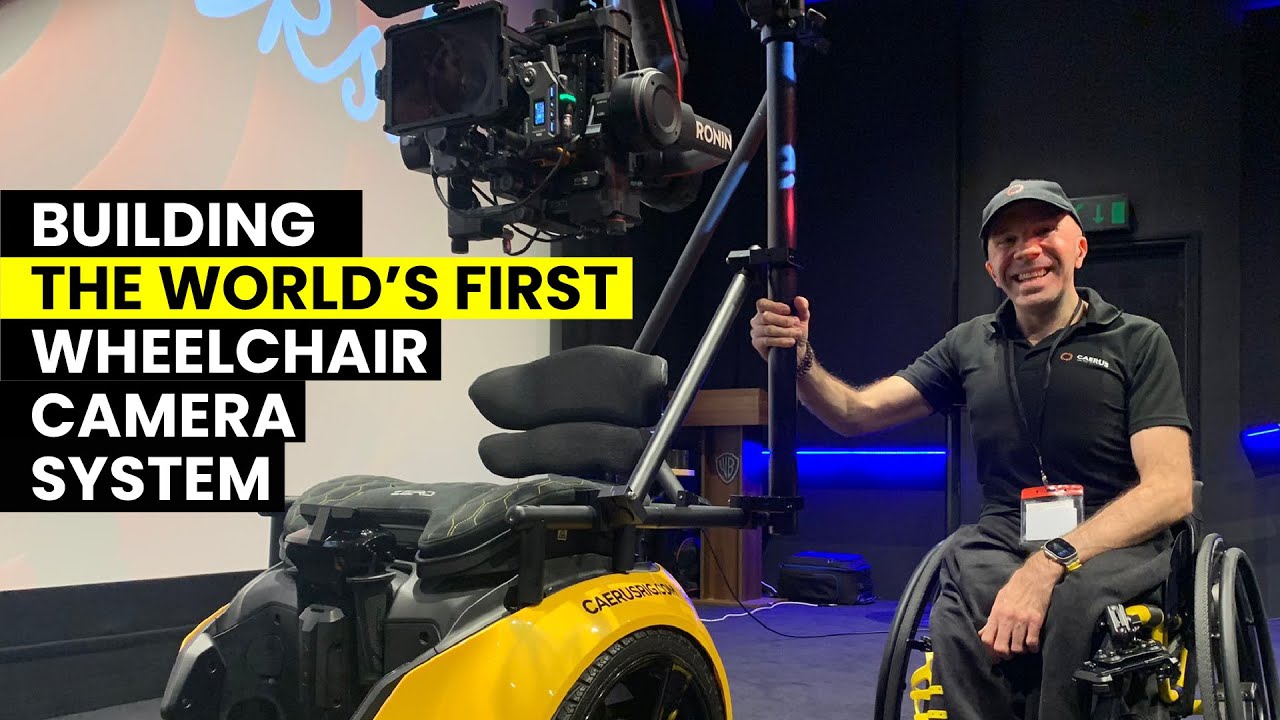
CAERUS comprises a Steadicam mounted on the side of an electric wheelchair and a control panel to operate it. The system has already been used in major productions, such as the BBC documentary, In the Driving Seat.
Speaking to the BBC, Lynch said: “This is a milestone within the disabled community. It means that I can shoot and be a camera operator, something I've wanted to do for a long time."
Until now, operating a camera rig has been impossible for wheelchair users because of the extensive physical movement needed. In the YouTube Video Lynch said, “As a wheelchair user you need four hands, two to push yourself and two to operate the camera.”
But with the dream of finally becoming a film operator, five years ago Lynch set out to smash down this barrier.
Early CAERUS designs were rudimentary and “not cinema grade”, according to Lynch.
In a recent BBC interview, he said he wanted a system that not only made operating cameras accessible to any disabled filmmaker, but that "added production value to any set".

In a bid to make this happen, Lynch relocated from Dublin, Ireland, to London England, to work with major studios and engineering companies.
The move paid off and Lynch secured a collaboration with Tilta, a manufacturing company specializing in in cinematography equipment.
Speaking to the BBC, Jack Charge of Tilta said: “This is a brand new system and is the first of its kind being mounted on a wheelchair.
"It means that you have a wide variety of situations you can use this in like live broadcasts, music videos or even fast tracking shots for long periods."
Lynch also struck a deal with Genny, the manufacturer of the Zero, a state-of-the-art electric wheelchair on which the CAERUS system is mounted.
After five years of development and demonstrations, including TV productions and speaking on the Nikon stage at the International Broadcast Convention 2025 in Amsterdam, Lynch is now showcasing CAERUS to major filmmaker and studios.
In a recent announcement, Divers Made Media stated: “The breakthrough isn't just technical, it's philosophical.
“CAERUS proves that tools designed for accessibility can expand creative options for everyone, not just disabled operators.”
You might also like
See our pick of the best video cameras to meet your needs and the best gimbals for mirrorless and DSLR cameras.

