







Digital Camera World Verdict
The Camp Snap 2 is an affordable retro compact camera that feels like a disposable film camera, despite shooting digital images. The screen-free design is excellent for retro fans, particularly with the new filter button to swap through six different retro filters. It also makes a great camera for kids. While I loved the design improvements, there's still some shutter lag. And, as with any cheap retro camera, there are some imperfect quirks to the images.
Reasons to buy
- +
Affordable
- +
Charming retro design
- +
Screen-free
- +
6 swappable retro filters
- +
Easy to use
Reasons to avoid
- -
Still some noticeable shutter lag
- -
Occasional blown highlights
- -
8MP low-fi images
Why you can trust Digital Camera World Our expert reviewers spend hours testing and comparing products and services so you can choose the best for you. Find out how we test.
As easy as it is to pull out my iPhone and take some quick snapshots, sometimes I crave the simple screenless disposable cameras of my childhood – and all the imperfect charm that comes with them. That is exactly why I was first drawn to the Camp Snap, a camera that looks like a disposable film shooter but packs digital guts inside. Now the viral minimalist camera is back – and the new Camp Snap 2 fixes most of the annoyances I found with the original.
The Camp Snap 2 brings the same lo-fi 8MP snapshots and screen-free design as the original, but tweaks the design with swapable digital filters, a wider lens, a slimmer body, easier memory card access – and less shutter lag.
I spent a few days with the Camp Snap 2 to see if the pocketable camera for digital minimalists and kids alike – and I think this will be every bit as viral as the original.
Camp Snap 2: Specifications
Sensor |
8MP 1/3.2" CMOS |
Lens |
4.2mm f/2.0 (26mm f/11.5 in 35mm equivalent) |
Filter thread |
30.5mm |
Flash |
Dual tone LED 6500K cool / 3000K warm |
Connectivity |
USB-C |
Storage |
MicroSD (4GB included) |
Battery |
Li-ion rated up to 500 photos per charge |
Dimensions |
124.3 x 65 x 32mm |
Weight |
108g / 3.8 oz |
Camp Snap 2: Price
The Camp Snap 2 launches at the same list price that the original has been selling for: About $70 / £54 / AU$130.
That makes for a fairly affordable point-and-shoot camera – though it may sit a little higher than some cameras made for kids. I’m glad to see that the camera hasn’t increased in price, despite the increased cost of memory lately. And yes, the camera still has a 4GB microSD card included in the purchase, which is enough to store around 2,000 photos.
Camp Snap 2: Design and handling

While I loved the original Camp Snap, I had a few annoyances about the earlier screen-free camera. The Camp Snap 2 fixes many of my complaints about the original design. With the same sensor inside, many of the changes between the original Camp Snap and the Camp Snap 2 are in the design.
The most welcome addition to me is that there is a filter button, making it possible to swap looks without plugging into a computer and updating the camera to a different filter. A small filter button at the back of the camera switches through the different options, and the small mini LCD screen – which also tallies the number of shots taken – shows which filter is active.

The back of the camera also houses the on-off switch, which also has a slot to turn the flash on.
The star of the show is the optical viewfinder. Without a screen, the Camp Snap 2 is used like an old-school disposable film camera: you have to put the camera up to your face and look through the viewfinder.


The front has one major difference compared to the original – the lens can now accept 30.5mm screw-in filters. That’s a smaller filter size that’s not easy to find in stores, but it makes it possible to add on a protective filter or a haze filter for an even more film-like look.
But one of the key changes on the Camp Snap 2 makes the camera suited for both children and adults. The Camp Snap was originally designed as a way for kids to take a digital camera to summer camps that didn’t allow devices with screens. But, the minimalist tech craze and Camp Snap’s resemblance to a digital dupe of a disposable film camera have the camera finding a home in adults’ pockets as well as kids.
In order to keep the camera as simple to use as possible, the filter buttons on the back can be locked into place so the youngest kids don’t bump the settings off. This is done by just pressing and holding the filter button for ten seconds. When locked, the filter button doesn’t change the filter, but snaps a photo, serving as a secondary shutter button. This is a great way to give adults more creative filters while still making it easy to hand the camera over to a kid without them accidentally switching to black-and-white mode.

The wide range of potential ages was also kept in mind with the design of the ports on the bottom of the camera. One of my complaints about the first model is that you had to remove a screw in order to access the microSD card. That’s fairly annoying, but a must in order to child-proof a camera and keep a toddler from swallowing a microSD card. Now, the Camp Snap 2 still has that screw, but there’s also a latch to keep the door closed, so adults who don’t need childproofing can just throw the screw away and access the door more easily.
The bottom of the camera also has a quick-access USB-C port for charging and transferring images – and the included USB-C cord works for smartphones as well as laptops. And, new to the Camp Snap 2, there’s also a tripod screw mount.
I loved the design tweaks on the Camp Snap 2, but the affordable camera still has a similar build and style that reminds me of a digital version of a disposable film camera. The camera is plasticky – expected for the price point – but has a nice textured wrap around the middle and doesn’t feel fragile.
The Camp Snap 2 is still every bit a compact camera, and the updated version is about 15 percent slimmer than the original. The camera is surprisingly light at 108g / 3.8 oz.
I wouldn’t expect a camera at this price point to withstand a lot of drops and bumps, but it does feel rather sturdy for a camera at this price point. I handed the camera over to my 6-year-old without any durability issues.
Camp Snap 2: Performance

The reason that the Camp Snap feels like a digital dupe of a disposable film camera isn’t just the design – it’s the images too. The photos are colorful and nostalgic, but also, like disposable film, imperfect. There can be a bit of charm to that imperfection, though of course this depends on what you’re looking for in a camera.
The Camp Snap 2 has the same 8MP sensor as the original camera, so image quality remains similar to the original. However, the lens has been updated from a 32mm equivalent to a 26mm equivalent, allowing the camera to capture a bit wider view. The aperture narrows slightly from the older version from an f/1.8 to an f/2.
At 8MP, the images are a low-fi sort of photograph that looks more like the early digital cameras of 20 years ago. The photos look good from a distance, but the 8MP quickly becomes obvious when viewing at 100 percent – there’s a graininess and lack of detail.
That imperfection, however, can also feel more nostalgic – particularly with the camera’s lens, which is a bit soft on the edges as well.
The ability to swap filters is a key update from the original and really helps build on that nostalgia.

The standard mode aims for colors that are close to the original scene.

Vivid 1 has deeper greens and less overall warmth to the image.

Vivid 2 has warmer tones, with less saturated greens and reds.

Vivid 3 is even warmer than Vivid 2 with lighter colors and less contrast.

B&W is a classic black and white treatment with a good amount of contrast.

A or Analog is the warmest filter of the bunch, with colors that feel soft and sunny.
Other imperfections can feel less nostalgic and more bothersome. Outdoors in bright light, the brightest portions of the image are often overblown to white – a symptom of the camera’s smaller sensor.

One of the trickiest parts of shooting with the Camp Snap is that there’s a shutter lag – a delay between when the button is pressed and when the photo is actually taken. The update improves on this shutter lag a bit, but it’s not as quick as more advanced compact cameras – I would put the shutter lag somewhere above the original, but a little behind the more advanced Camp Snap CS-Pro.
The delay means that if you – or the child you hand the camera to – don’t hold still for quite long enough, you’ll end up with blurry shots. This is particularly true indoors, although the flash has a decent strength.
The Camp Snap 2 has a fixed focus lens. This adds to the feel of a disposable film camera and means there’s no waiting for the autofocus to lock on. But it does mean that if you get too close to the subject, the photos will be out of focus.

I used the Camp Snap 2 for several hours on a field trip without running out of battery. The battery is rated for 500 shots. Without a screen, though, there’s no battery life indicator to warn of how much juice is remaining.
After using both the original and the Camp Snap 2, the image quality feels par for the course for a camera of this price point. The ability to swap filters is a major update that I loved, adding to the more nostalgic feel of the lower resolution images. But, I was disappointed that the shutter lag, while improved, was still noticeable.
Camp Snap 2: Sample Images


Camp Snap 2: Verdict
The original Camp Snap went viral for its similarity to disposable film cameras, but with all-digital guts. The new Camp Snap 2 delivers more of the same nostalgia and minimalism – and it’s a blast to use for both adults and kids alike.
The second-generation camera improves on many of my annoyances with the first. Filters can be swapped right on the camera, the memory card is easier to access (but still toddler safe), and it even supports filters and tripods. The shutter lag improves a little, but it is still noticeably slow.
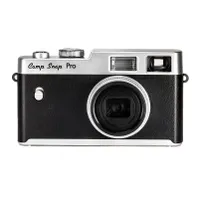
However, the Camp Snap also now has more competition, particularly from itself. For adults wanting a screen-free, nostalgic, minimalist camera, I would gravitate towards the Camp Snap CS-Pro, which has a bit higher resolution, a battery life indicator, and a lovely black-and-silver design, for a slightly higher price point.
For kids and the most budget-strapped adults, though, the more affordable Camp Snap 2 is an easy win for a charming minimalist camera. It’s an easy choice for parents annoyed at the kids' cameras that have games built in, who are looking for a camera that doesn’t count as screen time. And it’s still a solid choice for digital minimalists, provided you don’t mind the shutter lag and occasional blown-out highlight.
Features ★★★★☆ |
The Camp Snap 2's ability to swap filters is an excellent addition to the camera, but it remains a simple point-and-shoot |
Design ★★★★☆ |
The Camp Snap 2 is smaller but still feels sturdy for an affordable plastic camera |
Performance ★★★☆☆ |
The Camp Snap 2 images are charmingly retro and low-fi, but there is still noticeable shutter lag, highlights are occasionally blown out, and there's no close-up capabilities |
Value ★★★★★ |
The Camp Snap 2 is a rather affordable point-and-shoot camera and sits at an excellent price point |
Camp Snap 2: Alternatives
You may also like
Browse the best compact cameras, the best cameras for kids, or the best retro cameras.

