
When it comes to the best sports cameras – just like the best athletes – speed is everything! After years of photographing all kinds of sports, from basketball and boxing to swimming and skateboarding, I’ve learned that fast burst shooting, quick autofocus and reliable memory are absolute essentials. When the action peaks, there’s no time for hesitation.
Because of these demands, the best cameras for sports photography tend to be pricey, packed with cutting-edge technology from each brand. If you’re making that kind of investment, you want the best performance possible. That’s why I’ve tested every pro-level sports camera to help you find the perfect one for your needs.
So, what’s the best option? For all-around performance, the Canon EOS R5 Mark II is tough to beat, with rock-solid autofocus, excellent stabilization, and AI-powered features – plus, it can shoot in stunning 8K. If absolute speed is your top priority, the Sony A9 III takes the crown with its mind-blowing 120fps burst rate.
And if you're a beginner looking to shoot sports, the Sony RX10 V is an all-in-one camera that's the easiest to use while the Canon EOS R10 is the most budget-friendly. So you don't have to be an Olympic-level photographer to get in on the game!
No matter which you choose, every camera on this list is a winner. Based on my hands-on experience, here’s my roundup of the best sports cameras to help you capture every game-changing moment…

I've been photographing all kinds of sport since 2014, from motorsport to combat sports, from pickup games to the Olympic level. That covers ball sports like basketball and soccer to choreographed events like floor gymnastics and professional wrestling!
The best cameras for sports photography
Why you can trust Digital Camera World Our expert reviewers spend hours testing and comparing products and services so you can choose the best for you. Find out how we test.
Best camera for sports photography overall


This is the single most advanced camera on the market right now, packed with so many features that it's almost ridiculous!
It captures 45MP stills, but it can upscale them to 180MP in-camera with zero loss of quality. It shoots 8K 60p raw video, can fires continuous bursts of 40fps (raw and JPEG), boasts Eye Control AF (which enables you to move focus points simply by looking at your subject) and has the most incredible autofocus system.
Using Canon's latest, AI-powered Dual Pixel Intelligent AF system, not only can it detect and track subjects, but thanks to the new Action Priority mode it can recognize and predict movement – such as a spike in volleyball or an alley oop in basketball – so that it always knows which player to focus on. (This is currently limited to basketball, soccer and volleyball, though more sports may be added in with firmware.)
With Face Priority AF, you can also program up to ten faces in order of importance – so again, the camera will know to keep the star player in focus rather than jumping to a bench warmer just because his face might be a bit clearer.
There's also Canon's best-in-class in-body image stabilization to consider. This is good for up to 8.5 stops (in the center; Canon is the first brand to disclose its efficacy in the corners, where it's rated at 7.5 stops) and it makes such a huge difference when you're using the big pro lenses.
While it doesn't have the Sony's top speed, truth be told 40fps is absolutely more than enough (I never shoot above 20fps). But if video is key for your shooting, the Z8 offers longer native shooting times (though the R5 Mark II can achieve extended shooting with an optional cooling fan grip). The Canon EOS R1 offers even better autofocus performance at the expense of resolution.
Honestly, though, everything else that this camera offers just blows its rivals out of the water. The autofocus system alone transforms the way that the biggest ball sports are shot, and the Neural Network Image Processing doesn't just quadruple the resolution of your images – it can also denoise them by two stops, cleaning up high-ISO) shots or adding crispness for even slight sensitivity boosts.
Read my Canon EOS R5 Mark II review
Best Nikon camera for sports photography


The first question you're probably asking is, why the Z8 and not the Nikon Z9? The answer is twofold: price and convenience.
Specs-wise, the Z8 and Z9 are identical (though features do fluctuate depending on firmware updates, as the Z9 is technically the company's flagship). The primary difference is that the Z9 features an integrated vertical grip, accommodating a bigger battery and balancing better with larger lenses (and the larger body also means better heat dispersion).
This does, however, come at a price. Right now there is around a $1,600 price difference in the US and a £900 disparity in the UK. So you can get the same camera tech for much less money – and you can buy a vertical battery grip for the Z8 if you need it, meaning you can keep your body small and nimble or big and better balanced depending on your needs.
So you're getting a 45.7MP beast with a super-fast stacked sensor – fast enough to crank out 120fps bursts, albeit at 11MP resolution. You can shoot full 45.7MP JPEGs at 30fps and RAW files at 20fps, which isn't a patch on what the Sony A9 III or Canon EOS R5 Mark II can do, but it's still pretty impressive.
You also get up to 8K 60p and 4K 120p video internally, in 12-bit RAW and 4:2:2 ProRes RAW HQ, along with 8- or 10-bit H.265 and Apple ProRes RAW. And while the Z9 offers sligtly longer record times, the Z8 still delivers around 120 minutes of 4K 60p or 90 minutes of 8K 30p.
The only true downside, which is common to the Z9, is the lack of a fully articulating screen – something that I really, really prefer for both stills and video. The Z8 features Nikon's 4-axis tilt, which enables you to tilt the screen both horizontally and vertically, but it's much more limiting than the articulating affairs on its competitors.
Still, given all the Z8's other upsides – most of all the fantastic price – I can forgive this relatively minor irritation.
Read my full Nikon Z8 review
Best beginner camera for sports photography


Want to shoot sports but never picked up a camera before? The RX10 V is the best place to start for everyone from soccer moms to those who want to shoot their buddies playing flag football.
Where most cameras come as a standalone body (relying on you to choose, purchase and mount a lens for any given situation) this is one of the best bridge cameras – an "all in one" camera that has a built-in lens with an impressive and versatile zoom range.
In this case, the Sony RX10 V has an equivalent 24-600mm zoom – which takes you from close-up action underneath the basket on a fast break, to capturing the action in the opposite end zone for football.
The secret to this is a one-inch sensor, which is significantly smaller than full-frame and APS-C sensors but has a crop factor that amplifies the power of the attached lens. The compromise is that the image quality isn't quite on par with that of the interchangeable lens cameras elsewhere on this list.
Which isn't to say that the photos are no good – far from it! With 20.1MP resolution, there are more pixels here than Canon's flagship DSLR and some of Nikon's mirrorless cameras – and the photos are very impressive. The real caveats are that low light performance isn't as pliable, and you can't blow your shots up as big for large format prints.
Another upside is that this is a super-fast stacked sensor, meaning that you can fire off up to 30fps with the mechanical shutter. Combined with robust autofocus and subject detection worthy of Sony's Alpha range of mirrorless cameras, you'll be able to capture the best moments of the match.
The RX10 V is a versatile video shooter, too, offering up to 4K 120p shooting with a crop or uncropped 4K 60p – oversampled from 5.2K for crisp, clear footage. You also get super-slow-motion 240p in FullHD, along with support for Sony's S-Log3 and S-Cinetone profiles.
It's all-in-one-ness comes with two trade-offs; this is a slightly bulky camera and you're locked into this lens forever. It's also a slightly pricey proposition, as a mirrorless body and lens can work out a lot cheaper. However, to buy all the lenses that cover the same zoom range as the RX10 V, you'll have to spend thousands more – so in that sense, it's actually great value!
Read our full Sony RX10 V review
Best budget camera for sports photography


Of all the cameras in Canon's mirrorless lineup, I think the R10 is the most overlooked.
For less than a thousand bucks in the US and UK it gives you the same flagship autofocus system found in the EOS R3 – and using the mechanical shutter, it's actually faster than the R3 (and the Sony A1, for that matter) as well. Heck, the electronic shutter is faster than the Canon EOS R5 and R6!
Some people feel that an APS-C sensor is a strike against sports camera, but on the contrary – I think it can be an advantage, because that 1.6x crop factor effectively increases the focal length of your lenses. Stick a 300mm lens on this camera and it gives you an amazing reach of 480mm – how can you not love that!
Since this is an enthusiast-level camera there are, of course, some compromises – the biggest one being the lack of in-body image stabilization (though lots of Canon RF lenses have optical stabilization, so you won't be completely unsupported).
While 4K video goes all the way up to 60p, this does invoke a crop (though the oversampled 4K 30p and FullHD 120p are uncropped), and there's only a single memory card slot.
Still, given everything else it offers for such a low price, this is both the best cheap sports camera and the best beginner sports camera you can get right now. It's time to give this camera the respect it deserves!
Read my full Canon EOS R10 review
Best Sony camera for sports photography


The Sony A9 III is an absolute monster. If raw speed is what you need, then look no further – because this camera is an absolute Gatling gun, rattling off 120 frames every second. And unlike the Nikon Z8 / Z9, that's 120 full-size frames in both raw and JPEG.
This is thanks to the game-changing global shutter sensor, with instant full-sensor readout that eliminates rolling shutter and banding – something that's increasingly relevant in a sporting world that uses so much LED illumination – and also enables you to sync with flash at any speed.
The A9 III boasts a dedicated AI processor to power its predictive autofocus system, which 90% of the time is incredibly effective – though it's not quite as reliable as Canon's AF, occasionally losing subjects that "zig" when it expects them to "zag".
The only real downsides to the camera are the more limited sensitivity of ISO250-25600 (expandable to 125-51200 for stills), which is a compromise of global shutter technology, as well as Sony's color science that often needs repairing in post-production – especially if artificial light has been used.
Otherwise, this is a camera that literally doesn't miss a moment of the action. If you're an elite sports stills shooter, this is the most elite camera that exists.
Read my Sony A9 III review
Best DSLR camera for sports photography


Mirrorless cameras have surged ahead of DSLRs in nearly every respect, but the Canon EOS-1D X Mark III skillfully integrates the strengths of both technologies, making it a standout option for sports photography.
This camera's unmatched battery life is a significant advantage, allowing for continuous shooting without the worry of running out of power – I’ve yet to deplete a battery in a single session. Moreover, it retains an optical viewfinder, a feature still cherished by many traditional photographers for its clear, direct view and reliability.
The Canon EOS-1D X Mark III is a harmonious blend of proven and cutting-edge technology. It supports modern formats like HEIF files and HDR PQ, which enhance image quality and dynamic range. Dual CFexpress card slots ensure rapid data transfer and ample storage capacity, essential for high-speed photography.
The camera also boasts 12-bit internal 4K raw recording, offering superior video quality. One of its standout features is the innovative Smart Controller, which provides a more intuitive and efficient alternative to the conventional joystick, enhancing the overall user experience.
Additionally, the camera’s advanced Deep Learning Autofocus system delivers precise and accurate focusing, even in fast-paced environments. The inclusion of the EF mount further extends its versatility, granting access to one of the most comprehensive and diverse lens selections available on the market.
This rich lens ecosystem enables photographers to tailor their gear to virtually any shooting scenario, solidifying the Canon EOS-1D X Mark III still as a robust and adaptable tool in the world of sports and action photography.
Read our full Canon EOS-1D X Mark III review for more details
How to choose the best camera for sports photography
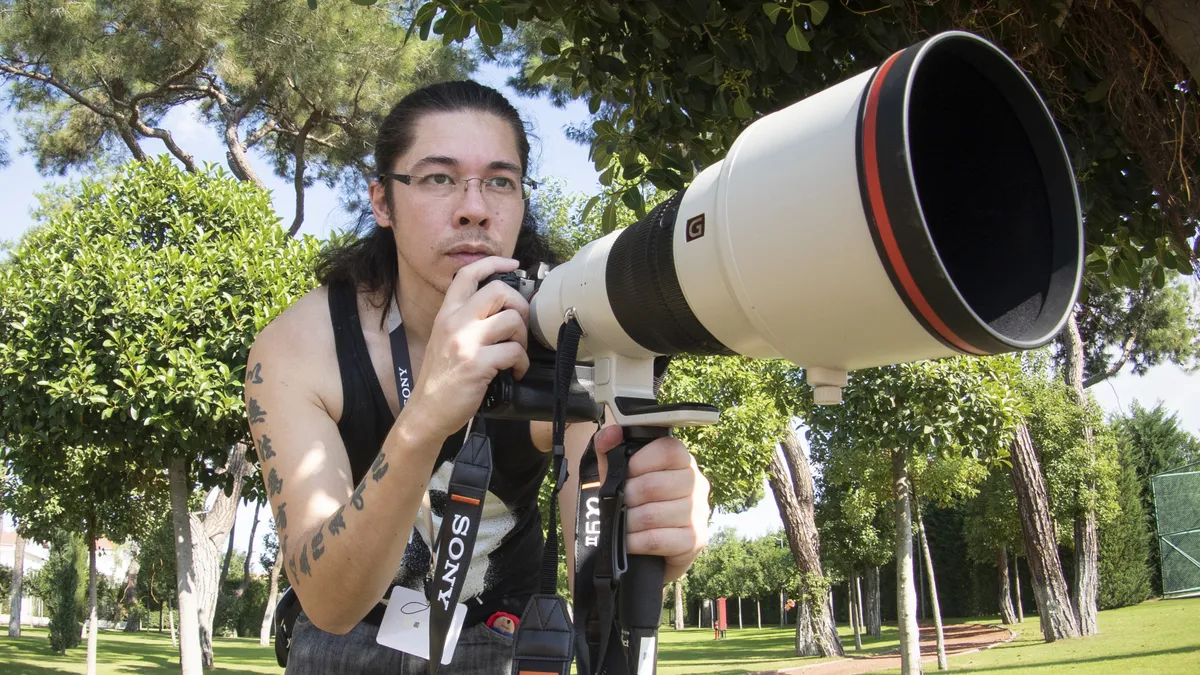
One of the most crucial features of a sports camera is a high-speed burst mode. This determines how many frames per second (fps) your camera can capture – faster speeds increase your chances of nailing that perfect mid-action shot. Mirrorless cameras dominate in this area, offering burst rates of up to 120fps, far surpassing the 16fps limit of DSLRs.
However, a fast burst mode is only useful if the camera has a deep buffer to support it. The buffer determines how many continuous shots you can take before the camera pauses to process images. Shooting in JPEG allows for a larger buffer, while raw files take up more space, reducing the number of shots before the buffer fills. That said, high-end sports cameras are designed with deep buffers to handle extended raw bursts without slowing down.
Another must-have feature for sports photography is fast and reliable autofocus. If your camera can’t keep up with the action, you’ll end up with missed shots. Look for models with extensive autofocus point coverage and advanced subject detection powered by AI. The latest cameras can intelligently track subjects, including human faces, eyes, and heads, as well as driver helmets and vehicles for motorsports, ensuring consistently sharp images.
How we test cameras
When I test a sports camera, I don’t waste time shooting brick walls or static landscapes – I take it straight to the action. Whether it’s courtside, ringside, or trackside, I put these cameras through real-world sports scenarios to see how they perform under pressure. Sometimes that means shooting pick-up games at the local rec center, and other times, it’s photographing elite Olympic athletes. No matter the level, the goal is the same: to push these cameras to their limits.
I stress-test autofocus, burst shooting, buffer depth, and battery life, capturing both stills and video. I shoot in bright outdoor conditions and dimly lit indoor arenas to see how the ISO performance holds up and whether the autofocus can track fast-moving subjects in tough lighting.
Once I’m done, the cameras go to our lab manager, Ben Andrews, for rigorous scientific testing. Using Imatest Master and DxO Analyzer, he evaluates:
Use the dropdown menu to select between Resolution, Dynamic Range, and Signal to Noise Ratio
| Timestamp (ISO) | Canon EOS R5 II () | Nikon Z 8 () | Canon EOS R10 () | Sony a9 III () | Canon EOS 1D X III () |
|---|---|---|---|---|---|
| 1 | 39 | 38 | 26 | 30 | 26 |
| 2 | 39 | 38 | 26 | 30 | 26 |
| 3 | 39 | 38 | 26 | 30 | 26 |
| 4 | 39 | 38 | 26 | 28 | 26 |
| 5 | 39 | 38 | 26 | 28 | 26 |
| 6 | 38 | 38 | 26 | 28 | 26 |
| 7 | 38 | 38 | 24 | 28 | N/A |
| 8 | 35 | 35 | 20 | 26 | N/A |
| 9 | 32 | 31 | 18 | 24 | N/A |

FAQs
Do sports photographers shoot in raw or JPEG?
Professional sports photographers tend to shoot in JPEG, as it is faster and more efficient – both in terms of shooting and uploading their files. In general, many sports photographers shoot in JPEG + raw, so that a high-quality "negative" is retained for editing purposes.
What type of camera does a sports photographer use?
Professional sports photographers generally rely on full-frame flagship cameras from major manufacturers, including DSLRs like the Canon EOS-1D X Mark III and Nikon D6, as well as mirrorless models such as the Canon EOS R1, Nikon Z8, and Sony A9 III.
These cameras offer large sensors with excellent ISO performance, high dynamic range, and rapid continuous shooting speeds. Semi-pro and enthusiast photographers often choose APS-C DSLR or mirrorless cameras, which have smaller image sensors but a 1.5x/1.6x crop factor that effectively increases the focal length of lenses. For beginners and casual shooters, bridge cameras are a popular choice. These cameras feature fixed lenses with wide – sometimes extreme – focal ranges and are easy to use, functioning similarly to point-and-shoot models.
Is a DSLR or mirrorless camera better for sports photography?
Traditionally, DSLRs have been preferred for sports photography due to their lack of lag and longer battery life, whereas mirrorless cameras have often struggled with latency in their electronic viewfinders and shorter battery life.
However, modern mirrorless cameras now offer lag-free, blackout-free shooting. With improved specifications, particularly in autofocus, burst speeds, and stabilization, though they still can’t quite match the battery life of DSLRs.
Is a full-frame camera better for sports photography?
All else being equal, a full-frame camera produces the highest quality images. However, a crop sensor camera offers the advantage of increasing the effective focal length of lenses. For APS-C cameras, this can transform a 500mm lens into an 800mm lens, while bridge cameras can reach impressive focal ranges, such as 24-2000mm, which are impossible on a full-frame camera.

