Digital Camera World Verdict
The Z Fold 8 is a pleasure to use; the passport-sized shape has real benefits, and as the first version to hit the international market, it feels super fresh and exciting. However, it's far from perfect. It's pricey, the cameras aren't the best, and thermal performance needs work. I think a lot of people are going to fall in love with this phone, and I'm almost certain the shape is here to stay, but if you want top-notch cameras and performance, you might want to wait and see what the competition brings to the table.
Pros
- +
Incredibly compact
- +
4:3 folding screen is very versatile
- +
Good battery life and quick charging
- +
Multitasking is excellent
- +
Robust video features
Cons
- -
There's no telephoto camera
- -
It gets hot
- -
Software needs tweaking
Why you can trust Digital Camera World Our expert reviewers spend hours testing and comparing products and services so you can choose the best for you. Find out how we test.
Samsung just launched its latest foldable phones, and alongside the usual Flip and Fold formats, there's a new, shorter, wider model, shaped a lot like a passport. Somewhat confusingly, it's just called the Galaxy Z Fold 8, while the traditional book-style foldable is now called the Fold 8 Ultra.
This new foldable sits in the middle of the lineup; it's more premium than the Flip 8, but the cameras aren't quite as advanced as the Ultra model. Samsung reckons it's the model to choose if you're all about content consumption, but that doesn't mean it can't make content, too.
The Z Fold 8 might lack a telephoto camera, but it has some surprisingly advanced features for photography and video. There's RAW shooting, a Log profile, and the fancy new APV codec - to name but a few. Plus, by all accounts, it seems to be the same shape that Apple's first foldable will adopt, so it might be a taste of things to come. I've been using it for the past week to find out what it's like to live with.

Specifications
Price |
£1699 / $1899 / €1,999 |
Screen |
Cover: 5.5-inch 16:10 OLED 120HZ Inner: 7.6-inch 4:3 OLED 120Hz |
CPU |
Qualcomm Snapdragon 8 Elite Gen 5 |
RAM / Storage |
12GB / 16GB + 256GB / 512GB / 1TB |
Wide Main Camera |
50MP 23mm f/1.8 |
Ultra Wide Camera |
50MP f/1.9 |
Telephoto Camera |
None |
Front Camera |
10MP f/2.2 (dual) |
Video |
Up to 8K30 / 4K120 |
Battery |
4800 mAh |
Operating System |
One UI 9, based on Android 17 |
Size (HWD) |
81.9 x 123.9 x 9.7 mm (folded) |
Weight |
210g |
Price & Availability
The Samsung Galaxy Z Fold 8 is up for pre-order now, and it's expected to land on store shelves and with customers around August 7th (at least in the UK).
There are three versions to choose from. The base model comes with 12GB of RAM and 256GB of storage for £1699 / $1899, there's a 12GB+512GB version for £1869 / $2099, and a 16GB+1TB model that will set you back a whopping £2119 / $2499.
It's available in Graphite, Cream and Lavender as standard, with a rather fetching Pistachio colourway exclusive to Samsung's online and retail stores.
Design
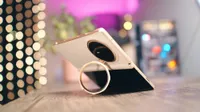
The Galaxy Z Fold 8 is unlike any phone I have used before. It's almost exactly passport-sized, and while other devices have toyed with this form factor before (like the OnePlus Open and the original Pixel Fold), I think this one is noticeably shorter and more compact.
It immediately sparks excitement and intrigue; everyone who sees it is desperate to have a go with it. And that makes sense, as phones, even foldables, have become quite homogeneous, and this stands out as something truly unique (for now),
Aside from the shape, though, the Fold 8 retains Samsung's signature look. It has sharp corners, just like the last few Folds, flat edges, and the classic traffic-light-style camera layout (with one less camera). The front is covered with a flat pane of Gorilla Glass Ceramic 3, while the back is made from Gorilla Glass Victus 2, with a smooth matte finish.


Just like last year's Fold 7, the Fold 8 is impressively skinny. It measures just 4.3mm thick when unfolded, and 9.7mm when closed. It's also very lightweight, tipping the scales at 210g. This means it's lighter than the S26 Ultra, and not too much thicker, either.
One of the more subtle changes is that Samsung has added a new bevelled edge and changed something about the magnets to make the new foldables easier to open. It's almost impossible to notice, visually, but the difference is very noticeable in practice.
The crease has also been greatly reduced thanks to a new display manufacturing technique that incorporates a flexible titanium layer. When viewed head-on, you can barely notice the crease at all, and you'll barely feel it with your fingers, either.

Image credit: Luke Baker / Digital Camera World

Image credit: Luke Baker / Digital Camera World
To make matters even better, the screen is far less shiny, so you won't get as many distracting reflections. I was a little concerned that the less-shiny screen would be a fingerprint magnet (as they often are), but this one fares well. It might not be quite as smudge-resistant as the Fold 7, but I think it's a fine tradeoff overall.
Both screens are brighter than ever, now able to reach 3000 nits at peak, which makes them very easy to see outdoors. However, it's worth noting that the Z Fold 8 dims both displays to prevent overheating, and with the recent spate of hot weather in the UK, that happened to me a lot, which was quite frustrating.
The best thing about these screens is the aspect ratios. The cover display is 16:10, a lot like a laptop screen (when held horizontally), while the inner display is 4:3, like a retro TV or an iPad Mini. Usually, foldable phones give you a pretty normal phone shape when folded shut, and open into an almost-square shape, so this feels extremely unique.

Image credit: Luke Baker / Digital Camera World

Image credit: Luke Baker / Digital Camera World
It means that there's a very big difference using the foldable screen in portrait or landscape mode, and the experience is much closer to a traditional tablet screen. Held vertically, it's amazing for watching TikToks, browsing websites and reading ebooks or comics, and horizontally, it's excellent for watching YouTube, movies and gaming.
My favourite thing to do with the 4:3 screen is watch old TV shows and skate videos, as they're natively 4:3 and fill the entire display. For the same reason, it's also perfect for emulating old game consoles from the SNES to the PS2. It's also great for reviewing images, as a lot of cameras shoot 4:3, so it has the same benefit.
16:9 content is also great, as the black bars are much smaller than they are on a traditional folding phone. However, don't go into this thinking the screen will be significantly larger than a book-style fold, because the actual size of the content is about the same - it just takes up more of the screen.
The cover display is more of a mixed experience. It's adorably tiny, and some apps look great on it, while others can feel a little cramped.
Typing is the most divisive thing about it. The on-screen keyboard takes up about half the screen when it pops up, and if you're using both hands, it feels excellent. It's significantly wider than normal, which makes it much easier to type on. The flip side of that is that typing with one hand is pretty challenging, especially if you have smaller hands. It's a real stretch to reach the left side of the screen, and that can get tiresome.

Image credit: Luke Baker / Digital Camera World

Image credit: Luke Baker / Digital Camera World
Camera Performance

The Samsung Galaxy Z Fold 8 only has two cameras on the rear. There's a 50MP 23mm equivalent with an f /1.8 lens and a 1/1.56-inch sensor, and a 50MP ultrawide with an f/1.9 lens and a 1/2.51-inch sensor. Each screen also gets a 10MP punch-hole selfie camera, but the one on the folding screen has a wider FOV than the cover selfie camera.
Obviously, the biggest downside to this configuration is the lack of a telephoto camera. Natively, you can choose from a wide shot or an even wider shot, and that feels extremely limiting. Of course, there is digital zoom, but you can't go much past 4x before seeing an obvious drop in image quality. It maxes out at 10x, and doesn't look great when you go that far.


Photos taken on this phone have the signature Samsung look to them. They're very sharp, with natural colours and a pronounced HDR effect. They seem inoffensive by design; they'll rarely exceed your expectations, but they'll rarely let you down. It's essentially the polar opposite approach to the Honor Magic V6 that I tested recently.
I like my photos to have a little more personality than the default look delivers, but thankfully, that's not hard to achieve. You can either play with the built-in filters, which are all highly customisable, or you can shoot RAW and process the images as you see fit.


Daylight photography is where this device shines, and despite wide apertures and fresh imaging pipelines, low light is still a weak point. In fairness, nighttime images are well exposed and don't require super-long exposures, but they're pretty grainy compared to the competition.
The selfie cameras are decent enough, but they're not going to knock your socks off. I like how wide the internal selfie camera is; it's well suited to video calls, and that's likely how it'll be used most often.
The portrait blur effects are quite reliable, which adds to the appeal, but with a device like this, you can easily use the rear cameras and get some genuine background softness from the larger sensors.


When it comes to video shooting, I was pleasantly surprised by the wealth of options available. The Fold 8 has a Pro Video mode, complete with Log recording options, audio meters and APV codec support. Samsung is one of the few brands offering PAL recording formats in its default camera app, too. So if you need to shoot at 25p or 50p, it's all right here.
You can shoot at up to 8K30 on both rear cameras, and the main camera can shoot 4K120 for some buttery-smooth slow-motion shots. As ever, the stabilisation is solid, and the microphones are very decent, too.
Samsung also gives you some fun new video tools to play with. There's full 360 horizontal lock, just like we saw on the S26 Ultra, and a new dual-video recording mode that lets you capture your face and your surroundings at the same time.
The FanCam mode is particularly novel. If you have a wide shot, you can select a subject in the frame, and the software will automatically crop in and follow this person about in an aspect ratio of your choosing. I don't have a particular need for this feature, but I suppose it's an alternative to having a gimbal follow you about when shooting solo.


Phone Performance
The Samsung Galaxy Z Fold 8 has the Qualcomm Snapdragon 8 Elite Gen 5 inside, and it's a specially tuned "for Galaxy" version. If you opt for the 256GB or 512GB version, you'll get 12GB of RAM, while only the pricey 1TB variant gets 16GB of RAM. I have the 12+256GB model in for testing.
For the most part, the Z Fold 8 is as powerful as its specs suggest. Apps open quickly, multitasking is a breeze, and it'll run almost any game you throw at it. Popular titles like Genshin Impact are very well optimised on this device, but newer, heavier titles like Wuthering Waves pose more of a challenge.
To play at 60fps on the folding display, I had to lower the graphics preset to "balanced", and even on this setting, the frame rate would often dip to the low 40s. It's perfectly playable like this, and still looks good, but with my other 8 Elite Gen 5 foldables (like the Oppo Find N6) I am able to bump up the graphics settings a couple of notches and achieve similar performance.

I believe it's all due to thermal throttling. The Fold 8 has plenty of power on tap, but there's much less surface area to dissipate the heat, so it has to rein itself in. It's all the more disappointing because games scale so much better to this 4:3 screen than they do on other foldables.
Of course, this only matters if you're trying to play graphically demanding games. Most mobile games will run perfectly, and if you're into retro emulation, you're going to have a field day with this 4:3 screen.
Samsung has finally started experimenting with silicon battery tech, and as a result, the Z Fold 8 gets a bigger battery than the Fold 7, despite being significantly smaller. It's now 4800 mAh, up from 4400 mAh, and it charges faster, 45W with a wire and 25W wirelessly.
These figures don't sound too impressive, with Chinese brands touting 100W+ speeds and 6000mAh+ packs, but the reality is better than you'd expect. For instance, I found that the Fold 8 could go from 0 to 70% charged in just half an hour - keeping pace with the 80W Honor Magic V6.
The battery was also good enough to last me through the day with ease. I had to charge it every night without fail, but considering how often I was using the larger folding display and how many photos I was taking, that's a very good showing.
As for the software, Samsung hasn't rewritten the formula with its latest updates, so it'll look and feel very familiar if you've used a recent Samsung flagship.
The things I love are all still present, like the customisation options, the smooth, speedy animations and the slick default look, but the downsides are still there, too. My main issue with One UI is that it feels cluttered, as it comes loaded with all of Samsung's first-party apps and most of Google's, too. A lot of these apps serve the same purpose, which can make things confusing and messy.
The update I'm most excited about is the ability to run three apps side-by-side in split-screen mode. It really takes advantage of the wider format screen, and it turns this pocket-friendly device into a productivity powerhouse.

There's also a new app from Google called Notebook, which allows you to upload almost any kind of media: audio, video, PDF documents, etc. Then you can generate audio summaries, infographics, or just chat with Gemini about the contents. It seems to be a rebranding of Google's web-based Notebook LM, but it's a handy tool, and it's now easier to access.
There are, however, a few areas where One UI doesn't feel like it's fully optimised for this new shape. The one that bugs me the most is that it will only allow four apps on each row on the homescreen. Weirdly, the home row can have five. Every Samsung phone I have used, even relatively narrow ones like the Fold 7, allows for more apps on the grid, so I have no idea why this wider display is so restricted.
Another annoyance is that your apps change positions when you rotate from horizontal to vertical on the main display, and you can't add apps to the homescreen when it's held vertically. It's a minor issue, but when you're used to your apps being in a certain order, it can be quite frustrating.
I'm sure Samsung will iron out these issues before long, and it has plenty of time to do so, as this phone should receive updates and security patches for the next seven years.

Final Verdict
The Samsung Galaxy Z Fold 8 is one of the most interesting phones I have tested in recent years. And while rumours say there will be many more like it in the near future, for now, this is a wholly unique experience.
It's really fun to use, and the new shape has some tangible benefits, especially for content consumption and gaming. The cameras, though, aren't too special, and the lack of a telephoto is hard to deal with - especially at a price like this. I do wonder if the novelty will wear off and the small frustrations will begin to overshadow the fun that this shape brings - but after using it for a week, that hasn't happened yet.
As ever, whether or not you should buy this phone all comes down to your personal needs. I'm a photographer who enjoys playing graphically intensive games, so it's probably not the ideal device for me, but the shape shows real promise.
If you don't have such high performance demands, and you're just looking for a compact phone that can extend to give you a big screen experience, you will almost certainly fall in love with this device.
Design ★★★★☆ |
Compact, lightweight and refreshingly different, the passport-sized design is the Fold 8’s greatest strength. The reduced crease and bright, less reflective 4:3 display make it a joy for watching content, gaming and multitasking, although the small cover screen can sometimes feel cramped. |
Camera Performance ★★★★☆ |
The main and ultrawide cameras deliver sharp, dependable daylight images, while RAW capture, Log video, 8K recording and 4K at 120fps give creators plenty to work with. However, low-light quality is only average, and the lack of a telephoto camera is difficult to excuse at this price. |
Phone Performance ★★★★☆ |
Everyday performance is fast, multitasking is excellent and the battery comfortably lasts a full day, with quicker charging than Samsung’s previous foldables. |
Value ★★★★☆ |
$1,899 is a lot to ask for a device with pedestrian cameras. Early adopters may find the distinctive form factor worth the premium, while most buyers would be better served by waiting for stronger competition or a price drop. |
Overall |
★★★★☆ |
Alternatives