





The iPhone Duo (or iPhone Fold) brings inferior specs and a new premium price – the only thing it will do is separate real photographers from so-called "Pro" customers who just buy the top-of-the-line without thinking what that means.
Until now, the top of the line – measured in cost – was also the best iPhone for photography. It had Apple's best arrangement of cameras, a three camera array, and I had little trouble persuading myself to "invest" in one each year. OK, a depreciating asset isn't really an investment, but I could at least tell myself that I'd have the best cameras I could get without leaving iOS.


Now the advantages of a folding phone – principally a larger inside screen for enjoying content and for productivity – come at a compromise: fewer cameras in the array. Specifically, there is no telephoto camera, which is the one which boasted a similar EFL to a traditional portrait lens and (when cropped and digitally zoomed) also provided half-decent telephoto.
So if you use the device to create content, you're better off with one of the iPhone 18 Pros. If you use it to view it then the folding phone will afford you a bigger screen. So there is no one 'best' iPhone.
And that makes it very difficult for me, and, oddly, it brings another voice that usually loses out entirely in the excitement that comes when a new iPhone is announced. The voice that says; "If the choice isn't obvious, why buy a new iPhone at all?"
That isn't to say I'm going to switch platforms. I regularly test Android-based phones, and I have no problem with the system, but I'm also well into the Apple ecosystem and I find I get on better with it.
And that hints a little at the situation I suspect many will now find themselves in.
Apple has gone to great pains to cultivate an ecosystem – if you own an Apple phone you'll find life is a good deal easier if you also have an Apple Mac computer and (if you're so inclined) an Apple Watch, Apple's own headphones, and an iPad.
And, though it isn't always easy for people who grew up with computers at the top of the tech tree, the iPhone is the key to this empire. Despite a lot of diversification, 50% of Apple's $416 billion revenue last year came from the iPhone – and there are thought to be around 1.5 billion active iPhones out there.
For contrast, the iPad made $28 billion and the Mac $33 billion in the same period.

Even if you can't conceivably afford the best of every part of your Apple ecosystem (and who needs a fully specced out Mac Studio with a five-figure price tag?) it was easy to have the best iPhone, and so the best 'key'.
Having the best phone was something that was within reach for many, and a pretty simple choice, which is why around 40-50% of sales come from the Pro or Pro Max line, and the Pro Max is routinely the top-selling single flagship phone.
I strongly feel that by making the premium phone a compromise, Apple has shot itself in the foot.
If I buy the folding phone, I'll feel I've finally got a new and exciting form factor. But the first time I go to take a photo of something a little distant from me I'll be disappointed.
And for a device that carries the price premium, there shouldn't be a compromise. Certainly not one that doesn't seem beyond the bounds of possibility to fix.
After all, the cameras tend to be on a stick-out module anyway, so it can't be that difficult to add three rather than two.
So why would Apple do this? Sure it'll save a gram or two and perhaps even make the phone a little more compact, but forcing me and others to make a difficult choice – essentially to have no one 'best' phone – is going to be hard work.
It won't make life easy for Apple Store staff, for a start.
And it'll create disappointment among many buyers too. Especially photographers, who will have seen the iPhone 18 Pro opening Apple's event on September 9 – and heard from new CEO John Ternus about a true adjustable aperture in the camera.
The iPhone 18 Pro also gets a 6-Core A20 Pro CPU with 7-core GPU and accelerated "Neural Accelerators" and 32-core Neural Engine cores, like the Duo, but only on the Pro presentation did Apple discuss thermal management which (hopefully) will keep the SOC cool this time. (I experienced a lot of overheating with my iPhone 17 Pro Max on holiday in Spain last August.)
The iPhone Duo also has slightly inferior battery times and, despite fast charging, tops up only 5 rather than 6 hours playback from the same 5 minutes charging.
The "Biggest camera improvement in years" forced Apple to explain the Aperture to consumers, but the 100mm EFL lens is there.
Apple has officially unveiled the iPhone 18 Pro.It’ll come in four colors:• Burgundy• Deep Black• Glacier Blue• Silver pic.twitter.com/uk4AlUU0GgSeptember 9, 2026
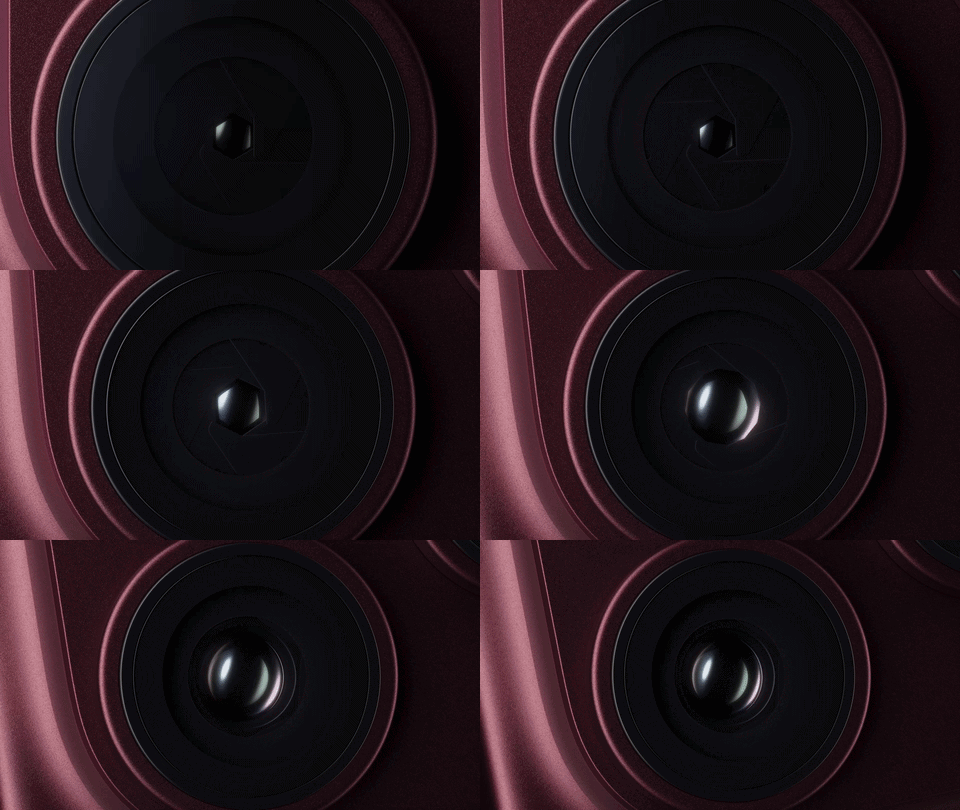
The main camera on the 18 Pro Max is upgraded with a "48MP Fusion" main camera with 6-blade variable Aperture (f/1.48 - f/4). There is a new Pro interface to access this, and timelapse is upgraded to Dolby Vision HDR 4K.
The Duo's main camera, though, is a f/1.6 fixed aperture (though the phones share the same ultra-wide camera).
The camera also boasts subject tracking similar to that on action cameras that can handle subjects leaving and re-entering the frame.
Surveys (and sales in the Android world) have shown that not many customers are interested in folding phones. But perhaps the compromises are the reason.
Then again, the Samsung Galaxy Z Fold 7 managed three cameras last year.
Perhaps Apple will eventually address it with a Pro version with the same 'sacrifice' of a little more weight for more capable cameras?
So everyone who buys the first generation will be forced to upgrade in the end?
That's disappointingly plausible, isn't it?
Apple's launch also talked about "Rethinking design principles that have been set for years." How long will it take to recover from the inevitable dent to years of use experience?
In exchange, the main screen is only 50% bigger than the iPhone Pro Max, while you lose Face ID – it only has Touch ID.
Though there is another feature: Apple also announced "Handoff" which will let you attach a second phone to the same phone number.
So perhaps the solution Apple wants is for you carry two iPhones.
$1199 for iPhone Pro 256GB will be available for pre-order on Saturday, while the Duo will be $1999 and not available for pre-order until October. Will it be the best iPhone for photography? The Duo doesn't seem to want to be!

