Digital Camera World Verdict
The Huawei Pura 90s Pro Max is capable of taking some exceptional photos. Its 50MP main camera is dependable, the enormous 200MP telephoto offers impressive reach, and its macro performance is among the best I have seen from a phone. It is also gorgeous, comfortable to hold, and equipped with a bright, sharp display. However, Huawei’s processing can be overenthusiastic, particularly with sharpening and HDR, while its professional video controls lag behind the competition. The larger problem remains software. EMUI runs smoothly, but there is no native Google support, and the global version also misses several of Huawei’s advertised AI editing features. Workarounds can restore access to many apps, but they cannot recreate the properly integrated experience available on another Android flagship. This is a very good camera phone, but recommending it as a complete phone is considerably more complicated.
Pros
- +
Excellent main and telephoto cameras
- +
Outstanding telephoto macro
- +
Beautiful, distinctive design
- +
Strong battery life and charging
Cons
- -
No native Google services
- -
Heavy HDR and sharpening
- -
Limited professional video tools
- -
Inconsistent global feature availability
Why you can trust Digital Camera World Our expert reviewers spend hours testing and comparing products and services so you can choose the best for you. Find out how we test.
Huawei was one of the first out of the gates to push the smartphone as a genuine photography tool. The Huawei P20 Pro and P30 Pro were particularly compelling, and the company has continued producing ambitious camera phones even as international restrictions have made them increasingly difficult to recommend outside China.
The Huawei Pura 90s Pro Max is the return to the global stage for Huawei flagships, which, in recent years, have rarely launched outside China. Why the international model has gained an additional “s” remains something of a mystery, but the important differences are the global version of its EMUI 16 software and international network support, including 5G.
The Pro Max is the largest and most camera-focused model in the Pura 90s range. Its headline feature is a 200MP periscope telephoto camera with a large 1/1.28-inch sensor, but it also includes a 50MP main camera with a physical variable aperture and a 40MP ultra-wide camera.
With specs like that, Huawei is clearly targeting photographers who might be browsing our guides to the best camera phones or the best Android phones for photography. However, it enters a market now packed with impressive alternatives from Oppo, Xiaomi, Vivo, Samsung, Google, and Apple, several of which offer equally ambitious camera hardware without Huawei’s software complications.
Specifications
Processor |
Huawei Kirin 9030S, octa-core |
RAM / Storage |
12GB/256GB; 12GB/512GB |
Display |
6.9-inch LTPO OLED, 2880 x 1308, 1-120Hz, 460ppi |
Main camera |
50MP, 24mm equivalent, 1/1.28-inch RYYB sensor, f/1.4-f/4.0 physical aperture, OIS |
Telephoto camera |
200MP, 89mm equivalent, 1/1.28-inch RYYB sensor, f/2.6, OIS, macro |
Ultra-wide camera |
40MP, 13mm equivalent, f/2.2, autofocus; sensor size not disclosed |
Front camera |
13MP wide-angle, f/2.0, autofocus; focal length and sensor size not disclosed |
Video |
Up to 4K 60p from the rear and front cameras; HDR recording up to 4K 30p |
Battery and charging |
5,270mAh; 100W wired and up to 80W wireless charging |
Operating system |
EMUI 16.0 |
Dimensions |
164 x 77.1 x 8.1mm / 6.46 x 3.04 x 0.32in |
Weight |
230.5g / 0.51lb |
Design
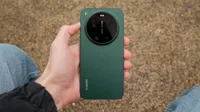
The Huawei Pura 90s Pro Max looks gorgeous. The Orange Ocean version I tested blends blue at the top into a rich orange across the lower portion of the rear panel. Huawei says the same transition continues around the aluminum frame, although it mostly just looks gold to me; however, it is still very pretty and complements the finish nicely. It is not a phone for anyone hoping to go unnoticed. The ombré effect is bright and eye-catching. More restrained buyers can choose Blush Gold or Graphite Black.

The phone feels suitably premium in the hand. At 230.5g, it is weighty without feeling excessively heavy, although it remains amongst the larger flagship phones, sitting around the same weight as a Vivo X300 Ultra or Oppo Find X9 Ultra. The outer frame is smooth but not particularly slippery, and the gently tapered edges prevent it from digging into my palm during longer periods of use.
Huawei has also returned to a completely flat screen, which I much prefer for photography, reviewing images and video (and just in general). Curved displays should be consigned to a footnote of phone design. The display itself is excellent. The 6.9-inch LTPO OLED panel is sharp, bright, and richly saturated, with strong viewing angles. Its adaptive refresh rate ranges from 1Hz to 120Hz, which keeps motion smooth while allowing the phone to reduce power consumption when the screen is static.
The front uses Huawei’s Anti-Reflection and Scratch-Resistant Kunlun Glass. Huawei claims this reduces reflections by up to 70%, increases scratch resistance by 16 times, and improves drop resistance by 25 times compared with conventional glass. The phone also carries both IP68 and IP69 ratings. I don’t tend to throw my review units around or drown them, but from sliding in and out of bags and pockets, getting splashed and bumping up against my keys quite a few times, it's still looking good as new.

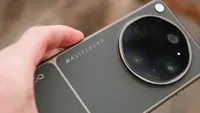
The P90s’ camera island remains one of the most unusual designs on any phone. I’m not sure how I feel; I don’t love it, but I certainly do not hate it. The rounded triangular arrangement spreads the three lenses across the upper-left corner rather than collecting them into a huge central circle or a small squircle like almost every other phone. It is noticeably different from almost everything else available, and I respect that.
That positioning has one practical advantage: my fingers rarely wandered over the lenses while I was holding the phone. I cannot say the same for several devices with large, centrally positioned camera modules. The bump itself is significant, although Huawei has softened its effect with a sloping outer edge. There is some minor table wobble, but it is less severe than on phones where several individual camera rings are clustered along one side *cough* Samsung. Because Huawei’s module occupies more of the phone’s width, it distributes the weight a little more evenly.
Box contents likely vary by region. Huawei included a charger, USB-C cable, and transparent case in my review unit.
Camera Performance
The Pura 90s Pro Max has three rear cameras. The main camera uses a 50MP, 1/1.28-inch RYYB sensor behind a 24mm-equivalent lens. Its standout feature is a 10-step physical aperture that moves between f/1.4 and f/4.0, with optical stabilization also included.


Beside it is the headline 200MP telephoto. This uses another big 1/1.28-inch RYYB sensor, but places it behind an 89mm-equivalent f/2.6 periscope lens. That provides approximately 4x optical zoom. Although interestingly, Huawei offers a 10x crop as the default “optical” zoom in the camera app, which defies the usual optical crop of twice the standard focal length, which shows how confident Huawei is in its zoom. Finally, there is computationally enhanced zoom for 20x and beyond.


The third camera is a 40MP, 13mm-equivalent ultra-wide with autofocus. Huawei also adds a dedicated True-to-Colour Camera 2.0 sensor to gather additional color information and produce more accurate white balances and skin tones, similar to what we have seen from Oppo and others on recent models.


At their optical focal lengths, all three cameras are very good. The main and telephoto cameras are the clear standouts, but the ultra-wide also produces very nice images, and doesn’t feel like the usual afterthought.
With the Pura 90s Pro Max its just remarkably easy to get good photos. In its standard photo mode, point it toward a scene, and I know I will reliably get a well-balanced, usable image. Exposure is consistently good, white balance is usually effective, and skies in particular retain a realistic blue.
However, while Huawei’s processing does an excellent job of giving photographs immediate impact, it can become overenthusiastic. Images are slightly over-reliant on sharpening, even at the cameras’ native focal lengths. This makes photographs look crisp and detailed at normal viewing sizes, but zooming in reveals fine textures taking on a slightly squiggly, processed appearance. It is not bad, and most people will never notice it. However, it prevents images from looking quite as natural or photographic as those from the best modes available on Oppo and Xiaomi phones with their Leica and Hasselblad input.
HDR is similarly aggressive. The Pura 90s Pro Max is exceptionally good at preserving highlights and pulling detail from shadows, but the result can be a photograph in which almost all the highlights are borderline too bright. I could not find a way to disable HDR capture in the standard camera mode, which is an odd quirk. HDR has its place, particularly in strongly backlit scenes, but I do not necessarily want every photograph to look that way. Editing afterward can tone down some of that effect, but I would prefer more control at the point of capture.
Color consistency across the three cameras is good, but not perfect. Each lens can produce a slightly different white balance, which becomes noticeable when shooting a sequence intended to sit together. The differences are not dramatic, but they make matching photographs more work than it should be. Below you can see the color and contrast become a little moodier between the 1x and 4x cameras, with the 4x not quite capturing the warmth of the day as well.


The 200MP telephoto is enormously capable. At its native 4x focal length, it captures excellent detail with attractive compression and dependable exposure. Results beyond the optical range are also impressive. Huawei’s high-resolution sensor gives the processing system plenty of data to work with, so photographs at 8x and 10x remain incredibly usable and up to optical quality.
However, some limitations appear once I examined the files a little more closely. At approximately 240mm equivalent and beyond, I occasionally saw odd blurring around the edges of subjects, along with small processing artifacts in areas of complicated texture. These effects become more obvious as the light falls and the phone has less genuine image information to work with.


Huawei’s 20x output can look remarkable at first glance, but it should not be confused with optical zoom. It remains a crop enhanced by significant computational reconstruction. It works well for a record shot or social-media post, but pinch in, and there are a lot of smoothed textures and digitally sharpened outlines.


Macro performance is excellent. Both the ultra-wide and telephoto cameras can focus at close distances, giving me a choice between an exaggerated wide-angle perspective and a tighter telephoto composition. The telephoto macro is particularly impressive. I could photograph extremely fine details without placing the phone directly on top of the subject, and in one image of a bee, individual grains of pollen were visible among the hairs on its body. This is one of the best macro cameras I have used on a phone.


The main camera’s variable aperture is another welcome feature, although it's not the game-changer that it could be. On a sensor this small, changing from f/1.4 to f/4 does not transform depth of field in the way it would on a mirrorless camera, but it can help control exposure and extend shutter speeds for more creative long exposures. I would love to see Huawei push the concept further. A smaller minimum aperture, combined with more direct manual control, could make the feature even more valuable for light trails or moving-water effects.
The camera application itself is straightforward, but it has several unnecessary frustrations. There is no direct 20x shortcut, nor are there convenient buttons for intermediate focal lengths such as 1.5x or 2x. Most rival applications let me tap or cycle through their zoom icons to reveal additional options, while Huawei makes me use the imprecise zoom slider.
Pro mode offers manual exposure control, but creative customization is limited. The main color options are essentially Standard, Vivid, and Bright. Oppo’s Hasselblad Master Mode and Xiaomi’s Leica profiles offer much more control over the character of an image, including less-processed output and customizable recipes.
Video quality is good in the standard mode, and the phone can record up to 4K at 60fps from every rear camera and the front camera. Footage is clean, detailed, and easy to capture, while the stabilization makes longer telephoto clips much more practical than I expected.
Unfortunately, the more advanced options fall behind rival flagships. There is no Log capture or LUT support, manual controls are limited, and Huawei’s Advanced Image Stabilization restricts recording to 2.7K. Subject tracking is more limited still, topping out at 1080p. That is difficult to overlook when phones from Apple, Samsung, Vivo, Oppo, and Xiaomi are offering Log profiles, 4K120 recording, advanced codecs, LUT previews, and support for external storage.
Phone Performance
My global Pura 90s Pro Max uses Huawei’s Kirin processor, paired with 12GB of RAM and 512GB of storage. The international model also restores 5G connectivity, something that had been missing from several previous Huawei flagships sold outside China.
In ordinary use, I had few complaints. The phone feels quick when browsing, switching between applications, streaming video, and navigating the camera interface. I did not encounter meaningful hangs or slowdowns, and it handled on-device photo and video editing without any obvious difficulty.
However, Geekbench 6 figures show that Huawei remains considerably behind the latest Qualcomm-powered flagships. Devices using Qualcomm’s Snapdragon 8 Elite Gen 5 deliver more than twice Huawei’s multi-core result. Those benchmark differences do not make the Pura feel slow in normal use, but they matter for demanding games and heavy use.
| Row 0 - Cell 0 | Huawei Pura 90s Pro Max (Huawei Kirin) |
Oppo Find X9 Ultra (Snapdragon 8 Elite Gen 5) |
Xiaomi 17 Ultra (Snapdragon 8 Elite Gen 5) |
Vivo X300 Ultra (Snapdragon 8 Elite Gen 5) |
GeekBench 6 CPU (Single Core) |
1257 |
3548 |
3560 |
3632 |
GeekBench 6 CPU (Multi Core) |
4437 |
10701 |
10512 |
10619 |
The more significant issue is EMUI 16. Huawei’s interface is clean, responsive, and generally easy to use, but the global phone does not include Google Mobile Services. That means there is no native Google Play Store, Google Wallet, Android Auto, or properly integrated Gemini. Huawei offers alternatives through AppGallery, Huawei Wallet, Celia, Petal Maps, and Huawei Cloud, and many of those applications are perfectly competent.
The problem is that much of my digital life is tied to Google. My files are in Google Drive, I sign into countless services with my Google account, and I use Google’s applications across several other devices. Replacing one app is manageable, but replacing an entire connected ecosystem is considerably harder.
There are third-party methods for installing many Google applications, including containerized services and manually installed APK files. These can work surprisingly well, but they remain workarounds. They do not provide the same deep system integration, and applications that rely closely on Google Play Services, device certification, payment security, or background synchronization may behave unpredictably.
The global model also has a confusingly restricted set of AI editing tools. Huawei promotes AI De-glare, AI Move, AI object removal, and other generative features in some markets, but the global version is missing these options. That leaves the global Huawei well behind Google, Samsung, Oppo, and several other brands for AI-assisted photo editing, despite the strength of the cameras producing those photographs.
Battery life is excellent. My review unit comfortably lasted around a day and a half with a mixture of photography, video recording, browsing, and general use. Huawei officially rates the battery at 6,000mAh outside the European Union, while the EU version has a 5,270mAh rated capacity. Charging is very fast. The phone supports up to 100W wired charging and up to 80W wireless charging with compatible chargers.
Final Verdict
The Huawei Pura 90s Pro Max is a hard phone to assess. It has built an excellent camera system and wrapped everything in one of the most distinctive designs around. It is comfortable to hold, the display is excellent, battery life is strong, and ordinary performance is smooth.
The cameras are capable of producing outstanding images, particularly at their native focal lengths. I also enjoyed how little effort was needed to get a successful photograph. Exposure, color, and white balance are usually dependable without intervention. However, the processing can look too sharp and too HDR-heavy, while Huawei provides fewer tools than its competitors for dialing that processing back. Its video hardware is impressive, but the lack of Log recording, LUT support, and full-resolution stabilization makes it a less convincing choice for serious video makers.
Then there is Google. Many applications can be made to work, but I never stopped noticing what was missing. The limited AI editing tools on my global unit were also missed. For photographers willing to accept those compromises, the Pura 90s Pro Max is a remarkable imaging device. For everyone else, other Android and Apple phones offer more complete all-round experiences.
Design ★★★★½ |
A bold, beautifully finished flagship with comfortable handling, a superb anti-reflective display, and a camera island that is unusual without becoming impractical. |
Camera Performance ★★★★☆ |
Excellent main and telephoto cameras produce impressive images and outstanding macro shots, although excessive HDR, sharpening, and digital artifacts limit their photographic purity. |
Phone Performance ★★★☆☆ |
Smooth in everyday use with strong battery life and charging, but benchmark performance, unclear software support, and absent Google integration hold it back. |
Value ★★★☆☆ |
The camera hardware justifies flagship pricing, but limited availability, regional feature differences, and major software compromises make rival phones easier to recommend. |
Overall |
★★★★☆ |
Alternatives