Digital Camera World Verdict
The Benro A572LLKH Lightning Lock Aluminum Video Tripod Kit has quite a mouthful of a product name, but the clue is in the title. I like the ‘lightning lock’ design that features just one quick and easy clamp per leg. The leveling bowl is equally effortless to adjust, and pan & tilt work with the kind of fluid feel that I expect from a high-end video head. All in all, it’s a tripod that’s solid, dependable, and easy to live with, and it comes at a competitive price.
Pros
- +
Fast ‘lightning lock’ legs
- +
Fluid head with 60mm bowl
- +
Smooth pan and tilt operation
- +
Carbon and aluminum versions
Cons
- -
Modest max load rating
- -
No adjustable counterbalance
- -
No accessory mount socket
- -
Fiddly feet
Why you can trust Digital Camera World Our expert reviewers spend hours testing and comparing products and services so you can choose the best for you. Find out how we test.
Benro is renowned for offering solid support to photographers and videographers. The Chinese manufacturer has been going for 30 years and counting, creating a diverse range of products. I’ve been impressed by many and varied bits of Benro kit, including the Benro Cyanbird Carbon FS30 travel tripod kit, Benro SupaDupa Pro MSDPL46C monopod, Benro FS20PRO Video & Foto Head, Benro GH5C gimbal head, and the Benro QRB95DUAL Quick Rotation Lens Bracket, to name but a few.
The Benro A572LLKH Lightning Lock Aluminum Video Tripod Kit that I’m reviewing this time around is from a new series of video tripods, their main claim to fame being the ‘lightning lock’ leg system. As its name suggests, the design aims to be super-fast for setting up the tripod and packing it away again after a take. Available in both aluminum and carbon fiber versions and with different heads, it aims to be one of the best video tripod kits on the market. I put the aluminum kit with the KH fluid head to the test.

Benro A572LLKH Lightning Lock: Specifications
Material |
Aluminum |
Folded height |
81cm / 31.9in |
Maximum operating height |
151cm / 59.4in |
Minimum operating height |
75.5cm |
Weight |
3.9kg / 8.6lb |
Load rating |
6.8kg / 15lb |
Sections per leg |
3 |
Maximum leg section diameter |
18mm |
Locking leg angles |
1 |
Feet |
Twin spike / pad |
Case/bag included |
Padded bag |
Benro A572LLKH Lightning Lock: Price
The current range of Lightning Lock-series legs and complete kits starts at a very competitive price and stays very reasonable through to the top end. Kicking off the selection is the set of aluminum legs on their own, priced at $175 / £220. Adding the KH fluid head for a complete kit brings the price up to $280 / £330. The carbon fiber legs on their own are slightly pricier than the complete aluminum kit, priced at $300 / £340, while the range-topping carbon kit with head sells for $380 / £450. Even that’s very affordable for a pro-grade video tripod.
Benro A572LLKH Lightning Lock: Design & Handling
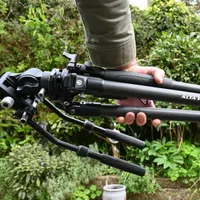
Following something of a time-honored tradition for video tripods, the legs are constructed from twin-tube sections. The idea is to maximize the overall stability while reducing the risk of tortional flexing and twisting while you’re panning. As such, the top and middle sections of the 3-section legs have double tubes, and the bottom section has the usual single tube.

When folded out, the legs have the usual look of five tubes in a row. At least, that’s how things look when the tripod is set to its minimum height. As you extend the legs for loftier operation, the top two sections extend in pairs of tubes, and the single bottom tube of each leg also extends.

Another bit of video tradition is that the Benro features a spreader between the legs. Again, this is to enhance stability and to make sure that the legs stay evenly and securely positioned while the tripod is in use. The spreader is typically hinged so that it folds out automatically as you pull the legs out from their folded position. As such, the tripod doesn’t feature alternative locking leg angles for operational use, and clips are included for holding the legs together when the tripod is folded down.

Getting on to the hotter news about extending and contracting the legs to alter the height, the tripod features Benro’s new ‘lightning locks’. I’m a fan, liking that each leg has just a single lock/release lever for height adjustment, making them very quick and easy to adjust. You simply pull each lever outwards from the leg to release all three sections, make the necessary height adjustment, then push it back in again. As well as speeding up the process of height adjustments, the system also makes it easier to level the legs.

While the lightning locks enable quick and broadly accurate leveling, you still need the platform that supports the head to be perfectly leveled if panning is on the cards. That’s so that the horizon doesn’t start to tip over at an angle during panning. As such, the tripod features a 60mm leveling bowl and a simple lock/release knob underneath the main platform. Again, it’s a quick and easy system to use, as you just have to loosen the knob, make the leveling adjustment, then tighten it back up to lock the platform in place.

As an aid to leveling, there’s a bubble level on the platform, and I’m pleased that it’s comparatively large and easy to see, unlike the tiny bubble levels of some tripods. Naturally, most cameras these days feature an artificial horizon that can be more accurate than using a bubble level, but every little helps.

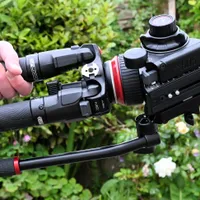
I’ve found that some video heads have a panning action that’s a little too loose for my liking, whereas others feel a bit tight and stiff. A neat feature of the Benro is that, as well as the pan lock/release knob, there’s an adjustable fluid drag control. This has a twist action that enables you to set just the right amount of fluid drag that you’re most comfortable with, for the job at hand.

The tilt mechanism is relatively straightforward, with a simple lock/release knob. This gives some control over the amount of drag for front-to-back tilting, but not so much as with the panning adjuster. As I’d expect, there’s a spring-loaded counterbalance system but, again, this is quite a simple affair and the head doesn’t feature an adjustable counterbalance mechanism for tailoring it to different weights of camera.

To further enhance the feel of the tilt and panning action, the head features a generously long panning handle. It has the usual elbow that angles its shaft, and is mounted on splines that avoid any risk of slippage or wobbling. The grippy rubberized hand grip area of the panning handle is also comfortably large and feels good to the touch.

As is often the case with up-market video heads, a splined attachment bracket is featured on both the left and right sides of the head, to accommodate comfortable panning with either your left or right hand, respectively.

The clamp up on top is industry-standard 501 compatible and comes complete with a quick-release plate. The clamp has a rotary lock-release knob plus a security pushbutton at the rear, to avoid any nasty surprises with the plate sliding out accidentally.

The QR plate itself features a sliding mounting screw saddle for attaching your camera, cage, or lens with a tripod-mounting collar. There are also three spring-loaded security pins and a calibrated scale along both sides of the plate, for precision placement.

The tripod comes with large, rubber pads which give a firm and stable footing on hard flooring and ground. They’re removable, to reveal dual spikes as alternative footwear that’s more suitable for soft flooring and loose ground. It’s nice to have the choice, my only slight complaint being that I found the rubber retaining straps that hold the rubber feet in place to be quite stiff and fiddly for removal and replacement.

The image above shows one of the large rubber foot pads, whereas it has been removed for the image below, which shows the dual metal spikes.

Benro A572LLKH Lightning Lock: Performance
A key performance plus point is that the ‘lightning locks’ live up to their billing and enable super-quick setup of the tripod. That can be a massive bonus if you need to react quickly to an unfolding storyline at weddings and other events, and for shooting sports or wildlife. The bowl mechanism in the head is similarly speedy for quick and accurate leveling, so you’re ready to roll in no time at all.

There’s a fairly decent height range on offer, from a minimum operating height of 75cm / 29.5 inches, up to a maximum of 151cm / 59.5 inches. That should suffice for most scenarios, but won’t cover you for ultra-low-level shooting or for getting an overview with a really tall perspective.

Stability and rigidity are impressive, and the tripod is very resistant to flexing and vibrations when panning and tilting. Pan and tilt themselves operate with the requisite fluidity for videography, and I’m very happy with the adjustable fluid drag control for panning. The lack of an adjustable counterbalance system can be less rewarding, especially if you’re using hefty camera and lens combinations. The maximum payload rating of the kit is 6.8kg / 15lb, which again should suffice for most needs but isn’t overly generous. There’s also no threaded socket for attaching accessories like an LED lamp, microphone, or monitor screen via a magic arm.

Ultimately, the Benro won’t win any prizes for its range of height adjustment or maximum load-bearing capability, but performance is very pleasing within the design parameters. It’s a quick and easy video tripod to use, without being too big, heavy, and cumbersome.

Benro A572LLKH Lightning Lock: Verdict
There’s a lot to like in the Benro A572LLKH Lightning Lock Aluminum Video Tripod Kit. Living up to its billing, the new ‘lightning lock’ system enables super-fast height adjustments and leveling of the legs, while the 60mm bowl mechanism in the head allows for ultra-precise leveling adjustments. As well as being quick and easy to set up, the tripod operates with smooth efficiency and features an adjustable fluid drag mechanism for panning. That’s backed up by good resistance to unwanted flexing and vibrations.
The maximum load rating isn’t overly generous, there’s no adjustable counterbalance system, and the feet require a bit of effort to swap them between rubber pads and dual metal spikes. Even so, the Benro is simple to use, highly effective in most shooting scenarios, and very good value for money.
Features ★★★★½ |
The lightning locks for height adjustment are the most innovative feature but the adjustable fluid drag for panning is another high point. |
Design ★★★★☆ |
The design is a mix of old and new, enabling speedy setup but lacking a few finer points like an adjustable counterbalance system, accessory mount or a provision for ultra-low-level shooting. |
Performance ★★★★☆ |
Rigidity and resistance to flexing and vibrations are good, and the tripod is a smooth operator for panning and tilt. |
Value ★★★★☆ |
For a complete video tripod kit that includes specialized legs, a leveling bowl and clever head, the aluminum version in particularly is good value for money. |

Alternatives