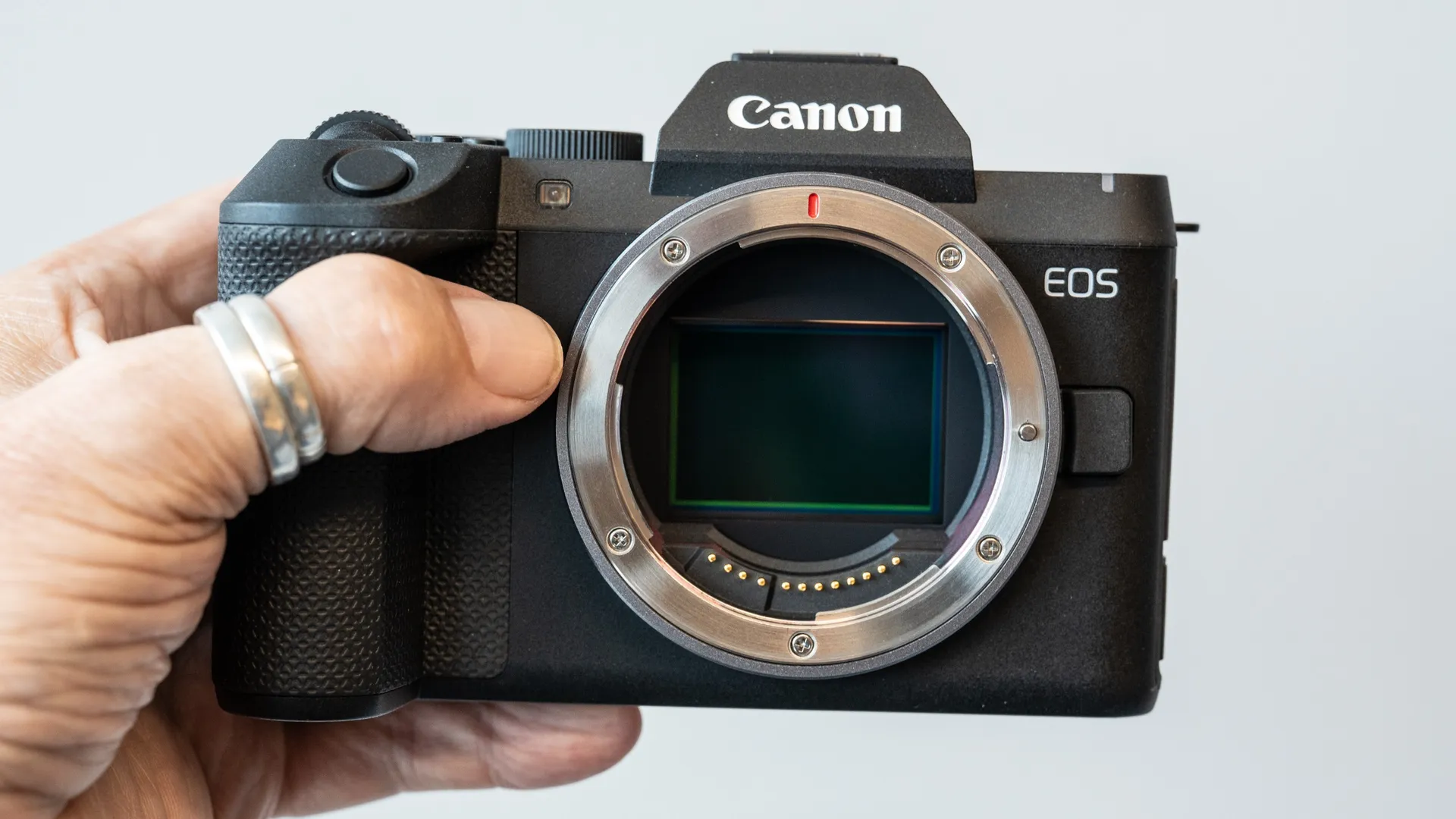
Canon has long been rumored to be working on a “retro camera” – but when Canon finally unveiled its first retro mirrorless, the Canon EOS R8 Mark II, the launch was met with mixed opinions.
The internet’s reaction to the R8 Mark II is varied. Many seem disappointed that Canon didn’t take inspiration for its looks from the popular A-E1. Others find the camera’s sharper lines make it look more like a Sony than a Canon.
I got my hands on an early sample of the Canon EOS R8 Mark II, and when I first pulled it out of the box, my first thought was that the camera doesn’t really feel retro – or at least, it doesn’t really feel a lot like other retro cameras.
I wouldn't call the R8 Mark II a "retro camera," but I do love the design for two reasons: the comfortable grip and joystick.
The Canon EOS R8 Mark II is inspired by a consumer camera

The phrase “retro camera” probably brings to mind a certain look – mainly, a silver-and-black body with retro dials at the top and a more vintage-inspired silhouette. The history of camera design varies from Art Deco box cameras to folding bellows, and yet most digital cameras with a retro-inspired design seem to go after either the SLR or rangefinder look with that classic silver-and-black look.
Many retro cameras also draw inspiration from higher-end models built for serious photographers. That’s where the retro dials come in.
But Canon is going after not just a mid 1980s camera, but one that was more consumer-oriented, drawing inspiration instead from the Canon T80. The Canon T80 launched in 1985 and didn’t offer a full manual exposure mode – which gave the camera its flatter top rather than one filled with dials for adjusting shutter speed. The T80 was built for beginners and general consumers, not serious photographers.
The Canon EOS R8 Mark II, of course, has full manual mode, but it is built as the entry-level option into Canon’s full-frame mirrorless. Canon told me that around 20 percent of those who bought the original R8 were moving up from a smartphone.
I think one of the reasons for the more subtle retro design – in particular, sticking with the classic mode dial and command dials – is that the R8 series is meant not only as a camera for serious hobbyists but as a camera that newer photographers can grow into. Retro dials can feel a bit more intimidating to newer photographers.
The retro design on the R8 Mark II is subtle – but unlike other RF bodies

While taking inspiration from a camera without full manual controls explains why Canon didn’t use retro dials, the T80 inspiration still feels a bit subtle. The viewfinder shape has similar sharp angles, though the R8 Mark II’s is much shorter, and the top of the camera is all sharp angles rather than the R-series' usual preference for smooth curves.
The T80 has a much different grip and a much different logo. Adding a bit of the T80’s lines in the grip or even using a gold colored logo like the T80 would have made the R8 Mark II feel a bit more retro.
The Canon EOS R series has long carried a very similar look between the different bodies, all sporting smooth, more curved lines and chunky grips that feel almost DSLR-like. It feels like the conversation has shifted from complaining that Canon’s cameras look too similar to complaining that Canon didn’t take inspiration from the same decade of camera design as other retro cameras. Complaining that Canon’s cameras feel too similar and then complaining that Canon’s retro camera doesn’t look like other retro cameras feels a bit hypocritical.
Yes, the R8 Mark II’s sharp angles do feel a bit Sony-ish. But the R8 Mark II also doesn’t look anything like other retro cameras like the Nikon Zf or the Fujifilm X-T5, either, because Canon is taking its inspiration from a different style of camera.
The Canon EOS R8 Mark II has a more subtle retro look than an obvious one. There is, of course, the question of how old a camera needs to be to be considered retro. Then again, the Nikon FM2 that the Nikon Zf finds inspiration from is only slightly older, launched in 1982.
I’d call the R8 Mark II more “retro-ish” than “retro.” But, at the same time, I love the ergonomics on the R8 Mark II.
The Canon EOS R8 Mark II’s more conservative take on retro leaves a large grip

As much as I love retro-inspired cameras, I hate that “retro” usually translates to “tiny grip.” Many retro-inspired cameras use shallow grips – or none at all – because the inspiration camera also had a non-existent grip.
The grip on the R8 Mark II still feels very much like a Canon. The R8 series is still among Canon’s smallest full-frame bodies, and that means the grip is a bit smaller too, but there’s still plenty of grip to wrap my hand around.
That’s paired with the autofocus joystick that was missing from the original R8. The R8 Mark II feels very easy to control with one hand.
Yes, the R8 Mark II’s retro inspiration is far more subtle than other retro cameras. Yes, straying from Canon’s unusual curves does make the camera look a bit more like some of the competition. And yes, I probably would have been more excited if Canon had decided to make a digital AE-1 complete with retro dials, instead of the T80. Those are all valid points.

The R8 Mark II wasn’t the “retro” camera that I was expecting. I think Canon could have played up the retro looks of the R8 Mark II, but the feel of the camera is fantastic. The grip is excellent for such a lightweight camera, and the Mark II has the joystick that I sorely missed on the original.
I wouldn’t put the Canon EOS R8 Mark II on the same retro level as options like the Nikon Zf or the Fujifilm X-T5. But while the retro look is far more subtle, I do love the ergonomics on the R8 Mark II.
One of the downsides to the R8 Mark II, however, could be that many of the changes are about those ergonomics. Besides the design changes, the R8 Mark II adds a very welcome in-body stabilization system, along with a better burst buffer and improved low-light autofocus.
The Mark II carries the same sensor and processor as the original, which leaves the differences largely about the shooting experience and not the image quality. Without a change in the sensor or processor, I don’t see many Canon EOS R8 users making the upgrade. I also see a lot of users being swayed by the R6 Mark II instead, whose age has brought the price much closer to the R8 Mark II.
It will be interesting to see where Canon goes from here. Will subsequent cameras in the series have those sharper edges or go back to Canon’s curves? Will Canon ever launch a digital remake of the AE-1?
The Canon EOS R8 Mark II may be more subtle in its “retro” design, but the ergonomics feel like a significant upgrade from the original.
You may also like
For more inspiration, take a look at the best Canon cameras or the best Canon RF lenses.

