Early Verdict
The Canon EOS R8 Mark II fixes nearly all of our biggest complaints about the original, adding in-body stabilization and a joystick, while carrying the same sensor and processor as the original. The result is an entry-level full-frame camera that feels far from basic. Image quality remains solid and the already impressive 40 fps comes with a bigger buffer. The one thing that wasn't fixed? The battery life sadly remains the same as the original. Adding IBIS also makes the Mark II a little heavier than the original.
Pros
- +
In-body stabilization
- +
Fantastic ergonomics with a joystick and tilt screen
- +
Solid image quality for the price
- +
40 fps bursts with Dual Pixel II AF
- +
Uncropped oversampled 4K60p
Cons
- -
Pricier than the original
- -
Animal eye-AF could be better
- -
Battery life remains rated for 220 shots
Why you can trust Digital Camera World Our expert reviewers spend hours testing and comparing products and services so you can choose the best for you. Find out how we test.
Canon has given the popular R8 a retro-inspired makeover – and fixed some of the complaints about the entry-level full-frame camera at the same time. The Canon EOS R8 Mark II brings the same well-loved sensor and processor as the original, but adds in-body stabilization and overhauls the ergonomics.
Inspired by the 1985 film SLR T80, the Canon EOS R8 Mark II takes on a design with sharper angles without sacrificing the actual feel of the camera, keeping a good-sized grip and even adding the must-requested joystick.
I shot some portraits and wildlife with the Canon EOS R8 Mark II to see if Canon has found the ideal balance between features, ergonomics, and price.
Canon EOS R8 Mark II: Key specs
Sensor |
24.2MP full-frame CMOS |
Processor |
Digic X |
Lens mount |
Canon RF |
Autofocus |
Dual Pixel CMOS AF II with 4368 positions (3588 for video) |
ISO range |
100-102,400 (50-204,800 expanded) |
Video |
Uncropped 4K up to 60p oversampled from 6K, FullHD at up to 180fps, Cropped UHD 4K60p, C-Log3, HDR PQ, 4:2:2 10-bit |
Viewfinder |
2.36 million dot OLED |
Memory card |
Single SDXC/SDHC/SD up to UHS-II |
LCD |
1.62 million fot three-inch touchscreen with tilt |
Max burst |
40 fps electronic, 6 fps mechanical |
Connectivity |
Wi-Fi, Bluetooth |
Size |
131.4×90.0×79.7mm / 5.17×3.54×3.14 in |
Weight |
Approx. 546g / 19.26 oz with battery and SD card |
Canon EOS R8 Mark II: Price
The Canon EOS R8 Mark II is expected to list for $1,899 body-only and $2099 with the 24-50mm f/4.5-6.3 IS STM lens in the US. In the UK, the body lists for £1,729 and the kit for £2,119.
That’s notably higher than the original R8’s list price, which started at $1,499 / £1,699. In the US, that price later rose to $1,649 after tariff increases.
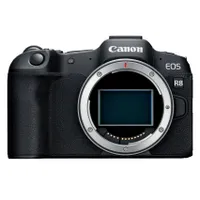
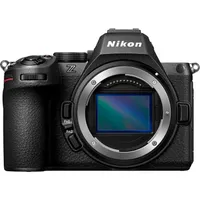
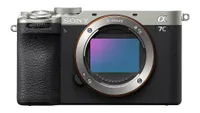
Despite being higher than the earlier generation, the R8 Mark II is Canon’s most affordable full-frame mirrorless with IBIS, and among competitors, the price still fares fairly well. The Nikon Z5 II comes in at a similar price point at $1,846 / £1,599. While the Sony A7C II comes in at $2,498 / £1,999, Sony has kept older models around with IBIS, like the A7 III, which is $1,998 / £1,499 retail.
Another worthwhile note? Canon plans on keeping the original R8 around for a bit as a budget alternative.
Canon EOS R8 Mark II: Design

The Canon EOS R8 Mark II is Canon’s first retro-inspired mirrorless camera, but where most retro bodies find inspiration from 1970s-era cameras, Canon is taking a dramatically different approach. The R8 Mark II is inspired by the Canon T80, a film SLR that was introduced in 1985 and discontinued less than two years later.
Taking inspiration from the mid-1980s, the R8 Mark II doesn’t scream retro but rather has a more subtle nod to the old camera, with a more angular pentaprism and a more angular cut.


While I was surprised at Canon’s first choice of a retro camera, what I love about the R8 Mark II is that despite the slight retro nod, the body still does what Canon does best – and that’s to create a very comfortable grip.
Retro cameras tend to have small and, in some, even nonexistent grips, but the R8 Mark II still has a very healthy grip that still managed well even with a 100-400mm lens mounted on the front.
I’m a petite person, and my hands wrap nicely around the grip without my pinky falling off the bottom. The R8 Mark III will have an optional extension grip that will leave more room for larger hands.

But the Mark II also fixes one of the biggest ergonomic oversights of the original and adds a joystick. While it’s not uncommon for entry-level models to do without, once you’ve used an autofocus joystick, it’s hard to go back to the old, clunky method of adjusting with the menu arrow keys.

That joystick is joined by a handful of key shortcut buttons and a nice tilt-enabled touchscreen. The screen uses a hinge at the side, which allows the screen to fully face forward for vlogging and selfies, along with being angled for high and low-angle shots.
The electronic viewfinder also juts out a bit from the body, and I love that my nose didn’t feel squashed up against the screen.

At the top of the camera, the R8 Mark II has two control dials, one placed horizontally and paired with an on/off switch, and the other arranged vertically within easy reach of the index finger. The top is completed with a classic mode dial (sorry, no retro dials here), an Fn button, a dedicated record button, and, of course, the shutter release.

There’s just a single SD card slot on the R8 Mark II, which is on the grip side and separate from the battery compartment at the bottom. (That battery door, by the way, is far enough away not to be blocked by a tripod quick release plate.)

On the opposite side of the grip, the R8 Mark II has ports for mic, headphones, a cable release, micro HDMI out, and USB-C.
Despite all of these changes, the R8 Mark II remains relatively lightweight. The camera weighs 546g / 19.26 oz once fully loaded with a battery and memory card. That is a little bit more than the 461g / 16.26 of the first generation, but I think that added IBIS system is well worth the slight increase in weight.

The Mark II also carries dust and weather seals, with the same level of sealing as the original.
Overall, while I think some may be disappointed that the retro take is subtle, the Canon ergonomics that fans already know and love are still in play here – and it even gains the joystick over the predecessor.
Canon EOS R8 Mark II: Performance

The Canon EOS R8 Mark II carries the same 24.2MP full-frame sensor and Digic X processor as the original-generation camera. That leaves the second generation with similar image quality to the original, outside of enhancements like fewer blurry shots thanks to the new in-body stabilization.
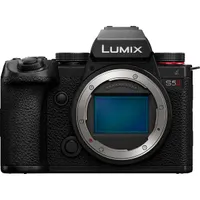
The lack of a sensor upgrade may disappoint some, but the 24.2MP resolution on a full-frame camera remains very capable. The resolution is still similar to similarly priced competitors such as the Nikon Z5 II and Panasonic Lumix S5 II, though options like the Sony A7C II sit at 33MP. Detail may not be as impressive as Canon’s pricier bodies, but the R8 Mark II strikes an excellent balance between detail and noise for the price point.

Dynamic range also fit right in with what I expected. I was able to recover quite a bit of detail in the shadows on RAW files from backlit, underexposed shots of birds.
Like the sensor, the Dual Pixel II autofocus system matches much of the specs of the original, except the Mark II sees a low-light boost, rated down to -7.5 compared to the -6.5 from the original.

The autofocus overall locked on quickly and managed to keep up with moving subjects. The R8 Mark II managed to freeze birds in midflight, though it dropped some frames. What made the autofocus all the more impressive was the fact that I was using a more affordable telephoto – the 100-400mm f/5.6-8 IS USM.
Subject detection locked onto human eyes well. Animal detection did well on uncluttered backgrounds, but the animal eye AF sometimes struggled to find the eye of some birds and also struggled when shooting with a few stray branches in the way, locking on to tree branches instead of the bird more than I would have liked.

Like the original, the R8 Mark II can shoot at 40 fps with the electronic shutter (but just 6 fps with the mechanical shutter). Even more impressively, those high-speed bursts didn’t come with a long wait to process shots, and I was able to photograph birds without waiting for the camera to catch up. Canon says the buffer improved 30 percent for RAW files over the previous version and 58 percent in JPEG, and it’s a noticeable, welcome improvement.
While the sensor and autofocus may be a match with the original, the new in-body stabilization is impressive. Working with a telephoto that shoots at only f/8 at 400mm inside shadowy branches was a good test for the camera’s image stabilization. I shot this photo at just 1/60th of a second at 400mm:

While I don’t mind that Canon kept the same sensor – at least at this price point – one of the annoyances from the original R8 that isn’t fixed on the update is the battery life. The R8 Mark II carries the same 220-shot (370 in power-saving) rating for battery life while using the viewfinder. Those specs tend to be conservative estimates – I shot more than 350 shots and still have plenty of battery remaining. But for long shoots and travel, picking up a spare battery will be a must.
Canon EOS R8 Mark II: Image Samples


Early Verdict
The Canon EOS R8 Mark II keeps the solid image quality of the first generation – while fixing all but one of our complaints. The camera now has in-body stabilization, a key move to keep up with competing options. A joystick creates fantastic ergonomics, while the memory card door is no longer in an awkward spot blocked by tripod plates.
The only complaint from the original Canon didn’t fix? It has the same battery life – so many users are going to want to factor in the cost of a backup battery.
The Canon EOS R8 Mark II delivers an excellent balance between performance and price. The autofocus and burst speed are excellent – though the animal eye AF doesn’t do as well at picking up a bird in a mess of branches as I would have liked.
The Canon EOS R8 Mark II is an ergonomically lovely camera that packs in a lot of tech for the price point.
Alternatives