





Ever since Olympus released its first mirrorless camera, back in 2009, people were asking whether the company would make a full-frame camera.
Seventeen years on, now known as OM System, the brand has reaffirmed its commitment to Micro Four Thirds cameras – even though the subject of going full frame has been raised a number of times over the years.
"The idea has come up from time to time, only to fade away again," explained Eiji Shirota, head of OM System's Business Unit, in a video posted on the company's Japanese YouTube channel.
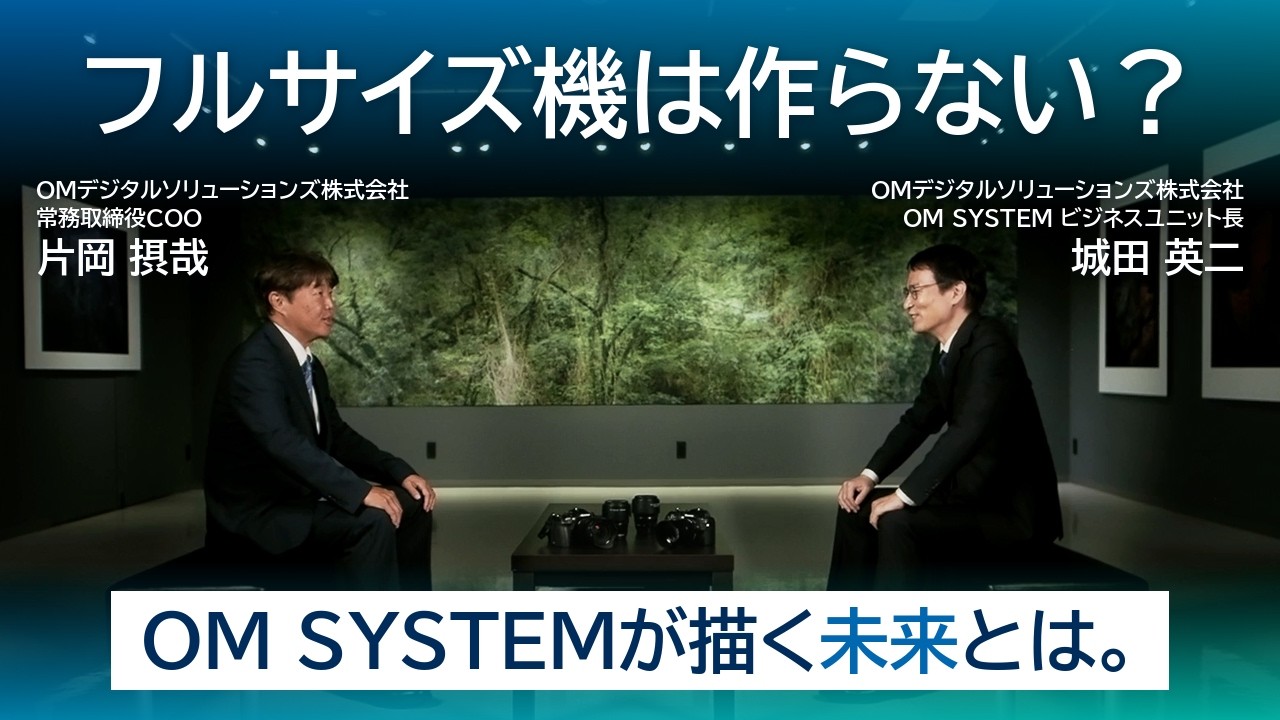
"I have a clear vision of the value I want to deliver through the Micro Four Thirds system – a value that can only be realized because it is Micro Four Thirds. I have certainly considered what it might look like to move to full-frame, but I never reached the conclusion that we should shift gears and pursue that."
Shirota explained that, while a disparity in ultimate image quality will always exist, it largely becomes redundant when you reach a certain level.
"While it’s true that the gap with full-frame systems won’t disappear – they will never be identical – once you reach a level of image quality that satisfies the users, that gap effectively ceases to matter… We are often asked which one is 'better'. But it’s not a matter of 'good' or 'bad.' Instead, we focus on which system is better suited to the specific situation the user is in.

"For instance, if portability is the priority, Micro Four Thirds is the way to go; if the goal is to capture the absolute 'best shot,' then full-frame might be the better option. The number of people using Micro Four Thirds is growing, and I believe it is crucial to provide users with these kinds of choices."
OM doesn't believe that the limits of the format have yet been reached, with even better image quality able to be achieved by the smaller system.
"To be honest, back when I first started working with the Micro Four Thirds system, I did briefly consider expanding into full-frame or APS-C as a potential future direction," added Setsuya Kataoka, OM's executive director and COO.

"But when I consulted a senior colleague at the time, he asked me, 'Before you start wondering what might happen if you used other formats, have you truly pushed the Micro Four Thirds system to its absolute limit? If you’ve fully explored and exhausted every possibility, then perhaps that’s a conversation to have – but suggesting other formats before you’ve even finished what you started? That’s not the right approach.'
He explained how, over the last 15 years, he has been focused on how to surpass those expectations within the Micro Four Thirds framework.
"We’ve also been committed to addressing the bottlenecks of the Micro Four Thirds system. For example, we developed the High Res Shot mode for users who are otherwise perfectly happy with the system but find the output resolution insufficient. It seems that the 'deal-breakers' – the factors that might have previously ruled out the system – have largely disappeared."

More relevant than the crude image quality offered by a camera, OM believes that its cameras are able to offer unique properties that are more important to some users – such as durability in extreme conditions and weather.
"Our equipment’s dustproof, splashproof, and low-temperature resistant capabilities are key," says Shirota.
"For instance, a shot that looks like an ordinary landscape might actually have been taken at -40°. Or consider a photograph of a snake – captured after a three-day trek through the Amazon wilderness, using only our camera system. The story behind the image – the fact that our system enables photographers to reach such remote locations and capture these shots – is, I believe, a crucial part of the value we provide."

He shared the story of Japanese photographer Tetsuro Shimizu, working in Mongolia.
"He traveled for days on horseback, camping out along the way, which meant carrying both his daily necessities and his camera gear on the horses. In such a scenario, if the camera system isn’t compact, you simply can’t bring it along.
"When he told me about shooting in conditions like sandstorms or temperatures of -40°, I felt a sense of relief – and almost wanted to praise the camera itself for making it back in one piece! It’s truly impressive that our system can fulfill a photographer’s desire to go to such extreme places and create their work."
The full interview is well worth a watch – and serves as a valuable reminder that there's more to 'how good' a camera is than the number of megapixels on its sensor.
You might also like…
Take a look at the best Olympus and OM System cameras, along with the best Olympus and OM System lenses.

