Digital Camera World Verdict
If you need anamorphic capabilities, without having to spend huge amounts on them, Sirui’s Saturn V2 set might be just what you need. Ideal for solo shooters, thanks to a compact build, they produce a lovely characterful image without it being dominated by colorful flares or distortion. The headline act here is the ability to rotate the mount by 90°, making them possibly the only anamorphic lenses out there made for vertical shooting. Which means that social media shooters and vertical content creators can finally join the party without any hassle.
Pros
- +
90° rotation for anamorphic vertical video
- +
Excellent build quality
- +
Small and Compact
- +
Characterful, but not overwhelmingly so
Cons
- -
Minimum focus distance isn’t great
Why you can trust Digital Camera World Our expert reviewers spend hours testing and comparing products and services so you can choose the best for you. Find out how we test.
The anamorphic look has had something of a resurgence over the last few years, driving a good number of manufacturers to invest in producing (relatively) affordable anamorphic lenses at various squeeze factors. This has enabled many filmmakers to create projects with the distinctive look you get, at far less prohibitive costs.
Sirui is one such company and it has released a number of anamorphic lenses in the past, which have gone down well with the community. The Saturn range in particular seemed to have just the right balance of features, performance and cost.
Another development in filmmaking has reared its head, however, and Sirui is spearheading a change in lens technology to try to fit this – and that is social media. Well, vertical video.
While there are ways to get ‘normal’ footage to work on socials, such as cropping a 16:9 shot or turning the camera to fit the vertical format, it does have some limitations – and they are most obvious for those wishing to publish anamorphic footage.

Frame edges, bokeh shapes and, most obviously, flares just don’t look right when rotating the camera, as the squeeze direction is off by ninety degrees and cropping such a wide image could be problematic when trying to reframe the content.
With this in mind, Sirui has developed the Saturn V2 lenses with a neat feature: the lens / mount can be unlocked and rotated.
I haven’t seen this before and was keen to test it out, while also seeing whether the Saturn V2s are a useful addition to my kit – even without this feature, as image quality and performance on a shoot are just as, if not more, important than a rotating mount.
Having shot with countless lenses over the years, including the Blazar Remus (another lower-cost anamorphic), I opted for an L-Mount set – which consists of a 35mm, 50mm and 75mm T2.9 – to go with my Lumix S5 for a compact, lightweight setup. Sony E and Canon RF options are also available.
Sirui Saturn V2 35mm / 50mm / 75mm T2.9: Price & availability
Each of the lenses – the Sirui Saturn V2 35mm T2.9, 50mm T2.9 and 75mm T2.9 – is available for $599 / £529 / AU$749.
The three-lens kit, comprising the entire set, is available for $1,699 / £1,589 / $2,693. While that isn’t a small investment, it does represent excellent value – and includes the hard case, along with a free gift in the form of a Sirui Alien Series Crab Clamp with Magic Arm (worth $29 / £27 / AU$46).
The selection of focal lengths gives you coverage for a broad range of shots and the build quality is even better than the cost might have you believe. Compared to other anamorphic lens sets, you are getting a great deal.
Sirui Saturn V2 35mm / 50mm / 75mm T2.9: Specifications
Mount options |
Sony E, Canon RF, L-Mount (reviewed) |
Full frame |
Yes |
Anamorphic |
1.6x |
Image stabilization |
No |
Weather sealing |
No |
Focus |
Manual, geared (0.8 Mod), 120° rotation, Ø64.8mm |
Control ring |
No |
Aperture ring |
Geared (0.8 Mod), Ø64.8mm |
Lens construction |
35mm: 18 elements (5 cylindrical, 1 aspherical), 13 groups, 10 aperture blades • 50mm: 17 elements (5 cylindrical, 1 aspherical), 12 groups, 10 aperture blades • 75mm: 15 elements (5 cylindrical, 1 aspherical), 11 groups, 14 aperture blades • |
Minimum aperture |
T16 |
Minimum focus distance |
0.9m |
Filter size |
62mm |
Length |
35mm: 102.9mm E, 100.9mm L/RF • 50mm: 109.1mm E, 107.1mm L/RF • 75mm: 114.2mm E, 112.2mm L/RF |
Weight |
35mm: 439g E, 437g L, 445g RF • 50mm: 515g E, 507g L, 520g RF • 75mm: 489g E, 487g L, 494g RF |
Sirui Saturn V2 35mm / 50mm / 75mm T2.9: Design & build
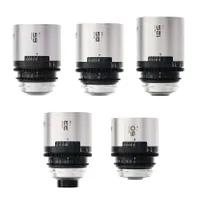
I have the Saturn V2 set, which includes the 35mm, 50mm and 75mm T2.9 in a very nice hard case, with foam cutouts for the lenses and accessories.
The three lenses are identical in dimension except for length, with the 50mm and 75mm gaining a few millimeters extra. All three have gears for both iris and focus, pitched to fit standard follow focus / PIZ motors, and the rings are far enough apart that dual motors should fit.
If you have used the previous version, you won’t be surprised by the form factor. These are compact lenses – much smaller, in girth at least, than your typical cine lenses – barely wider than the L-Mount itself.
They feel great in the hand, too. Weighty and solid, thanks to the metal construction, and finished in a satin charcoal paint, bar a couple of silver rings. Markings are clear in both white for iris and focal distance in meters, and orange for feet.
Each lens ends in a 62mm filter thread so, while you could add a matte box, for a small rig you could save some cash on filters too, as they generally increase in cost with size.
It’s worth noting that the front of the barrel is fixed. The focusing section, which sits behind and partially beneath it, rotates, but there is a section of the front barrel that protrudes over the focus ring.
It doesn’t extend much in radius, and is unlikely to cause any issues, but when focusing by hand you may find yourself coming into contact with it. It may be aesthetically pleasing, but I’d rather it wasn’t there – especially as I can’t see a use for it, other than being a place to label the lens as a 1.6x anamorphic (information that is found on the front, too).

The only other feature to be found is the locking tab on the left side, right by the mount, which allows for the entire lens to be rotated 90°.
Maximum aperture for all three lenses is T2.9, fairly standard at this price point. The minimum is T16 with no clicks in the gearing, ideal for videography. There’s a very smooth action and lovely damping to the ring, as is the same for the focus ring, which makes for easy operation.
It’s also worth noting that the equivalent field of view (compared to a spherical full frame lens) is wider. Vertically you retain the same coverage but horizontally, that stretched image gives you a far wider field of view. The 35mm becomes 22mm, the 50mm covers 31mm while the 75mm is equivalent to a 47mm.
The Saturn V2s looks and feels premium, although there’s a distinct lack of weather sealing gasket around the mount so I wouldn’t be overly confident in adverse conditions.
I’m a fan of the compact nature of these lenses, as well as the feel. The weight is good and both iris and focus rings are smooth. My only gripe is that the throw isn’t all that great. Fine with a motor that can be adjusted for speed, but it could be problematic otherwise, though I'll come on to that.
Overall a pleasing design that looks and feels good, which is best suited to small set-ups – which I imagine is the target market.

Sirui Saturn V2 35mm / 50mm / 75mm T2.9: Performance
I’ll start off with handling, which is generally very good. The compact nature of the Saturn V2 set makes it easy to build a small, light rig, ideal for handheld shots or solo filmmakers – but it’s easy to expand it where needed, thanks to the geared focus and iris rings.
I generally use my S5 as a true hybrid, without a cage, rods and so on – and for this, the Saturn V2 is perfect. Really easy to pop in a shoulder bag and take on trips and hikes, but I have tricked it out with a focus motor, field monitor and my PolarPro mattebox, and found that to work really well, too.
As mentioned, the focus throw is a bit short for my liking. At just 120° and with a larger aperture setting, nailing critical focus can be slightly challenging – although almost all cameras will have focusing aids, which do help. With a smaller aperture this problem drops away, and the ring really is nice and smooth, plus the damping helps a lot.
Speaking of focus, a big part of the look gained from shooting anamorphic is the out-of-focus areas, especially the bokeh. The Saturn V2s produce pleasantly consistent bokeh, with just a touch of onion skinning and a little bit of color fringing (although not overly obtrusive).
The size of these lenses (ranging from 100.9mm to 112.2mm) means balance is very good, too, and I have no issue with them feeling front-heavy, something to keep in mind if you are a regular gimbal user.
All this means nothing, though, if the image produced isn’t what you are after. Anamorphic lenses have an inherent look, which is one reason they are so popular. They don’t have the most clinical image, with a slightly softer appearance than a spherical lens, along with the headline flares and often some distortion towards the edges.

These would usually be considered flaws, if you were reading a review of a non-anamorphic lens, but here they tend to be sought after, as their character can be pleasing. Of course, there is the field of view to be considered as well.
Anamorphics come in different squeeze factors and the Saturn V2s sit around the middle of the range at 1.6x – but that isn’t the whole story. Your final output will depend on your sensor size and dimensions, and whether you are shooting open gate or in something like a Super35 mode.
There’s a lot of interplay between different elements of your shot to be considered. For example, some cameras will force you to crop in on the sensor if you want to shoot slow-motion footage. So, consider these factors when making your decision.
For my case I am shooting a 3:2 full frame in 4K on the S5. Unfortunately the S5 doesn’t have an internal desqueeze of 1.6x for monitoring, but it has 1.5x which is close enough – and I often have a field monitor attached, which does have the 1.6x desqueeze. This is purely for camera use, though, and squeezing the footage in Resolve isn’t affected.
You can see some sample images below, which are the correct ratio and they show the image characteristics of these lenses. I shot a sequence showing both flares and differences in sharpness and edge distortion.
Having used a good number of anamorphic lenses over the years I was expecting to see more of both, but the Saturn V2s are pretty clean in both regards.

For a start, while there is some pincushion distortion and sharpness falls off towards the edge, it isn’t as strong as I expected and is quite pleasing to my eye. Depending on your sensor and timeline ratio, you may not see much at all.
Optical performance is generally very good here. Minimum focus distance is average at 0.9m, but sharpness is excellent across all three focal lengths – although the 75mm is a little softer than the others.
The trio all show some edge softness wide open, but that is virtually eliminated at T4. It’s worth noting that they aren’t as sharp as their spherical counterparts, thanks to the nature of anamorphic squeezing, but it’s minimal.
Chromatic aberration and color fringing, on the other hand, are more noticeable. High-contrast edges show some across the aperture range. It’s not so much that it becomes a problem, but you may spot some magenta. Again, this decreases with higher T-stops.
Vignetting is visible at the extremes of all the lenses, again slightly more so with the 75mm, but like distortion, it’s not strong and will likely disappear once you crop to your timeline.
Anamorphic flares are often a headline feature and, whether you love them or hate them, they are part and parcel of shooting this type of lens. This set has neutral flares, which should pick up the colour of the light source causing them. Personally I prefer this to the blue, but that’s really personal taste.

Flares are definitely present, but not as strong as those found in other lenses – and I’m all for it. You retain the character they provide, without overwhelming the image.
Lastly, there is the Saturn V2 party trick: the 90° swivel. Increasing amounts of vertical video are being made and this doesn’t cause an issue for other lenses – but shooting anamorphic can be a headache because, as soon as you turn the camera for vertical shooting, your bokeh, flares and distortion all fall the wrong way.
While that could be a creative choice, there’s no control over it – so Sirui added the rotating mount. All you do is orient your camera for vertical shooting then pull back the little switch and rotate the lens. This only goes in one direction, so the right side of your camera will be at the top.
The action is very smooth and there is no play in the resting position at either end. It simply locks into position with a satisfying click and you are good to go. The button is spring-loaded, meaning you won’t be able to accidentally knock it out of position.
Because of the squeezing aspect to shooting this way, it takes a minute to get accustomed to framing – but that could just be middle-aged vertical video-avoiding mindset. Either way, the lenses perform identically in both orientations.
This a neat trick and something I can see become more common, as shooting for social media becomes ever more popular – especially narrative work, where this type of lens excels. Props to Sirui for innovating and giving us new opportunities.
Sirui Saturn V2 35mm / 50mm / 75mm T2.9: Sample video
Sirui Saturn V2 35mm / 50mm / 75mm T2.9: Verdict
The Saturn V2 set of lenses is ideal for solo filmmakers or creators, who want the benefits of a characterful image for use across various deliveries. That rotating mount makes them perfect for content creators and social media shoots, as well as more traditional horizontal output.
They are solidly built and, besides a short focus throw, very easy to operate – and could reduce accessory costs, too, thanks to a small filter size.
Sirui Saturn V2 35mm / 50mm / 75mm T2.9: Alternatives