




Digital Camera World Verdict
The Fujifilm XF 400mm f/4.5 R LM OIS WR is the kind of super-telephoto prime lens that dreams are made of. For one thing, it looks like it’s been sprinkled with silver fairy dust (compared with average ‘great white’ lenses) but on a more down-to-earth level, it combines powerful super-telephoto reach with super-fast autofocus, super-effective optical stabilization and super-sharp image quality. And all of that’s backed up by pro-grade build quality and handling characteristics. This is one fab Fuji lens.
Reasons to buy
- +
Relatively compact and lightweight
- +
Premium build and handling
- +
Superb image quality
- +
5.5-stop optical stabilization
Reasons to avoid
- -
Expensive (justifiably)
- -
No aperture de-click
Why you can trust Digital Camera World Our expert reviewers spend hours testing and comparing products and services so you can choose the best for you. Find out how we test.
Allow me to hit the Rewind button for a moment. About 18 months ago I reviewed the Fujifilm XF 500mm F5.6 R LM OIS WR. Prepare to be dazzled, said Homer Simpson, and indeed I was, giving it a 5-star rating and a gold star for its efforts. As far as I was concerned, the 500mm super-telephoto prime lens put Fujifilm on the podium of sports and wildlife lenses, while also doing full justice to its latter-day 40MP cameras. And more than that, it put Fujifilm’s X-system well and truly on the map as a kit destination for pro-level sports and wildlife photographers.
Looking back on it now, I have one criticism. If anything, the 762mm effective focal length of the lens (taking the X-system’s 1.5x crop factor into account) is perhaps a little too long for comfort. I’d sometimes find that even at a considerable distance, I couldn’t squeeze all that I wanted into the image frame.
The new 400mm lens that I’m reviewing here has a still mighty but more manageable effective focal length of 609mm. That actually suits me much better, and makes the lens practically perfect for action, sports, motor racing, aircraft and bird photography. And more besides. This lens definitely has its eyes on being one of the best lenses for sports photography and best lenses for bird photography, and is maybe destined to rule other roosts as well.
Fujifilm XF 400mm f/4.5 R LM OIS WR: Specifications
Mount options |
Fujifilm X |
Full frame |
No |
Autofocus |
Yes |
Image stabilization |
Yes (5.5-stop) |
Lens construction |
21 elements in 14 groups |
Angle of view |
4.1 degrees |
Diaphragm blades |
9 |
Minimum aperture |
f/22 |
Minimum focus distance |
2.75m |
Maximum magnification |
0.16x |
Filter size |
95mm |
Dimensions |
105x240mm / 4.1x9.4in |
Weight |
1,250g / 2.7lb |
Fujifilm XF 400mm f/4.5 R LM OIS WR: Price
With all their high-tech glass, high-tech autofocus, high-tech stabilization and high-tech everything else, top-grade super-telephoto lenses don’t come cheap. Sure enough, the Fujifilm XF 400mm f/4.5 R LM OIS WR will set you back around $3,199 / £2,499 / AU$4,949. However, some competing lenses from other mainstream manufacturers have 5-figure price tags, making the Fuji potentially look like outstanding value for money. Sure, it’s not directly ‘like for like’ but the Canon RF 400mm f/2.8 L IS USM weighs in at a frankly unaffordable $13,399 / £13,199 / AU$24,999 (often discounted in Australia).
As a more direct comparison, the longer Fujifilm XF 500mm F5.6 R LM OIS WR costs around $3,599 / £2,899 / AU$5,199 which, in most world regions, is a fair chunk more expensive. Out of the two, the 400mm looks the better buy if you don’t need even greater super-telephoto reach. For other camera systems, there are bargains to be had in the full-frame camp. Sony E-mount and L-mount versions of the Sigma 500mm f/5.6 DG DN OS Sports cost $2,999 / £2,779 / 5,695, and the new Sony FE 400mm f/4.5 GM OSS sells for $2,698 / £2,399 / AU$3,999, the latter being amazingly lightweight.
Fujifilm XF 400mm f/4.5 R LM OIS WR: Design & Handling
Super-telephoto prime lenses are often big, hefty and unwieldy. Not only are they a pain to carry around on location (and getting there) but they also make even short spells of handheld shooting a struggle. By contrast, the XF 400mm is refreshingly compact and lightweight at 105x240mm / 4.1x9.4in and 1,250g / 2.7lb, making it entirely viable even for long periods of handheld shooting. My colleague and I both felt that the lens was well balanced on the Fujifilm X-H2S body that we used for testing.
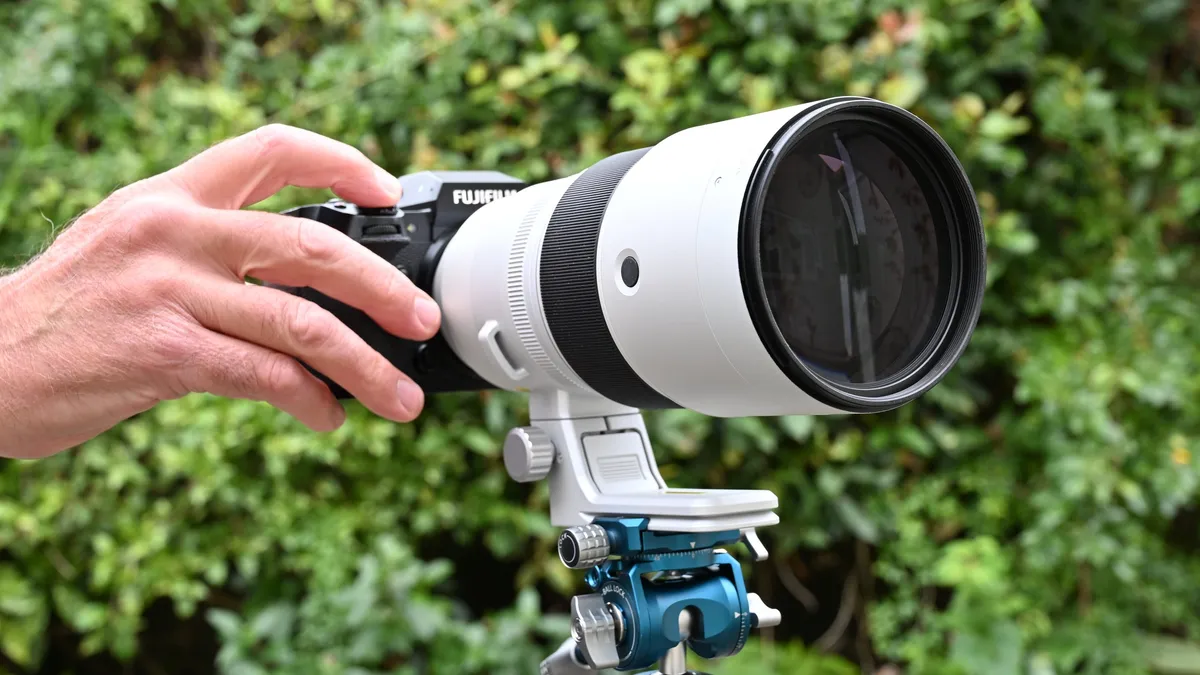
Autofocus speed and accuracy is all-important for fast-paced sports and wildlife shooting. As an LM (Linear Motor) lens, this one obliges with a high-speed linear STM (stepping motor) autofocus system for following the action, teaming up well with the advanced subject recognition and tracking abilities of recent Fujifilm cameras, and the high continuous drive rate of the X-H2S. Focusing is fully internal, so the front element neither extends nor rotates during focusing. To avoid autofocus hunting in tricky conditions, the lens features an autofocus range limiter switch which locks out the closer end of the range between 2.5-5m / 9-16.4ft.

Just in front of the manual focus ring, there’s rank of four customizable function buttons. Using associated switch towards the rear of the lens, you can assign their action to AF-On, AF-Lock or Focus Preset. The fact that there are four of them at 90-degree increments around the entire barrel means that one of them is sure to fall neatly under the thumb, whatever orientation you’re shooting in.

Typical of Fujifilm’s ‘R’ lenses, the XF 400mm has a dedicated aperture control ring, which is often preferred for hands-on aperture control when shooting in aperture-priority mode. I particularly like that it has a locking button, again typical of Fujifilm R lenses, which avoids accidentally nudging the ring from its Auto position (aperture controlled from the camera body) to the narrowest aperture setting of f/22. The ring rotates in one-third f/stop click steps but yet again, it’s typical of Fujifilm lenses in not featuring a de-click option. That means there’s no handy option for stepless, silent aperture transitions when using the control ring while shooting video.

Optical image stabilization tends to be more effective than IBIS (In-Body Image Stabilization) for long telephoto lenses. Sure enough, this lens has a highly efficient 5.5-stop optical stabilizer, which comes with a physical on/off switch. However, there are no switchable static and panning modes on offer, both OIS and IBIS relying on automatic panning detection.

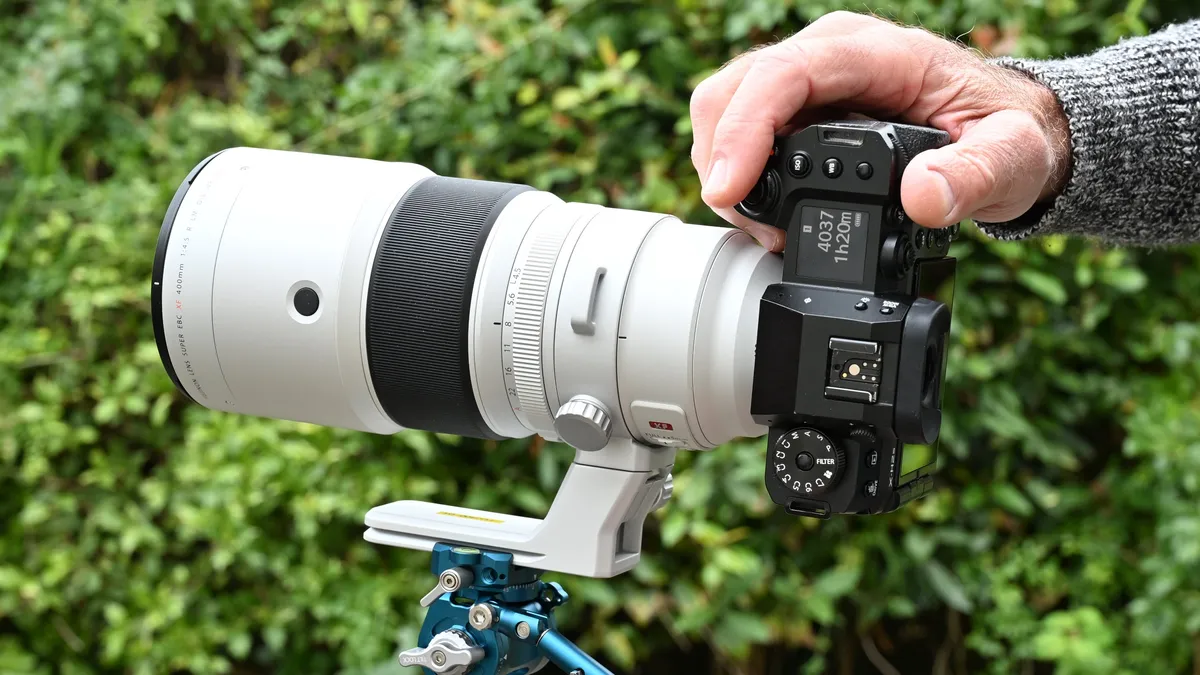
The optical path is based on 21 elements arranged in 14 groups. High-performance glass includes 4 ED (Extra-low Dispersion) elements and 2 Super ED elements, with the aim of boosting clarity and minimizing chromatic aberrations. Fujifilm says that the optical arrangement is designed so that weight is transferred towards the rear of the lens. This puts the center of gravity closer to the camera body, which gives a better balance for handling, especially when panning for action shots.

The color and lightweight build of the hood make it a perfect match for the lens. And like the lens itself, the hood feels solid and robust. It features both a locking button and a sliding window, the latter making it easy to use rotation-specific filters like screw-in circular polarizers with the hood attached.

Although the lens is easily lightweight enough for handheld shooting, there are times when a tripod or monopod can help take the strain, as well as enhancing steadiness. As I’d expect, the lens comes complete with a tripod mounting ring and as is often the case nowadays, it has an Arca-Swiss compatible foot. This makes it easy to slot the foot directly into the mounting platforms of compatible tripod and monopod heads, instead of having to add a quick-release plate into the mix.

When I’m shooting handheld with super-telephoto lenses, I quite often rotate the tripod foot up on top. That gets it out of the way but I can still use it as a carrying handle. If you’d rather remove it altogether, you’ll find that that you can’t detach the entire collar, which also includes lugs for attaching the supplied carrying strap. Instead, you can only remove the foot, which is par for the course nowadays, and the collar stays in place. To avoid the lens accidentally coming off its mounting foot, there’s the two-fold security of a locking screw and a pushbutton release. The remaining stub is very short, takes up little extra stowage space and doesn’t impair handheld shooting.

For sports and wildlife photography, you might well need to keep shooting whatever the weather. For example, sports fixtures generally won’t be rearranged due to rain and if you’ve travelled to a distant wildlife location, you’ll just have to make the best of it, whatever the weather. Thankfully the XF 400mm is comprehensively weather-sealed, with no less than 20 seals around all critical joints and potential trouble-spots, to keep out moisture and dust. The front element also has a fluorine coating to repel water droplets and greasy fingerprints. We spent a lot of time out in the rain photographing birds of prey, and found that the weather-seals and fluorine coating performed flawlessly.

Fujifilm XF 400mm f/4.5 R LM OIS WR: Performance
We were blown away by the performance of the XF 500mm f/5.6, and the newer XF 400mm follows suit. In the context of action, sports and wildlife photography, fast shutter speeds are often preferable to freeze motion. The performance of lenses at their widest apertures is therefore a key factor, enabling you to gain quick shutter speeds even under dull lighting conditions, without launching your ISO setting into the stratosphere. The XF 400mm really fits the bill with scintillating sharpness, clarity and contrast, even when shooting wide-open at f/4.5.
Indeed, the levels of sharpness on offer are sufficient to resolve extremely fine detail and the most subtle of textures. The lens is well able to make the most of Fujifilm’s recent high-resolution 40 megapixel cameras like the X-T5 and X-H2. Meanwhile, due to its long focal length, the lens is capable of delivering a tight depth of field. The quality of bokeh is smooth and soft, adding to the overall pictorial quality.


Birds in flight are a really tough test for camera bodies as well as for super-telephoto lenses. Paired with the Fujifilm X-H2S, the dynamic duo made a decent job tracking birds of prey but the hit rate of keepers wasn’t all we were hoping for. When the stars aligned though, autofocus and effective stabilization delivered very sharp shots. Rapid-fire bursts of shots at a fast drive rate of 15fps helped to ensure that we were left with at least a few sharp images from each sequences. For larger subjects that weren’t moving quite so quickly or erratically, we enjoyed a much better hit rate.
The test shots we’re publishing in this review were taken at Chavenage House near Tetbury in South West England, which was playing host to ‘Walks with Hawks’ a specialist outfit offering birds of prey experiences. As well as the birds themselves, we took shots of the location that included the likes of trees against a relatively bright sky. This often gives rise to the appearance of color fringing, but this aberration remained notably absent. All in all, the lens performed superbly well in our real-world tests, delivering excellent results and gorgeous image quality even in tricky scenarios and when shooting in dull, overcast and rainy weather.


Fujifilm XF 400mm f/4.5 R LM OIS WR: Lab Results
We run a range of lab tests under controlled conditions, using the Imatest Master testing suite. Photos of test charts are taken across the range of apertures and zooms (where available), then analyzed for sharpness, distortion and chromatic aberrations.
We use Imatest SFR (spatial frequency response) charts and analysis software to plot lens resolution at the center of the image frame, corners and mid-point distances, across the range of aperture settings and, with zoom lenses, at four different focal lengths. The tests also measure distortion and color fringing (chromatic aberration).
Sharpness:

The Fujifilm XF 500mm lens that we tested previously delivered excellent results for sharpness but this 400mm proved even better. Not only is it amazingly sharp across the entire image frame, but it serves up its best sharpness wide-open at f/4.5, enabling you to freeze motion in action, sports and wildlife photography with the fastest possible shutter speeds.
Fringing:

Color fringing is virtually absent altogether, even right out at the extreme edges and corners of the frame, where lateral chromatic aberration tends to be more noticeable. Again, it outstrips the XF 500mm lens in this respect, although both lenses are a pretty close match at f/5.6.
Distortion: 0.18
There’s the merest hint of pincushion distortion but it barely shows up in lab test results and will generally be completely unnoticeable in real-world shooting.
Fujifilm XF 400mm f/4.5 R LM OIS WR: Verdict

The Fujifilm XF 400mm f/4.5 R LM OIS WR is incredibly similar to the XF 500mm which was launched nearly two years previously. And that’s a very good thing. Both lenses feel virtually identical in terms of their high-end handling characteristics, right down to the various control rings, switches and buttons, and their placement on the silvery colored barrels. The 500mm lens is a tad over half an inch longer and three ounces heavier but to all practical intents and purposes, both lenses look and feel the same.
Further similarities are that both lenses are very robust, fully weather-sealed and ideally suited to the rugged outdoor pursuits of action, sports, motor racing, aircraft and bird photography. They also both feature super-fast and consistently accurate autofocus systems and highly effective 5.5-stop optical image stabilization. You can be guaranteed a great hit rate and plenty of keepers, even when shooting demanding subjects in very tricky conditions.
Actual image quality is superb. There’s a winning combination of excellent sharpness and clarity, along with soft and smooth bokeh, and a minimum of distortion and color fringing. There’s also good resistance against ghosting and flare when shooting against the light.
The trickiest decision is working out which of the 400mm and 500mm lenses is ‘better’. You’ll have to decide that for yourself but, for my part, I actually found the 762mm ‘effective’ focal length of the 500mm lens a little too long in many shooting scenarios. For me, in the absence of any zooming flexibility, the effective 609mm focal length of the 400mm lens is generally a better fit for the types of photography that I’ve listed above, and makes the lens easier to live with. The 400mm lens is also less expensive to buy. I think I have a winner!
Features ★★★★★ |
High-end features include fast autofocus, 5.5-stop optical image stabilization, an aperture control ring, customizable function buttons and an autofocus preset. |
Design ★★★★★ |
For a 400mm prime, the lens is refreshingly compact, lightweight and easily manageable for handheld shooting. It’s also very robust and comprehensively weather-sealed. |
Performance ★★★★★ |
Both of the autofocus and optical stabilization systems work brilliantly well. Image quality combines excellent sharpness with smooth bokeh and minimal unwanted aberrations. |
Value ★★★★½ |
The lens is less expensive to buy than the previously launched XF 500mm, and slightly better value for money. |
Overall |
★★★★★ |
Alternatives