Digital Camera World Verdict
With bags of style, including a sliding lens cover that recalls classic film compacts of yesteryear, the Kodak EC35 is an attractive proposition – especially once you see its price. But the plastic lens lacks sharpness, meaning you have to really love the lo-fi vibe, and I think most photographers are going to want something more before long. A good starting point for novice film shooters – but don’t be surprised if you’re quickly itching to upgrade.
Pros
- +
Extremely affordable
- +
Useful, stylish sliding lens cover
- +
Attractive colorways
Cons
- -
Plastic lens limits image quality
- -
No settings or focus control
Why you can trust Digital Camera World Our expert reviewers spend hours testing and comparing products and services so you can choose the best for you. Find out how we test.
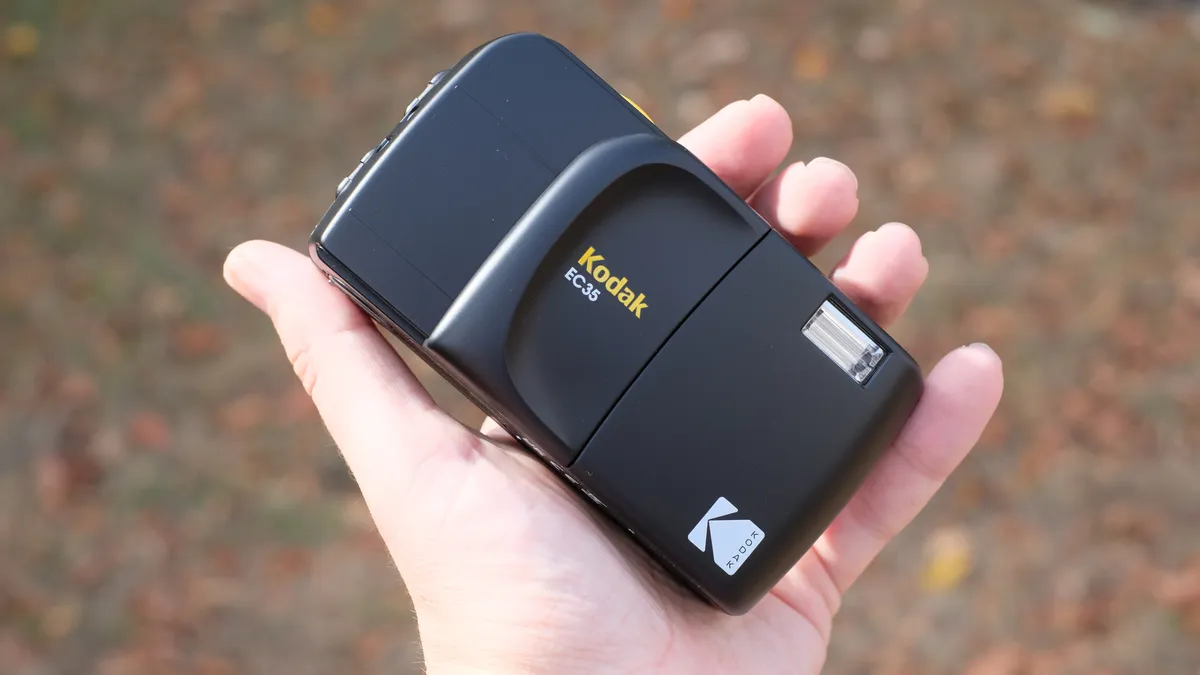
I was charmed immediately by the Kodak EC35. Cheap, analog point-and-shoots are hardly in short supply – indeed, they’re undergoing something of a renaissance – but the styling of this slim, plastic 35mm camera, with its sliding lens cover reminiscent of an Olympus Mju, is exactly to my taste.
Though the name on the box and the camera body is Kodak, the EC35 is in fact a product of brand licensee Reto Project. Reto has engineered a number of Kodak-branded successes in recent years. Most prominent has been the keychain-sized Kodak Charmera, a massive viral hit on Instagram, but in the analog space we’ve also seen the half-frame point-and-shoot Kodak Ektar H35N, and the slightly more swanky full-frame point-and-shoot Kodak Snapic A1, with its automatic wind-on and three-element glass lens.
So, with its rock-bottom price tag, where does the Kodak EC35 fit into this picture? I loaded it up with film and headed out to learn more…
Price
Cheap like the proverbial chips, the Kodak EC35 comes at an asking price of just $35 / £35 (about AU$55) for the camera on its own, or $45 / £45 (about AU$63) when bundled with film and a camera strap. That puts it as one of the cheapest new film compacts around – cheaper even than Reto’s half-frame Kodak Ektar H35N, which goes for $52 / £67, and considerably cheaper than the flashier Kodak Snapic A1, which sits at $99 / £99 (about AU$138).
Specs
Type |
Analog compact |
Film |
35mm |
Lens |
25mm fixed focus |
Aperture |
F10 (fixed) |
Shutter speed |
1/100sec |
Minimum focus distance |
1.5m |
Flash |
Yes |
Dimensions |
119 x 65 x 41.5mm |
Weight |
102g |
Power |
AA batteries (flash only) |
Build & handling
At a feather weight of 102g, the Kodak EC35 is made for one-handed operation and pocket transportation. Dimensions-wise it’s absolutely perfect for carrying around on city-breaks and day trips, a camera you can easily have about your person all the time and pull out at a moment’s notice. Since all settings are fixed, controls are very minimal – the only button on the top plate is the shutter release.

Film is wound on via a disposable-style geared wheel, and rewound using a flip-out lever. A switch on the front is used to toggle the flash, which is powered via AA batteries – these are only needed for the flash, and the camera will operate just fine without them. Open up the back and film is loaded on the right-hand side – simply thread the sprockets into the take-up spool and you’re away. There’s a very small shot counter on the bottom of the camera, which in bright daylight I found a little hard to see, but it’s not a serious problem.
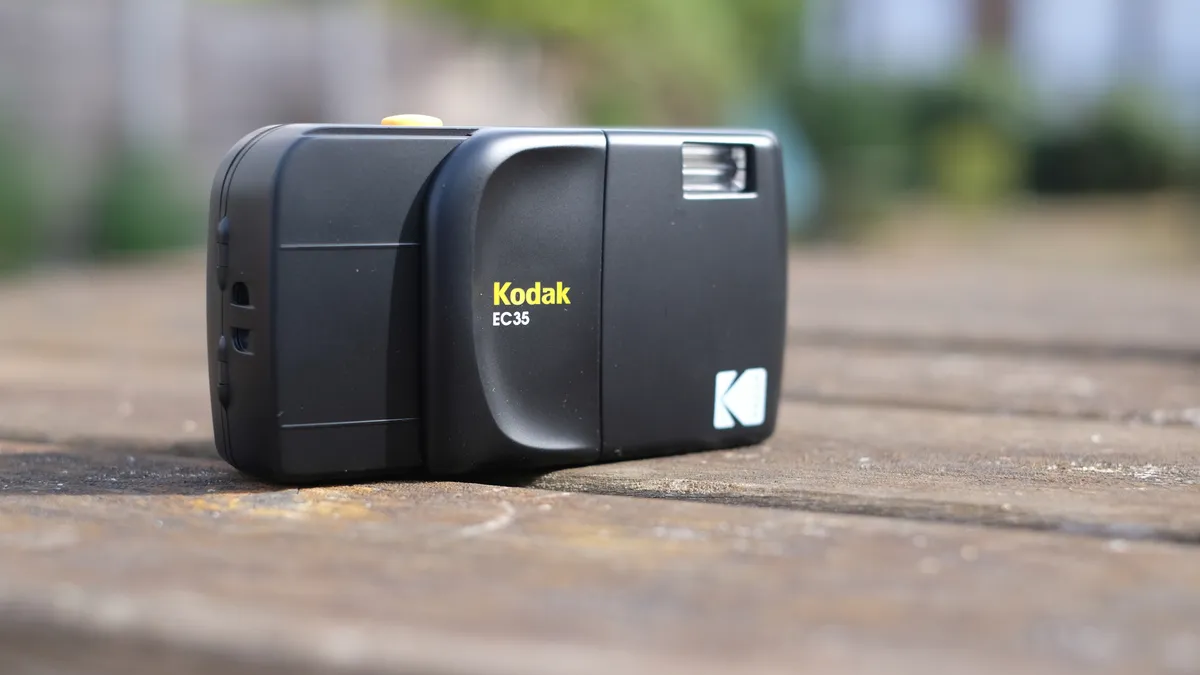
I’ve already alluded to the camera’s most immediately striking feature – its sliding lens cover, which hearkens back to any number of classic analog compacts, particularly those made by Olympus. I look at this camera and I think of cameras like the Mju, or my beloved XA2 with its clamshell-style cover. And it’s not purely aesthetic – this may sound obvious, but the cover serves the useful purpose of actually protecting the lens, something that most similarly priced compacts aren’t bothered about. Also, when the cover is closed, the shutter won’t fire, and I am exactly the sort of person that kind of feature is made for, so I am grateful.

I’d also say a word to commend the color options here. Reto is keenly aware of the power of aesthetics, and one of the reasons that so many of its Kodak-branded cameras have been so successful is because they’re, well, cute. The EC35 comes in a broad selection of lovely, pastel color options – I was genuinely a tiny bit disappointed to receive the Midnight Black as my sample unit, when I might have had the stunning Butter Yellow. Also available are: Avocado Green, Vanilla White, Powder Blue, Blush Pink and Lavender. A small thing, perhaps, but in my view it demonstrates how well Reto knows its target market.

Performance
I knew that the Kodak EC35 was a very cheap camera, and so I tempered my expectations accordingly – but even so, the low-quality plastic lens on the front of this camera does put a pretty hard limit on what you can achieve with it. Detail gets muddy quickly at any distance, and corner sharpness is almost non-existent.
The fixed settings of 1/100sec and f/10 are standard fare for a point-and-shoot. The 25mm lens is fixed-focus with a minimum distance of 1.5m – so mind you don’t get too close to your subjects. The more sophisticated and expensive Kodak Snapic A1 provides two-zone focusing, but there’s none of that here.

Now, as I’ve said ad nauseum, the Kodak EC35 is a very cheap film camera. But here’s the thing – film itself is not cheap. Developing is not cheap, whether you do it at home or hand it off to a lab. For this reason, ultra-cheap film cameras feel to me like a bit of a false economy. The more film I shoot, the more the $60 or so I saved by buying the Kodak EC35 rather than the Kodak Snapic A1 is eclipsed – and it should be said that the superior glass lens on the Snapic A1 takes much better pictures.
I would say that if you’re looking to shoot film on the cheap, the half-frame Kodak Ektar H35N is a much better investment. It’s about $20 more expensive than the EC35, but it’ll give you double the shot count from the same roll of 36 frames. Sure, they’re smaller, but I don’t think that full-frame images from the EC35 look much better than half-frame images from the H35N, especially given that the latter camera has a glass element in its lens.
Sample images


These sample images were shot on Kodak ColorPlus 200 film using the Kodak EC35 camera, in Valencia and London from late summer 2026 to early fall 2026. They were developed at box speed using the standard C41 process.


Overall verdict
The Kodak EC35 is fun. Its colors are fun, its retro look is fun, its point-and-shoot operation makes it fun for anyone to use. It’s at its best when you embrace its lo-fi vibe, rather than worrying about image quality – since you’re not going to get much. But with film as expensive as it is, you have to really, really like the lo-fi vibe for this camera to be worth it, even with its rock-bottom asking price.
I think this is a cute camera for anyone looking to try out film for the first time, even if I would try to gently steer that person towards the half-frame Ektar H35N. But I have difficulty imagining many people using it long-term. It seems inevitable that after a few months with the Kodak EC35, one of two things will happen. Either you chafe against its limitations and upgrade to a higher-quality camera that gives you more creative control – or the novelty wears off, the price you’re paying for these blurry shots starts to bite, and the camera makes its way to the bottom of the cupboard.
Features |
Not many to speak of – it's a very simple point-and-shoot. |
★★★☆☆ |
Design |
Slimline build with attractive looks and lovely colorways. |
★★★★☆ |
Performance |
It does the job, but the lens sharpness is underwhelming. |
★★★☆☆ |
Value |
A very cheap camera for beginner film photographers. |
★★★★☆ |
Alternatives