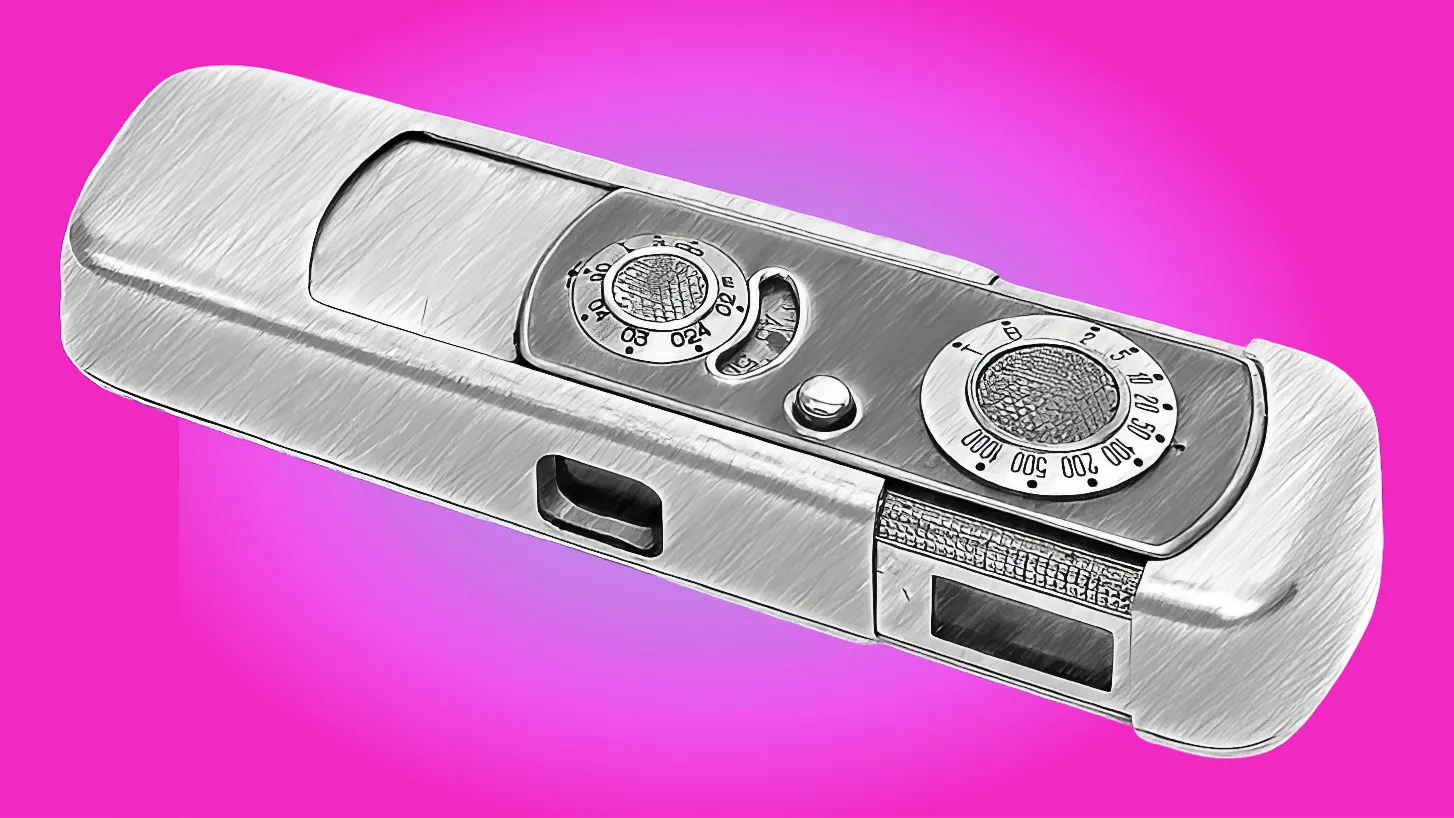
The original Minox is the stuff spy legends are made of, and it became one of the most famous cameras ever made. People would recognize it on sight, even if they could not remember the brand. But that was not what its inventor, Walter Zapp, had in mind.
Zapp felt that cameras had become unnecessarily large and complicated. During the early 1930s he envisioned a camera that could, and should, fit in a waistcoat pocket, produce enlargements of surprisingly high quality, and require almost no adjustments to operate. It was a tall order!
His earliest prototypes were built between 1932 and 1935 with the help of Richard Jürgens; a precision machinist and mechanical engineer. Jürgens ran a small precision workshop in Riga during the early 1930s. Walter Zapp had conceived the Minox but lacked the facilities and practical machining expertise to turn his ideas into a working instrument.
The first working Minox prototypes, completed around 1935–1936, were largely fabricated in Jürgens' workshop. Without his craftsmanship, it is doubtful that Zapp's concept would have gone beyond paper drawings. Yet it progressed to the point where it attracted the interest of the Latvian electronics company VEF.
Zapp’s revolutionary design featured a stainless-steel body that could be concealed inside a clenched fist. Extending the shell simultaneously advanced the film and cocked the shutter. Focus was by guesstimation, with closeups measured with bumps on a chain. No camera like it had existed before.
Once the prototypes proved successful, Zapp began approaching manufacturers, but most dismissed the project almost immediately, saying it was too complicated to manufacture.
From a business perspective, this was a reasonable concern.
The turning point came when Zapp demonstrated the camera to executives at VEF (Valsts Elektrotehniskā Fabrika), Latvia's state-owned electrical manufacturing company.
Although VEF specialized in electronics, it also possessed one of the finest precision engineering facilities in Northern Europe.
The demonstration reportedly astonished the engineers. But even after VEF expressed interest, many engineers remained skeptical. The greatest challenge was not designing the camera—it was manufacturing thousands of identical examples. The camera contained around 140 precision parts, many of them tiny and requiring exceptionally close tolerances.

Remember, this was the mid-1930s. Modern CNC machines did not exist. Every operation relied on precision lathes, milling machines, jigs, and highly skilled workers.
Eventually VEF's management approved the project. It was a remarkably bold decision as the company had no proof that a market even existed for such a camera. Still, they invested heavily in tooling and optical manufacturing equipment. When production finally began in 1938, the Minox emerged as perhaps the most precisely engineered miniature camera ever built. But the timing was disastrous for the young Minox enterprise. By the time the Soviet’s invaded Latvia in June of 1940, production was well established. Some production continued, but the Soviets shifted more and more resources to military communications equipment, and production fell.
After a year, the German army invaded, as part of their war on the Eastern front. Under German control, production of Minox cameras resumed on a limited basis during the occupation. In all, some 17,000 “Riga Minox” cameras were produced.
When the Red Army returned in 1944, Walter Zapp fled westward rather than remain under renewed Soviet rule. He eventually settled in Wetzlar, West Germany, where he succeeded in reviving Minox production in 1948 under the newly formed Minox GmbH.
The new factory was established in Wetzlar, Germany—the city already famous for precision optics and home to E. Leitz GmbH, makers of the Leica. Unlike Leitz, Minox manufactured virtually every component in-house, including shutters, film cassettes and lenses. A level of vertical integration that was extraordinary for such a small manufacturer.
Model |
Year introduced |
Notes |
Minox A |
1948 |
First German model |
Minox B |
1958 |
Built-in selenenium meter |
Minox C |
1969 |
Cds meter & electronic shutter |
Minox LX |
1978 |
Improved elecgtronics |
Minox EC |
1981 |
Simplified budget model |
Minox TLX |
1995 |
Titanium body |
The postwar cameras became known simply as the Minox A, Though nearly identical to the Riga model, manufacturing quality became even higher.
During the next forty years Minox produced a remarkable succession of models.
The Minox B (for Belichtungsmesser, the German word for light-meter) became the best-known model and is often considered the classic Minox. In all, from 1928 to then end of production in 2003, just under one million Minox miniature cameras were made.
Despite a tiny 8×11mm negative, Minox cameras produced enlargements rivalling much larger cameras. Most models used the superb 15mm f/3.5 Complan though later versions introduced others. All of them could resolve extraordinarily fine detail.
No discussion of Minox would be complete without mentioning espionage. Many intelligence agencies reportedly used Minox cameras, including those of the United States, Britain, the Soviet Union, East Germany, Israel and undoubtedly many more who simply don’t want to say.
The Minox became so closely linked with spies that it appeared in countless novels and films. But, in reality, most Minox cameras were purchased by ordinary people.
Read more of David Young's ongoing series on classic cameras, as well as his book A Brief History of Photography.
You might also like…
Check out the best spy cameras and the best hidden camera detectors

