
If you're a high-end creator or videographer, you've probably got one question on your mind: Sony FX3 vs FX5, which do I get?
Chances are, you've probably already got a Sony FX3. Launched back in 2021, it's been an absolutely monster success story for Sony and has been the go-to camera for creators, videographers and even filmmakers for the past half-decade.
But it's definitely a camera with room for improvement, which is why Sony finally pulled back the curtain on the Sony FX5.
While it's keen to stress that this isn't a replacement for the FX3, and isn't just an FX3 II by a different name, the FX5 offers a clear upgrade path for existing users – and a compelling proposition for those using other brands how might be considering a Sony system.
So, stick with the familiar face or drop the not insignificant extra bucks on the new kid in town? Here's my Sony FX3 vs Sony FX5 at-a-glance comparison.

Sony FX3 vs Sony FX5: At a glance
| Row 0 - Cell 0 | Sony FX3 |
Sony FX5 |
Launched |
February 2021 |
August 2026 |
Price |
$4,298 / £3,579 / AU$5,999 |
$4,898 / £4,700 / AU$7,849 ($5,498 / £5,200 / AU$8,849 with XLR handle) |
Sensor |
12.1MP full frame Exmor R |
16.6MP full frame stacked Exmor RS |
Photos |
Yes |
No |
ISO range |
ISO80-102,400 (exp to 409,600) |
ISO320-102,400 (exp to 409,600) |
Base ISO |
800 • 12,800 |
800 • 4,000 • 12,800 |
Dynamic range |
15+ stops |
15+ stops (without Dual Gain Shooting) |
Autofocus |
627-point Fast Hybrid AF |
759-point Fast Hybrid AF (with Bionz XR2) |
Recognized subjects |
Human, animal (photo only) |
Human, animal, bird |
In-body image stabilization |
5.5 stops Active |
Dynamic Active equivalent to A7R VI (8.5 stops center, 7 stops periphery) |
Max video resolution |
4K 120p, FullHD 240p |
5K 120p / 4K 60p open gate, 4K 240p with firmware v2 (5K 60p open gate, 4K 120p, FullHD 240p at launch) |
RAW recording |
16-bit external |
16-bit internal (with X-OCN) |
Anamorphic desqueeze |
1.3x, 1.5x. 1.6x, 2.0x |
1.3x, 1.5x. 1.6x, 1.8x, 2.0x |
Audio |
48kHz / 24-bit, 4-channel |
96kHz / 32-bit float, 4-channel (via compatible accessories) |
Viewfinder |
None |
None (optional 7.07 million-dot DVF-EL1) |
Rear screen |
3-inch articulating, 1.44 million dots |
3.5-inch, 4-axis, 2.76 million dots |
Memory |
2x CFexpress Type A / SD UHS-II |
2x CFexpress Type A / SD UHS-II |
Connectivity |
WiFi (2.4 + 5GHz), Bluetooth, XLR x2 (on handle), HDMI, timecode, microphone, headphone, USB-C x1 |
WiFi (2.4 + 5 + 6GHz), Bluetooth, XLR x2 (on handle), HDMI, timecode, microphone, headphone, USB-C x2 |
Battery |
NP-FZ100 (135 mins continuous recording) |
NP-SA100 (170 mins continuous recording) |
Dimensions |
129.7 x 77.8 x 84.5mm |
132.2 x 79.0 x 87.0mm |
Weight |
715g body (with battery) |
734g body (with battery) |
Sony FX3 vs Sony FX5: What's the ACTUAL difference?

I'll try to make this as straightforward as possible.
The Sony FX3 is a 4K 120p camera that doesn't shoot internal RAW, but can take photos (12.1MP). It has dual base ISO (800 and 12,800), good for 15 stops of dynamic range. It has 5.5 stops of in-body image stabilization and a last-gen autofocus system with human-only subject detection (with birds in stills mode). It has a 3-inch, 1.44 million-dot rear screen and no native viewfinder options. It tops out at 24-bit audio and uses dual SD cards.
The Sony FX5 is (or rather, will be) a 5K 120p / 4K 60p open gate camera that doesn't take photos but shoots internal RAW, including X-OCN. It has three-base ISO (800, 4,000 and 12,800), good for 15 stops of dynamic range (before using Dual Gain Shooting). It has "equivalent" 8.5 stops of stabilization and an integrated AI processor with human, animal and bird algorithms. It has a 3.5-inch, 2.76 million-dot screen with optional Sony EVF. It 32-bit float (with the right accessories) and has dual hybrid SD / CFexpress A slots.
But of course, there's a bit more to it than that.
Sony FX3 vs Sony FX5: Buyer beware
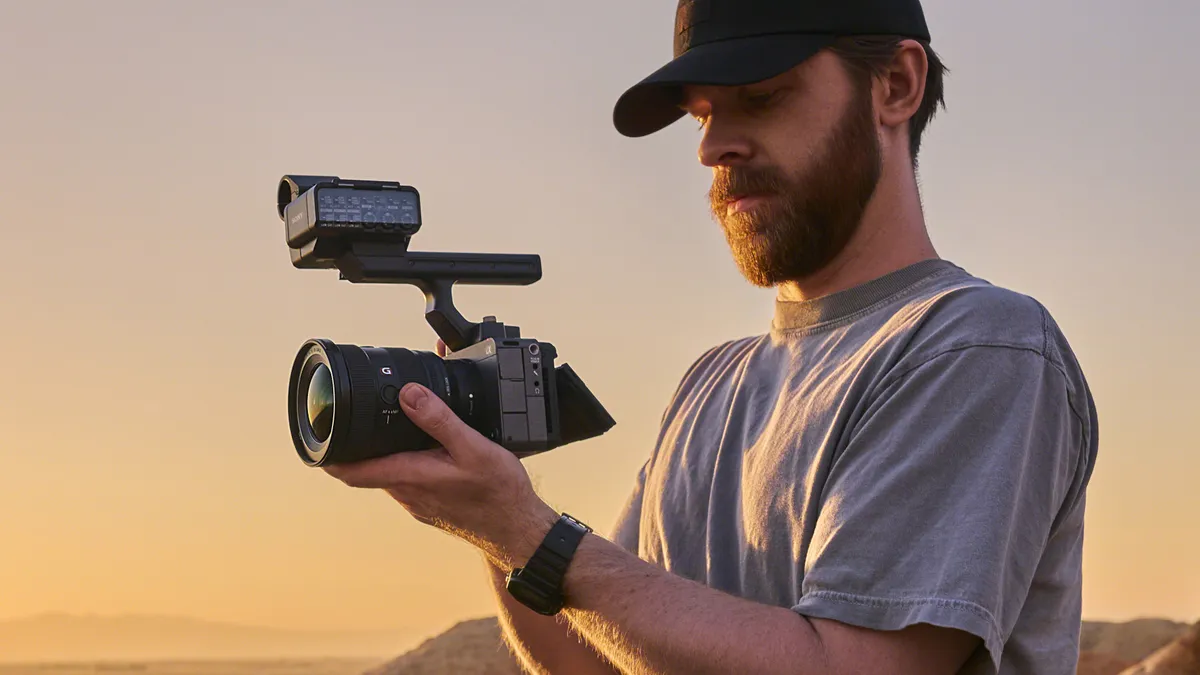
Crucially, the FX3 includes the XLR handle – and does so for an all-in price tag of $4,298 / £3,579 / AU$5,999. The FX5 does not include the handle, despite its higher $4,898 / £4,700 / AU$7,849 asking price – you'll need to shell out considerably more for the $5,498 / £5,200 / AU$8,849 bundle.
Neither camera comes with an EVF. Third-party options are available for the FX3, though they use the HDMI feed. Sony offers a first-party option for the FX5, with 7.07 million-dot resolution and 90° tilting, which will cost you an extra $698 / £650 / AU$999.
Note that you will not natively be able to use the XLR handle and the EVF simultaneously on the FX5, due to a conflict of space and outputs on the top plate. The Sony has hinted that a third-party solution may soon be available for those who need it.

Perhaps most importantly, a number of headline features – namely full open gate and RAW recording functionality – are not available on the FX5 at launch. On day one the camera will only be capable of 5K 60p open gate and 4K 120p capture; the full 5K 120p / 4K 60p open gate and 4K 240p shooting will only be available with firmware v2, which won't come until 2027.
It should also be pointed out that Sony does not provide an official CIPA rating for the stabilization in the FX5 "because it's a Cine Line product", but explained that its performance is "equivalent" to the Sony A7R VI (rated 8.5 stops at the center and 7 stops at the periphery).
Sony also offers an irreversible service to disable the stabilization unit completely on the FX5, if your work requires hard mounting or drone use where IBIS is unhelpful or even problematic. The camera will be labelled as such on the bottom plate, to make it clear that the IBIS system has been deactivated to prevent confusion (particularly, I assume, on the resale market).
Sony FX3 vs Sony FX5: Verdict

Obviously this isn't a verdict on the performance of both cameras; I think it's pretty clear that the FX5 outperforms the FX3 in every category, unless you want to take a photograph.
Ultimately, if you're reading this, you want to know whether the FX5 is worth the considerable extra expenditure – and there are obviously a whole bunch of provisos and asterisks to consider, both for the camera itself along with your work and the way you shoot it.
If money is no object, of course – go straight for the FX5, there's nothing to discuss. Otherwise, you need to ask yourself if you really need what it offers that the FX3 doesn't.
Do you really need 5K open gate? Does the resolution you get at 16:9 shooting genuinely limit your work and the way you deliver content? How often do you truly need to use the same shots for vertical and horizontal output, and would an L-bracket and an extra take be better value? Do you even have the storage and processing power in your workflow to handle open gate files?
Do you really need three more stops of stabilization or AI-powered autofocus? Or do you use your camera on a gimbal, with a focus puller or even manual-focus lenses?

I think, if most creators and video shooters answer honestly, the answer is no to most of those questions. Or at least, no to the $1,200 difference between the like-for-like cameras. In truth, I think the biggest and most important considerations aren't the headline attractions at all.
Okay, I'll grant you that three-base ISO is important if you're not able to control the lighting where you shoot. There's a gaping chasm between ISO800 and ISO12800, so splitting the difference with an ISO4000 option can be a pretty big deal depending on your typical shooting conditions.
But far more important to me are things like 32-bit float, which is guaranteed to save your audio ass at least once in your career (and might single-handedly justify the purchase). The dramatically improved battery life is another big bonus, boosting continuous recording by around 35 minutes.
I'd also argue that switching to CFexpress cards is a pretty huge upside, as we all know how fragile the SD format can be. And obviously, internal RAW recording is an enormous plus if that's what your content requires.
In all, if you've been bumping into its limitations and the FX3 has been actively impeding your work, upgrading to the Sony FX5 is a sensible option for serious, high-end videographers. Remember, this is a hybrid product that boasts features and interfaces from the Venice and Burano lines. Are you really that caliber of shooter?
Otherwise, despite its age, the Sony FX3 still offers fantastic features and powerhouse performance – and at a much lower price point. And hey, if all you want is the option to use a nice EVF, you can buy the Sony FX2 for less than both of these cameras.


