
The best wireless microphones can be a critical purchase in improving the quality of your video output. Audio matters – arguably even more than the picture. YouTubers and other vloggers have discovered to their cost that few things make a viewer click away faster than bad-sounding audio.
In this guide, I’ve focused specifically on wireless mics that transmit sound to a receiver that’s plugged into a camera or smartphone. These types of mics are often used for presenting to camera and interviews, as they can be clipped to the subject to ensure a clean recording. As such, they are designed to be small and discreet, offering a dependable and stable connection with no dropouts. An exception to the small mics in this guide is the Maono PD200W tabletop presenter mic, which I've included as it can also be operated wirelessly.
I’ve tested all the mics on this list for my own video projects, and there are options for different budgets. These mics are mostly designed to work with smartphones, but if you’re a DSLR/mirrorless user, then head straight to the RØDE Wireless GO (Gen 3) entry. The USB-C-connected mics will also work with iPhone 15 and newer models – but if you are recording with an iPhone, we also have a dedicated guide to the best microphones for iPhones.

George has been freelancing as a photo fixing and creative tutorial writer since 2002. He also produces regular and exclusive Photoshop CC tutorials for his YouTube channel – where he has mastered the art of great sound recording in a range of situations.
The best wireless microphones
Why you can trust Digital Camera World Our expert reviewers spend hours testing and comparing products and services so you can choose the best for you. Find out how we test.
The best wireless microphone overall

The DJI Mic 3 is a significant upgrade from its predecessor, the DJI Mic 2, with a smaller and lighter design. Audio is top-notch, with 32-bit float recording and adaptive gain control to prevent audio clipping and ensure high-quality sound, and I found it to transmit reliably within the promised 400m range. There's a generous 32GB of built-in storage, and it boasts decent battery life, with the charging case providing up to 28 hours of use.
Build quality is just as impressive as the sound quality, with the transmitter and receiver units fitting neatly in the included metallic-looking charging case. The receiver slots into an iPhone's USB-C socket or camera hotshoe and has an OLED touchscreen that is both convenient and easy to use.
It's ideal for solo creators who require a high-performing and reliable audio solution, but it's on the pricey side and may be overkill for casual users looking for a more wallet-friendly option.
Read our full DJI Mic 3 review
Best budget wireless microphone

The Hollyland Lark A1 is one of the cheapest wireless microphone kits I’ve tested, but it rarely felt like a budget product in use. I plugged the tiny USB-C receiver into my iPhone, clipped a transmitter to my shirt, and was recording clean, clear audio within seconds.
Its wireless performance surprised me most. During my usual distance test, I walked down a long flight of stairs with my back to the camera, expecting the signal to drop out quite quickly once my body blocked line of sight between the transmitter and receiver. Instead, the Lark A1 kept broadcasting clearly until I was around 77 steps away. As soon as I turned back towards the camera, the full-quality signal returned.
The noise cancellation was equally effective. I tested it next to a loud air-conditioning unit, and the strongest setting removed most of the unwanted background noise without making my voice overly warbly or artificial. Three noise-reduction strengths can be selected in the LarkSound app, alongside EQ and reverb options.
My favourite feature, however, is the transmitter’s remote recording control. Triple-pressing its discreet button can start or stop video recording on a compatible smartphone, which is genuinely useful when filming yourself without a camera operator.
The Combo kit includes two transmitters, USB-C and Lightning receivers, a charging case, and easy-to-fit furry windshields. The transmitters rely on small magnetic attachments, so losing one could be a pain. The Lark A1 delivers remarkably dependable wireless audio, effective noise reduction, and a few clever features for a low price. It’s also an excellent first wireless mic for smartphone vloggers and filmmakers.
Read our full Hollyland Lark A1 review
Best wireless mic for ease of use

Capturing sub-par audio is surprisingly simple – just step a little farther from your phone’s internal microphone, and your voice will be swallowed by street noise or the rumble of overhead planes. A wired lavalier solves part of the problem, but its cable quickly tethers your movement. Thankfully, recording clean, clear dialogue at a distance is just as simple with the Røde Wireless Micro.
The system pairs a slim, USB-C receiver that slots directly into your phone with a lightweight transmitter-mic you can clip (or magnet-mount) to your clothing. Once in place, you’re free to roam while maintaining excellent sound quality – up to about 100 meters, provided the transmitter stays in the receiver’s line of sight. Setup is genuinely plug-and-play, and Røde’s Intelligent Assist Gain means you don’t have to fuss with input levels or worry about clipping.
For smartphone video creators new to wireless audio, this kit hits the sweet spot of price, performance, and the proven reliability of Røde’s product line. It doesn’t include onboard noise-reduction software, but tools like iMovie, Final Cut Pro, or Premiere Pro can remove unwanted background sounds more precisely in post-production.
Read our full Røde Wireless Micro review
Best discreet wireless mic

The Hollyland Lark M2S wireless lavalier mic is a highly capable option, but also a simple one – it's got decent 'plug and play' operability, and this thereby ideal for anyone who's getting their head around the ins and outs of sound recording. Unlike the previous Lark M2, it doesn't attach by magnets, but instead uses a reworked design in which the tiny omnidirectional microphone is extended on a curved stalk that simultaneously acts as a hook to clip onto your subject's clothing. Simple and effective.
The actual performance of the mic is also first-rate. I used it in conjunction with my iPhone 16 and the LarkSound app, giving me complete control over the transmitter and receiver. I found the sound quality to be consistently excellent, and the noise reduction feature worked well even when I tested it near a noisy fountain. The makers advertise a transmission range of up to 300 metres (realistically much more than you'll ever need), though I did find that losing line of sight with the mic could easily cause dropout – and there's no on-board recording to compensate.
Thanks to its high 24-bit depth and 48 kHz sample rate, the audio quality of the Lark M2S – it bears repeating – is excellent. It's an easy mic to use, and an affordable one, too.
Read our full Hollyland Lark M2S review
Best entry-level wireless mic
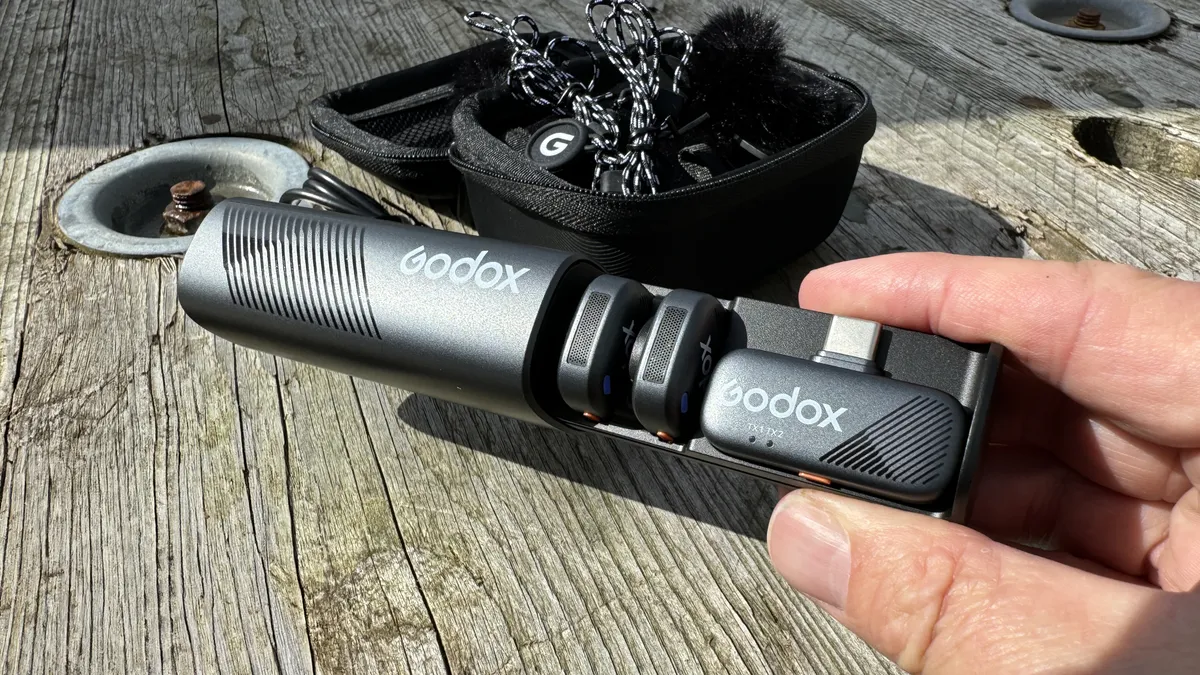
Your smartphone’s built-in mic will capture good-quality sound in close proximity to the subject, but the audio quality will diminish with distance. The Godox Cube-SC is a wireless mic kit that’s designed to help smartphone videographers capture great quality sound at a distance of up to 300 meters. I tested it at 150 meters, and the sound quality was rich and clear thanks to the kit’s 48kHz/24-bit signal. However, if you turn away from the camera and the transmitter loses line of sight with the receiver, then the kit is prone to signal dropout, even at 35 meters between mic and receiver. But as you’ll probably be facing the camera during a recording, this won’t be an issue for most vloggers.
What makes this particular wireless mic kit stand out from other kits in this buying guide is its size. The two transmitters and the receiver are tiny. The 7g transmitter attaches via a magnet to your subject’s shirt. As the mic is less than an inch in diameter, it is much more subtle than the typical chunky plastic-brick transmitters found in some other mic kits. The receiver is the smallest and lightest I’ve encountered. As it weighs in at a mere 5g, you can easily attach it to a smartphone without needing to re-balance it on a gimbal.
Another distinctive feature is the option to make your smartphone’s camera app start/stop recording with a double press of the transmitter’s button. You can also tap the mic’s button to activate its built-in noise reduction (NR) feature, which works well – and it doesn’t flatten your voice too much. Noise reduction on both transmitters can be activated by a tap on the receiver’s button, so you don’t have to interrupt an interview if you suddenly need to activate the NR feature. The charging case (and its contents) can also be tracked by Apple’s ‘Find My’ app, which is a nice touch for iPhone users!
Read our full Godox Cube-SC review
Best wireless mic for content creators

The Boya Mini 2 is a great starting point for content creators wanting to capture studio-grade wireless audio without a premium price tag. This affordable pocket-sized system punches well above its weight class with upgraded 48 kHz / 24-bit audio quality, an 80 dB signal-to-noise ratio for hiss-free recording, and a maximum 120 dB SPL to handle loud voices effortlessly.
The standout physical feature is portability. The entire charging case mirrors an Apple AirPod case, and the minuscule transmitters weigh a mere 5 grams. They clip effortlessly onto your clothing without causing fabric to sag. Additionally, I highly appreciate the inclusion of a -12dB safety track, which acts as a brilliant insurance policy against clipped audio during unexpected shouts.
However, it isn't completely flawless. While you can face the camera and sound loud and clear from up to 100 meters away, I noted immediate signal dropout the moment I turned my back and lost direct line of sight. Furthermore, the included foam windshield was somewhat ineffective at filtering out heavy wind noise during my outdoor test shoot.
Read our full Boya Mini 2 review
Best wireless mic for pros
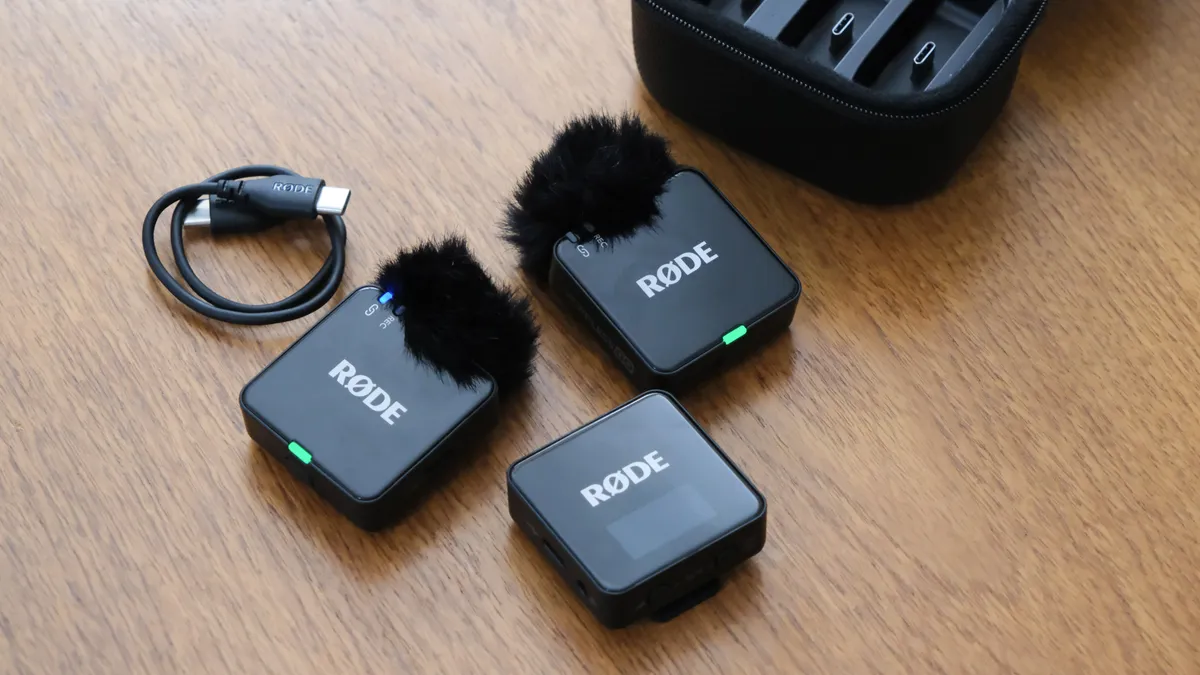
At first glance, the Røde Wireless Go Gen 3 looks much like its predecessors – and like many of the wireless mic sets in this buying guide. But this latest generation adds refinements that make it more versatile and creator-friendly (with a slightly higher price tag to match). Unlike most compact wireless kits, the Gen 3 transmitters can record onboard backups, giving peace of mind should you ever experience dropouts or interference.
Røde has also upgraded its GainAssist feature, which automatically manages audio levels to reduce clipping or distortion, while still allowing you to take full manual control, if you prefer. For those working in more advanced video workflows, the system also supports timecode, making it much easier to keep audio and video perfectly in sync.
Like other small wireless mic systems, the Gen 3’s transmitters are quite visible if clipped directly to a shirt or jacket. For a more subtle setup, you can plug a lavalier mic into the transmitter and hide it on a belt or waistband, keeping your subject’s look clean while still capturing professional-quality sound.
Read our full Røde Wireless Go Gen 3 review
Best wireless mic kit for size and features

If you’re looking for a compact, reliable wireless microphone system that delivers professional-grade audio, the DJI Mic Mini is worth considering. I’ve found its lightweight and portable design perfect for creators like vloggers, interviewers, and filmmakers who need high-quality audio without the bulk. The system includes a transmitter with a built-in mic and a receiver that easily connects to cameras, smartphones, or laptops via USB-C or Lightning adapters. It’s super versatile and works with a wide range of devices.
One thing I really appreciate about the DJI Mic Mini is its impressive range – up to 250 meters. That means I can move freely while recording and still get clear, uninterrupted audio, even in noisy or large spaces. The battery life is solid too, lasting about five and a half hours, so I don’t have to worry about running out of power during longer shoots.
Setting it up is quick and easy, with intuitive controls that make it simple to start recording right away. Despite its small size, the audio quality is outstanding, consistently capturing clear professional sound. While it’s not the cheapest option around, I think the DJI Mic Mini is worth the investment if you’re serious about creating high-quality content. It’s reliable, portable, and delivers exactly what I need for my projects.
Read our full DJI Mic Mini review
Best wireless shotgun mic

Resembling a small shotgun mic in form factor, able to stand like a desk mic, and transmitting wirelessly over distance like a lav mic, the Shure MoveMic 88+ is many things at once! It's an ideal choice for any filmmaker or videographer who expects to find themselves in lots of different shooting situations. It can be bought with a receiver for a comprehensive shooting solution, or if you're on a budget, you can buy just the mic for considerably less money and record straight to your smartphone.
One could easily worry that the Shure MoveMic 88+ could end up being a classic jack of all trades and master of none, but in my testing, it held up well. The mic itself, constructed from solid die-cast zinc plated in black chrome, feels reassuringly premium, and the audio quality is excellent. If you did shell out for the receiver, you'll be able to take advantage of 24-bit audio quality (it's 16-bit for smartphones). You get a choice of four directional polar patterns to choose from, giving you flexibility in a range of scenarios.
There are limits to how well the Shure MoveMic 88+ performs in some of its guises – it's a bit too big to really work as a lav mic, and its wireless range is substantially shorter than some on this list. Overall, though, I came away from my time testing it feeling it deserved a place in my kit bag for its ability to capture great-sounding audio in such a broad variety of situations.
Read our full Shure MoveMic 88+ review
Best wireless hybrid mic

The Maono PD200W is an unusual hybrid dynamic microphone that gives vloggers and filmmakers three ways to record sound. It can connect directly to a computer via USB-C, plug into professional recording equipment through an XLR cable, or transmit wirelessly to the supplied USB-C receiver.
Wireless operation is its biggest advantage for video creators. The receiver can be connected to a laptop or USB-C smartphone, allowing the microphone to be positioned on a desk, mounted on a stand, or carried as a handheld interview mic. During my outdoor test, audio remained loud and clear over a useful distance, although brief dropouts occurred when my body blocked the line of sight between the microphone and receiver.
Its cardioid pickup pattern captures sound primarily from the front, helping to reduce room echo and noise from the sides. Three levels of noise cancellation are available. The Moderate setting effectively reduced traffic and room reverb without making my voice sound noticeably artificial. Audio is recorded at 48kHz/24-bit and sounds clean, detailed, and is well-suited to interviews, pieces to camera, and voice-over narration.
The Maono Link desktop and mobile apps provide gain adjustment, noise reduction, level monitoring, and presets for different recording situations. An illuminated RGB ring on the mic can also add eye-catching color and movement when the microphone appears in a vlog or studio-based video.
The supplied desktop stand is useful, while a (not supplied) Maono boom arm offers more positioning control. The plastic wireless receiver feels slightly fragile, but the PD200W’s USB-C, XLR, and wireless connectivity make it a versatile choice for filmmakers and vloggers who want to record both indoors and on location.
Read our full Maono PD200W review
How to choose the best wireless microphone
Any of the wireless mic kits in this buying guide will enable you to improve the audio production values of your video, but it’s worth considering your specific needs as a filmmaker.
My buying guide focuses on the duo-microphone kits, which enable you to clip a mic onto yourself and another onto your interviewee, so you both sound loud and clear. However, if you merely want to talk to the camera without the constraints of a hard-wired mic, consider a cheaper version of the kit that contains a single transmitter mic and a receiver.
On the whole, the more you spend, the more features you’ll get – such as onboard recording, for example. You should also consider whether you want a simple kit that lets you start recording straight away, or the option of manually adjusting sound levels on the receiver.
However, even the cheapest kits in this guide will sound far better than your camera’s built-in mic, especially once you’ve moved a few feet away from your recording device.

How do I connect a receiver to a smartphone?
Some of the wireless mics in this guide ship with an audio jack cable that connects the receiver to the 3.5mm socket on a DSLR, mirrorless camera, or smartphone that has a jack input. Many have a USB-C receiver that plugs straight into a smartphone or laptop’s USB-C socket. If you have an older (pre-15) iPhone, then some, like the Røde Wireless Micro, sell a version with a Lightning plug (as well as a USB-C version), so do be careful when looking at the connectivity spec of a mic before you buy it.
How easy is it to attach windshields to transmitters?
Most mics in this guide have a larger rubber mount that slots easily over the top of the transmitter. However, some mics have windshields with a push-and-twist connector. When I first encountered this design, I didn’t know about the ‘twist’, so I struggled for ages to push the windshield onto the transmitter!
How we test the best wireless mics
I’ve been recording sound professionally since the late 1980s, and the younger me would be astonished by the quality and range of modern wireless mic kits, not to mention that I’m no longer tethered by a lavalier clip-mic cable hardwired to my camera!
Testing is the fun bit! I like to use wireless mics in a wide range of locations, from wind-swept hills to noisy city centers. This enables me to discover how effective a kit’s physical windshields and the software noise cancellation features are. I like to see how far I can get before the signal drops out, especially when the transmitter loses line of sight with the receiver.
Today's best prices compared
