Digital Camera World Verdict
The Nothing Headphone (a) might look like a classic case of style over substance, but these chic-looking cans offer an impressively complete package: strong battery life, fairly effective ANC, excellent physical controls, and a design that stands out in a sea of samey headphones. Although audiophiles might not be sold, for most of us, sound quality is broadly good, with plenty of distinction between highs and lows, and with a solid bass. The biggest issue is long-session comfort, with the Headphone (a) feeling a little clamped to my head.
Reasons to buy
- +
Excellent battery life
- +
Great physical controls
- +
Distinctive design
- +
Strong value
Reasons to avoid
- -
Comfort could be better
- -
ANC is good, not class-leading
- -
Flimsy included pouch
Why you can trust Digital Camera World Our expert reviewers spend hours testing and comparing products and services so you can choose the best for you. Find out how we test.
Nothing has quickly built a reputation for making consumer tech that does not look like everyone else’s, and the Headphone (a) continues that trend. These are the company’s more affordable over-ear headphones, arriving below the original Headphone (1) with a much lower launch price but many of the same headline ideas intact. That means the transparent, industrial-inspired design is still here, as are the tactile physical controls that I loved on the first model.
The Headphone (a) does confuse Nothing’s over-ear formula a little. They undercut the original quite significantly on price, while still promising active noise cancellation, LDAC support, a companion app with customization, and enormous battery life figures – the only thing you really lose out on is KEF tuning, which, to be honest, side by side with the Headphone (1) and (a), I can’t really notice.

Nothing Headphone (a): Specifications
Drivers |
40 mm |
RF |
20 Hz - 40,000 Hz |
Diaphragm |
Dome material: PEN+PU Coating: Titanium-coated |
Playback |
AAC: ANC off: up to 135 hours | ANC on: up to 75 hours LDAC: ANC off: up to 90 hours | ANC on: up to 62 hours |
Charging |
USB-C to full: 2 hours Fast charging: ANC OFF - 5mins = 8hrs | ANC ON - 5min = 5hrs |
ANC |
Depth up to 40 dB, Frequency range 2000 HZ |
Weight |
310 g |
Dimensions |
177 x 78 x 190.4 mm |
Nothing Headphone (a): Price
The Nothing Headphone (a) launched at $199 / £149 / AU$329, which is a far more aggressive price than the original Headphone (1). Nothing has preserved a lot of what people liked about the first model while making the overall package more accessible but not at a cheap compromise, but rather a cut-price version of the more premium model. You are clearly not getting Bose-level ANC or a truly audiophile tuning here, but Nothing has packed in it's personality and style for a much more reasonable price than the (1).
Nothing Headphone (a): Design & Handling
If there is one area where the Nothing Headphone (a) immediately separate themselves from the pack, it is design. These just look so different from the usual generic black over-ear headphones, and whether you like that transparent, slightly sci-fi aesthetic or not, they certainly do not disappear into the background. The (a) does, however, tone down the industrial look of the original Headphone (1), with a slightly softer and more approachable look. But still, in a category full of safe, familiar designs, they stand out.

Nothing’s excellent controls from the original remain untouched. The Roller and Paddle are really intuitive ways to interact with the headphones. The Roller handles volume, play/pause, and ANC mode switching, while the Paddle makes skipping through tracks easy. Touch controls can often be infuriating, so this is the kind of tactile interface I love, and that is instantly more reliable than endless swiping on an earcup.
There is also a customizable button, which can be used for summoning your chosen AI assistant or reassigned for other quick settings. Power is handed by a clear on/off switch with an LED light. There is also a 3.5mm jack for a wired connection if you run out of power.

The only downside is comfort over longer editing sessions. At 310g, these are not that heavy, but they are not featherweights either. The top band is padded and sits on my head nicely, although, as it takes most of the weight, it does start to become a bit irritating after a few hours of wear. But my biggest issue is just how tight these headphones are, with a firmer clamp over my ears, combined with quite firm pads, they just felt a little claustrophobic.
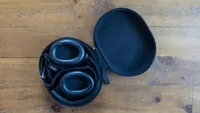
There is also a case included in the box, but don’t get too excited, as this is a very flimsy pouch rather than a proper hard case. Which is a shame, as the felt case included with the Headphone (1) was lovely. I get it, sacrifices have to be made for the price, but other similarly priced headphones do come with better soft cases. Bose's QC35s outperform the Headphone (a) on several metrics, and are available with a superior soft case for not much more money.

Nothing Headphone (a): Performance
The Nothing Headphone (a) gets the essentials right. Sound quality is very good, with enough balance and bass to be punchy and enjoyable. For music, I found them immersive. I tried a few different genres, and while they seem set up best for pop out of the box, there is an almost overwhelming in-depth audio tuning section in the accompanying app, should you be more of a rock or classical fan, and the default isn’t quite doing it for you.
For video editors, these headphones are absolutely fine for hearing your audio with plenty of clarity. My voice in video recordings sounded clear, and mixing in background tracks, I could get a good understanding of the levels before export. However, as expected, audiophiles can get better sound quality, but that isn’t really the point of the Headphone (a).

Automatic Noise Cancellation (ANC) is effective enough for everyday travel, office, or on-location use, but it does not seriously challenge the best from Sony or Bose. However, I flew on a 10-hour flight from China to London with the Headphone (a), and it effectively blocked out enough plane (and passenger) noise that I could comfortably focus on work or hear my movie. Transparency mode, however, is less convincing; it's fine, but there are much better implementations.
Battery life is where the Headphone (a) really excel. Nothing claims up to 135 hours without ANC and 75 hours with it, and that seems to hold true. I have used the headphones with ANC for around two weeks, including two long flights, plenty of commuting, and watching movies, and they are still going strong. For anyone who hates charging yet another device, that alone could be enough to tip the scales.
Nothing Headphone (a): Verdict
The Nothing Headphone (a) is the product that the Headphones (1) should have been. It takes the best aspects of Nothing's first attempts at over-ear headphones, including the unique design and intuitive controls, but repackages them with a price that feels more apt.
The Headphone (a) still looks distinctive, keeps the tactile physical controls that make it easy to use while editing or listening to music, and backs that up with incredible battery life. They are not the last word in outright audio fidelity, and the active noise cancellation is good rather than class-leading, so audiophiles may still want to spend more on something more refined. Comfort is also an issue, with a far too tight design. But for the money, the Headphone (a) gets an awful lot right – and looks like nothing else on the market.
Features ★★★★½ |
Standout design, physical controls, strong app support, LDAC, multipoint, and an IP52 rating. |
Design ★★★★☆ |
Distinctive design unlike anything else, but if the firmer fit and basic carry pouch stop it from feeling quite as polished. |
Performance ★★★★☆ |
Sound quality, ANC, are good for the money, while the colossal battery life is a winner. |
Value ★★★★½ |
A feature-packed alternative to pricier big-name headphones with a unique design. |
Alternatives