




Sony’s early push into full-frame mirrorless means the E-Mount lens family has a wealth of different options, but one category has remained suspiciously absent until now: A fisheye. The Sony FE 8-14mm f/3.5 Fisheye G is the first Sony-branded fisheye for the mirrorless E-Mount system.
Announced on September 8, the Sony 8-14mm brings the ultra-wide distortion the lens type is known for into the E-Mount system with a bit of control. At 8mm, the lens shoots the classic round fisheye image on a black border, but at 14mm, the zoom becomes a rectilinear fisheye that fills the frame yet still has that extreme curved barrel distortion.
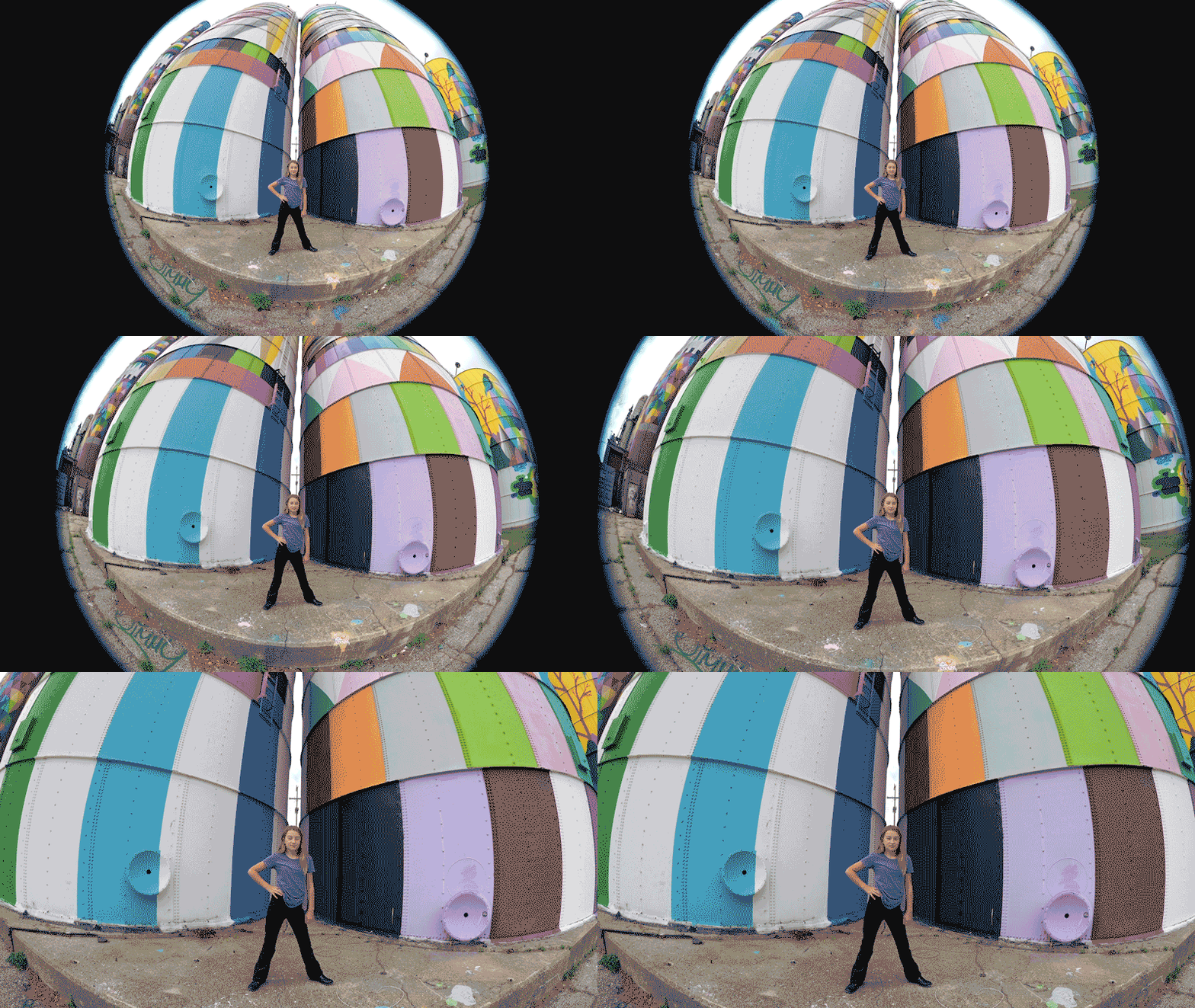
The lens can also shoot two different looks – equidistant or equisolid. Under the default distortion compensation-off settings, the lens is more “equidistant,” with a more even image distribution and less enlargement at the center. The lens creates an ”equisolid” look where the center looks larger, and the edges look more compressed with distortion compensation set to auto. (Shooting in RAW, the distortion settings can be adjusted after the shot with Sony Imaging Edge Desktop.)


The E-Mount system has a small handful of third-party fisheye options, but the lenses that mix a circular and rectilinear look in one using zoom are manual-focus-only options like the Laowa 8-15mm f/2.8 FF Zoom Fisheye.
That’s not the case with Sony’s first mirrorless fisheye, which uses two autofocus motors that Sony says are capable of keeping up with cameras with 120fps autofocus readouts.
The lens can focus as close as .15m / 5.91 inches from the front of the lens, creating some .22x closeup opportunities mixed with unusual fisheye distortion.

The Sony 8-14mm Fisheye is unusually narrow and compact, considering the optics needed for an ultra-wide view tend to create bulky lenses. But Sony’s streamlined design for the new fisheye is very much on purpose.

Besides the 314g weight making the lens easier to carry around – and smaller and lighter than the Laowa fisheye zoom – the lens is unusually narrow. That’s in part because Sony built the lens to also work with the Venus extension system to create a 3D VR setup with two lenses side-by-side.
For video, a 16:9 aspect ratio will crop the top and bottom of circular images, but cameras with 3:2 Open Gate can preserve the full circle.
The lens’ design also includes a focus lock switch for shooting astrophotography, as well as a zoom lock switch and seals for dust and moisture resistance.

I was able to shoot a few photos on the new Sony 8-14mm Fisheye mounted on the A7 V. Fisheye lenses create a bit of a quirky look that doesn’t work for every genre, but I found shooting with Sony’s fisheye to be far more fun than I expected.


Images are sharp and colorful, but mixed with the highly exaggerated perspectives of a fisheye. The only problem that I ran into is that the hood does need to be removed for shooting at 8mm – that and, as someone who doesn’t normally shoot with a fisheye, I had to constantly check the edges and make sure I didn’t accidentally get my own feet inside the ultra-wide 180-degree perspective.
The Sony FE 8-14mm f/3.5 Fisheye G will begin shipping in early October, with an expected list price of about $1,599 / £1,499 / CA$1,999.
You may also like
Take a look at the best fisheye lenses or the best Sony E-Mount lenses.

