Digital Camera World Verdict
With a more accessible price, this single-camera variant of the new Luna from Insta360 is a triumph for the majority of users. Serious creatives who understand depth of field should dig a little deeper in their pockets, but a lot of users will find their needs met, and met well, by this compact but clever camera.
Pros
- +
8K video from 1-inch sensor
- +
4x telephoto via tactile controls
- +
10-bit log
Cons
- -
Zoom is all digital
- -
Can overheat over time
Why you can trust Digital Camera World Our expert reviewers spend hours testing and comparing products and services so you can choose the best for you. Find out how we test.
With the launch of the Insta360 Luna Pro – a seemingly high-end product name – the company has actually filled the gap beneath its Luna Ultra, to offer both a single-camera and a dual-camera variant of its new pocket gimbal camera.
This kind of lightweight, wand-held camera – with stabilizing technology reminiscent of a tiny Steadicam – was pioneered by DJI with its Osmo Pocket series, and both companies have recently delivered two models in the category. The difference is that, for Insta360, this is a first. The DJI Osmo Pocket 4 and Pocket 4P have generational improvements, while Insta360 has started from scratch.
Given that blank slate, Insta360 has made some different choices when it comes to build, value for money, and the surprising (but welcome) remote control system. Does that make it the best proposition? That's what I'm testing...
Price
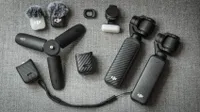
The Insta360 Luna Pro is launching at $599.99 / £469 / AU$809 for the Standard Version. This is the model I tested, and is supplied with a goos-quality zip case, a rubber protector for the gimbal, a wrist strap, and a USB-C cable. That puts it at $170 / £180 less than the Insta360 Luna Ultra – putting a very specific price on the additional optics (curiously, a higher one in the UK).

Specs
Sensor |
1-inch |
Lens |
20mm f/1.8 equivalent |
Video resolution |
8K30fps / 4K/120fps |
Stills resolution |
9MP (raw) / 37MP ('UltraPhoto') / 200MP (stitch pano) |
Display |
2-inch OLED |
Battery life |
1550mAh = up to 4 hours |
Range (of detachable remote) |
20m / 60ft |
Storage |
47GB built-in + MicroSD |
Weight |
8.2oz / 233g |
Build & handling
The Luna Pro feels a lot like the Luna Ultra, but without the extra-wide WALL-E like 'head'. The Ultra hasn't been out long, so there is a decent chance you won't have held one in your hand either, but it's worth knowing that the Pro and Ultra share the same core mechanics.
Both versions share the detachable touchscreen remote control (even though a lot of A.I. summaries inaccurately suggest that this is an optional upgrade).

Personally I feel like the Luna series devices have a pleasing weight to the grip's body, and perhaps it is even better on the Pro because, with a single camera at the top, the balance is closer to perfect.
The 90-degree flick of the 2-inch touchscreen to activate the camera – acting like a power switch – is a brilliantly natural maneuver, albeit first seen on the DJI Osmo Pocket 3.
Where Insta360 have definitely pushed things ahead (in my view) is their arrangement of the other controls. By creating a dedicated zoom switch, separate from the thumbstick, you don't need to switch the main camera controls from one to another using an unnatural touchscreen control, as you do on the DJI alternatives (both Pocket 3 and Pocket 4 series have the same flaw).
The entire control array is detachable. That is the screen/switch, two buttons at the bottom of the screen, thumbstick, zoom controller and record button. Obviously that has some risk in terms of dirt and dust, but a gimbal camera is far from invulnerable anyway, so it doesn't seem an unacceptable risk (as I discovered, the control section will let you know if it is having trouble communicating with the rest of the camera, and let you know how to clean it!)

Like its sibling, the camera has a detachable base that extends the controller and has a tiny fold-out tripod which, despite being made of paperclip-like materials, is actually very useful a lot of the time. In the middle of that is a standard tripod thread, too, so it's just a handy backup.
Not in the standard bundle, but an option, is an extended battery that can attach here instead (and, thoughtfully, Insta360 put the tripod and thread in that, too).
The device also boasts a microphone in the detachable remote, and 47GB of built-in storage (should you forget your MicroSD card, for which there is also a rubber-sealed slot on the right-hand side as you look from the operator's side.

Performance
While the Luna Pro does indeed lack a second camera, so also drops 12x telephoto (3x and some digital help, since you ask), virtually nothing else is missing.
The closest focusing distance is 9cm (3 inches), meaning that if you have vlogging in mind you won't have to hold the camera too far away from you (that's good as some newer action cameras with larger image sensors do have issues here).
The Luna Pro still boasts the abilities of the Ultra when it comes to video; 8K30 video, or 4K120, and shoots in SDR, Dolby Vision HDR, and its own I-Log for editing. It also panorama photo mode, slow-mo mode and 'PureVideo' – Insta360's night mode.
There is still enough telephoto fun, digitally, for 3x zoom at three different speeds, and 4x coming with a software update I've yet to test. You do need to pop the settings out to change tracking speeds fast, medium and slow are the only choices, it's not touch-sensitive, but you can't have everything.
I did find that, in some situations, the camera overheated when recording extended 8K – a problem it shares with its premium sibling.

Overall Verdict
First impressions of the Luna Pro are very good, and if you have no need for the longer tele camera, then this is a choice that could save you a good deal of money.
Personally I'd do my best to find the extra cash, though, because I always see the advantage in optical zoom. I found (when testing the Luna Ultra) that I had a lot of use for the telephoto camera because it created a natural softening of the background and – since there are several ways to record sound wirelessly – that didn't' come at the expense of audio quality.
More casual users, though, more interested in finding a replacement for a DJI Osmo Pocket or equivalent, could do a lot worse than this.
Alternatives